

When the Mob owned a minor-league hockey team

Standing up to a reputed Mob associate was a part of Richard Brosal’s job 15 years ago.

As commissioner of the United Hockey League, Brosal knew he could not back down in confrontations with Danbury Trashers owner James Galante. The team nickname derived from Galante’s trash-hauling company.

“Bullies are bullies until you stand up to them,” Brosal said recently. “If you allow somebody to strip you of your dignity, then shame on you.”

The Trashers were a rowdy minor-league team in Western Connecticut, playing in the Danbury Ice Arena about an hour and a half northeast of Manhattan.

Galante had handed the team over to his teenage son, a 17-year-old high-schooler named A.J. Together, the father and son encouraged their players to stir up trouble during games. “I wanted tough guys on the team,” James Galante said. He even once fought a referee.
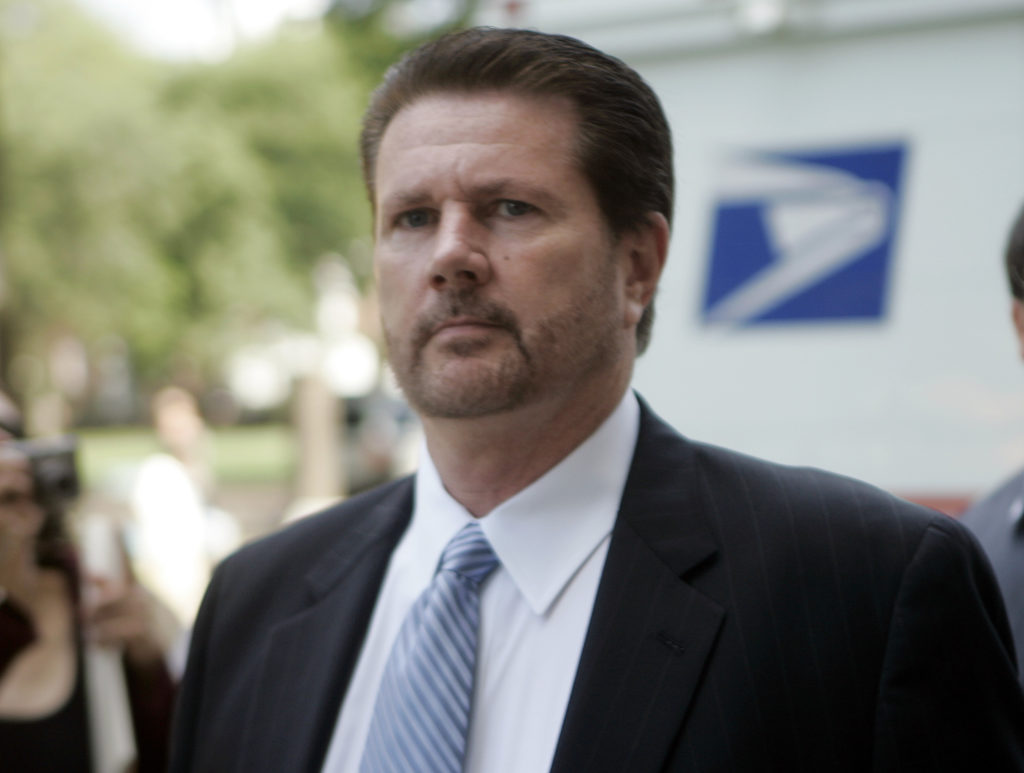
James Galante, who owned a trash-hauling company in Connecticut, enters U.S. District Court in New Haven on September 3, 2008, for sentencing. Galante was given 87 months in prison on a variety of charges, including racketeering and fraud. AP Photo/Bob Child

The Trashers’ short but colorful existence, lasting from 2004-2006, is the subject of a Netflix documentary, Untold: Crime & Penalties. Galante was accused of defrauding the United Hockey League, in part by paying players extra under the table. He was imprisoned on federal racketeering and tax fraud convictions. He served six years, beginning in 2008. The league no longer exists.

In the documentary, Brosal discusses his confrontations with the Galantes, who, in the commissioner’s view, were embarrassing the league by encouraging on-ice muggings. Brosal’s mission was to “protect our image and our affiliation with the NHL,” he said.

Among other punitive actions, Brosal suspended the Trashers’ equipment manager, tough-talking Tommy “T-Bone” Pomposello. The equipment manager’s dirty tricks included turning off the hot water in the opponents’ locker room.

“He was a bigger thorn in my side than anybody else,” Brosal recently said from his office in Las Vegas.

The former commissioner now is CEO of Jet Luxury Resorts, a condominium management company. He works out of an office west of downtown Las Vegas near a practice rink where the National Hockey League’s Vegas Golden Knights prepare for games.

Though Brosal is friends with Golden Knights executives and takes in games at T-Mobile Arena on the Strip, the 62-year-old Southern California native has been a Los Angeles Kings fan for years. Brosal even attended a 1991 NHL preseason game in Las Vegas between the Wayne Gretzky-led Kings and New York Rangers. The game was held outdoors at Caesars Palace. Gretzky scored a goal in the Kings’ 5-2 victory.

Trash czar

Years ago, James Galante controlled an East Coast trash-hauling empire that federal authorities said was linked to the Genovese crime family and acting boss Matthew “Matty the Horse” Ianniello. Galante’s trash business at one time had 400 employees working in parts of New York and Connecticut.

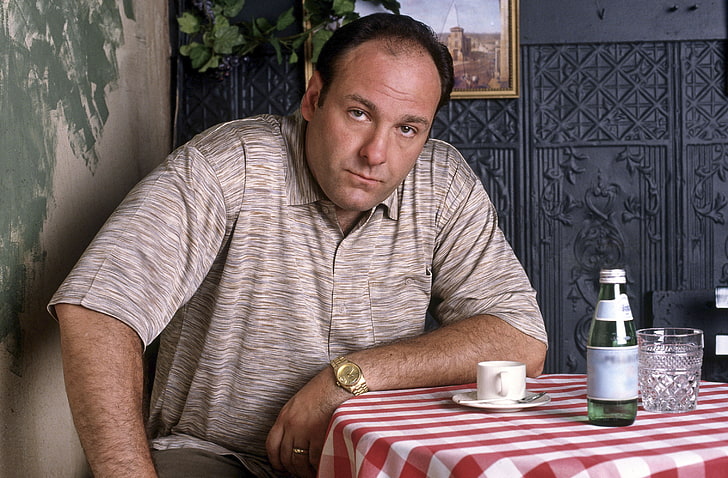
James Gandolfini, who starred as fictional mobster Tony Soprano in the HBO series The Sopranos, once autographed a photo of himself and other cast members for Galante, referring to the trash czar as “the real Tony Soprano.” In the television series, Tony Soprano’s son, like Galante’s, is named A.J.

Since his release from prison, Galante, 68, has been involved with a company that delivers heating oil and propane, according to former FBI agent Ed Adams. Galante is prohibited from re-entering the trash-hauling business. His son, A.J., is owner of Champs Boxing Club in Danbury.

Adams said James Galante is a “regular guy” who enjoys spending time with his family. “Jimmy is a businessman,” Adams said.

Galante did not respond to questions submitted to him in writing through his attorney, Hugh Keefe. A.J. Galante did not reply to telephone voice messages left at the boxing club.

‘Three-ring circus’

In his youth, A.J. Galante gravitated toward hockey instead of football, as his father preferred, after seeing the 1992 movie The Mighty Ducks. Before being seriously injured in a game, the younger Galante had developed an aggressive style of play, modeled after his two favorite sports — ice hockey and professional wrestling. At one of A.J.’s childhood birthday parties, his father arranged for pro wrestlers The Rock, Triple H and Chyna to show up for the celebration.

A.J. has always looked up to his dad. When James Galante watched movies, for instance, he rooted for the bad guys. His son adopted the same philosophy.

This affinity for villains trickled over into the Galantes’ hockey team. By stocking the Trashers with outcasts and brawlers, and by encouraging on-ice fights, the father-son duo packed the Danbury Ice Arena with loud fans, attracting media attention from outlets such as ESPN and the New York Times that seldom give minor-league teams any attention.

A.J. Galante was a teenager when his father, James Galante, put him in charge of a minor-league hockey team. Courtesy of Netflix

The Trashers’ first player was Brent Gretzky, whose legendary brother, Wayne, is known as “The Great One.” In the documentary, Brent is referred to as “The Next Best One.”

The team’s roster included hard-hitters such as Rumun Ndur, “The Nigerian Nightmare,” who played in the NHL for the Rangers and other teams.

Another player who stood out for his rough play was Brad “Wingnut” Wingfield, whose many career injuries include nine broken noses and 300 facial stitches. During one of Wingfield’s game-halting fistfights seen in the documentary, blood droplets sprayed the ice, hitting a logo for Galante’s garbage company, Automated Waste Disposal.

Brosal referred to this collection of players and their antics as “a three-ring circus.”

Packed house

These days, Brosal stays in contact with James Galante. Not long ago, Galante phoned to ask if Brosal would appear in a 10-part series based on the Netflix documentary. “Absolutely,” Brosal told Galante.

In the end, the senior Galante is a loyal person who stands up for his family, Brosal said. “You’ve got to love a guy like that,” he said.

Even A.J., whom the commissioner once considered a diamond-earring-wearing punk, has matured, Brosal said.

Adams, who assisted Galante in his legal defense after retiring from the FBI, said hockey teams at all levels used to put brawlers on the ice. This included the NHL, where the Philadelphia Flyers, once known as the Broad Street Bullies, were infamous for roughing up opponents.

Galante simply tried to emulate that, Adams said. “His thinking was, ‘How are we going to get fans? We’ve got to have some muscle on the ice,’” Adams said.

The strategy worked. Crowds showed up. A raucous group of fans who sat in Section 102 at the Danbury Ice Arena became part of the team’s lore. Former NHLer Mike Rupp, who played for the Trashers during a lockout, said fans still remember him from his Danbury days — this despite his having scored a Stanley Cup-clinching goal for the New Jersey Devils. 

Reflecting on his years as commissioner, and recalling the Trashers’ combative style, Brosal said, like it or not, the team generated a lot of publicity.

“Would I want that to be the legacy of the league? No,” Brosal said. “But say what you want, they packed the building every night.”

Larry Henry is a veteran print and broadcast journalist. He served as press secretary for Nevada Governor Bob Miller, and was political editor at the Las Vegas Sun and managing editor at KFSM-TV, the CBS affiliate in Northwest Arkansas. The Mob in Pop Culture blog appears monthly.
Capone tax evasion trial: Jury finds Chicago mobster guilty on 5 of 23 counts

Last of two parts.

On October 10, 1931, a Saturday, the prosecution read into the record Al Capone’s admissions to spending $200 to $250 a week in Miami on meat, $3 to $4 a day on bread and cake, $21,550 on furniture and $6,180 on suits in 1925, as well as $3,160 on a Columbus Day party and $4,925 on a Kentucky Derby shindig, both in 1926. His phone bill in Miami totaled $3,141 for 1929 (about $56,500 today). Meanwhile, he sent $15,600 to his church in 1926 and $58,000 to a police and widow’s fund in 1925. Capone also paid $40,000 for his estate at Palm Island, Florida (put in his name of his wife, Mae), and made $100,000 worth of improvements, including a $4,000 swimming pool. He also forked over $12,500 for a specially built automobile.

As the prosecution ended the half-day Saturday hearing, a sudden incident drew everyone’s attention. Federal tax agents grabbed and detained Phil D’Andrea, Capone’s intimidating bodyguard, who attended each hearing. D’Andrea was detained inside a back room after Treasury agent Mike Malone noticed the outline of a gun in his coat. Officers removed a loaded .38-caliber pistol and loose ammo from his person. D’Angelo argued that he held a court bailiff permit for the weapon. However, it had recently expired. Judge Wilkerson ordered D’Angelo jailed without bail, and he remained jailed throughout the trial.

On October 12, as Capone sat chuckling nervously with others in the courtroom, the jury heard testimony that the crime boss paid $12 each for pairs of glove-silk underwear (around $215 apiece today), favored $18 to $27 monogramed shirts, sterling silver dinner sets, and that his favorite colors for furniture included canary and green. In 1927, he spent $401 (more than $7,200 in 2021) on neckties and handkerchiefs. For Christmas one year, he bought 30 diamond-encrusted gold belt buckles for his friends. Witnesses from Chicago’s Marshall Field & Company department store said that from 1927 to 1928, Capone went on shopping sprees, laying out $3,715 for 23 suits, three topcoats and an overcoat, and spent more than $1,300 on 35 tailored and monogramed shirts.

Elmer Irey, head of the Treasury Department’s Intelligence Unit, testified about how his team of investigators built the tax evasion case against Capone.

One journalist covering the trial, Meyer Berger, wrote that information on Capone’s lavish tastes “was too much for [the] rural gentlemen” of the jury who were “of simple and rather careless habits of dress” and “look like men who would have no use for Chinese rugs and wouldn’t feel right in canary chairs and green rockers. One of them spanned his forehead with a tired hand, as if dazed by it all.”

The so-called “star” witness for the prosecution was Fred Ries, ex-cash handler for Capone’s Subway, Hawthorne and Radio gambling houses. The government had Ries hide out in South America before his appearance for security reasons. He testified about writing cashier’s checks to “J.C. Dunbar,” a fake name he used to cash them to himself at a bank. In 1927, the checks totaled about $150,000, equal to profits at Capone’s Cicero gambling joints. Capone henchman Jake Guzik had received the checks. Prosecutors entered the canceled checks into evidence.

Ries helped the government’s case by implying that Capone’s hidden hand at running the gaming dens. He said Al’s brother Ralph hired the gambling club’s managers and that Guzik bade him not to hand over cash to “anybody besides himself and the man he would send for it, not even Al.”     

The defense then got Ries to admit he never saw Capone take any of the cash or even handle money or accept any wagers when he saw the gangster at the Ship, Hawthorne and Radio.

Then on October 13, while the subpoenaed Johnny Torrio and reputed Capone partner Louis La Cava waited outside the courtroom, the prosecution surprised observers by resting its case, believing to have proven it. Capone’s lawyers immediately argued that they had not done so, had not provided enough evidence for conviction, and moved for the judge to order a direct acquittal. Wilkerson, by implication agreeing that the prosecution had submitted sufficient evidence, declined the request and instructed the defense to either present its case or provide a final argument to the jury.

Capone’s side started its case on October 14. Coincidentally, the Hollywood actor Edward G. Robinson, whose hit film Little Caesar, in which he played a Capone-like gang chief, was in theaters, showed up among the spectators permitted in the courtroom. One reporter wrote with irony that Robinson apparently came by “to give Snorky [Capone] a few pointers [on] how a real gangster should act.”    

The defense’s case strategy proved faulty from the start – his lawyers called a number of bookmakers to swear that Capone lost a lot of money betting on horse races. Their reasoning was that perhaps Capone’s gambling losses might excuse his tax bills, which made no sense. Deductions from losses are permitted only for taxes owed on winning wagers.  

The first Capone witness, a cigar dealer who also accepted handbook wagers, praised the gang leader as a reliable horse race bettor, risking $1,000 to $5,000 a pop on horses from 1924 to 1925. However, Capone had no luck with the horses, losing from $8,000 to $10,000 in 1924 and as much as $12,000 the next year. A handful of other defense witnesses made the same point – Capone lost large sums at the track: more than $217,000 (equal to $3.9 million in 2021) from 1924 to 1927. Not one of them could name a single time Capone won a bet. The news prompted famous journalist Damon Runyon to quip that he had given the award of “world’s worst horse player to Mr. Alphonse Capone.”

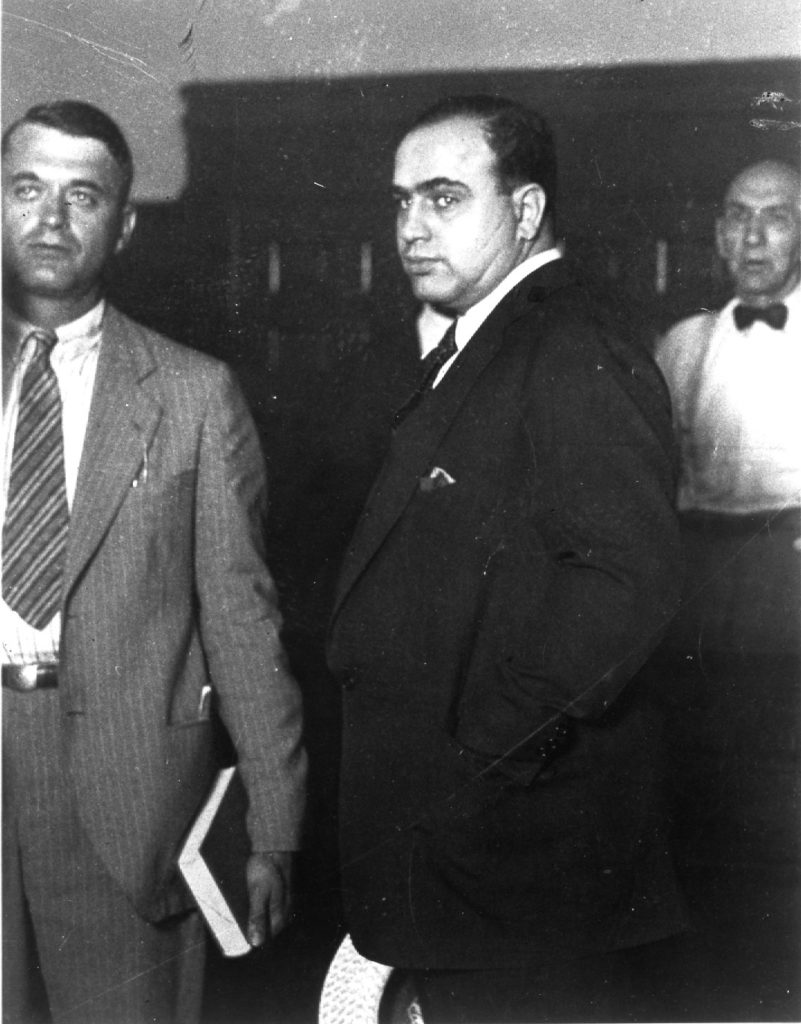
The jury convicted Capone of three felonies and two misdemeanors, while delivering not-guilty verdicts on 18 other counts. Then Judge James Wilkerson handed him an 11-year prison sentence. William J. Helmer Collection, The Mob Museum

Taking a different tack, the Capone defense called two illustrious men to the stand: Elmer Irey, head of the Treasury’s Intelligence Unit, which started the Capone investigation, and one of the prosecutors, Assistant U.S. Attorney Green himself.

Irey testified that his unit began probing Capone’s finances on October 18, 1928. He acknowledged that a court had sentenced Capone to serve 11 months in prison from 1929 to 1930 on a concealed weapon conviction.

In answer to Capone lawyer Albert Fink, Green volunteered that Capone’s ex-lawyer Mattingly testified before the grand jury that indicted Capone on the tax charges. But when Fink then argued the defense must be allowed to read Mattingly’s testimony to see if it was consistent with the notorious letter, prosecutors objected, stating that grand jury proceedings had to remain secret. Wilkerson agreed with the prosecution, which did not cross-examine the witnesses. 

With that, Fink rested Capone’s defense. Fink hoped to bruise the government’s case with the jury by raising uncertainly about Mattingly’s letter to spark reasonable doubt. Again, he asked Wilkerson for a directed not guilty verdict and claimed that Irey’s testimony that the investigation began in 1928 meant a three-year statute of limitations had expired. Wilkerson again rejected his plea.

With that, the prosecution summed up its case to jurors. Grossman stated that the government proved Capone spent $40,000 in 1927 and $86,000 in the next two years, and that the gangster’s own witnesses claimed he wagered more than $200,000 from 1924 to 1927.

“Who is this man and where did he get his money?” Grossman asked. “You have the high privilege of putting the stamp of disapproval on the whole Capone organization and the conduct of the defendant.”

Then his colleague Clawson reminded the jury that the Mattingly letter described how Capone earned $266,000 in income from the mid- to late-1920s, but he never filed an income tax return. 

Michael Ahern, for the defense, offered the jury a strange literary analogy – he compared the federal government’s crusade to get Capone to what the Ancient Roman statesman Cato the Elder once said: “Carthage must be destroyed!”

Fink then rose to insist the prosecution had not presented “a scintilla of evidence that [Capone] made a dollar,” only that he bought things, from 1924 to 1928, and that the checks signed by Guzik to buy furniture could have been loans. He said the defense had revealed how Capone, right after his release from prison in 1929, did attempt to pay his income tax.

“How in the world can you find him guilty of willful intent to defraud the government [that year]?” he asked, adding that prosecutors took aim at his client “merely because his name is Al Capone.”

Fink admonished the jurors to “not be swayed by the argument that the defendant is a bad man. He may be everything he is said to be, but do not for that reason find him guilty of something of which he has not been proven guilty.”

On October 17, the trial’s last day ended with the prosecution’s rebuttal. U.S. Attorney George E.Q. Johnson requested the jury to “draw your own conclusion” about where the cash originated to pay for the money orders that enriched Capone. In answer to Fink’s summation, Johnson made perhaps the most enduring statement of the tax evasion trial of the infamous leader of a violent Chicago crime group who had served so little time behind bars.  

“Future generations will not remember this case because of the name Alphonse Capone, but because it will establish whether or not a man can go so far beyond that law as to be able to escape the law,” Johnson said.

The judge excused the jury for deliberations at 2:40 p.m. They took eight hours to reach a verdict. It was almost 11 p.m. Capone, in his room at the Lexington Hotel, dashed to the court, and at first received relieving news. The verdict came in “not guilty” for the single felony tax evasion count in the first indictment for tax year 1924. The jury found him guilty of a felony charge for evading taxes in 1925, but not guilty on three misdemeanor charges. Jurors ruled the same for 1926 and 1927 – guilty of a felony on count one, not guilty on the lesser counts.

Finally, the panel found him innocent of felony evasion for tax years 1928 to 1929, but guilty of two misdemeanor allegations of willfully failing to file tax returns.

The jury’s peculiar result in total rendered Capone not guilty on 17 of the 23 charges. But their guilty verdicts on the three felonies carried a maximum sentence of five years in prison and a $10,000 fine each, and up to one year in county jail and a $10,000 levy for each of the misdemeanors.

Capone stood before Wilkerson for sentencing on October 24. The judge gave him the maximum five years in federal prison and a $10,000 fine on the first felony conviction. However, Wilkerson allowed for the five years on the second felony to run concurrently with the first, meaning only five years total.

Then he dropped the bomb. Capone had to serve the five-year term on the third felony consecutively, essentially creating a 10-year prison sentence. He granted one misdemeanor conviction to run alongside the first felony sentence, but then ordered Capone – after serving the federal prison time – to do one year in jail for the remaining misdemeanor count, and then six additional months on a contempt of court conviction. The bottom line was 10 years in the federal pen, one and a half years county jail time. If Capone won on appeal for the felony convictions, he would still have to serve the jail sentence. He also had to pay $50,000 in fines and court costs (nearly $900,000 today).

“I guess it’s all over,” Capone said to his hapless lawyers. “You done all you could.”

While being led away, Capone told news photographers: “Get enough, boys, you won’t see me for a long, long time.”

While in the Cook County jail for six months, awaiting transfer to federal prison, Capone resumed his duties as boss of the Outfit through messages to visitors – including Guzik, Murray “The Camel” Humphreys and, some claim, Lucky Luciano and Dutch Schultz. He also sent telegrams and made telephone calls.

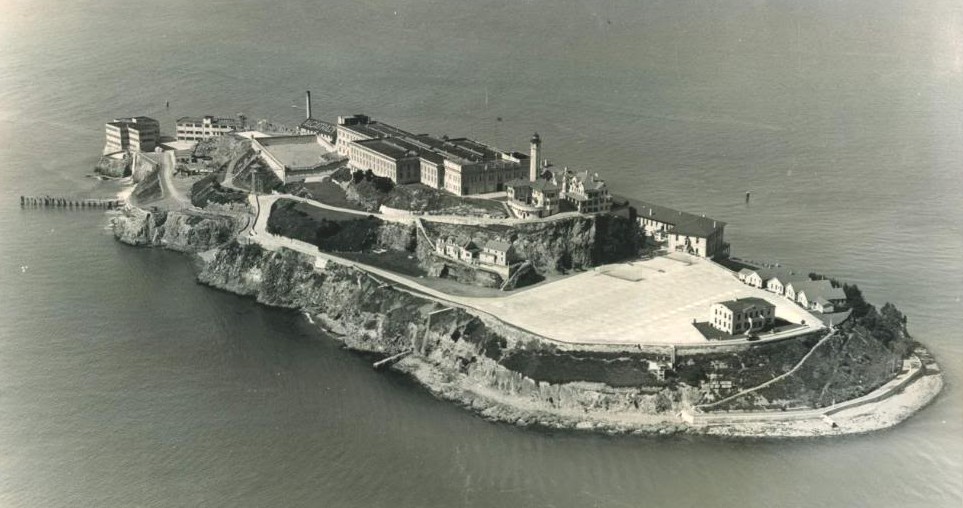
After serving two years of his sentence in a federal prison in Atlanta, Capone was transferred to Alcatraz, the island prison near San Francisco.

Capone lost his appeals, first in the U.S. Circuit Court, then, in 1932, the U.S. Supreme Court. The government almost immediately transferred him to the federal prison in Atlanta, where he would enjoy special privileges, for a while. In 1934, to his violent objections, the feds put him, along with 52 others in Atlanta, on a special, barred, steel train and delivered him to the far-stricter federal slammer on Alcatraz Island outside San Francisco.

In 1939, with good behavior credits, and suffering from dementia due to untreated syphilis, Capone gained release after serving eight years. The government again put him on a train and drove him secretly to meet his family outside Gettysburg, Pennsylvania. In 1940, his family moved him to their estate in Florida, where he died of a heart attack on January 25, 1947, just days after his 48th birthday.

Capone tax evasion trial: 90 years ago, the T-Men had the goods on Mob chief

First of two parts.

Spectators gathered outside each doorway to the U.S. District Court building in Chicago in the fall of 1931, hoping to see gangland leader Al Capone arrive for his trial for alleged tax evasion. Capone, surrounded by police, used a side entrance and sauntered briskly past photographers down the crowded hall to the courtroom. A judge earlier had barred the public – except for the press – from his pre-trial hearings.

But the large chamber proved no refuge. About 30 reporters soon converged on Capone as he strolled to the defense table. He wore a silk shirt, pearl-gray spats, polished brown shoes and white powder smeared over his scarred, jowly face. The reporters treated him like the celebrity he was. One asked if he had lost any weight from his 260-pound frame, while another questioned him about the shade of blue of his fedora.

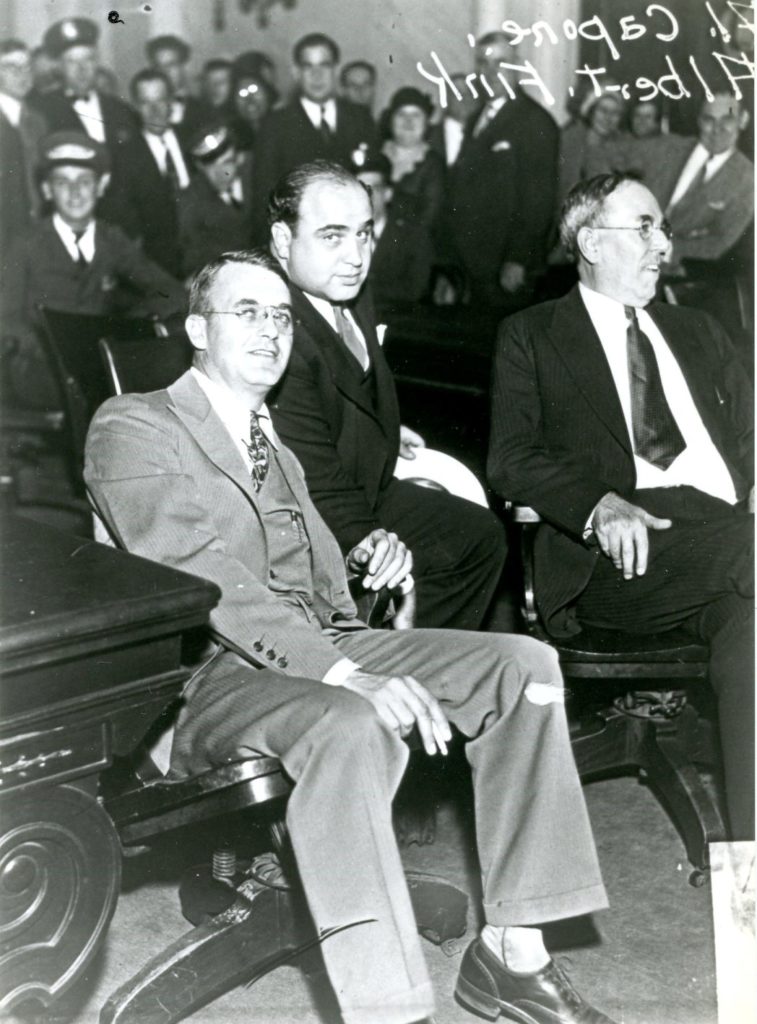
Capone is seated in court with his attorneys, Michael Ahern, left, and Albert Fink. William J. Helmer Collection, The Mob Museum

“Are you worried?” one inquired, more to the point.

“Well, to be frank with you, who wouldn’t be?” he said.

Moments later, federal Judge James H. Wilkerson asked ceremoniously, “Is the defendant in the court?” and bade Capone to enter a plea to grand jury indictments of 22 counts of allegedly evading federal income taxes – one a single count for 1924 and the other with 21 counts from 1925 to 1929.  

“Not guilty,” Capone said twice.

It was the most anticipated trial ever of an American mobster, its daily activities making the front pages of hundreds of newspapers. Capone at the time held worldwide notoriety as a ruthless rackets leader, believed to be linked to scores of murders while earning hundreds of millions on illegal beer and liquor, prostitution, a half-dozen illicit gambling casinos, several breweries and dog tracks, and about 1,200 speakeasies protected by outright bribery of Chicago-area police, the courts and elected officials. Federal Treasury and Justice Department agents had worked for more than two years building a case against Capone.     

On October 6, 1931, Capone watched as jury selection started. Sixty prospective jurors entered the courtroom, quietly taken from a pool assigned to a separate case to throw off attempts by the powerful crime lord’s men to influence them. Federal prosecutors submitted a list of 75 witnesses to appear to make their case. 

For Capone, the trial was an all-in proposition. Weeks earlier, in June, he tried to earn a lenient sentence by pleading guilty to the two tax evasion indictments. He also conceded his guilt to an astonishing list of 5,000 charges related to a suspected conspiracy with 68 others to violate federal Prohibition laws. The bootlegging accusations resulted from the painstaking efforts of the Justice Department’s Volstead Act enforcement crew in Chicago, headed by Special Agent Eliot Ness, that the local press called “The Untouchables.”

Capone’s criminal trial lawyers, the flamboyant, cane-supported Albert Fink and his less-courtroom savvy cohort Michael Ahern, won a deal with the lead prosecutor, U.S. Attorney George E.Q. Johnson, to limit Capone’s potential prison sentence to as little as 18 months in exchange for a guilty plea on the tax and booze law violations. Johnson made the settlement offer out of concern the case would be difficult to win at trial and the fact that appeals could go on for years.   

However, the pact was too deferential for the no-nonsense Judge Wilkerson. The judge made it clear he would not be duty bound to approve the prosecutor’s tentative agreement.

Not only had Treasury and Justice invested a lot of time and effort into the outcome, but President Herbert Hoover himself had applied political pressure to “get Capone” since the 1929 St. Valentine’s Day massacre in Chicago that killed seven Capone rivals. The U.S. government, in the person of Wilkerson, would not go easy on a Mob boss. It wasn’t just about him paying what he owed to the IRS and be done about it. The judge a year earlier presided over the tax evasion trials of Al’s brother Ralph “Bottles” Capone, and Capone’s top men Frank Nitti and Jake “Greasy Thumb” Guzik, and sentenced each to the federal prison at Leavenworth. 

The government regarded those cases as a prelude to throwing the book at the big man in 1931. Wilkerson leaned on Al. To consider granting the plea deal, the judge added a caveat – Capone would have to take the stand and answer the judge’s direct questions related to the criminal charges regardless of the guilty plea. Capone balked. He didn’t want the attention nor take the chance of incriminating himself further. Ahern moved to withdraw the guilty plea.

U.S. Attorney George E.Q. Johnson initially agreed to a plea agreement with Capone because he feared the prosecution might not win at trial.

Wilkerson then shelved the potentially controversial 5,000 liquor conspiracy claims – filed when the public was having its fill of the ineffective, 11-year-old Volstead law – to serve as a backup case if needed. Instead, he opted to pursue the 23 tax evasion counts (a mixture of felonies and misdemeanors) against Capone and eventually ordered the mobster’s trial to commence the first week of October.

Much of the government’s evidence originated from ledgers detailing earnings from customer losses from roulette, craps, horse races for Capone, brother Ralph, Guzik and some lower-level Outfit hoods at The Ship, one of his gambling houses in Cicero, from 1924 to 1926. Prosecutors bolstered their case with eyewitnesses, including former Capone employees Fred Reis, who testified in Guzik’s tax evasion trial, and Lou Shumway. Both men made entries in the house’s ledgers.

By 1930, or even 1929, Capone’s Outfit had a secret overseer – Johnny Torrio, its former chief before a supposed retirement to New York in 1925, leaving control of the liquor gang – temporarily, as it turned out – to Al. Torrio served as Chicago’s rep with what was then called the national “Combination” of crime families, who repudiated Al after the 1929 massacre. Taking regular plane fights to Chicago, Johnny quietly presided over a loose partnership between the Outfit and the city’s North Side gang. When Capone and his top men faced IRS problems in 1930, Torrio convinced Al to let Lawrence Mattingly, Torrio’s own tax lawyer, take over his case.

Mattingly would prove to be a turning point for Capone’s prospects, and not a good one. Before the trial, Mattingly tried to sell the government on a plan in which Al would admit to evading income taxes, make good on them, pay a fine and receive no jail time in return. Mattingly also got Capone to agree to an interview with Treasury officials. But during the interviews, Capone deferred to his attorney when asked about his income. So Mattingly offered to provide Treasury with a letter delineating Capone’s income for reasons of a negotiated settlement without prison.

Months later, in late 1930, Mattingly provided the document – later dubbed “the confessional letter” by the press – to Treasury agents. He maintained that Capone made a salary of only $75 a week as an employee – for Outfit gang leader Torrio – in 1924 and 1925 while supporting a wife, son, widowed mother, brother and sister. He admitted Capone later earned incomes of about $26,000 and $40,000 “respectively” for 1926 and 1927 and then not more than $100,000 for 1928 and 1929. The letter backfired. The feds would effectively use it in court to argue that Capone admitted to earning untaxed income while a member of a criminal organization.

Members of the jury empaneled on October 6 included grocers, painters, a pattern maker, hardware merchant, insurance agent, stationary engineer, farmer and clerk. Capone’s lawyers objected, saying the jurors were from the rural outskirts of Cook County, and not Capone’s inner-city peers. Wilkinson approved the panel anyway.

Federal Judge James H. Wilkerson refused to accept a plea deal that would have put Capone in prison for no more than 18 months.

The formal proceedings began on October 7 with an opening statement by Assistant U.S. Attorney Dwight Green about the two indictments. He claimed Capone failed to file tax returns from 1924 to 1929 and knowingly shirked exactly $215,080.48 in U.S. taxes owed on an income of $1,038,654.84 (about $18.6 million today).

The first witness was Charles Arndt, a director of the Bureau of Internal Revenue in Illinois, who, based on his records, backed Green’s assertion that Capone never filed for taxes from 1924 to 1929. The next witness, Chester Bragg, a citizen activist in Cicero, described how he and other townsfolk in 1925 went on an organized “raid” of a Capone-owned gambling casino, the Hawthorne Smoke Shop, “to make the western suburbs of Chicago fit places in which to live and raise children.” He said that as he stood at the club’s door to discourage customers, Capone himself tried to force his way by and said, “What the hell do you think this is — a party?” Bragg let Capone in, followed him into the Hawthorne and heard him berate another citizen raider, the pastor of a local church: “You’ve pulled the last raid on me you’re ever going to pull.”

In the upstairs section of the club, Bragg said he saw “pool tables and billiard tables … a roulette wheel, a chuck-a-luck table and racing forms.” Hours after Capone left, some top-level city and county police arrived with an arrest warrant, to no avail, he testified.

Now it was the defense’s turn. During cross-examination, Capone lawyer Ahern pointed out discrepancies in Bragg’s summary of the facts. However, Ahern proved ineffective, as Bragg blurted: “When I came out of the place, I was set upon by about a thousand hoodlums. I was slugged over one ear. My nose was broken with a blackjack. One of my eyes blackened — maybe two eyes — and I had to be taken to a doctor …”

More damaging testimony came next from a key prosecution witness, Lou Shumway, one of Capone’s former bookkeepers for five or six of the gang lord’s gambling clubs in Cicero, including the Hawthorne. Questioned by Assistant U.S. Attorney Jacob Grossman, Shumway said he saw Capone almost every day “in this rear room when we were going over the books and the money.”

Assistant U.S. Attorney Dwight Green was the lead prosecutor in the Capone case. He would later become governor of Illinois.

That money from the Hawthorne flowed to a second club four doors away, called The Subway, Shumway said. The books showed Capone frequently received cash. And the clubs showed great profits, he said — more than $350,000 in 1924 and more than $117,000 in 1925 and $170,000 in 1926 (combined, $11.4 million today). During the defense’s cross, Shumway had to admit he heard about but had no hard evidence that Capone pocketed any gambling profits from the clubs, only that Capone placed wagers on races.

The following day, October 8, came the prosecution’s introduction of information provided by Capone’s former lawyer, Lawrence Mattingly, who wrote the infamous letter to U.S. income tax officials. Several tax bureau workers described the letter as proof that Capone for years avoided paying what he owed the federal government.

Defense lawyers objected to accepting the letter and Mattingly’s discussions with taxmen as evidence. Fink complained that Mattingly spoke about Capone’s finances and wrote the letter even after the feds warned that any statements might be used in court.

The judge, hearing arguments with the jury out of the courtroom, ruled the tax officials had made it clear they could introduce the letter and statements during the criminal trial. The decision rocked the defense.

On October 9, the jury heard Assistant U.S. Attorney Samuel Clawson read Mattingly’s letter, in which he confirmed that after earning incomes of $26,000 to $100,000 from 1926 to 1929, Capone never filed a tax return.

Clawson further read damning assertions that Capone made during his conferences with government tax employees. Capone revealed he had pulled out bankrolls of $100 and $500 bills each week to pay for his rooms at the Metropole and Lexington hotels and $1,633 in cash for two days of festivities during the Dempsey-Tunney fight broadcast on radio.  

Capone had stated “I’d rather not answer” to questions about how he acquired $10,000 to pay for a house and whether he owned a dog track. The jury laughed when the prosecutor read Capone’s answer to a question about how long he had been earning a big income: “I never did have much of an income.”

The world’s top five organized crime rackets

Online display ads on your computer and apps on your smart phone might include malware linked to a truly modern organized crime racket – digital ad fraud. Over the past few years, this underrated scam has risen to become one of the biggest money-earning illegal rackets worldwide.

Last year, online advertisers lost about $35 billion in payments to fraudsters who used automated bots and “click farms” of employees to imitate ad impressions and fake viewership to receive payments, according to the Israel-based cybersecurity firm CHEQ. Fraudulent phone apps alone garnered $4.8 billion for scammers last year.

Digital ad fraud, born of the fourth industrial revolution of technology, is one of the latest lucrative organized crime schemes in a world economy increasingly globalized since the 1980s. How does it stack up to the other profitable international rackets as of 2021? It’s up there, but nowhere near the largest illegal businesses operated by crime groups.

Rackets are illegal businesses operated by criminal organizations to produce cash profits for members. The oldest of crime rackets include theft, burglary, armed robbery, extortion, loan sharking, smuggling, murder, prostitution, narcotics, counterfeiting, illicit gambling, tax evasion, labor racketeering and fraud.     

It was around the time that traditional American organized crime entered a steep decline in the mid- to late 1980s that the globalization of the world’s economies began to take shape, and international crime plots expanded with it, according to the FBI. 

As of 2021, total revenues for what are known as transnational organized crime (TOC) groups approach $2 trillion per year. Online access permits TOCs to commit crimes from almost anywhere. As the FBI states:

“TOC groups may encompass both the Eastern and Western hemispheres and include persons with ethnic or cultural ties to Europe, Africa, Asia, and the Middle East. These groups, however, are able to target victims and execute their schemes from anywhere in the world; thus, the extent of their presence within a particular area does not necessarily reflect the degree of the threat they pose.”

Here are the top five most profitable rackets for the world’s transnational crime outfits:

1. Counterfeit products and pirating

The counterfeiting of proprietary consumers goods and pirating of copyrighted movies and other digital content – collectively known as intellectual property theft – make for the world’s most valuable crime racket.

Consumers drive these crimes, looking for bargains on faked versions of branded items they want. Organized crime is happy to provide them. And it works like a charm. The Global Brand Counterfeiting Report of 2018, by the India-based business think tank R Strategic Global, put the total profits from worldwide counterfeiting and piracy at $1.2 trillion as of 2017, and projected that to rise to $1.8 trillion by 2020.

Counterfeiters take advantage of brand-name consumer products by copying items protected by trademark, including toys, medical equipment, pesticides, phones, auto parts, electronics, food and beverages, and then selling them at a markdown prices. They imitate well-known items using cheap substances, such as low-quality fabrics and low-dose chemicals, which are used in fake and ineffective pharmaceuticals.

Piracy is mainly the online theft and infringement of copyrighted entertainment products, such as on-demand movies, TV shows, and illegally intercepting broadcasts from subscriber-only streaming services. Cyber-pirates also exploit websites such as YouTube to steal and sell protected videos. Others sell illegally copied DVDs and CDs.  

Estimated losses to multinational product makers from online orders of falsified items alone in 2017 was about at $323 billion. For makers of high-end consumer products – i.e., clothing, footwear, handbags, watches and sunglasses – losses totaled about $30.3 billion. The Organization for Economic Co-operation and Development (OECD), a business institute in Paris representing 38 nations, learned that the most popular brands for fakes are watches by Rolex, apparel by Louis Vuitton and Gucci and shoes by Yeezy and Croc. The counterfeit products searched most often by consumers online are fabricated Gucci belts and slide sandals. Countries with companies suffering the biggest financial losses from knockoff purchases are the United States, France, Italy, Switzerland and Germany.

Profits for counterfeiters are ever increasing with the expansion of e-commerce platforms such as Amazon, eBay and China’s Alibaba and Baidu. It extends to the COVID-19 pandemic era. Criminals in Italy, for example, have hawked counterfeit protective masks and fake vaccines. 

As many as two out of five products sold on the Internet these days are counterfeit, according to a study by the U.S. Government Accounting Office.  

More than 55 percent of the worldwide supply of bogus goods come from many low-paying, mass-producing “sweat shop” factories in China. Another 25 percent originate from China-run Hong Kong. Most are shipped inside thousands of containers by sea to ports where customs officials are overwhelmed or receive bribes to look the other way. The leading export points include Hong Kong, Singapore, Saudi Arabia, Africa, the Ukraine and the European Union. 

Many fake goods come from online orders sent en masse in small packages to consumers by international post or express mail. In the United States, the sheer volume of millions of these parcels makes it hard for Customs and Border Protection officers to locate and intercept them.

What is the single most smuggled product in the world? Answer: cigarettes. About 600 billion of the tobacco products are trafficked per year. The main goal is tax evasion, worth about $30 billion a year, according to the United Nations Office on Drugs and Crime (UNDOC).

2. Drug Trafficking

Information on profits from drug trafficking (specifically heroin, cocaine, marijuana. LSD, methamphetamine, ecstasy and fentanyl) can be inexact and present challenges for investigators. Hence, the disparities in estimated revenues for global illegal drug sales. Still, the profits are alarmingly high, and qualify as the world’s second most lucrative racket.

Canadian Currency Drug Bust
Canadian currency was displayed when federal prosecutors announced that 30 people were indicted for distributing hundreds of pounds of cocaine, heroin and methamphetamine from Mexico through Southern California and into Canada. Courtesy of U.S. Department of Justice

One study by the Washington, D.C., nonprofit research firm Global Financial Integrity estimated the yearly worth of illicit narcotics sold worldwide at between $426 billion and $652 billion. Meanwhile, the perhaps overly cautious OECD places it from a low of $45 billion to a high of $500 billion. The OECD blames the wide range on the difficulty of measuring varied sets of data on drug prices from different countries, imprecise methodology and flawed assumptions by researchers.

Heroin remains the most profitable of illegal drugs. More than 430 tons of it flows into the global market per year, according to the UNDOC. Afghanistan produces by far the highest amount of opium used to make heroin – 380 tons annually – with only five tons of it seized and 375 tons trafficked. From there, the drug is distributed on two main paths. The Balkan Route, which transports about $20 billion worth of heroin per year, runs through Iran, Turkey, Greece, Bulgaria, and Southeast and Western Europe. The Northern Route, valued at $13 billion a year, wends its way via Tajikistan and Kyrgyzstan to Kazakhstan and the Russian Federation.

Europe has emerged in recent years as a major destination for cocaine trafficking, with Colombia as the leading source of supply. The cocaine smuggled into the United States originates mainly in Peru and Bolivia.

In the United States alone, illegal drug users spent $150 billion in 2016, with marijuana and heroin being the largest retail markets, according to the RAND Corp.

Mexico, long a significant source of trafficking to the U.S., has seen changes in criminal rackets recently. The country has nine main drug trafficking groups, as of 2020, the Congressional Research Service reported. The Sinaloa and Jalisco New Generation cartels still reign. Mexico grows opium and sends heroin to the United States. It ranks with China in fentanyl trafficking. However, the value of its drug trafficking has declined to as little as $10 billion to $20 billion a year, or only 1 percent of Mexico’s gross domestic product, Forbes magazine reported in 2021. Why? Mexican groups have shifted toward more-profitable human and commercial sex trading, with migrant trafficking alone being a $41 billion business in 2020, and, as we will see later, fuel theft.             

3. Human trafficking and forced labor

This category involves the exploitation of human beings, from migrant trading and exploiting people for commercial sex trafficking to forced labor (adults and children), or what experts call “modern slavery.” As of 2017, about 25 million people worldwide were trapped in a state of slavery, about 71 percent of them women and girls, according to the International Labor Organization (ILO) of Geneva. Most of the women and girls were trafficked for sex work, the men and boys for agricultural, mining and construction labor. The ILO estimated in 2016 that criminal captors earned $150 billion in profits from forced labor, $99 billion of it from commercial sexual work and $51 billion from agricultural, domestic and other compulsory toil. The human trafficking and forced labor take place in developed and undeveloped economies, from the Asia-Pacific region to Africa, Europe, the Middle East, Latin America and North America.   

Human trafficking only happens “with the collusion of corrupt officials with criminal gangs,” the OECD reported.

Forced labor Niger
These children in Niger were assigned by a local religious leader to work at a farm. Courtesy of the International Labour Organization.

4. Illegal logging

The removal and sale of illegally cut timber has been profitable for many years but has soared lately to rank among the world’s foremost rackets. The value of illicit wooden logs obtained by cross-border organized crime networks ranges from $51 billion to $152 billion per year as of 2021, according to the U.S. Agency for International Development.

Valuable rare timbers such as rosewood, the most in-demand wood in Asia (often used in fine furniture and musical instruments), and mahogany are among those harvested and stolen in violation of permitted quotas and local controls on overcutting tree species. Other thieved logs are “laundered” through legitimate plantations and front companies to saw mills for conversion to construction timber, wood paneling and paper. The hot spots for timber thefts are Southeast Asia (including Cambodia and Indonesia), Central and South America (Peru, Colombia and Brazil, especially the Amazon Basin), Western and Central Africa, British Columbia and the U.S. Pacific Northwest.

Illegal logging mahogany
Illegal loggers of mahogany wood are arrested in the Philippines in 2019.

The scope of this lesser-known racket is enormous, with little awareness among consumers of wood products. Interpol, the European law agency, found that illegal logging creates 15 to 30 percent of all the world’s forest products. Crime networks commonly falsify logging permits, offer large cash bribes to government officials and hide illegally cut logs by mixing them with legal ones. As a result, countries and cities literally lose billions in uncollected taxes. Some of the illicit logging networks receive funding via hidden investors from Asia, the European Union and the United States.

5. Fuel theft

Another underrated global racket is the theft of one of the world’s most precious commodities – fuel, including crude oil, diesel, gasoline and other refined liquid energy. Companies transferring vast amounts of fuel are necessarily vulnerable to thieves.

Fuel Pipeline Theft
Organized crime groups tap into pipelines to steal fuel.

The London-based accounting firm Ernst & Young estimated this year that stolen fuel amounts to $133 billion annually. The leading culprits are Mexican drug cartels, Italy’s Mafia and syndicates from East Europe and Africa. Among the main targets for thefts are oil pipelines, refineries and ships. The top countries for this theft include Mexico, Nigeria and Azerbaijan. Thieves aim for refineries for the large caches of fuel stored in one place.      

Mexico’s state-owned oil giant Pemex loses more than $1 billion per year from constant tapping of fuel pipeline flows and refineries by organized gangs. Some drug cartels have shifted to fuel theft, seen as more lucrative and less risky than smuggling drugs, according to Mexico News Daily of Oaxaca, Mexico. Cartel gangs, including Los Zetas, Caballeros Templarios and Santa Rosa de Lima, rip off fuel through extortion, violence and kidnapping of company employees, corrupting police and politicians, and mass murders of rival gang members. More than 1,100 illegal taps of Pemex’s gasoline pipelines took place just in September 2020, and taps increased five-fold from 2011 to 2016. Gangs often peddle the gas to the public in small containers at a large discount.

Fuel bandits use a number of different methods aside from diverting from pipelines, according to the trade publication Oilman Magazine. Organized stealing also takes place at sea, with criminals sending small barges to intercept and transfer fuel from oil tankers. Other groups, such as off the coast of Libya, conspire to remove fuel from a legitimate ship to a criminal ship, and then trade it to various countries as an import. Armed rings of Nigerian pirates storm moving tankers and rob fuel at gunpoint in the Gulf of Guinea. Corruption is crucial for these plans to work – 57 percent of oil thievery involves bribery of officials along the way, Ernst & Young reported.

‘The Many Saints of Newark’ brings ‘Sopranos’ saga to the big screen

From his work infiltrating real-life Soprano-type mobsters in New Jersey, former FBI task force undercover officer Giovanni Rocco knows “the underworld is filled with treachery, violent criminal acts, victimization and greed.”

That lifestyle can take a toll, he said, even leading a few to seek help from mental health specialists as fictional New Jersey mobster Tony Soprano does in the six-season HBO series.

“During my career, I have had conversations with several mobsters who I have either arrested or handled as a cooperating government witness,” Rocco said. “On many occasions, they have expressed feelings of guilt and remorse for what they have done. They often struggle with the choices they have made in life, especially as they are on in their years.”

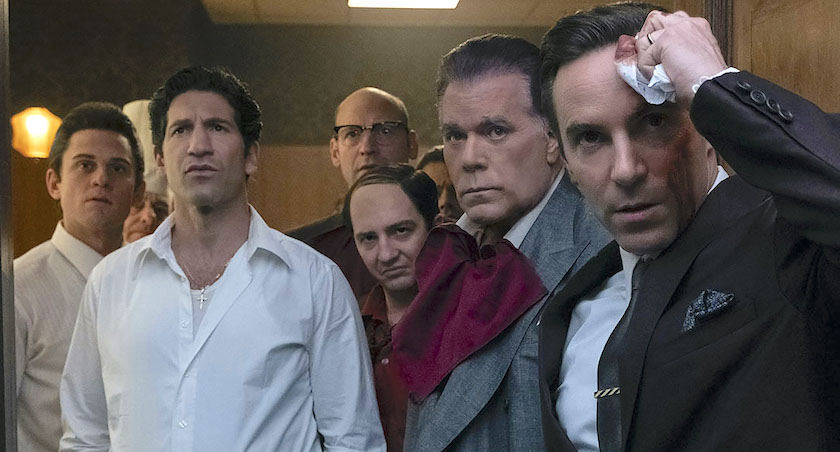
The October 1 release of The Many Saints of Newark, a movie prequel based on The Sopranos series, has revived interest in the show’s portrayal of Mafia figures. The television series is credited with changing the way mobsters are depicted in popular culture, especially in its intimate look at boss Tony Soprano’s family life, including his panic attacks and therapy sessions. The 86-episode series, created by David Chase, aired on the cable network from 1999 to 2007. Chase co-wrote the movie prequel with Lawrence Konner.

The Many Saints of Newark cast includes Jon Bernthal, front left, as Johnny Soprano, and Ray Liotta, second from right, as “Hollywood Dick” Moltisanti.

The film takes place amid strife between the Black and Italian-American communities in 1960s Newark, a major New Jersey port and transportation hub near New York City. The movie winds the clock back to when the characters in the HBO series were younger.

James Gandolfini, who portrayed Tony Soprano in the HBO series, died in 2013 of a heart attack while in Rome. He was 51. In The Many Saints of Newark, his son, 22-year-old Michael Gandolfini, plays a young Tony Soprano.

The human side

Leading up to the movie’s premiere, people familiar with the televised series, and others who dealt with real-life New Jersey and New York mobsters, have reflected on the show’s legacy. Mob historian Casey McBride said what he finds most interesting about the series is the “human side” that comes out in the characters. A Portland, Oregon, musician, McBride has recorded an album of songs, Gangsters and Ghosts Vol 1, about historical Mafia members.

David Chase, creator of The Sopranos TV series, also co-wrote the prequel movie.

The Sopranos showed another side of the life,” McBride said. “How The Sopranos adapted bits of history and humanity into the storyline very much added to its realism.”

McBride already was a fan of the show when he leaned that Frank Costello, a high-ranking East Coast mobster who died in 1973, had seen a therapist at one point. McBride is administrator of Uncle Frank’s Place on Facebook and Instagram. The sites include background information on Costello and photographs of the influential, well-connected mobster who was known as the Prime Minister of the Underworld.

Costello’s sessions with his therapist took place during walks through Manhattan’s Central Park, McBride said. “Costello’s ulcer and bouts with insomnia prompted their sessions,” McBride said. “In 1949, Costello hosted a fundraising event for the Salvation Army at his Copacabana Club. Costello’s therapist was in attendance, and when asked by a reporter who he was, he let it slip that Costello was his patient.”

When that information came out, “it caused the Mob boss to become enraged, something his associates said they rarely saw,” McBride said. Costello severed his relationship with the therapist.

McBride said the character portrayals in The Sopranos have made him a permanent fan.

Intimidation tactics

Many people looking for similarities between the Sopranos and their real-life counterparts point to the Boiardo and DeCavalcante families in New Jersey.

Rocco said he sees in Tony Soprano various mobsters he knew as an undercover agent working the streets. His book Giovanni’s Ring: My Life Inside the Real Sopranos, co-written with attorney and novelist Douglas Schofield, tells the story of Rocco’s undercover work. Rocco is a pen name he uses to protect his identity. He lives in an undisclosed location.

James Gandolfini played Tony Soprano for 86 episodes of the landmark HBO series The Sopranos. He died of a heart attack in 2013 at age 51.

“Tony Soprano is a compilation of real people I knew growing up or investigated and arrested during my career,” he said.

Rocco, who spoke at The Mob Museum in June, said the attention to detail is what sets The Sopranos apart — the vernacular, family relationships and one-liners “that drew us in every week no matter what was going on in our lives.”

“Each character had an individual story and played a part within the crime family’s story that sucked us in even more,” he said.

Bob Delaney, a former undercover New Jersey state trooper, said The Sopranos is a realistic show. Delaney investigated the Mob for more than a decade and ran the New Jersey State Police Institute on Organized Criminal Groups. He later became a longtime NBA referee.

Delaney’s book about his undercover experiences, Covert: My Years Infiltrating the Mob, was written with journalist Dave Scheiber. Delaney and Scheiber collaborated on a second book, Surviving the Shadows: A Journey of Hope into Post-Traumatic Stress. Delaney spoke at The Mob Museum in 2016.

In his police work, Delaney witnessed how mobsters use intimidation and the threat of violence to exert their authority and maintain control. “The intimidations that take place are what is so powerful about this group,” he said. “That, I saw on a daily basis.”

Sometimes the intimidation tactics become deadly. “In Tony Soprano’s world, he eliminates the competition with a bullet to the head,” Delaney said.

Family life

The family relationships on display in the fictional Sopranos world resemble some of those in real New Jersey crime families, including the Boiardos.

Family leader Anthony “Tony Boy” Boiardo saw a psychiatrist as he struggled with the strain of managing a criminal enterprise, according to Richard Linnett, author of In the Godfather Garden: The Long Life and Times of Richie ‘The Boot’ Boiardo.

Tony Boy was the son of powerful New Jersey mobster Richie ‘The Boot’ Boiardo.

Linnett told the New York Post that Tony Boy “worked with a therapist who had been a military doctor, specializing in PTSD.”

“Tony Boy was dealing with the stress of being the Boot’s son and running a Mob family, which he was ill-equipped to do,” Linnett said.

Tony Soprano’s difficulties in running a crime family, and his use of therapy sessions to cope with stress, add a dimension to The Sopranos that still comes up in conversations, even 14 years after the series ended. The Many Saints of Newark is bound to keep the conversation going.

Larry Henry is a veteran print and broadcast journalist. He served as press secretary for Nevada Governor Bob Miller, and was political editor at the Las Vegas Sun and managing editor at KFSM-TV, the CBS affiliate in Northwest Arkansas. The Mob in Pop Culture blog appears monthly.
The fall of Murder Inc.

It was the most brutal collection of bloodthirsty characters ever produced by organized crime in America. Murder Inc.’s inception, activities and inner workings shocked 1930s society and made newspaper sales soar with sensational headlines and salacious details of underworld death-dealing and deceit.

The proverbial house of cards actually began to fall in the late 1930s, slowly at first, because all the dots were far from being connected by the various law enforcement agencies. Gang-busting was the order of the day during the Depression. In Manhattan, Thomas Dewey put away Charles “Lucky” Luciano in 1936, then went hunting for fugitive Mob kingpins Louis “Lepke” Buchalter and Jacob “Gurrah” Shapiro on antitrust violations, while the feds also wanted Lepke for narcotics. In Brooklyn, Assistant to the Special Prosecutor John Harlan Amen led investigations into corruption, bail bond and racketeering rings. All the while, bodies of slain hoodlums were popping up around the city and all the way to upstate New York, almost always with the same suspects but never any convictions. Unbeknownst to the authorities at the time, all of this was connected to larger, more heinous criminal exploits.

In February 1940, William O’Dwyer became Kings County district attorney, and within a couple of months his prosecutors were tracking down a slew of unsavory characters. The DA’s interest was either piqued or forced by two factors in particular: a grieving mother and a convict with a grievance.

O’Dwyer listened to the woman’s story of how her son was killed and who she believed the perpetrators were. The disturbing tale was corroborated in letters penned by the convict. As fate would have it, several of the suspected villains were already in custody; it merely became a question of which one would start singing. The DA’s office convinced two low-level hoods to talk, Anthony Maffetore and Abraham Levine, followed by one of the most brutal leaders of the gang — Abe “Kid Twist” Reles.

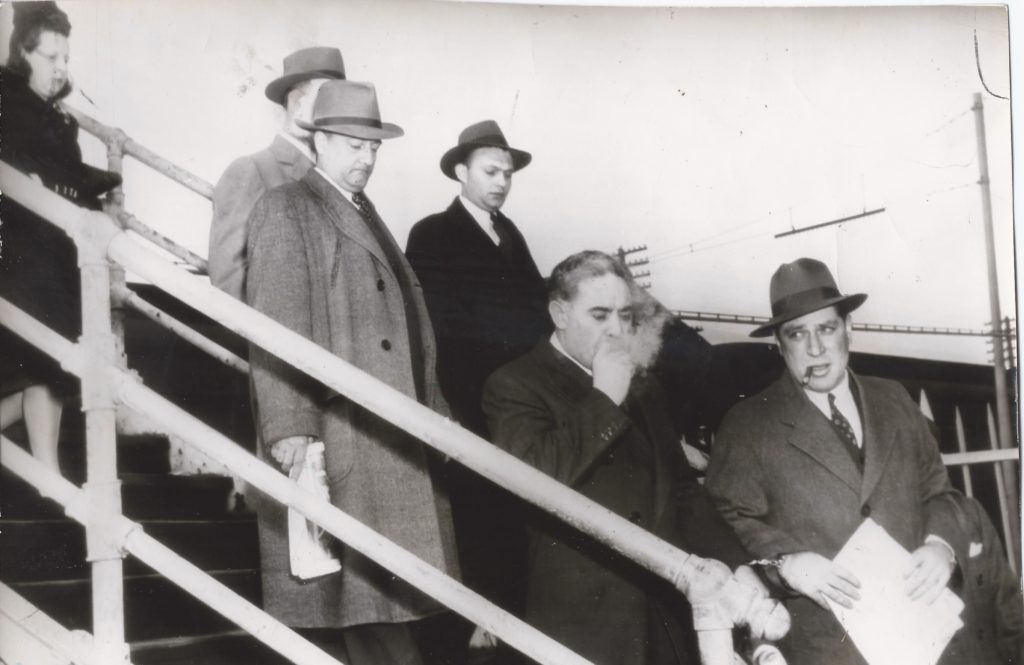
Louis Capone and Mendy Weiss, bottom of stairs, board a train bound for Sing Sing prison in 1941. Courtesy of Cipollini Collection

Why were they so willing to talk? Back then, the authorities could apply serious pressure and threats; the possibility of being put to death in the electric chair was a very real and present danger. Soon, more stool pigeons joined the choir, Albert “Tick-Tock” Tannenbaum, Mickey Sycoff and Seymour Magoon among them, while others such as Jack Drucker, Irving Cohen and Jacob Migden chose to go on the lam (all of them were eventually apprehended). By the summer of 1940, O’Dwyer’s office had in custody those they felt were the primary culprits, the most sinister of the lot: Martin “Buggsy” Goldstein, Harry “Pittsburgh Phil” Strauss, Harry “Happy” Maione and Frank “Dasher” Abbandando.

The task of sorting out how best to link the defendants with particular murders was daunting because prosecutors estimated Murder Inc. carried out more than 100 homicides nationwide. The DA settled on trying Goldstein and Strauss for the 1939 murder of Irving “Puggy” Feinstein, while Maione and Abbandano would go on trial for the 1937 murder of George “Whitey” Rudnick.

The biggest shocker related to Mob boss Buchalter. Lepke, who had been hiding out, turned himself in to federal authorities on narcotics charges in 1939, but New York pushed hard to get him. Lepke was handed over to local prosecutors to face capital murder charges in the 1936 shooting death of candy store proprietor Joseph Rosen. Emanuel “Mendy” Weiss and Louis Capone (unrelated to the Chicago Mob boss) joined Lepke on the charge.

Birth of a catch phrase

“They all had killers eyes. When you look into them … you see no hate, love, fear or courage and you never can tell what your subject is thinking.”

—Burton Turkus, assistant district attorney, 1944

What was Murder Inc. exactly? In terms of the Mob’s Depression-era quasi-corporate evolution, the idea behind its formation, perhaps ironically, was to limit the violence that always brings more heat on the organization as a whole. The smartest of gangland bosses realized that dead men can’t pay their debts, but if someone becomes an outright liability, there must be an organized, sanctioned system in place to deliver violence.

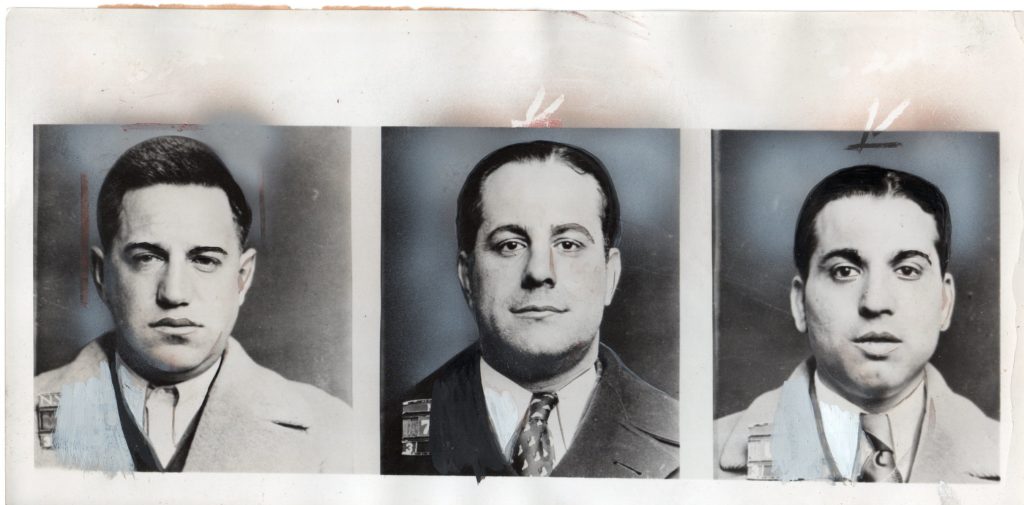
Mugshots of Martin Goldstein, Abe Reles and Harry Strauss. Courtesy of Cipollini Collection

As the story goes, two of the top dogs — Buchalter and Albert Anastasia — had just the right type of guys in mind for the job. Culled from the Brownsville and Ocean Hill sections of Brooklyn, a core team of Jewish and Italian thugs were tasked with dishing out Mob justice upon informants, deadbeats, witnesses, rivals and basically anyone whom the upper brass issued a contract to kill. These hired killers had a collective history of violence second to none in the Brooklyn underworld.

Notwithstanding the debate over when, exactly, this band of killers officially went on retainer, it can be traced back to a point of origin between 1931 and 1934. As time went on, Murder Inc. expanded to include both direct and loosely associated underlings and assassins, but the base of operations eventually was established inside Mrs. Rose Gold’s otherwise nondescript corner store at 779 Saratoga Avenue.

The catch phrase “Murder Inc.” went viral after most of the gang was broken up by law enforcement during the first half of 1940. Not unlike the hazy origins of the murderous crew itself, the question of who actually came up with the phrase is subject to debate, but it likely was the brainchild of one of two imaginative newspapermen: Asa Bordages or Harry Feeney. Within the underworld, the killer group was simply known as “The Combination.”

Trial by fire

The fall of Murder Inc. was a continuously unfolding event, with convictions, executions and appeals continuing well into 1944. But 1941 proved to be the fateful year for most of the core individuals. Burton Turkus, assistant DA, spearheaded efforts to swiftly prosecute beginning in the spring of 1940. He had the defendants tried in groups or pairs. The testimony of turncoats such as Reles, Tannenbaum and Magoon had a devastating effect. Rich in courtroom drama and scandalous side stories, the trials proved truth is indeed stranger than fiction. Lurid tales of icepick and meat cleaver killings were enhanced by accounts of gang girlfriends frolicking on beaches with celebratory killers and assisting in evidence destruction.

Murder Inc.’s unraveling was a convoluted, far-reaching affair cast with many lead actors and dozens of supporting roles. Some could argue the prosecution overreached, arguing for death sentences based not on forensic evidence but almost entirely on testimony of equally culpable underworld turncoats. Still, it didn’t take long for the zealous prosecutors to tally up wins and see the defendants handed capital punishments.

Mugshots of Seymour Magoon, Frank Abbandando and Harry Maione. Courtesy of Cipollini Collection

The first men led to the electric chair were Goldstein and Strauss. They were put to death in June 1941. Maione and Abbandando saw a glimmer of hope when their convictions were overturned in 1940, only to have those hopes dashed when their sentences were upheld in April 1941. They were put to death in February 1942.

Numerous other Murder Inc. trials were underway almost simultaneously. In Essex County, New Jersey, Charles “The Bug” Workman went to prison for the 1935 murder of Arthur Flegenheimer, better known as Dutch Schultz. Authorities whisked Reles and Tannenbaum to Los Angeles in September 1941 to testify against Benjamin “Bugsy” Siegel for the 1939 murder of Harry Greenberg (Siegel was acquitted), and in New York’s Nassau, Monticello and Sullivan counties, cold cases were being reexamined and trials commenced against other syndicate associates, including but not limited to Irving “Big Gangi” Cohen and Vito Gurino.

Into the hereafter

In a bizarre turn of events, the prosecution’s star witness — Reles — either fell, jumped or was thrown from the sixth-story window of a hotel on November 12, 1941. Reles, in protective custody with other witnesses at the time, was scheduled to testify in the biggest of the Murder Inc. trials, against boss Buchalter. The death didn’t alter the inevitable, though. Tannenbaum’s testimony proved sufficient. He had been within earshot of Buchalter issuing the murder contract for underlings to take out Joseph Rosen. That was enough evidence to condemn Buchalter, Weiss and Capone to death. The trio were marched into Sing Sing’s death chamber on March 4, 1944.

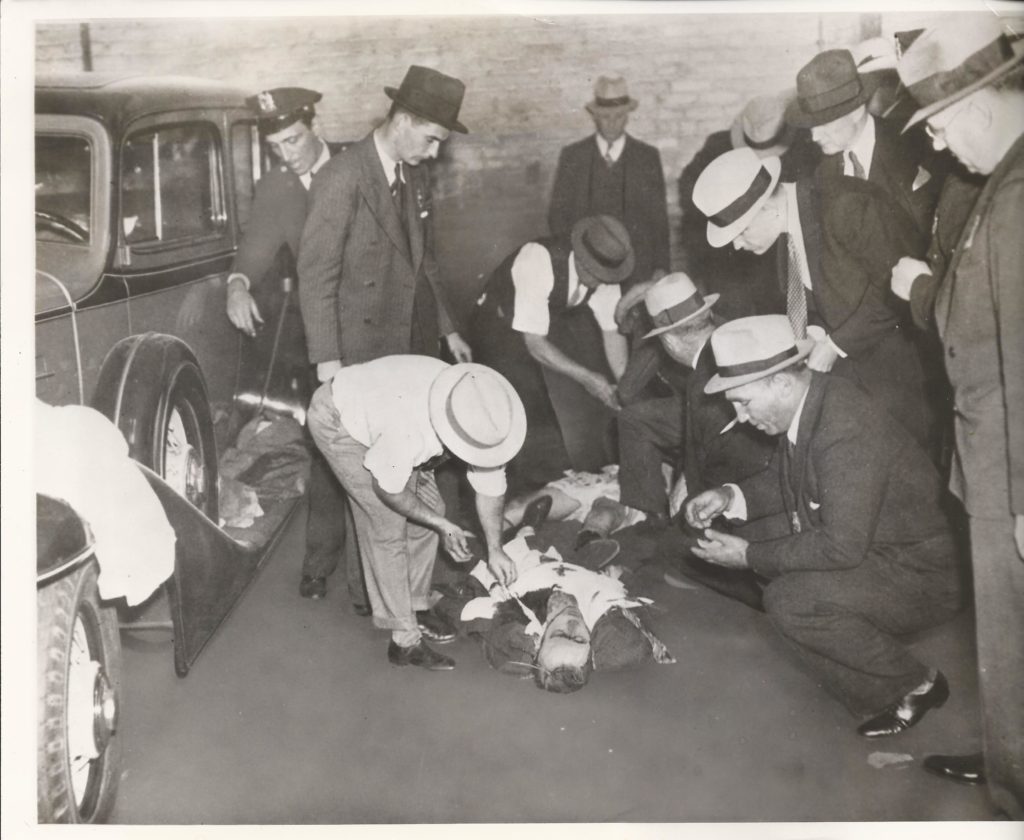
The bodies of Murder Inc. victims Joseph Amberg and Morris Kessler were discovered in a Brooklyn garage in 1935. Courtesy of Cipollini Collection

Although other trials were still taking place, Buchalter’s death marked the end of Murder Inc. executions and would go down in history as the only instance when a Mob boss was put to death.

As for the legal eagles O’Dwyer and Turkus, the former became New York mayor but unceremoniously left office amid scrutiny for never pursuing Murder Inc. boss Albert Anastasia, the mysterious and unsolved death of Abe Reles, and his alleged “friendship” with Mafia heavyweight Frank Costello. Turkus, meanwhile, publicly claimed he wasn’t after fame, but he certainly took to it with ease. He embarked on speaking tours and radio appearances and co-wrote a book with Sid Feder, titled, appropriately enough, Murder Inc.

Christian Cipollini is the author of Murder Inc.: Mysteries of the Mob’s Most Deadly Hit Squad and Lucky Luciano: Mysterious Tales of a Gangland Legend.

New John Gotti movie in the works

When Paul Castellano and a top aide were ambushed outside a New York City restaurant on December 16, 1985, a handgun that one assassin was using jammed and did not fire. Other gunmen finished off the Gambino crime family boss and driver Thomas Bilotti as the two got out of Castellano’s black Lincoln in front of Sparks Steak House.

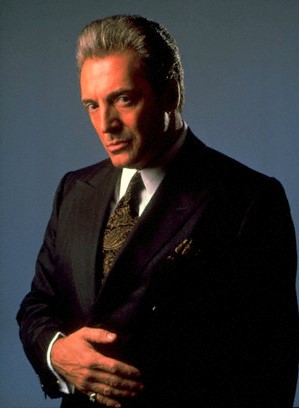
Armand Assante will once again play Gotti in the new movie titled Gotti II: The Final Chapter, Facts Undisputed.

Armed and ready about 5:30 p.m. during the busy holiday season, the killers all were wearing what author Anthony M. DeStefano describes in his book Gotti’s Boys as “long beige overcoats and fur Muscovite-style hats.” They dressed this way to confuse eyewitnesses in crowded Manhattan.

This bloody takedown was a power grab that John Gotti orchestrated to move himself up the ladder into the top spot as Gambino boss. He and future underboss Salvatore “Sammy the Bull” Gravano were in a car nearby, watching to be sure the hit was carried out. Over time, Gravano would turn on his boss and testify against him in court, sending Gotti to prison, where he died years later at age 61.

Gravano, 76 and free on parole, now has a website selling T-shirts, signed memorabilia, iPhone cases and more. He can be heard on his own podcast, Our Thing, discussing his life in the Mob.

The incident at the steakhouse is depicted in the 1996 television movie Gotti: The Rise and Fall of a Real Life Mafia Don, starring Armand Assante as the well-dressed celebrity gangster known in New York tabloids as the Dapper Don. In preparing for the starring role, Assante gained 35 pounds and closely studied Gotti’s life, even speaking with his attorneys about their client.

DeStefano, a reporter at New York Newsday in addition to writing nonfiction books about the Mob, is among those who say their favorite Gotti movie is the one with Assante. A 2018 version starring John Travolta as the Gambino godfather generated less enthusiasm, receiving a zero rating from Rotten Tomatoes.

“The first Assante movie is my favorite so far,” DeStefano said.

Fans wanting an encore Gotti performance from Assante, who won an Emmy for his first portrayal, might be in luck. A sequel to the HBO original Gotti movie is in its earliest stages of production and is expected to include the 71-year-old Assante in the lead role again.

‘Deliver the truth’

News that a sequel is in the works was announced at the SopranosCon and MobMovieCon event this summer in New Jersey. Gotti’s son, John A. Gotti, known as Junior, is serving as an adviser for the sequel, Gotti II: The Final Chapter, Facts Undisputed. The movie supposedly will focus on the last decade of Gotti’s life during the years he was in prison.

The sequel’s producer, Michael Mota, CEO of VirtualCons, said John A. Gotti’s mission is to “tell his father’s story factually and comprehensively,” according to The Wrap website.

“He understands that with Gotti II we will deliver the truth via the powerful vehicle of dramatic fiction,” Mota said.

Mota added that the only promise to Gotti’s son, and by extension to the family, “is one of honesty throughout the storytelling process.”

The Gotti sequel has a long way to go before being released to the public. Many matters still need to be worked out, including lining up the cast members surrounding Assante.

The mid-’90s version featured several actors who later starred in the HBO series The Sopranos. One of these was Tony Sirico, remembered by many as Paulie Walnuts, an associate of fictional New Jersey crime boss Tony Soprano. There is no indication yet whether any of these actors will sign on for the Gotti sequel.

Two Hollywood veterans with previous movie credits, Oscar-winner Nick Vallelonga (Green Book) and George Gallo (Midnight Run), are the script’s co-writers. Gallo also is directing The Legitimate Wiseguy, an upcoming movie about mobster Tony “The Ant” Spilotro and his efforts to help the son of a Chicago car dealer begin a career in the Hollywood film industry. Beginning in the early 1970s, Spilotro was the Chicago Outfit’s overseer in Las Vegas for more than a decade. In 1986, mobsters in the Chicago area lured Spilotro and his brother, Michael, to their deaths in a brutal beating.

Gotti’s legacy

On June 10, 2002, Gotti died of cancer in a federal prison hospital in Springfield, Missouri. Four years earlier, he had been operated on for neck and head cancer, according to the New York Times.

Though Gotti has been gone for nearly 22 years, interest in his life, and in places associated with him, remains high. In a story about Gotti’s death, the New York Times noted that his “swagger and seeming immunity from punishment earned him mythic gangster status.” 

The Ravenite Social Club, Gotti’s headquarters at 247 Mulberry Street in New York City’s Little Italy, continues to attract sightseers. Until this summer, the club had been a shoe store for 22 years, first called Shoe and then Cydwoq. However, the store closed permanently on June 26, with its remaining stock only available on the Cydwoq website, according to the company’s Facebook page.

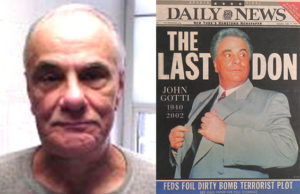
John Gotti died of cancer in prison in 2002. This was the New York Daily News cover the day after Gotti’s death.

The Ravenite is where Gotti and others were arrested on December 11, 1990, leading to his conviction on 13 felony counts, including murder, racketeering and obstruction of justice. He was sentenced to life in prison.

Before he finally was sent away, Gotti managed to thwart earlier unsuccessful government attempts to put him behind bars. A steady stream of news stories during this period referred to him as the “Teflon Don,” because criminal charges would not stick to him.

The media attention that Gotti received during his reign, including appearing on the cover of Time magazine, heightened his profile, reminding people of Mob leaders from an earlier era, DeStefano said.

“I think the public fascination with Gotti is partly the result of the media furor surrounding (him) at the time he was boss, and the public and media thirst for a gangster figure whose image was a throwback to the old days when mobsters like Frank Costello and Lucky Luciano were personalities and themselves became part of the folklore of crime history,” DeStefano said.

With his daily haircuts and expensive suits, Gotti seemed to have come straight from a Hollywood casting office. Michael Green, a UNLV associate professor of history, said Gotti’s image matched the public’s perception of a crime boss.

“He looked the way you wanted a don to look,” said Green, who serves on The Mob Museum board of directors.

Over the years, Gotti’s family also has kept his name in the news, Green noted. One example occurred in mid-August, when his daughter, Angel, posted a message on Instagram, saying, “John Joseph Gotti was never beaten in prison despite what the government and their rats say. You’re all going to find out very soon.”

This is an apparent reference to an incident in the late 1990s at a federal prison in Marion, Illinois. Gotti was beaten in the recreation area of the prison in an argument with a Black inmate, according to news accounts.

Gotti’s name also continues to pop up in stories on different news sites. He was mentioned in August in an online item about Vincent Artuso, once a member of the Gambino crime family

In an exclusive story on the Gang Land News website, veteran journalist Jerry Capeci reported that the 76-year-old Artuso had died of bone cancer. Years earlier, on that December 1985 evening outside Sparks Steak House, Artuso was the assassin whose gun jammed during the ambush on Bilotti and Castellano, with Gotti watching.

Larry Henry is a veteran print and broadcast journalist. He served as press secretary for Nevada Governor Bob Miller, and was political editor at the Las Vegas Sun and managing editor at KFSM-TV, the CBS affiliate in Northwest Arkansas. The Mob in Pop Culture blog appears monthly.
As the 75th anniversary of the Flamingo Hotel approaches, The Mob Museum is set to unveil a new exhibit

Ask many Las Vegas newcomers and visitors to identify the city’s origins, and they will say a mobster named Bugsy Siegel invented the town. Although this is a myth nurtured and perpetuated by fact-challenged writers and creative filmmakers, it is nonetheless fair to say that Siegel had a significant impact on Las Vegas — both intentionally and unintentionally.

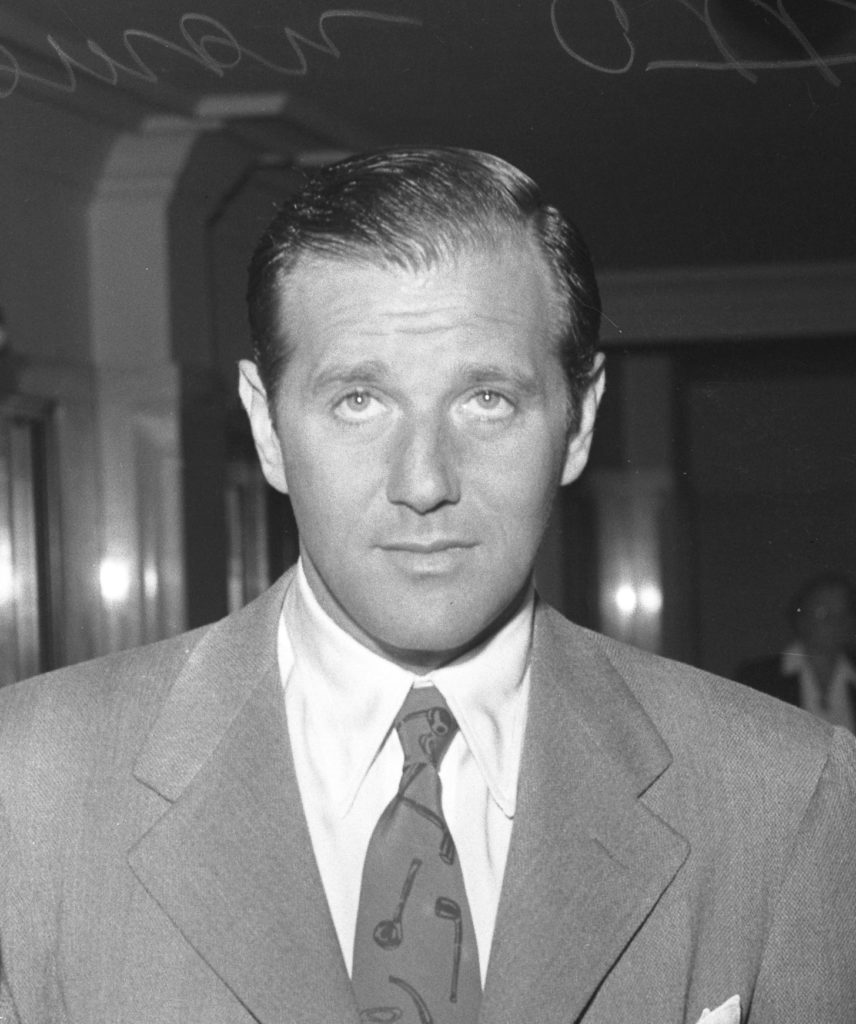
Benjamin “Bugsy” Siegel took over the Flamingo project after he forced Billy Wilkerson out. Los Angeles Daily News, Department of Special Collections, University of California at Los Angeles

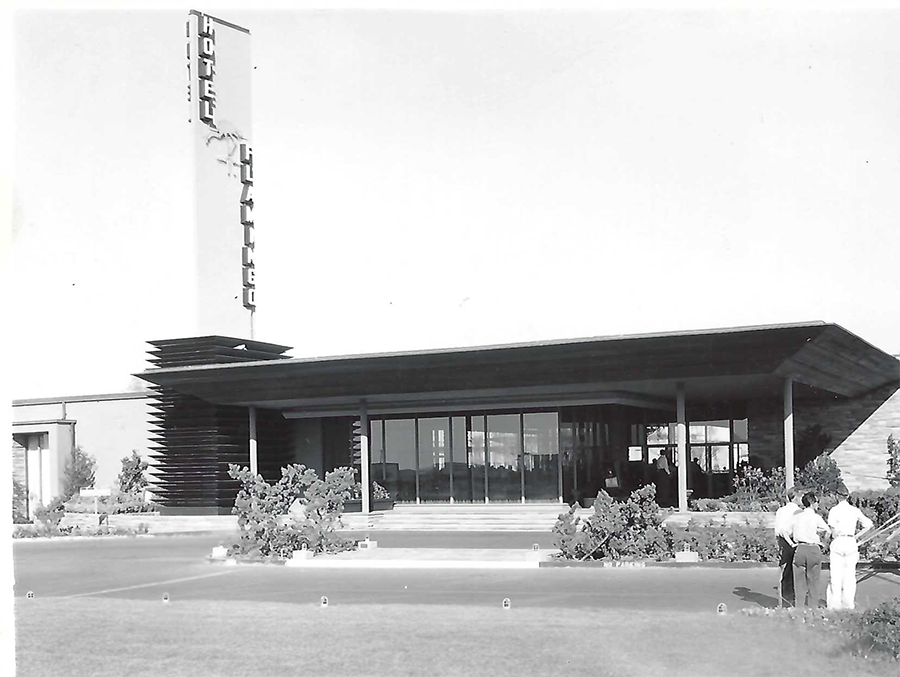
Benjamin “Bugsy” Siegel’s seven-year involvement with the city, from 1941 to 1947, culminated in the Flamingo Hotel, a $6 million casino resort that set a new standard of quality for Las Vegas. The Flamingo’s sleek design, modern décor and luxury amenities represented a dramatic turn for a town that had previously embraced a dust-covered Old West theme. Siegel’s vision expanded upon the more modest plans of Billy Wilkerson, who conceived and started the Flamingo’s construction.

But Siegel’s enduring impact on Las Vegas has been felt even more because of something over which he had no control. On June 20, 1947, six months after the Flamingo’s opening, Siegel was murdered in Beverly Hills, California. Police investigations uncovered multiple motives, but resulted in no arrests, and Siegel’s killer is still a mystery almost 75 years later. The murder of Siegel, which generated front-page headlines across the country, ultimately contributed to the allure of Las Vegas. Many visitors were drawn to the city on the prospect — however realistic — that the guy sitting next to them at the poker table or the bar might be in the Mob. This sense that Las Vegas offered opportunities to rub shoulders with the underworld — without any real complications — boosted the city’s growth more than any single casino ever could.

And so, beyond the details of his comings and goings in Las Vegas during the 1940s, Siegel has become a central figure in the city’s history. He was the first larger-than-life organized crime personality in Las Vegas. In his local dealings, he generated mostly positive feelings. His Las Vegas lawyer, Lou Wiener, recalled in his oral history that Siegel “was a visionary, and he was a great guy.” Wiener said that when Siegel died, “I felt I lost a good friend. … I was a great admirer of his, not for what he did if he did do it, but for what he did here.”

Although never convicted of murder, Siegel was widely regarded as a brutal enforcer and hit man, from his adolescence in New York through his racket-building years in Los Angeles. He narrowly escaped a murder conviction in Los Angeles when a key witness, Abe Reles, fell out of – or was tossed out of – a hotel window. Wiener and others certainly saw a different side of this hoodlum, who had Hollywood good looks and a temper that earned him a nickname he hated. The Las Vegas version of Ben Siegel perhaps was the man he wanted to become – a legitimate businessman.

The true origins of the Flamingo — and Siegel’s role in it — remain muddled for those who have relied on Hollywood to tell the story. Reflecting its ongoing commitment to accurately interpreting the history of organized crime and law enforcement, The Mob Museum will unveil a new exhibit, The Fabulous Flamingo, on Friday, August 13. This exhibit and its artifacts aim to pierce the myths and set the record straight.

Before the Flamingo

First, Las Vegas was a well-established community long before Siegel arrived. Founded as a railroad town in 1905, it expanded dramatically in the early 1930s with the construction of nearby Hoover Dam and the statewide legalization of gambling. Hoover Dam, completed in 1935, became a popular tourist attraction.

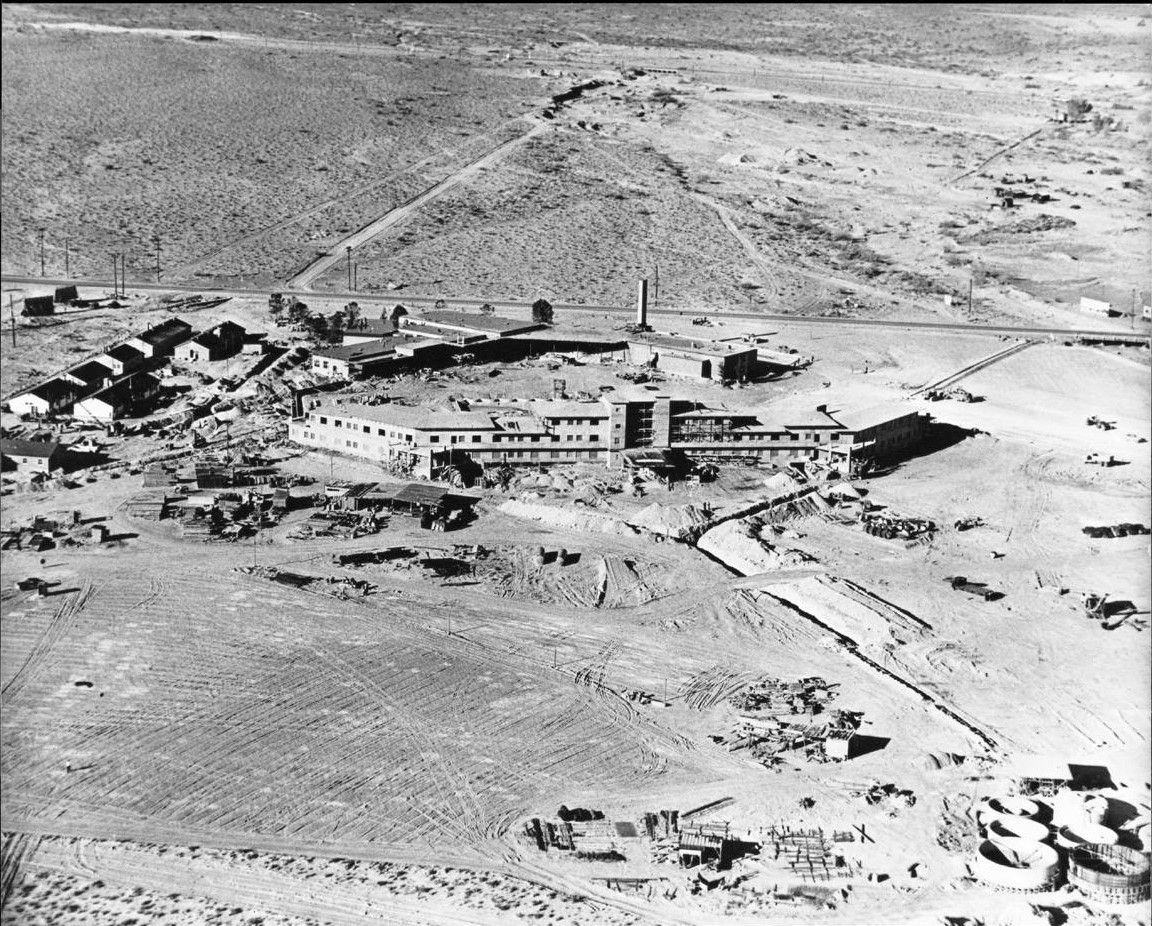
Billy Wilkerson bought the land and started building the Flamingo in 1945 – months before Bugsy Siegel became involved. Courtesy of the Wilkerson Archive

Las Vegas took another big leap forward in the early 1940s with two war-related projects: an Army air base and a magnesium processing plant. Both projects brought thousands of men and women to the Las Vegas Valley. The population explosion spurred the development of two casino resorts on Highway 91, south of Las Vegas. The El Rancho Vegas opened in 1941, and the Hotel Last Frontier debuted in 1942. These were the first two resorts on what eventually would become known as the Las Vegas Strip.

Meanwhile, Fremont Street in downtown Las Vegas continued to expand as well. The El Cortez opened in 1941, the Pioneer Club in 1942 and the Golden Nugget in 1946. The notion that Siegel “invented” Las Vegas is pure fantasy.

Siegel himself certainly knew this. Before he became involved with the Flamingo in 1946, he had invested in other Las Vegas casinos, and he was very involved with the race wire here. The race wire was a service that transmitted horse race information and results around the country. The timely availability of this information allowed bookies to take off-track bets. The Mob seized control of the race wire business, with Siegel in control of the Southwest, including Las Vegas.

Las Vegas was particularly valuable because Nevada was the only state that permitted off-track betting. As a result, Siegel, through his partner, Moe Sedway, operated the race wire in a number of Fremont Street casinos. By the mid-1940s, Siegel reportedly was receiving $25,000 per month in race wire payments from race books in Las Vegas.

Records show that in August 1941, Siegel invested $18,000 in the Northern Hotel on Fremont Street. He then heavily invested in the Frontier Club, also on Fremont Street. In 1943, Siegel tried to buy the El Rancho Vegas on Highway 91, but his offer was refused. Interestingly, Siegel’s underworld reputation kept him from acquiring the El Rancho Vegas. Its founder and owner, Thomas Hull, seeking to quell rumors, told the Las Vegas Evening Review-Journal, “The people of Las Vegas have been too good to me for me to repay them in that way. Mr. Siegel has contacted me several times with an offer to purchase, but I have told him I was not interested, and that goes for all time.”

Two years later, Siegel joined a group of fellow mobsters in the purchase of the El Cortez. They sold it a year later, presumably pouring their profits from the sale into the Flamingo’s construction.

Wilkerson’s vision, Siegel’s legacy

Not only did Siegel not invent Las Vegas, he did not even invent the Flamingo. That credit goes to Billy Wilkerson, publisher of the Hollywood Reporter newspaper and owner of a number of stylish Los Angeles restaurants and nightclubs.

This aerial view shows the Flamingo in early 1947, when construction of the sprawling resort is still in process.

Wilkerson bought the land on which the Flamingo would be built, and he started construction in late 1945. But Wilkerson, a compulsive gambler, soon ran short of funds. He had lost hundreds of thousands of dollars at casinos on Highway 91 and on Fremont Street. He turned to the Mob for financial help. Siegel, the Mob’s point man in Las Vegas, worked side by side with Wilkerson for a few months, but disagreements ensued, and Siegel eventually forced Wilkerson out and seized full control of the project.

Siegel opened the Flamingo on December 26, 1946. The crowds came, at first, and the critics fawned, but the Flamingo had a fundamental problem: Its hotel rooms were still not finished. Further, the casino experienced a strange run of bad luck, as gamblers won more than they lost in the first few weeks after opening. “Bad luck largely explained the losses,” according to Siegel biographer Larry Gragg. “For several nights many gamblers captured big wins.” But, Gragg notes, some of the losses could be attributed to incompetent or corrupt dealers.

The entrance to the Flamingo in early 1947, showing the original sign. Courtesy of Robert Stoldal

Siegel’s rush to start generating revenue for his impatient investors forced him to shut down the Flamingo on February 6, 1947, until the rooms were finished. The resort reopened on March 1, with 100 guest rooms available, and performed better. Siegel’s apparent confidence in improving returns prompted him to schedule a vacation with his two daughters in late June. He traveled to Los Angeles to meet their train from New York.

But on June 20, 1947, while sitting on a couch in girlfriend Virginia Hill’s Beverly Hills house, Siegel was shot to death, leaving a murder mystery that lingers to this day. The Flamingo thrived after Siegel’s demise, setting a new standard for Las Vegas casino resorts with its sleek, modern façade and lavish appointments. Today, the Flamingo remains one of the largest and most recognized resorts on the Strip, though none of the original buildings still stands.

The key artifacts

The Mob Museum’s exhibit is highlighted by several rare artifacts that help to establish the true story of the Flamingo’s origins.

Down payment check

The exhibit includes the original check Billy Wilkerson wrote as a down payment to purchase the property where the Flamingo would be built. The check, written for $9,500 and dated March 5, 1945, went to a local businesswoman named Margaret Folsom. In total, Wilkerson paid $84,000 for the 33-acre parcel, which would be $1.2 million in 2021 dollars.

Casino checks

Also displayed will be five original checks that Wilkerson wrote to five different Las Vegas casinos to pay gambling debts he incurred during the Flamingo’s development. Wilkerson’s compulsive gambling problem, which lost him hundreds of thousands of dollars at Las Vegas casinos, forced him to seek out underworld investors to finance his casino project.

Grand opening invitation

The exhibit will include an original invitation to the Flamingo’s three-day grand opening. This invitation is for the third opening night, December 28, which focused on attracting Hollywood’s elite to see and enjoy the new resort.

Siegel-signed legal document

The premier artifact in the exhibit is an original legal document, signed by Siegel, removing Wilkerson in all respects from the Flamingo operation. In this agreement, Siegel promises to pay Wilkerson $600,000 for his interest in the casino resort. Wilkerson received half the money before Siegel was killed; he never received the other half.

Ralph De Luca, a prominent collector and member of The Mob Museum’s Advisory Council, aided the Museum in acquiring the legal document at auction and provided financial support for its purchase.

These signature artifacts are supplemented by other unique and hard-to-find objects, including a pair of sunglasses owned by Siegel; a pistol owned by Siegel partner Moe Sedway; a ceramic flamingo given to grand opening guests; and a colorful Flamingo slot machine from the casino’s early years.

In addition, the exhibit features a touchscreen so that guests can dig deeper into the Flamingo story. The touchscreen offers iconic images and compelling stories from the 75 years the Flamingo has graced the Las Vegas Strip.

Allen Glick, 1970s owner of Las Vegas casinos skimmed by Mob, has died

Allen R. Glick, a decorated Vietnam War veteran and California developer who insisted he knew nothing about skimming by Midwestern mobsters at four Las Vegas casinos he owned in the 1970s, died August 2. He was 79.

Glick passed away in the seaside neighborhood of La Jolla in San Diego, his home for many years, following an extended battle with cancer, his family announced.

Allen Glick 79
Glick was 79 when he died earlier this week in La Jolla, California.

Glick was a central character in an infamous organized crime scandal that rocked the Las Vegas casino industry in the 1970s and was later dramatized in the 1995 movie Casino. Through his company Argent Corporation, Glick owned four casinos – the Stardust, Fremont, Hacienda and Marina – second only in number to the Nevada hotels owned by billionaire Howard Hughes at the time.  

The Nevada Gaming Control Board later determined that employees of Argent’s casinos quietly skimmed about $7 million from 1974 to 1976 from slot machines on behalf of Milwaukee, Chicago, Kansas City and Cleveland crime families with hidden interests in the properties.

The saga ended in 1986 with the convictions and federal prison terms for more than a dozen top U.S. mobsters, including Milwaukee boss Frank Balistrieri (who pleaded guilty), Chicago Outfit leaders Joseph Aiuppa and Jackie Cerone, Carl DeLuna of Kansas City and Milton Rockman of Cleveland. 

Glick swore he was not aware of the skimming, and indeed federal prosecutors never charged him criminally in return for his cooperation as a witness before two federal grand juries hearing evidence against the Mob-connected defendants.

The government defended Glick in court as a frightened tool of the underworld secretly responsible for loans from the corrupt Teamster pension fund used to buy the casinos.

However, the FBI would allege Glick hired a private attorney in Washington, D.C., to gather information on federal agents and the grand jury investigation into Argent and Glick to insulate him and others from the probe and possibly suborn perjury. Nevada gaming authorities revoked Glick’s casino license in 1979. 

For years before everything went south for him in the late ’70s, Glick earned glowing reviews in background checks requested by prospective partners and the Gaming Control Board, based on his military service and clean business history. 

A native of Pittsburgh, Glick was a graduate of Ohio State University and the Case-Western Reserve School of Law, then passed the bar in California and Pennsylvania. In 1967, he joined the U.S. Army, serving in Vietnam as a military police lieutenant and then as a captain in Special Operations. The Army awarded him the Bronze Star and three combat air medals for his part in search-and-rescue missions.

Upon leaving the Army in 1969, Glick took a job in San Diego with a suburban home-building firm, the American Housing Guild, and two years later joined the real estate company Saratoga Development Corporation. In 1972, the ambitious Glick used a $2.3 million loan from Saratoga to acquire a major and later controlling share in the Hacienda hotel-casino in Las Vegas, and obtained a Nevada casino license.

The next year, Glick met with Alvin Baron – asset manager of the Teamsters Union’s pension fund and a close associate of former Teamsters president James Hoffa – and Ed Buccieri, a reputed money courier for mobster Meyer Lansky. A plan to buy the King’s Castle casino at Lake Tahoe with Baron and Buccieri fell through, but Glick was now in close contact with pension fund chiefs.

In 1974, Glick set his sights on the Stardust hotel-casino on the Las Vegas Strip. Top leaders of the Milwaukee and Kansas City families took a meeting about Glick. As it happened, Glick knew Joseph Balistrieri, son of Milwaukee Mob boss Frank Balistrieri, from college. Glick then convened privately with Frank Balistrieri that April.

Out of those meetings came a sweetheart deal: Glick would buy the Stardust and Fremont casinos by purchasing control of Recrion Corporation (formerly Parvin-Dohrmann, owned by Delbert Coleman). Then, that June, he agreed to allow Balistrieri’s sons, Joseph and John Joseph, the option to buy Glick’s Argent Corporation for a mere $25,000. Glick thereby curried favor with the Mob boss, who used his clout to gain a big loan from the pension fund.    

Glick met with Kansas City Mafia leader Nick Civella (who died in 1983). Frank Balistrieri sought the help of Kansas City, Chicago and Cleveland bosses to get a Teamsters pension fund loan.

Finally, Glick, at age 32, received a $62.75 million loan from the pension fund. Another investor, wealthy California matron Tamara Rand, would loan him $2 million (and later, on orders from Mob leaders, was killed gangland style).   

As of the fall of 1974, Glick owned the Stardust, Fremont and Hacienda. In October, he announced that Frank “Lefty” Rosenthal would serve as his executive consultant for the three casinos. Later, state gaming investigators learned that the Mob’s skimming operation began that November. 

Frank "Lefty" Rosenthal
Frank “Lefty” Rosenthal, who supposedly answered to Glick, actually was overseeing the Mob’s skimming operation and other aspects of the Stardust, Fremont, Hacienda and Marina hotel-casinos. Courtesy of Las Vegas Review-Journal Archive.

In May, 1975, Glick opened a fourth casino, the Marina, owning 65 percent of the casino portion.

Rosenthal and Glick would revolutionize sports betting in Las Vegas by adding a large, elaborate sportsbook at the Stardust. Glick and Rosenthal also brought the up-and-coming Siegfried & Roy magic act to the hotel.  

A crooked oddsmaker with ties to Chicago Outfit leader Joseph Aiuppa, Rosenthal turned out to be the overseer for the Mob’s interests and embezzlement of slot machine coins in all four casinos. U.S. investigators also alleged Outfit made man Tony Spilotro had a hand in the operation.

While the Mob’s associates stole from the casinos, Glick, ensconced in his executive office at the Stardust, claimed to be unaware of the skimming that lasted for two years.

State officials discovered and ended the scheme in May 1976. The U.S. Justice Department launched a criminal probe into Glick, who escaped prosecution with his testimony for the feds. In June 1978, the FBI sent 50 agents to Las Vegas, with 83 search warrants, in a series of raids centered on Argent, based on wiretaps and other evidence.

By 1978, Glick, now owing the pension fund $94 million, had fired Rosenthal. Civella, he told federal investigators, before his death threatened to kill Glick’s sons if he did not sell Argent. Glick sold his Las Vegas casinos in December 1979 and returned to San Diego, still worried about potential Mob retaliation against him and his family.

The story of Glick and Argent is central to the book Casino: Love and Honor in Las Vegas, by author and screenwriter Nicholas Pileggi. With director Martin Scorsese, Pileggi co-wrote the screenplay for the 1995 movie Casino. The Glick character in the movie, named Phillip Green,  was played by Kevin Pollak.

Nick Pileggi
Author and screenwriter Nick Pileggi interviewed Glick for his book 1995 book Casino: Love and Honor in Las Vegas, which he wrote simultaneously while co-writing the Casino screenplay with Martin Scorsese. Pileggi is pictured at The Mob Museum in 2016.

Glick saw Las Vegas casinos as a business opportunity, but he was naive about the strings attached to the Teamsters loans he received to expand his operations in Southern Nevada, Pileggi said. “Allen Glick walked into this nightmare without knowing it was a nightmare,” Pileggi said.

When Glick realized how much trouble he was in, he didn’t know where to turn, Pileggi said. Believing that more than a few federal and state authorities in Nevada were in bed with underworld operatives, Glick feared that if he reached out to the wrong officials, those people would let the Mob know, Pileggi said. That could have been the end to Glick’s life.

“Glick was in a dangerous spot,” Pileggi said, like a “frog in the pot that’s slowly boiling.”

Ultimately, Glick found a federal agent he could trust and became a witness, Pileggi said. Glick’s later trial testimony was key to ending the Mob’s lucrative skimming operation in Las Vegas.

When writing the book, Pileggi met with Glick, who came across to the author as smart and cautious. Glick had security around during this time. Reflecting on Glick’s years in Las Vegas, Pileggi said he doesn’t think the former casino owner knowingly served as a front for the Mob or was involved in the skimming operations. If he had been, the FBI would have come after him, too, Pileggi said.

Larry Henry, who writes the Mob in Pop Culture blog, contributed to this report.

The story of Al Capone and Eliot Ness is headed for Showtime

The shooting death of seven gangsters in Chicago on February 14, 1929, was “the most cold-blooded massacre in the history of the city’s underworld,” the New York Times reported the next day.

This gruesome incident, which took place in a garage at 2122 N. Clark Street, near Lincoln Park, became known as the St. Valentine’s Day Massacre. The dead were members and associates of George “Bugs” Moran’s North Side Gang, rivals of Al “Scarface” Capone during the bloody bootlegging years in 1920s Chicago.

The massacre shocked the nation and brought even more attention to rampant crime in Chicago during that period. To this day, the St. Valentine’s Day Massacre symbolizes this out-of-control era.

Ever since that dark morning, dozens of books and movies about the Chicago underworld during Prohibition have been produced. Even Nobel Prize winner and Chicago-area native Ernest Hemingway, born in 1899, the same year as Capone, referenced that outlaw environment in some of his ground-breaking fiction. 

An upcoming television series on the Showtime network is expected to attract even more attention to Capone – and to Eliot Ness, a federal Prohibition agent who was tasked with going after Capone. Ness and his team became known as the Untouchables because of their resistance to corruption.

Scarface and the Untouchable, by Max Allan Collins and Brad Schwartz, was released in 2018. It is now available in paperback.

The Showtime production, now in its early stages, is based on the 2018 book Scarface and the Untouchable: Al Capone, Eliot Ness, and the Battle for Chicago by Max Allan Collins and A. Brad Schwartz. Collins and Schwartz spoke at The Mob Museum after the book’s release.

“The show will delve into Prohibition-era politics, industrialization, mass media, the immigrant experience, law enforcement and the birth of organized crime,” according to Deadline. “It will show how Al Capone corporatized crime on a level never before imagined, and how Eliot Ness, one of the most revolutionary cops in American history, fought an uphill battle to reform law enforcement, a battle that continues to this day.”

A date has not been set for when the series will air.

Capone’s vault

Capone is one of the main criminal figures from Prohibition whose name is still widely recognized. His nickname, Scarface, is well-known, the result of an incident in a New York bar, when Capone insulted a female customer. The woman’s brother, Frank Galluccio, pulled a knife and slashed Capone three times on the left side of his face. The longest scar extended to four inches.

In 1986, journalist Geraldo Rivera opened Al Capone’s vault at the Lexington Hotel in Chicago on live television. It was empty.

Schwartz, co-author of Scarface and the Untouchable, said the public’s fascination with Capone “seems to come in waves every three or four decades.”

One of these waves occurred in April 1986 with reporter Geraldo Rivera’s live, two-hour televised broadcast from a basement vault in Chicago’s Lexington Hotel, a one-time Capone headquarters. Near the end of the broadcast, Rivera revealed there was nothing Capone-related in the vault and nothing of value, just an empty “60-year-old bottle” that he tossed aside.

“I’m disappointed about that, as I’m sure you are,” Rivera told viewers.    

Rivera’s show about Capone’s vault continues to crop up as an example of how hype and overblown expectations can lead to ridicule. The veteran reporter “respectfully” declined requests to discuss the broadcast for this report, said Fox News spokesman Connor Smith.

According to Schwartz, however, Rivera’s show has gotten a bad rap.

“The documentary portions are actually quite good,” Schwartz said, “especially some of the interviews and footage inside the old Lexington Hotel.”

Capone historian Mario Gomes said that while Rivera’s broadcast might have looked like a flop, “in reality it brought millions of viewers to watching the event.” Gomes is founder of myalcaponemuseum.com.

“The documentary shown before the vault opening was one of the reasons I got interested in this subject,” Gomes said. “It was riveting and well made, despite the empty vault. This show brought many fans and collectors to seek out the Lexington Hotel to salvage anything from Al Capone’s suite, such as his famous Nile green bathroom tiles.”

‘The gangster mythos’

The public’s desire to know more about Capone has gone on for a long time and shows no sign of ending. During the height of his power, his “immense fame caught the eye of Hollywood,” Schwartz said.

Hollywood’s interest in Capone led to classic movies such as Little Caesar (1931) and Scarface (1932), which established the gangster genre, Schwartz said.

Three decades later, Capone and Ness were fading from popular memory, Schwartz said, “until several films and TV shows set in Prohibition-era Chicago all came out in 1959: Al CaponeThe Untouchables, and Some Like It Hot.”

And nearly 30 years after that, Geraldo opened Al Capone’s vault while the director (Brian De Palma), who remade Scarface, brought The Untouchables to the big screen,” Schwartz added. “I’d say we’re overdue for another revival. Showtime is working to make it happen.”

The author said Americans who “fell in love with Capone in the Roaring Twenties, when he offered himself up as a symbol of success, came to hate him in the 1930s, once the Great Depression made his lavish lifestyle seem obscene.”

“And because he made himself so visible in the mass media of his day, his personal style — his fedoras, suits, cigars and Tommy guns — became our cultural image of what it means to be a gangster,” Schwartz said. “He’s the truth behind the gangster mythos – and because that genre will always be with us, he’ll always be with us, too.”

Unsolved shooting deaths

The St. Valentine’s Day Massacre stands out as one of the most disturbing deadly episodes in U.S. criminal history.

At about 10:30 on that cold February morning, some in the garage had been drinking coffee at an electric stove and eating crackers when intruders lined all seven Moran gang members up against a white-washed brick wall and gunned them down. Two of the four gunmen were disguised in police uniforms, “their stars gleaming against the blue of their cloth,” the New York Times reported. Two men had Thompson submachine guns, and at least one had a shotgun. Police found more than 70 machine gun shells on the blood-stained floor.

The only survivor was a German shepherd named Highball. The dog belonged to John May, an overall-clad mechanic and suspected safe-blower killed in the massacre.

At the time of the shooting, Capone was in Miami, where he had a home, but he is believed to have ordered the attack, thereby strengthening his grip on many illegal enterprises in Chicago. That would not last long. In 1931, he was sentenced to 11 years in federal prison for tax evasion. Suffering physically and mentally from syphilis, Capone died in Florida in 1947 at age 48. Eight years before his death, doctors said he had the cognitive processes of a 12-year-old. (Family members dispute this depiction of Capone’s mental state in his final years.)

No one was ever held accountable for the massacre. After a private meeting with one suspect, Fred “Killer” Burke of St. Louis’ notorious Egan’s Rats, a Chicago prosecutor declined to file charges, according to historian and former Las Vegas casino executive Bill Friedman. The Chicago prosecutor instead deferred to a district attorney in Michigan, where Burke was wanted on suspicion of killing a policeman. Burke was convicted in that death and sentenced to a life term. He died of a heart attack at age 54 in a prison in Marquette, Michigan, near Lake Superior.

The site of the garage in Chicago now is an empty lot. A large portion of the bullet-pocked brick wall has been preserved and is on display at The Mob Museum.

Ness’s second chapter

Schwartz and Collins have written another book about that era, Eliot Ness and the Mad Butcher, which came out this summer in a paperback edition. The book picks up the Ness story in Cleveland, where he squared off against the Mob after Prohibition. Ness also was there to reform the police department and hunt down a serial killer, “long before most Americans knew such murders existed,” Schwartz said.

Max Allan Collins and Brad Schwartz co-authored Scarface and the Untouchable, the basis for a planned Showtime series.

“That period challenged him even more than the Capone case, and his efforts to transform American policing are worth remembering as we try to reimagine public safety today,” the author said.

For his next project, Schwartz is taking a break from the gangster era to write about the early days of broadcast news. But the underworld, with its deep well of story material that writers and readers find irresistible, might draw him back in.

“I hope to return someday,” he said.

Larry Henry is a veteran print and broadcast journalist. He served as press secretary for Nevada Governor Bob Miller, and was political editor at the Las Vegas Sun and managing editor at KFSM-TV, the CBS affiliate in Northwest Arkansas. The Mob in Pop Culture blog appears monthly.