The sensational exploits of Depression-era con artist Victor Lustig are now underworld legend. But many oft-told tales overlook his surprising involvement with key criminal figures and events in 1930s gangland.
Officially, his name was Robert V. Miller — at least according to law enforcement. But even that is uncertain. His birthplace and date are murky, although most agree he was born in Bohemia around 1890. A scar on his left cheek — allegedly from a jealous husband — was one of the few consistent features across his many disguises.
Throughout his criminal career, Lustig used at least 45 aliases, including Robert Duvall, Robert Wagner, Bert Lustig and, most famously, “Count Lustig.” Fluent in five languages, he refined his trade under the tutelage of notorious con men such as gambler Nicky Arnstein, and eventually settled in the United States after World War I.
Under the alias “Wagner,” Lustig’s 1930 mugshot appeared in the pages of the Buffalo Police Department’s Higgin’s Pocket Gallery of Criminals. Courtesy of Cipollini Collection
Friends in low places
From the early 1920s through the Great Depression, Lustig pulled scams from New York to Kansas City while quietly maintaining a family in the Midwest and conducting affairs abroad. He was frequently arrested but usually talked or bribed his way out of trouble. His criminal network included racketeering gambler Arnold Rothstein, bootlegger Waxey Gordon and St. Valentine’s Day Massacre suspect Gus Winkeler.
In a 1929 incident, U.S. and French agents arrested Lustig and associate William MacSherry for attempting to sell fake stocks. During questioning, the pair claimed to be members of Al Capone’s gang, an assertion quickly denied. When asked by reporters, Capone’s associate Jake Guzik said, “Never heard of them.” Other unnamed gang members echoed the sentiment.
Though best remembered for purportedly swindling Capone (and then returning the money) and “selling” the Eiffel Tower — twice — it was his infamous “money box” scam, in which he sold a phony currency “duplicator,” that cemented his legend. Ultimately, it was counterfeiting that brought him down in 1935. The exposés that followed — many likely fueled by Lustig himself — blurred fact and fiction. Even today, many aspects of his underworld ties remain obscured.
The original dopemen
On July 15, 1930, federal agents raided Manhattan’s President Hotel looking for gangster Jack “Legs” Diamond. They found Diamond meeting with Lustig and an associate, Abraham Leimas. All three were arrested but released shortly after due to lack of witness identification.
That meeting turned out to be a prelude to something bigger. A month later, Diamond left for Europe, allegedly to oversee a $250,000 investment in a liquor and narcotics venture. A Justice Department memo placed Lustig aboard a White Star Line vessel alongside several suspected underworld figures: Charles Green, alias Entratta; Salvatore Arcidiaco, a man identified as Lucania (likely Lucky Luciano); and another known only as Traeger. Aside from Entratta, who wasn’t on the mission, the others — including Lustig — arrived safely in Antwerp.
This long-lost mugshot of Lucky Luciano was taken in Florida six months before his Europe trip with Lustig and Diamond. Miami Daily News
Diamond took a separate ship but was arrested in Germany and sent back to Philadelphia. On October 12, Diamond was shot four times at New York’s Monticello Hotel in a botched assassination attempt.
Suspicions flew. Some blamed Capone, while others pointed to remnants of Arnold Rothstein’s faction (specifically traffickers Oscar Kirshon and Charles Cook). Nearly all theories circled back to cocaine, morphine and money.
Diamond stayed quiet while recovering, but his mistress, Kiki Roberts, did not. She told police that Lustig and Arcidiaco had met with him earlier that day. The pair, along with Diamond’s rival, Dutch Schultz, were briefly detained. Schultz was released quickly, but Lustig and Arcidiaco admitted to being in Europe.
Lustig claimed he had been in Paris when Diamond was arrested and believed the operation had been canceled. Arcidiaco gave vague answers about a failed business venture. Letters later showed Diamond begging Lustig for financial and legal aid. Records confirm that Luciano registered in Antwerp but was never questioned. Still, his name surfaced repeatedly in the press as a possible suspect in the shooting.
On July 15, 1930, Lustig, right, showed up in a police lineup with Jack “Legs” Diamond, left, and Abraham Leimas. Courtesy of Cipollini Collection
Double-crossed by a lover
By 1935 Lustig had accumulated 38 arrests on his record. He also had leveraged his underworld network into his most audacious scam yet: counterfeiting. Allegedly through Capone’s affiliation, Lustig partnered with William Watts, a Nebraskan druggist who crafted currency printing plates. Lustig handled the distribution channels. But the high-quality fake bills soon drew the attention of federal agents.
Lustig’s criminal network was responsible for his rise but also contributed to his fall. One of his connections was Mae Scheible, Pittsburgh’s infamous “Number One Madam,” who ran a high-end brothel in the city’s Oakland district. Pursued by authorities in 1934, she relocated her operation and some of her workers to New York.
Scheible and Lustig had history. He once conned her into buying fake bonds, only to return the money later. Despite the grift, they remained intimately connected. But according to former Secret Service agent Frank Seckler, things soured in 1935 when Lustig borrowed her car to take another woman out (some suggest it was Watts’s wife). Not long after, authorities received an anonymous tip. Another version claims someone mailed a locker key with instructions.
“We always thought Mae Scheible, burning with jealousy, was our informant,” Seckler wrote in 1951.
Agents staked out Scheible’s New York apartment and eventually arrested Lustig nearby. Although he had nothing incriminating on him, the key led to a Times Square subway locker containing printing plates and $50,000 in fake bills.
Lustig escaped federal custody in New York on September 1 by tying bedsheets together and climbing out a third-story window. Authorities suspected that one of Scheible’s associates helped him escape.
On the run for weeks, agents tracked him using wiretaps on Scheible’s phone and an unnamed informer. They traced Lustig to Pittsburgh’s Northside, where he was seen leaving Lane’s Stag Hotel on September 28. He entered a chauffeured car and was arrested a block away.
“His pointed mustache… shaved off, and with adhesive tape cleverly drawn over a livid cheek scar to make him appear smooth faced,” The Pittsburgh Press reported. “Lustig surrendered with a show of violence, shrugging his shoulders and remarking: ‘Well, boys, here I am.’”
He was briefly held in Allegheny County Jail before being extradited to New York.
This is a Department of Justice notice sent to law enforcement agencies nationwide following Lustig’s brazen escape from federal custody in 1935. Courtesy of Cipollini Collection
The Count’s legacy
Lustig and Watts went to trial in December 1935. Lustig refused to name accomplices, but Watts turned state’s witness.
“To hell with it, let’s get it over with,” Lustig told his lawyer. “All I wanted was to see if that rat would really squeal.”
Even his attorney, Charles White, gave up: “This man is a psychopathic case.”
Watts got 10 years. Lustig received 20 and was sent to Alcatraz.
While Lustig faded from headlines, Scheible remained tied to ongoing vice cases. In 1936, she was convicted under the Mann Act and sentenced to four years but jumped bail. She later surrendered in San Francisco. The same year, Luciano was convicted in a sensationalized vice trial and sentenced to 30 to 50 years. Decades later, some — including Seckler — suggested that Lustig, Scheible and Luciano together had been the prostitution racket’s true masterminds.
While in Alcatraz, Lustig filed more than 1,000 medical complaints. Most were ignored — until his health visibly declined. He was transferred to the federal hospital in Springfield, Missouri, and died on March 11, 1947, of pneumonia related to a brain abscess. His death wasn’t publicly confirmed until 1949, when his brother, Emil, appeared on counterfeiting charges in a New Jersey courtroom.
“Do you have a brother known as ‘The Count,’ a notorious swindler?” the judge asked.
“Yes,” Emil replied. “His name was Victor. He was my only brother.”
Agents told the New York Assistant U.S. Attorney’s office, “We do not know how many bills still may be in circulation. We have picked up $2,340,000 he and his agents made and passed.”
The Count’s storied escapades re-emerged in 1950s pulpy crime magazines and tabloids, followed by biographies published in the decades thereafter. However, contemporary efforts to uncover his origins — birthplace, schooling, family, etc. — have yielded little results.
Today Lustig remains what he always was: a charming phantom of crime, wrapped in rumor and illusion.
Christian Cipollini is an organized crime historian and the award-winning author and creator of the comic book series LUCKY, based on the true story of Charles “Lucky” Luciano.
Joey Merlino, a 63-year-old convicted felon and reputed former Philadelphia Mafia boss, has become a social media personality while also operating a restaurant, Skinny Joey’s Cheesesteaks, near the city’s sports complex. The South Philly complex is home to professional teams in the major sports leagues, including the defending NFL Super Bowl champion Philadelphia Eagles.
Among the athletes who have visited Merlino’s restaurant since the March 2025 grand opening is Jason Kelce, a retired Eagles Pro Bowler. Kelce and his brother, Kansas City Chiefs tight end Travis Kelce, co-host a podcast, New Heights, which recently featured Travis’ now-fiancée, pop star Taylor Swift, unveiling her 12th studio album, “The Life of a Showgirl.”
At least two current NFL players — Eagles starting left guard Landon Dickerson and Arizona Cardinals linebacker Mack Wilson — have appeared on the restaurant’s Instagram page.
A ‘fire’ chicken cheesesteak
During the summer before the 2025 football season began, Wilson made an appearance on the Instagram page with Merlino and co-host Joe “Lil Snuff” Perri Jr. In the post, Wilson is wearing sweatpants with the slogan “Control Yourself” across the front. As the camera is rolling, Wilson samples a chicken cheesesteak and praises it, saying the cheesesteak is “fire.” Merlino then says he will open a restaurant in Arizona for Wilson. The football player says, “Yeah, do that, so I can, we can do one together.”
“We’ll do one together,” Merlino says.
There has been no indication the two plan to move forward with that idea, but given the NFL’s efforts to protect its image, some have questioned whether an active player should enter into a business relationship with a felon once involved in illegal sports betting.
George Anastasia, an author and longtime Philadelphia reporter, said such a business arrangement would not be a “good look” for the NFL, considering Merlino’s history.
The author noted that Merlino once was the focus of media attention regarding his friendship with an NHL player, Eric Lindros of the Philadelphia Flyers. This friendship is discussed in Anastasia’s true crime book The Last Gangster, chronicling a violent period in Philadelphia decades ago involving Merlino and other organized crime figures. As the book notes, Merlino was even wounded in a shooting incident during that era’s Mob wars.
Merlino has associated with athletes since the ‘90s, when he often hung out at nightclubs with Philadelphia Flyers star center Eric Lindros. Andynok / Creative Commons
At the time of their friendship, Merlino and Lindros, who played for the Flyers during the 1990s, “were young and frequented some popular nightclubs,” Anastasia told The Mob Museum. “Merlino said there was nothing improper, that he would never take advantage of a friendship, and besides, Merlino said, ‘I always bet on the Flyers,’ not against them.”
Larry McShane, an author and retired New York journalist, said he would not be surprised if Wilson gets a call from the NFL about any possible business arrangement with Merlino “and perhaps even catches a personal invite from Commissioner Roger Goodell.” McShane is co-author with Don Pearson of Last Don Standing: The Secret Life of Mob Boss Ralph Natale. During the 1990s, Natale oversaw the Mafia in Philadelphia.
The Mob Museum contacted Merlino regarding his restaurant in general and received a text indicating he was unavailable for an immediate telephone interview because of a scheduled medical procedure. The Arizona Cardinals have not responded to an email request seeking comment. Wilson, a former collegiate player for the University of Alabama, is considered one of the Cardinals’ key players, and, according to Al.com, “will be calling the defensive signals” as the 2025 regular season gets underway.
Also on his podcast, Merlino, who sometimes offers sports betting advice, has speculated that one recent NFL playoff game was “fixed,” but Anastasia doesn’t view that statement as cause for concern. Sports betting has been legal in Pennsylvania since 2018.
“Merlino says a lot on his podcasts,” Anastasia said. “Speculating that a game was fixed might just be his reaction, as a gambler, to losing a bet. I wouldn’t read much more into that unless there is some legitimate foundation for the allegation.”
Merlino spent a total of 14 years in prison for racketeering. Here he leaves the Manhattan Federal Court in 2018 after being sentenced to his last prison term of two years. Merlino apparently left the organized crime life after his release in 2019. Sipa USA via AP
According to Jerry Capeci, a veteran journalist and author now operating the Gang Land News website, the “high visibility” of Merlino’s podcasts contributed to East Coast Mob bosses putting him “on a shelf,” indicating he has lost “his rights and responsibilities as a wiseguy.”
Last year on his website, Capeci wrote that the Gambino and Genovese crime families had expressed concern regarding Merlino’s role on the podcast “as prognosticator extraordinaire about sporting events, as well as a frequent critic of Mob ‘rats,’ reporters and other podcasters he says have wronged him.”
The fate of Philly bosses
Now that the restaurant is up and running, Skinny Joey’s Cheesesteaks is seen as an extension of the brand that Merlino has been creating for himself, Anastasia said. Cheesesteaks are a Philadelphia staple and the source of intense debate over where to find the best one. In the City of Brotherly Love, to survive in the cheesesteak business is an accomplishment, and Merlino appears to be more than holding his own. After a suspected arson fire at the building on South Broad Street in 2024, Merlino pushed forward with a renovation and grand opening the following year.
“I have not been there but am told the cheesesteaks are good,” Anastasia said. “The place is always crowded.”
Anastasia said the restaurant is not an underworld hangout, adding that the Mob in Philadelphia is less of a factor anyway than “it was 20 years ago when Merlino was in charge.”
Merlino’s current focus is on his restaurant and podcast, Anastasia said. The alleged former Mob boss now divides his time between Florida and Pennsylvania.
“Whether New York put him on the shelf or he jumped up there on his own is open to speculation,” Anastasia said in an email. “I think he got fed up with cooperators — Franzese, Gravano, et al. — turning their stories into a cash stream by doing podcasts and decided to do one himself.”
Asked who the current Philadelphia Mob boss is, Anastasia said a better question is why anyone would want the title. Most former Philadelphia organized crime leaders have not fared well in the long run.
Anastasia provided the following list of Philadelphia crime bosses since 1980, adding a brief description of their fate:
Philip Testa: killed when a bomb was detonated under his front porch.
Nicky Scarfo: died while serving a life sentence in federal prison.
John Stanfa: currently serving five life terms.
Ralph Natale: jailed on drug charges, cooperated. Died after being released from prison.
Joey Merlino: did 14 years for racketeering, “retired” to Florida. No longer a Godfather, now a “Podfather.”
Joe Ligambi: had a murder conviction overturned. Served as boss for 10-12 years. Now in his 80s and may be the family’s consigliere.
Life typically did not turn out well for Philly Mob bosses. In 1980, Angelo “The Docile Don” Bruno was murdered after dining at his favorite restaurant. His men did not share his feelings about using violence only as a last resort. Corbis
Unlike previous years, the Philadelphia Mob is generating less news these days, McShane said.
“The Philadelphia PD was recently cheering its takedown of a biker gang known as the Wheels of Soul Motorcycle Club,” he said, “but there’s not much about organized crime in Philly at all lately.”
Larry Henry is a veteran print and broadcast journalist. He served as press secretary for Nevada Governor Bob Miller and was political editor at the Las Vegas Sun and managing editor at KFSM-TV, the CBS affiliate in Northwest Arkansas. Today, he is a senior reporter for Gambling.com.
The Mob movie may be experiencing a lull, evident by the lukewarm receptions to this year’s The Alto Knights and Mob Cops, but the Mob video game is thriving. This month, 2K Games released Mafia: The Old Country as the latest entry in the Mafia series.
In the first three games of the series, players explored the streets of Lost Heaven, Empire Bay and New Bordeaux — inspired by Chicago, New York and New Orleans, respectively — representing eras of Mob history from the 1920s to the 1960s. For the latest installment, game developer Hangar 13 takes players overseas to San Celeste, Sicily, and turns the clock back to the beginning of the 20th century. In those days, the American Mafia was in its infancy, but the Mafia in Sicily had been going strong for decades.
‘Play a classic Mob movie’
The Old Country casts aside the modern trend of open-ended exploration in favor of a concise, narrative-driven experience. “Our top goal for every Mafia game is to deliver the promise … that you’re going to play a classic Mob movie,” Alex Cox, the game’s director, said in a panel at PAX East, an annual gaming convention.
Over the 12- to 14-hour playthrough, short by today’s standards, players control Enzo Favara as he works his way up the Mafia ladder. His tasks escalate in severity throughout the game. Enzo starts with intimidation, strikebreaking and counterfeiting, but it doesn’t take long to intensify into gun battles and risky assassinations. By the game’s end, Enzo’s body count is significantly higher than what you would see in a Mob movie, but it’s typical for an action-oriented video game that sacrifices some realism for entertaining gameplay.
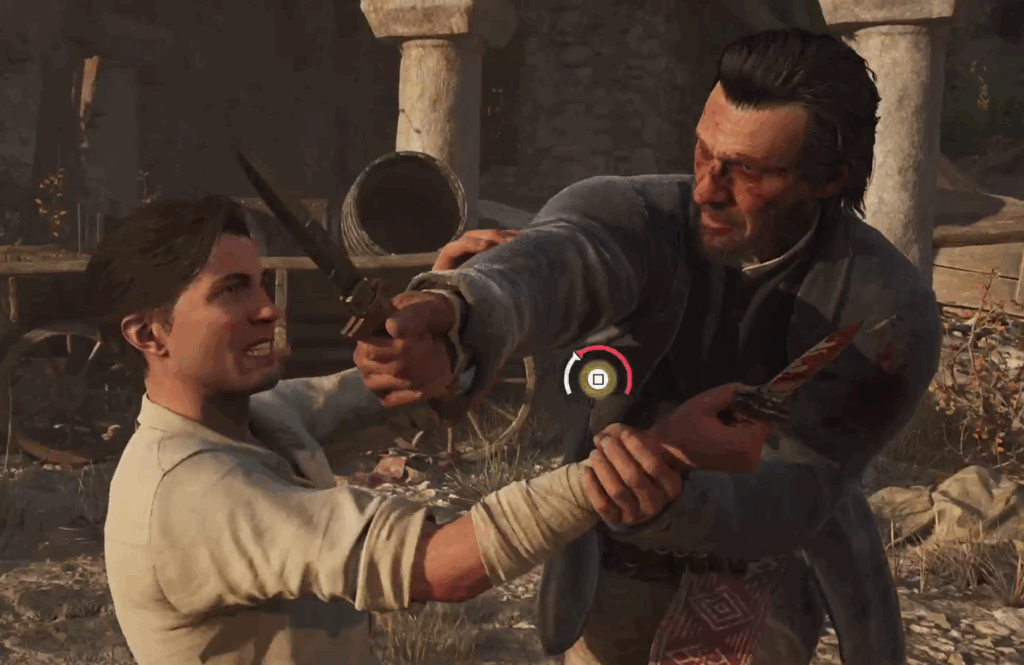
In addition to the game’s gunplay, showdowns with enemies frequently conclude in knife duels. From brigands to mafioso, Enzo slices his way through the Sicilian underworld. 2K Games
In a review for the gaming website IGN, Luke Reilly praised the game as “a potent and immersive time machine to a rarely explored era.” As the first game fully set in historical Sicily, The Old Country sits comfortably alongside other games that aim to faithfully re-create classical eras, such as the Ancient Egypt and Renaissance-era Rome settings in the Assassin Creed series.
Welcome to San Celeste
The Old Country’s title comes from the opening chapter of Mafia II with the same name, set in the fictional city of San Celeste. In the second game, the player controls Vito Scaletta, a future wiseguy who starts as a U.S. soldier fighting Mussolini’s National Republican Army in San Celeste. As his squad gets overtaken and killed one by one, Scaletta is saved by the arrival of local crime boss Don Calò, who announces Il Duce’s defeat through a megaphone.
The deliverance is straight from the apocryphal tale of Calogero Vizzini, a real-life Mafia don whose modest interactions with the U.S. military inflated to a Paul Revere-style trek across Sicily heralding the arrival of General George Patton’s forces.
The Old Country takes the setting from Mafia II and rewinds time 40 years. Hangar 13 expanded the world around San Celeste into the invented province of Valle Dorata. According to the game’s website, the development team traveled to Sicily for inspiration in building the town of San Celeste and the surrounding countryside. The team also used books, films and historical photos and documents as reference material to make San Celeste an authentic depiction.
Scattered across Valle Dorata are vineyards, sulfur mines and citrus fields, all in the foothills of Mount Etna, the most active volcano in Europe. However, Hangar 13 takes a major creative liberty in grouping these elements together.
Mount Etna is ever present in the background throughout the game. Amid the game’s warring Mafia clans, earthquakes and eruptions threaten to add more chaos to the region. But Etna is located on the east coast of Sicily, while most Mafia activity and sulfur mines were in the western and central provinces. Fruit orchards were also most prominent in the rich, volcanic soil around the base of Mount Etna.
Valle Dorata is a microcosm of Sicily rather than representing a specific region, which gave the developers latitude to draw a more complete picture of the Mafia.
Sicily’s Cosa Nostra
In the mid-1800s, amid Italy’s unification, the nascent government was tasked with establishing order in the newly united country. Sicily, however, was neglected in favor of the mainland.
Without law enforcement keeping the peace, criminal groups plundered Sicily’s rich natural resources. Wealthy landowners hired private guards to defend their estates, although these enforcers were often bandits themselves. As middlemen between their employers and brigands, these security forces capitalized on their position by demanding protection payments.
Gradually these intermediaries embedded themselves into Sicilian society and evolved into the Mafia, filling in the voids left by mainland Italian authorities. Through extortion, blackmail and labor manipulation, the Mafia both assisted and exploited the affluent, gaining influence over the island’s land and industries. It’s this Mafia-dominated Sicily that provides the setting for The Old Country.
The game begins in Sicily’s sulfur mines with Enzo as a young man sold into indentured servitude by his family. The “carusi,” or “mine-boys,” were children as young as 4 years old, forced to labor strenuously until they paid off the debt, which would take until adulthood at least — if they didn’t die along the way. The mine’s cruel overseers use violence to keep Enzo and the other workers toiling for long hours. All this is under the direction of a ruthless Mafia boss, Don Ruggero Spadaro.
Enzo’s beginnings in indentured servitude in the sulfur mines is a historically plausible introduction. In Sicily’s forced-labor “zolfo” mines, the Mafia used violence to keep the “mine-boys” working in poor conditions. 2K Games
Enzo soon escapes from the mines and finds himself in the service of Spadaro’s rival, Don Bernardo Torrisi, head of the most powerful Mafia family in San Celeste. Conflict between the two clans drives the narrative of The Old Country.
Both allies and enemies use Enzo’s origins as a nickname: “Carusu.”
Historian John Dickie, an expert on Sicily and the Mafia, told 2K Games in an interview that a mafioso starting as a “mine-boy” would be plausible in 1900s Sicily. “The sulfur mines … were a real hotbed of Mafia activity,” Dickie said. “It’s one of the key industries in Sicily, and it was a brutal, brutal industry.”
In 2024, a study led by Italian economic historian Carlo Ciccarelli reported a correlation between sulfur mines with primitive, hard-labor working conditions and the presence of the Mafia. Mafiosos provided the muscle needed to push workers to their limits. Larger industrial mines had better and safer working conditions, reducing the need for Mafia motivation.
The horse before the car
Driving vehicles has been a fixture of the Mafia series, and The Old Country is no exception. However, the dirt roads that crisscross Valle Dorata aren’t bustling with cars. Instead, Hangar 13 introduces to the series a more common form of transportation in that era: horses.
Horses join automobiles as a primary form of transportation in The Old Country. The real-life scarcity of cars in 1900s Sicily is reflected in the game’s country roads. 2K Games
As Enzo begins his journey through the Sicilian secret society, horses are his primary mode of getting around. There are hand-cranked cars in The Old Country but with high speed comes poor handling and the risk of catastrophic crashes. And unlike past games, players must wait until Enzo rises a little higher in the Mafia before earning the privilege of driving.
Cars were relatively rare in Sicily at that time. Although Italy was a major producer of automobiles, exports vastly outperformed domestic sales. A 2021 study by Italian researchers at the University of Torino estimated that Italy had only about 6,000 cars in 1907, which amounts to one vehicle per 5,500 residents. Cars were a luxury item reserved for the wealthy, affluent mafiosos among them.
However, the seemingly endless supply of enemy cars in one of The Old Country’s chase sequences defies realism in favor of thrills.
Another use of early Italian automobiles in The Old Country is racing, a regular feature in the Mafia games. In 1906, the Targa Florio debuted as Italy’s first car racing event. In its inaugural rally, drivers navigated the perilous mountain roads surrounding Palermo on a circuit that spanned 148 kilometers. The first champion of the Targa Florio crossed the finish line after more than nine hours. A version of the Targa Florio appears in The Old Country, although Hangar 13 has mercifully shortened it compared with its real-life counterpart.
Mafia lip service
Once Enzo proves his worth, he, like most of the other anti-heroes in the series, is formally initiated into the Mafia. The details of the ceremony — the knife on the table, oath of omertà and burning card of a saint — mostly resemble the later American version with one significant change: Instead of pricking Enzo’s finger, Don Torrisi slices Enzo’s lower lip.
The Mafia initiation ritual in The Old Country borrows from a Corleone-based custom of cutting the lower lip rather than pricking the finger. 2K Games
“Usually, it’s the trigger finger. You prick the trigger finger and then you drip some of the blood onto the sacred image. That’s the Madonna of the Annunciation, the Mafia’s patron,” Dickey explains. “I know that in Corleone, which is a town that’s about 50 kilometers from Palermo, they did use the cut on the lip.”
The heavy influence of Catholicism in the Mafia, as seen in the initiation ritual, is gamified in the “perk” system, which upgrades Enzo’s abilities. Players can find bead charms throughout the game that they can swap into Enzo’s rosary to hold more ammunition, have better aim or give knives more durability. Spending money to upgrade the crucifix with finer metals, such as silver and gold, allows the rosary to hold more beads and give Enzo more perks.
The upgrade system in The Old Country is based on the Catholic rosary. As Enzo explores the lands around San Celeste, he finds beads and medallions to put in the rosary that allow him to carry more ammunition or move more quietly in stealth sequences. 2K Games
For all the religious traditions that the Mafia observes, there are moments in The Old Country where sacrilege is not out of the question if it fills the boss’s wallet and gives him an edge over his enemies.
And that is one thing the Mafia series does well: It does not glorify organized crime. The Old Country illustrates that the Mafia’s honor is a thin veneer concealing selfish ambition and greed. From the beginning, the player feels uneasy as Don Torrisi’s generosity is offset by subtle signs of fear among the workers on his estate. Enzo receives vague warnings about becoming too friendly with Torrisi’s daughter, Isabella, whose father sees her only as a pawn for cementing alliances among the elite.
The Old Country captures the Sicilian Mafia authentically — without romanticizing — while still offering a satisfying gameplay experience reminiscent of the streamlined, cinematic games of the 2000s. With reviews summing up to “mostly positive” according to the game’s page on Steam, a PC gaming platform, the future bodes well for the Mafia series.
Perhaps Hangar 13 will place their bets on another unique setting desired by fans: Mob-era Las Vegas.
At one time Owen Hanson, a former University of Southern California national championship football player, was making millions as a global drug trafficker who also ran an illegal sports betting operation. His clients included professional athletes and Hollywood stars.
Now the 43-year-old paroled felon earns $500 every two weeks selling the iced protein bars he first learned to make in prison mop buckets.
The lifestyle change has been dramatic. During earlier years, known in some circles as O-Dog, Hanson participated in epic debauchery, including wild parties on the Las Vegas Strip. During one Super Bowl bash at the Aria hotel-casino, a call came in from Paris Hilton’s boyfriend wanting to place a $10,000 bet for her, according to Hanson’s book The California Kid: From USC Golden Boy to International Drug Kingpin, written with Alex Cody Foster.
That Super Bowl party in Las Vegas was memorable.
“Around me, the fellas were slugging champagne like there was no tomorrow, snorting lines of coke off the table, and downing shots of Clase Azul Ultra Tequila in between slobbery bites of herb-butter snow crab and sixty-day dry-aged Tomahawk steak,” Hanson wrote. “Our table was the personification of gluttony, lust, and excess: gorgeous women and coked-up guys, mounds of food, all different variations of drugs and alcohol. The Super Bowl was like Christmas in the betting community.”
Previously, he had been a campus drug dealer who first played competitive volleyball and then football for USC, a Redondo Beach surfer kid from a broken home without much money who landed at a major private university as a 6-foot-3 athlete with a 37-inch vertical jump. He also joined a fraternity.
“I was willing to do anything it took to be able to fit in with those USC kids,” Hanson said during a telephone interview.
Hanson, number 88, was a walk-on tight end for the 2004 USC football team. With future Heisman trophy winners Matt Leinart and Reggie Bush on the roster, the Trojans won the national championship that year. Donald Miralle / Getty Images
Later, at the table in Las Vegas, the call from Paris Hilton’s boyfriend elevated Hanson’s status even more. “Here I was a twentysomething kid fresh out of college (and) I was bringing in celebrity clientele and famous sports players,” he wrote in The California Kid.
Ultimately, those days of “gluttony, lust, and excess” led to an arrest that kept Hanson behind bars for nine years. He had been running an illegal sports book and was linked to a Mexican narcotics cartel that, to this day, he won’t name publicly.
“I can’t say who I was working for,” Hanson said, “but just put it this way: At the time I was working for the most infamous cartel in the world.”
In prison, cartel members showed Hanson respect for “not squealing,” he said.
“I would have guys coming up to me once a week when the new buses of inmates came in and guys shaking my hand, tipping their hat,” Hanson said.
That recognition extended to a ballad about him, performed by Tribi Carrillo, available on Spotify and YouTube. Titled “Don Corleone,” the name refers to an encrypted email identification Hanson once used and is a nod to the leader of the fictional crime family in The Godfather.
Hanson published his story in his book, The California Kid: From USC Golden Boy to International Drug Kingpin. Courtesy of Owen Hanson / @theofficialcakid
‘Prison saved my life’
In late June 2025, Hanson was released from a Southern California halfway house but is still on supervised parole. He only recently was allowed to leave the state with permission.
As founder of California Ice Protein, Hanson is building the startup from its base in Los Angeles, with plans to expand nationally. For now, he lives at the ice protein warehouse in a small studio space furnished with a Murphy bed.
Rather than viewing this transition as a low-paying setback, he regards it as the first step in a turnaround.
“I should have been dead a long time ago,” he said. “I should have been killed by the cartel. I should have overdosed on cocaine that was laced with fentanyl. Going to prison saved my life, and I can honestly say that as scary as prison was, it’s the best thing that happened to me because now I feel better than ever.”
Hanson said prison was like military boot camp for him. “I said, ‘OK I’m going to get in shape. I’m going to get my master’s degree. I’m going to write my book. I’m going to get a documentary told about me. I’m going to create a business while I’m incarcerated and better myself and better the world.’”
One way of bettering himself, beginning with creating a cold protein snack first perfected in prison mop buckets, is through his company. California Ice Protein’s frozen bars-on-a-stick include flavors such as Strawberry Swole Cake and Coliseum Cookies & Cream. The term swole refers to the buff body-building effect on someone who works out and becomes “swole,” Hanson said. The cookies-and-cream bar is a reference to the Los Angeles Memorial Coliseum, where Hanson, a walk-on from the volleyball team who didn’t even know how to put on football shoulder pads, played tight end for the Trojans under head coach Pete Carroll, now in his first season at the helm of the NFL’s Las Vegas Raiders. Two of those USC teams won national collegiate championships.
After his release from prison in 2024, Hanson started a company selling frozen treats, California Ice Protein, which he promotes on Instagram. Courtesy of Owen Hanson / @californiaiceprotein
Soon, Hanson’s story will become known to a wider audience. An Amazon video production headed by Mark Wahlberg will air this year, Hanson said, though he doesn’t yet know the run date.
Hanson said the production will focus on “the overall story of my life,” including the “rise and fall.”
Violent racketeering enterprise
A news release in December 2017 from the U.S. Attorney’s Office, Southern District of California, details the government’s case that led to the collapse of Hanson’s narcotics trafficking and sports-betting empire. Hanson told The Mob Museum his illegal endeavors at one point were pulling in $1 million a day.
According to the U.S. Attorney’s Office, Hanson was the leader of the “violent ‘ODOG’ racketeering enterprise” operating in the United States, Central and South America and Australia from 2012 to 2016.
The news release states that court records indicate “ODOG trafficked thousands of kilograms of cocaine, heroin, methamphetamine, MDMA (also known as ‘ecstasy’), marijuana, anabolic steroids and Human Growth Hormone (‘HGH’).”
The government says Hanson admitted that his “drug operation routinely distributed controlled substances at wholesale and retail levels, including selling performance-enhancing drugs to numerous professional athletes.”
“The organization also operated a vast illegal gambling operation focused on high-stakes wagers placed on sporting events,” the news release states. “The enterprise used threats and violence against its gambling and drug customers to force compliance.”
In addition to a prison sentence, Hanson was ordered to pay “a criminal forfeiture in the amount of $5 million, including $100,000 in gold and silver coins, a Porsche Panamera, two Range Rovers, luxury watches, homes in Costa Rica, Peru and Cabo San Lucas, a sailboat, and interests in several businesses.”
Among the 22 defendants charged in connection with the case was former NFL running back Derek Loville, who, according to the news release, “pleaded guilty to distributing retail quantities of drugs for the ODOG Enterprise in Arizona.”
While in a federal prison in Colorado, Hanson completed an MBA program through California Coast University. Courtesy of Owen Hanson / @theofficialcakid
‘I got charged for that?’
During the telephone interview, Hanson confirmed he took sports bets from athletes, including a World Series closer for a Major League Baseball team. He declined to name the athletes who placed sports bets with him but said he didn’t accept wagers from players on games involving their own teams.
Currently, sports betting is legal in 38 states and Washington, D.C., and is set to go live December 1 in a 39th legal state, Missouri. However, sports betting is illegal today in California, as it was when Hanson was operating an underground sports book.
The explosion in legal sports betting occurred nationally after the U.S. Supreme Court in 2018 opened the door for all states to regulate and tax sports betting.
As legal sports wagering spread across the county, Hanson said he remembers watching televised games in prison and seeing a point spread displayed on the screen during live action.
“All of a sudden you’re watching the game on ESPN, and there’s a spread of minus three and over-under of 44 1/2, and you’re like, ‘Wait a minute. I got charged for that?’”
Back on the outside, Hanson no longer runs a sports book and said he doesn’t have anything to do with alcohol or drugs. Hanson also said he has no desire to place sports bets himself because “you can’t beat the house.”
“I don’t like to lose my money,” he said. His focus now is on spearheading the growth of California Ice Protein. One of his goals is to provide work for other convicted felons.
“I want to help people that have been incarcerated that are having trouble finding a job, because you’d be surprised how many smart people there are in prison,” he said.
Larry Henry is a veteran print and broadcast journalist. He served as press secretary for Nevada Governor Bob Miller and was political editor at the Las Vegas Sun and managing editor at KFSM-TV, the CBS affiliate in Northwest Arkansas. Today, he is a senior reporter for Gambling.com.
The shooting death of 43-year-old Luther Mixon on July 1, 1955, landed Chester Wheeler Campbell, 24, and two accomplices in prison. During Campbell’s 13 years in the infamous Michigan State Prison, aka Jackson Prison, he spent his time learning new illicit trades. According to gangland lore, the locked-up training turned him into a fearsome figure upon reentering society in 1969.
Detroit’s death-dealing enforcer was never successfully convicted of murder again, despite being the prime suspect in at least 10 homicide investigations from 1969 through 1975.
Campbell’s first murder
Campbell was born in 1930, the fourth of six children. His father died when Campbell was in the second grade, leaving his mother to raise six children alone. According to available information, Campbell was the only one in his family who encountered any significant legal issues. He accumulated a modest record of two burglary charges by age 20, yet his criminal activities were significant enough for the police to display his photograph in the station house.
At 24, his criminal exploits escalated to a tragic and violent confrontation during the summer of 1955. Campbell, along with David Green, 24, and Watson Brooks, 23, set out on July 1 to hold up a known numbers gambling spot in an apartment. The trio, concealing their faces with handkerchiefs, first confronted Mixon. Two of them brandished pistols and demanded to know the owner of an expensive car parked out front. Mixon’s silence was rewarded with a pistol whip. Mixon fell and, as he tried to regain his footing, one of the assailants fired a round into Mixon’s face.
The robbers weren’t finished. After forcing their way into the apartment, they roughed up and robbed four people inside: John and Julia Jackson, Roosevelt Williams and Emmet Carter. The thieves made off with about $420, including what they took from the pockets of the man bleeding out in the street. Mixon was later pronounced dead at the hospital.
Campbell had been a habitual offender since 1950. He was a prime suspect in multiple attempted burglaries of the same location, F & F Drug Company, which landed him some jail time. Local police were quite familiar with Campbell — the precinct wall photo had come back to haunt him.
The day after the murder, Officer Frank Rewekant spotted two men near an intersection on his way to work. Recognizing one of the men from the precinct picture, he stopped and detained Campbell and Green (who had a .32 handgun). The pair weren’t held on the Mixon murder, however. At the time, police suspected them in connection with an auto parts theft. Police released the two shortly after.
Campbell, left, and David Green, right, arrested for the murder of Luther Mixon, are pictured here in Recorder’s Court on July 27, 1955. David Atkins / Detroit Tribune
Campbell and Green were arrested again at the end of July — this time for murder. At the station, Otis McClure and his wife, residents of the apartment beneath the numbers spot, positively identified Campbell and Green in the lineup. The third suspect, Brooks, remained at large until late August when FBI agents in New York apprehended him. Brooks was extradited back to Detroit and faced a judge in September.
The court convicted Campbell of first-degree murder and, in January 1956, sent him to Michigan State Prison.
A plea deal
After 13 years in prison, Campbell was granted a new trial. Campbell and his attorney, S. Allen Early, went before Judge Robert Evans in September 1969 to plead down to second-degree murder.
Judge Evans went through the formalities and asked Campbell if he was sure he wanted to forgo a jury trial. “Yes, sir,” Campbell confirmed.
Evans: Mr. Campbell, on the first of July 1955, were you in the city of Detroit and involved in some sort of homicide?
Campbell: Yes, sir. I was.
Evans: Do you know the name of the person that was killed?
Campbell: I think it was Luther Mixon.
Evans: Do you know where he was killed?
Campbell: On the street.
Evans: What street?
Campbell: Lawton.
Evans: Do you know approximately what time?
Campbell: About 5, I think.
Evans: Tell me the circumstances of that incident.
Campbell: Prior to going to this Lawton address, I and several other fellows planned a robbery. After we got there and carried it out and, in the process, my … I shot Mr. Mixon.
Campbell was hesitant to give up the names of his accomplices. Early assured Campbell, “You are not copping out when you say who it was.”
Campbell vaguely explained how Mixon approached him and “offered resistance.” Campbell admitted to striking Mixon with the gun but implied the gun went off accidentally.
Evans: After that, what happened?
Campbell: I think I went through his pockets.
Evans: Did you take anything from his pockets?
Campbell: Yes, sir.
Evans: What did you take?
Campbell: Took some money.
Evans: Now you said before that time — did I understand you to say before this happened you had planned to rob, had you planned to rob Mr. Mixon?
Campbell: Not him in particular, no. The place was supposed to have been a numbers house.
Campbell was paroled in September 1969. He soon returned to a life of crime, but much had changed during his 13 years behind bars.
“Dr. Death”
Following his release from prison, Campbell rebuilt his reputation as a killer in the drug underworld of Detroit and the Midwest. His notoriety earned him the nicknames “Dr. Death” and “The Undertaker.” In 1987, prosecutor L. Brooks Patterson described Campbell as “absolutely incorrigible,” “a dedicated recidivist” and “a heavy-duty criminal.”
A so-called “dope war” was underway, and Campbell wasted little time making alliances and establishing himself as an assassin.
“Detroit in the late 1960s was going through a transitional phase,” author and historian Scott Burnstein says. “The Italian Mafia was passing the torch of leadership from the crime family’s founding fathers to their second generation of college-educated offspring. The African American underworld was experiencing an upheaval and cultural makeover as the docile, subservient gambling bosses working for the Mafia were being replaced by more independent-thinking crime lords and volatile drug kingpins not satisfied with the status quo.”
Augustus Miller was one of several aliases Campbell used in the early 1970s. Courtesy of Cipollini Collection
Within a month of gaining his freedom, Campbell was considered a suspect in a double homicide. In November police suspected Campbell, Brooks and reputed heroin kingpin John Classen in the brutal, double murder of Jimmy Davis and his girlfriend, Lisa. The couple were both shot in the head execution style while sitting in a parked car. Davis had been a protected witness in trials against drug dealers, including Classen.
Campbell’s alliances mostly leaned toward the drug factions aligned with the Mob. “Chester was in the East Side camp, connected to one of the last Black street crews working for the Italians that would eventually be dubbed the Murder Row Black Mafia organization,” Burnstein says. “This was a crew of ruthless and hardened contract killers, extortionists, pimps and drug traffickers that acted as a sub-unit of the Giacalone Mob crew within the Tocco-Zerilli crime family.”
Murder Row, Burnstein says, “would expand its territory citywide, having operations on the West Side and headquartering in Midtown at the Michigan Federated Democratic Social Club.”
Besides contending with the ongoing turmoil between rival drug lords, Detroit soon found itself embroiled in investigations and accusations of major corruption and conspiracy between law enforcement and narcotics dealers, called the “Pingree Conspiracy.”
A legal “dumpster fire”
By 1973, Campbell received more frequent attention for his suspected involvement in several unsolved homicides and the ensuing conspiracy case.
Campbell’s short-lived but storied criminal career came to a head 20 years after his first and only murder conviction. On February 6, 1975, while driving to his girlfriend’s home in upscale Orchard Lake, Michigan, Campbell nearly collided with a patrol car. The incident revealed a trunk full of weapons, drugs and cash. But more important, a proverbial Pandora’s Box of incriminating material awaited the police who searched his home in Detroit and his girlfriend’s residence in Orchard Lake.
A police officer found guns, cash and drugs in Campbell’s car during a stop in 1975, which triggered an investigation that would, reveal corruption throughout Detroit’s public sector. Courtesy of Cipollini Collection
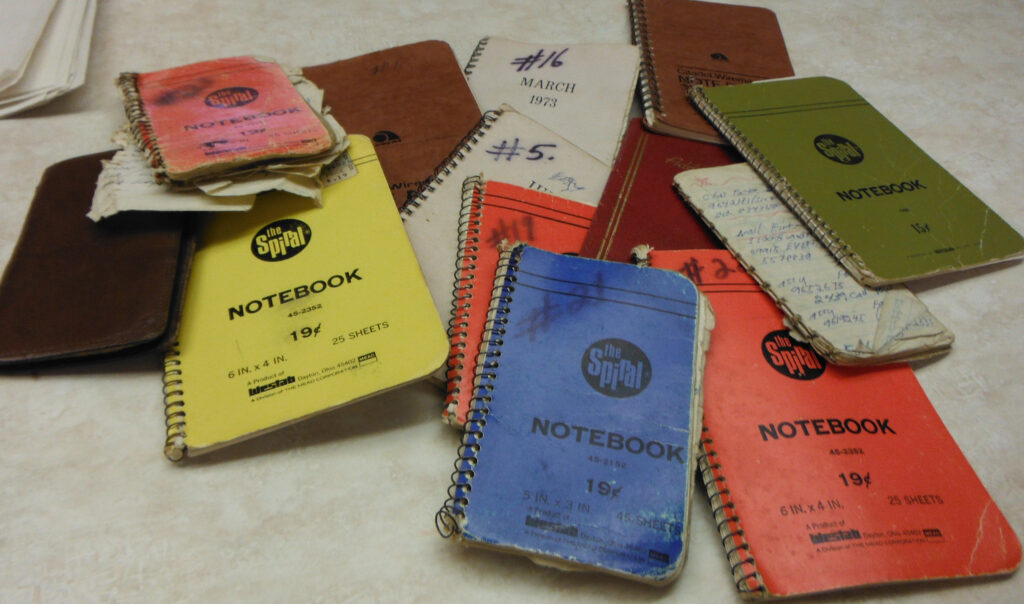
In Campbell’s possession were documents bearing the names, addresses and intimate details of cops, politicians, judges, gangsters, addicts, witnesses and prosecutors. He even had sealed grand jury files in his stash. Campbell meticulously kept tabs on both criminals and law enforcement, maintained an array of espionage equipment and was well read in the subjects of criminal law and homicide.
The revelations in these documents exposed the true extent of Detroit’s corruption. Cover-ups, bribes, homicides, espionage, racism, addiction and rampant greed were at their peak.
The implications for possessing this material were not lost on Campbell. “I’m a dead man,” he allegedly told a cellmate after his arrest. “Whether I stay in here or get out, brother, I’m dead.”
The Detroit Free Press reported extensively on Campbell’s unfolding story and the chaos that followed. “That’s how important Campbell’s documents are — at least in his eyes,” the Free Press wrote. “And in the eyes of at least a half-dozen law enforcement agencies in Wayne and Oakland counties as well, who have engaged in squabbling over the potential bonanza of information and intelligence embodied in the Campbell case.”
Campbell also maintained some semblance of power while in custody. Local gangster and murder witness James Lee Newton, aka “Watusi Slim,” was found with his throat cut and eyelids marked with X’s while awaiting to testify against Campbell for the 1972 murder of Roy Parsons.
Regarding the slain witness, Campbell’s lawyer told the judge audaciously, “Chester doesn’t need to be physically present to conduct business.” And his business was thriving as the tensions and raw wounds of a profoundly unstable city escalated.
Several pending murder cases against Campbell did indeed get dropped. While incarcerated, he used his time to pen dozens of letters and legal filings. In his writings he railed against numerous individuals and, perhaps most important to him, made an issue of the seized cash, which was an estimated $250,000.
Forced retirement
Although prosecutors would never successfully convict the prolific contract killer of murder again, there were plenty of other charges to work with. A court in Oakland County, Michigan, convicted and sentenced Campbell to 40 to 60 months for possession of weapons and drugs. In 1977, a Wayne County court added another 20 to 30 months under Michigan’s habitual offender statue. After that, he faced federal charges for possessing a sawed-off shotgun.
Campbell’s notebooks were filled with lists of drugs and incriminating information of individuals on both sides of the law. Courtesy of Cipollini Collection
Cambell did prevail in the legal battle over the loot discovered in his home in February 1975. The court ruled in Campbell’s favor and ordered it returned, but the win was on paper only. The case dragged well into 1983 when an appeals court once again ruled in Campbell’s favor, but the money had since gone to the IRS, where it would stay.
Campbell was paroled from prison in September 1984, but he still had to keep one eye open. The following April he was shot several times in the leg and thigh but survived. After an 11-hour operation, Campbell told reporters, “I don’t have anything newsworthy to say.”
In a bout of déjà vu, he was caught again in 1987 with a carload of guns, drugs, explosives and spy gear. The 40-year sentence from that case would land him in prison for the rest of his life.
Campbell died in a federal prison medical facility in 2001. The cause of death was determined to be natural: “End stage liver disease; Hepatitis C.”
Christian Cipollini is an organized crime historian and the award-winning author and creator of the comic book series LUCKY, based on the true story of Charles “Lucky” Luciano.
Late in the evening of June 19, 1975, Sam “Momo” Giancana was cooking in his basement apartment, presumably for a guest. Before the late-night meal could be served, Giancana was shot in the back of the head.
The murder of the former Chicago Outfit boss remains one of the most debated unsolved homicides in organized crime history. His tumultuous final years fuel several theories about his demise. Over the course of his long career filled with violence and political maneuvering, Giancana provided motives to rivals and allies alike.
From infamy to fame
Born Salvatore Giancana on June 15, 1908, in Chicago to Sicilian immigrants, Giancana was raised in the rough Italian neighborhood known as “The Patch.” Like many of his contemporaries, he was lured into the criminal world at a young age. His early connections with street gangs, such as the 42 Gang, laid the groundwork for a lifetime of criminal activity. Known for his fierce temper and sharp intellect, Giancana quickly built a reputation for brutality and loyalty, which helped him win the favor of established members of the Chicago Outfit — Chicago’s powerful and feared crime group.
Giancana’s true rise began under the guidance of then Outfit leader Tony Accardo. Throughout the 1940s and early ’50s, Giancana served as a ruthless and effective enforcer, managing gambling and loan-sharking operations for Accardo. His increasing influence and knack for generating revenue solidified his position in the Outfit’s upper echelons. When Paul “The Waiter” Ricca and Accardo chose to step back from daily operations in the mid-’50s, they chose Giancana to act as the front boss, effectively becoming the public face of the Chicago Mob. Behind the curtain, Accardo still held significant power, but Giancana had substantial control over the organization’s vast enterprises.
During his time as boss, Giancana broadened the Outfit’s influence into Las Vegas casinos, Latin America and Hollywood. He was especially known for building high-profile connections, most notably with the Kennedys, the CIA and celebrities. Giancana collaborated with U.S. intelligence agencies on schemes to assassinate Cuban leader Fidel Castro. His connections to Frank Sinatra and an affair with singer Phyllis McGuire further propelled him into the limelight.
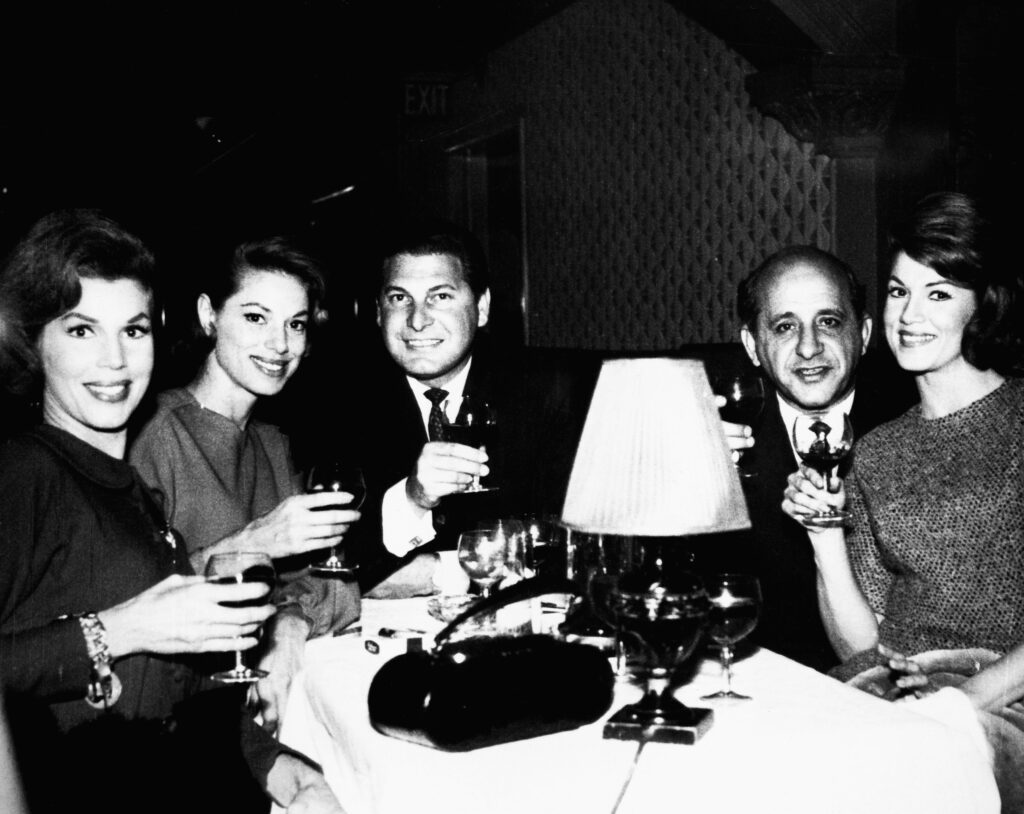
Giancana, second from right, gained a public profile from his involvement with politicians and celebrities. In this 1961 photo, Giancana is enjoying a drink with the singing trio, the McGuire Sisters. Giancana was romantically involved with Phyllis McGuire, far right. Corbis
Giancana had become a public figure — which never sits well with the Mob.
Giancana wound up facing government inquiries, including those of Mob-busting Attorney General Robert F. Kennedy. Giancana refused to talk and, in 1965, was jailed for contempt. Ricca and Accardo had oversight of the Outfit during Giancana’s reign, albeit from the shadows. When Giancana was imprisoned, Accardo stepped back into the acting leadership role.
After Giancana’s release in 1966 he hastily fled to Mexico and established business endeavors south of Mexico City in Cuernavaca. He remained there until 1974 when, as declassified CIA and FBI documents show, Mexican officials detained Giancana on July 19, 1974, and moved to expel him. He returned to American soil two days later. Although still a powerful figure in the Chicago Mob, Giancana’s leadership days were over.
Giancana’s last meal
In 1974, journalist Seymour Hersh released a front-page story in the New York Times, alleging that the CIA had been monitoring anti-war activists for more than 10 years, breaching its charter. This revelation, along with the Watergate scandal and other wrongdoing by intelligence agencies, led lawmakers to demand an investigation.
On January 27, 1975, the Senate passed a resolution to form a committee to carry out a comprehensive investigation of the nation’s most secretive agencies and programs over the next year (later extended to 16 months). The Church Committee pinpointed programs for examination and started requesting documents from intelligence agencies. Giancana was one of the individuals summoned to appear before the committee.
That summer, Giancana went to Houston to visit friends but became ill. He checked into a hospital and underwent gall bladder surgery. According to Dominic “Butch” Blasi (who had been an FBI asset for some time), Giancana had a limited list of who could visit him while recuperating in the hospital, which included Blasi and Carolyn Morris, Giancana’s girlfriend at the time.
After recovering, Giancana returned to his home in Oak Park, a Chicago suburb, and threw a little party on the evening of June 19, 1975.
This house at 1147 S. Wenonah Ave. in Chicago’s Oak Park suburb was the site of Giancana’s murder. Cook County Assessor
All the guests departed sometime around 11 p.m. Another person or persons arrived at Giancana’s home and entered through a back entrance leading to Giancana’s basement apartment. Giancana, likely familiar with and/or expecting the guest, casually began cooking up a small meal.
The longstanding version of Giancana’s last moments is a scenario of Giancana hovering over a pan cooking up sausage and peppers, presumably a dish intended for his guest. His back to the mystery guest, Giancana received a shot or two to the back of the head from a .22 pistol equipped with a silencer. The shooter then put more shots into the victim’s face and neck.
On June 19, 1975, Giancana was killed inside his basement apartment while cooking a meal, which he may have been preparing for the culprit. Charles Schauer Collection
Who killed Sam Giancana?
There is no shortage of theories floating around about who took out Giancana and why. One theory has fellow Chicago mobster Tony Spilotro killing him as a personal vendetta. Others claim it was Blasi, acting on behalf of the Outfit over money or power struggles. Other theories propose the CIA did it as a cover-up for either the Castro assassination plot or the Mob’s alleged role in the JFK assassination.
Blasi was the last person to see Giancana alive, a fact he never denied. Blasi was never charged despite being one of the most likely suspects. The theories of government involvement may technically be possible, but unlikely. In a piece for MafiaHistory.us, Edmond Valin gave a possible origin for this theory, writing that Blasi once told FBI agent Bill Roemer, “Giancana was killed by ‘forces outside of organized crime.’”
Valin continues, “This seems to be a suggestion that Giancana’s murder was tied up somehow in his role in the Central Intelligence Agency plot to kill Cuban leader Fidel Castro. A more likely reason was that Outfit leaders believed Giancana was going to talk about his criminal history in Senate committee hearings set to begin a few days later.”
Recent reports suggest the looming appearance before the Church Committee may have indeed been the final nail in the proverbial coffin.
NBC5 Chicago aired a two-part series in May with investigative reporter Chuck Goudie revisiting the Giancana case. Goudie offered a bold revelation of the identity of the actual culprit that fateful night in 1975. According to his research, the hit on Giancana wasn’t just ordered by Accardo, it was carried out by the boss personally.
Tony Accardo, left, and his associate Jack Cerone. Accardo helped Giancana in his rise to Outfit and is suspected in recent theories of personally bringing Giancana’s career to a close. After taking over from Giancana, Accardo led the Chicago Outfit until his death in 1992. The John Binder Collection
In the televised version and subsequent written articles, Goudie’s team of reporters revealed findings in previously unseen documents, spoke to four investigators involved in the case and interviewed former Mob associate Frank Calabrese Jr. All four investigators firmly believed Accardo pulled the trigger, though it could not be proven. The .22 used in the murder (which had been purchased in Florida) was recovered in a location between Giancana’s home and Accardo’s. What’s more, the FBI had Accardo’s home under surveillance that evening and their report noted Accardo’s car leaving before 11 p.m. and returning shortly thereafter. Interestingly, Giancana’s home was being watched by cops, too, but those officers called it a night and left the area shortly after the original partygoers retired.
Referring to the Church Commission dilemma, Calabrese Jr. told Goudie, “Sam was the one that could really get Tony in a lot of trouble.”
Some have described Accardo as the epitome of a tough street guy, old school, who believed in taking care of business himself, if necessary, even if you’re the boss. His street reputation started with his days as a baseball bat-wielding muscle man for Al Capone, allegedly giving him his nickname, “Joe Batters.” It was characteristic of him to personally resolve a loose end.
And, besides Dominic Blasi, there are very few people Giancana would have ever welcomed into his basement unless he trusted them completely — or had no choice in the case of the boss.
Incidentally, the Goudie investigation also mentions Giancana’s last meal being sausage, escarole and beans, with no mention of peppers.
Christian Cipollini is an organized crime historian and the award-winning author and creator of the comic book series LUCKY, based on the true story of Charles “Lucky” Luciano.
In the 1970s, Mickey Bruce, a former University of Oregon football player, was called to Nevada to testify against Mob associate Frank “Lefty” Rosenthal at a casino licensing hearing. Threatened by Rosenthal’s lawyer, the former collegiate athlete declined, according to his wife, Patsy Bruce.
“He didn’t go because of comments that were made by Lefty’s attorney that if he came to Las Vegas, he would … something about the sand,” Patsy Bruce said. “That they would find him in the desert.”
This account of what amounts to a death threat appeared recently in a story about Rosenthal on The Athletic website. The New York Times owns The Athletic, a well-regarded online sports news and information site.
The story details efforts by Rosenthal and a Brooklyn schoolteacher named Dave Budin, a former college basketball player, to bribe Oregon’s Mickey Bruce with $5,000 in a point-shaving bid involving the Ducks’ 1960 road game against the Michigan Wolverines. Bruce was supposed to help guarantee that Michigan, favored by six points, would win by more than that. The Wolverines won 21-0, covering the point spread by a wide margin, with no evidence that Bruce tried to tilt the outcome. According to The Athletic, Bruce “played his heart out,” even intercepting a pass.
The lawyer who supposedly made the death threat was not named in the story, but during Rosenthal’s later years in Nevada, he was represented by defense attorney Oscar Goodman, a future three-term Las Vegas mayor and popular ambassador for the city.
Before he became a three-term mayor of Las Vegas, Oscar Goodman, left, had a long career as a defense attorney in Las Vegas. Among his clients were known members and associates of organized crime, including Tony Spilotro, right, and Lefty Rosenthal. Las Vegas Sun
In a telephone interview, Goodman, reflecting on that era in Las Vegas, said he did not threaten Mickey Bruce.
“I would never even think of something like that,” Goodman said, adding that Bruce didn’t go to Las Vegas to testify probably because he was not properly subpoenaed or ordered to be there.
“I objected to everybody who wanted to testify against Rosenthal,” Goodman said. “He was just one of many.”
Goodman added that it’s “almost silly that someone would make an allegation like that.”
Posted online in May, the story also revisits the Mob era in Las Vegas and delves into Rosenthal’s past as an illegal bookmaker in Florida and elsewhere.
The story notes that Rosenthal was arrested in earlier years but not for attempting to bribe Bruce. “Instead, Rosenthal and Budin faced charges in North Carolina for offering $500 to Ray Paprocky, a basketball player at NYU, to shave points in a 1960 NCAA Tournament game against West Virginia,” the article states.
Ray Paprocky of NYU was one of many college basketball players implicated in the 1961 point-shaving scandal orchestrated by Rosenthal and his co-conspirators. Boston Herald-Traveler Photo Morgue, Boston Public Library
The story notes that authorities had uncovered “a nationwide network of fixers who conspired to influence hundreds of college basketball games over a five-year period.”
“In all, 37 players from 22 schools were arrested on charges related to point shaving,” the story states. “Rosenthal pleaded no contest and was fined $6,000 for attempting to fix the NYU-West Virginia game, though he later maintained his innocence and said Budin fed his name to authorities in hopes of receiving a lighter sentence.”
In the late 1960s, Rosenthal moved to Nevada, where legal gambling attracted people like him who were betting illegally elsewhere. For a time in the 1970s, Rosenthal, an oddsmaker originally from Chicago, took control of four Argent Corp. casinos in Las Vegas for Midwestern crime families and, according to a 2008 Las Vegas Review-Journal story by Jane Ann Morrison, was a federal informant.
During that period, Rosenthal fought with Nevada gaming regulators in an effort to obtain a casino license, even criticizing them on the air while hosting a television talk show from the Stardust hotel-casino, one of the Argent properties. That period in Rosenthal’s life is dramatized in the 1995 Las Vegas Mob movie Casino, featuring Robert De Niro as a character based on Rosenthal.
The Stardust has since been demolished. In 2021, Resorts World Las Vegas opened at that location on the north end of the Strip near Circus Circus. When the Stardust was still in operation, however, the former Oregon football player, having already testified before a congressional committee about the bribe attempt in Michigan, was asked to speak in Nevada to help end Rosenthal’s attempt at legitimacy there.
But, said Patsy Bruce, “we never went to Las Vegas.”
Mickey Bruce, the son of a lawyer, became a criminal defense attorney, dying of natural causes in 2011 at age 70 at his home Oroville, California. He left an athletic legacy that continues to resonate with Ducks fans. One blog devoted to Oregon football has a story about his encounters with Rosenthal, calling the early 1960s team co-captain “The Incorruptible Mickey Bruce.” The player also won accolades for his on-field performance. Before being injured during the 1961 season, Bruce, a defensive back, led the nation in interceptions with six.
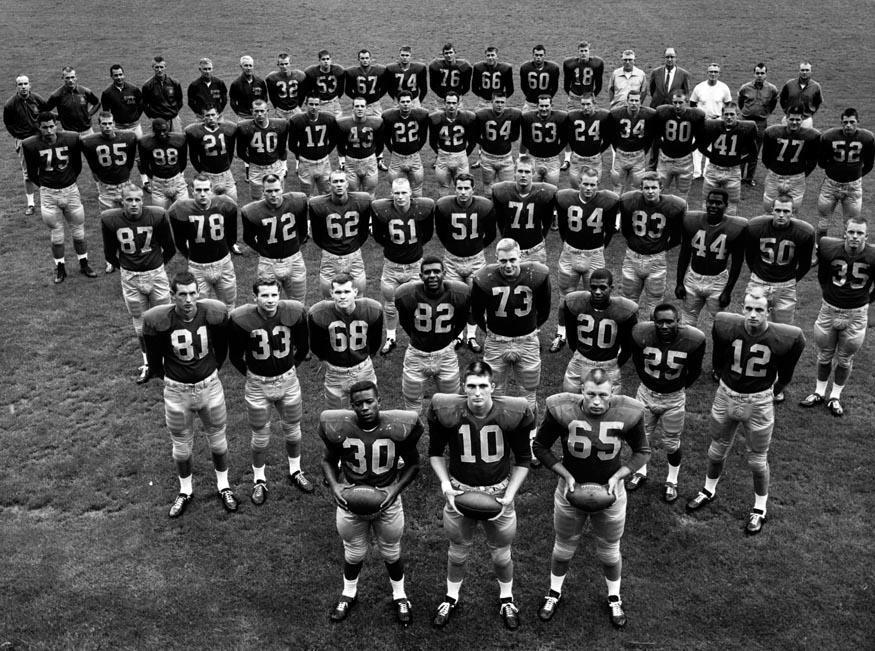
Mickey Bruce, number 35 at the end of the third row, poses with the rest of the 1960 Oregon Ducks football team. Although Bruce declined to testify against Rosenthal in the 1970s, he had already testified to Congress about the bribing scandal in 1961. UO Athletics, University of Oregon
Major sports leagues embrace Las Vegas
During his time in public office and in later years, Goodman, 85, has been credited with helping revive downtown Las Vegas and spearheading efforts to attract sports teams to the valley.
At one time, major sports leagues shunned Las Vegas because of its association with betting, but in recent years the city has become home to the NFL’s Raiders, NHL’s Golden Knights and WNBA’s Aces. A Major League Baseball team, the former Oakland Athletics, is scheduled to begin play in 2028 at a stadium to be built where the Tropicana hotel-casino once stood on the Las Vegas Strip. Until then, the team, now known only as the Athletics, is playing home games at a minor league ballpark in Sacramento.
Meanwhile, legal sports betting and casino gambling have spread across the country in the years since Rosenthal was sparring with gaming authorities and law enforcement officials. Regulated sports betting is legal and live in 38 states and Washington, D.C., and is set to go live December 1 in a 39th state, Missouri. Across the county, legal sports-betting companies have entered into promotional arrangements with major teams that, in some instances, include sportsbook logos on uniforms and at arenas. Legal casinos, either commercial or tribal, are operating in every state except seven, according to the American Gaming Association.
Currently, Goodman, whose wife, Carolyn, later became mayor, appears at dinner events in a steakhouse named for him at the Plaza hotel-casino on downtown’s Main Street.
At these Oscar’s Steakhouse events, Goodman often discusses the Mob era in Las Vegas and some of his former clients, including Rosenthal.
During a phone conversation, Goodman, recalling those years, said gaming regulators in Nevada hated Rosenthal, who eventually was placed in the Black Book, the state’s List of Excluded Persons banned from entering any Nevada casino. In October 1982, Rosenthal’s car blew up outside a Tony Roma’s restaurant on East Sahara Avenue, injuring him with minor burns. The car bombing has never been solved, though theories suggest that Midwestern mobsters or California outlaw bikers might have had a hand in it.
Rosenthal was officially added to the Black Book, officially the List of Excluded Persons, on November 30, 1988. The Mob Museum Collection
Goodman said he fought the state for years over Rosenthal’s inclusion in the Black Book, calling it an “unconstitutional vehicle to keep people out of the casinos.”
“And we fought that Mickey Bruce (bribery) allegation along with a lot of others against Rosenthal,” he said.
After publicly fighting with Nevada gaming regulators such as Harry Reid, a future Democratic U.S. Senate majority leader, Rosenthal was denied the casino licensing he sought. Not long after the car bombing, he moved away from Nevada, finally ending up in South Florida, where he died of a heart attack in 2008 at age 79.
Las Vegas polishes image
Goodman said that Las Vegas today has moved beyond the Sin City image of earlier years.
“It sold books and newspapers and dime-store novels, but we’re way past that reputation,” he said. “We’re the gaming capital of the world, the entertainment capital of the world, probably the nicest city in the history of the world. And those old allegations, they’re made and it’s like water off a duck’s back. We don’t even pay attention to it.”
Nicholas Pileggi, the journalist and author who co-wrote Casino with film director Martin Scorsese, also noted the city has undergone substantial change since the days when mobsters ran casinos.
“I’m sure a lot of people did wind up in the desert,” he said over the telephone, “but it became cliché.”
Since those days, the city experienced rapid growth, as mobbed-up casinos gave way to the publicly traded companies now dominating the resort industry in Las Vegas.
“It’s so much bigger than anybody envisioned,” Pileggi said.
Larry Henry is a veteran print and broadcast journalist. He served as press secretary for Nevada Governor Bob Miller and was political editor at the Las Vegas Sun and managing editor at KFSM-TV, the CBS affiliate in Northwest Arkansas. Today, he is a senior reporter for Gambling.com.
A high-profile murder in 1950s Southern California at the former home of a Las Vegas casino operator led to the death row execution of one woman and two men — and was made into an Oscar-winning movie starring Susan Hayward.
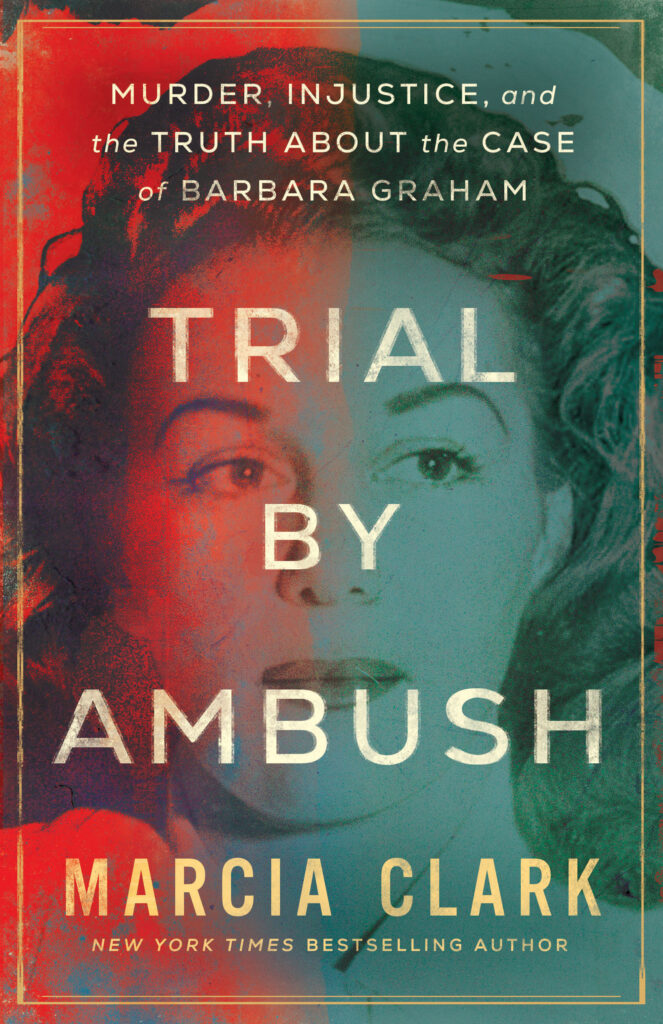
The brutal killing and its aftermath, including the courtroom drama, is the subject of a new true crime book, Trial By Ambush, by Marcia Clark, former lead prosecutor in the ill-fated O.J. Simpson murder trial during the mid-1990s.
Recently, Clark appeared with Los Angeles Times reporter Christopher Goffard in a “Crimes of the Times” podcast on the newspaper’s website, discussing the 1953 bludgeoning and strangulation in Burbank of Mabel Monahan, a 64-year-old widow with a slight limp from an old car accident.
A vaudevillian and palm reader sometimes known as Madam Martinez during earlier years, Monahan was a former mother-in-law of Luther B. “Tutor” Scherer, a Los Angeles underworld figure who became a casino executive in Las Vegas. Monahan lived alone in the one-floor, ranch-style house in Burbank, north of downtown Los Angeles, after her daughter divorced Scherer and moved out of state.
In an email to The Mob Museum, Clark said Scherer had given his ex-wife, Iris, Mabel Monahan’s daughter, the Burbank house at Parkside Avenue and South Orchard Drive.
“Mabel had always loved the house,” Clark said. “She’d never owned or lived in one, having spent her life on the vaudeville circuit, which meant staying in hotels around the country, and Iris didn’t want it, so she gave it to Mabel.”
After moving to Southern Nevada, Tutor Scherer remained good friends with Mabel Monahan, often visiting her when he was in Los Angeles, Clark said. This led to word on the street that Scherer was hiding skimmed Las Vegas casino money at the Burbank house.
“No one seems to know how the rumor got started,” Clark said. “Here’s my guess: Tutor had tried to get a foothold in the gambling game in L.A. for a while, but the notorious gangster Mickey Cohen owned the gambling business in L.A. and Tutor decided it might be best to give Cohen a wide berth, so he moved to Las Vegas. Some of the crooks who’d worked for Tutor before he decamped to Las Vegas probably noticed he was visiting Mabel when he was in town and surmised he was hiding cash in her house, skimming the proceeds of his casino in Las Vegas.”
Los Angeles Times reporter Christopher Goffard discusses the Barbara Graham case with lawyer and author Marcia Clark during a panel about lesser-known true crime stories in California at the Los Angeles Times Festival of Books. Courtesy of Kate Henry
‘She swore she never murdered’
The home-invasion crew that entered Monahan’s Burbank house on March 9, 1953, included two habitual criminals in their 40s, Emmett Perkins and Jack Santo. Also present were safecracker Baxter Shorter and John True, a deep-sea diver who claimed to know Tutor Scherer. The crew supposedly believed casino “black money” was in a safe in the house.
There was a fifth person involved in the incident, Barbara Graham, a 29-year-old heroin user and prostitute with a felony perjury conviction, sometimes called Bonnie, also known as Barbara Radcliff and Barbara Kielhamer. At a gambling den in El Monte, about 14 miles east of downtown Los Angeles, Graham was a shill, or “dice girl.” This illegal dice-and-poker operation was run by her friend Perkins, a 44-year-old hoodlum who went by the alias Jack Bradley and carried his false teeth in his pocket.
In a story on the Los Angeles Times website, Goffard wrote that Graham had been abandoned at a young age by her mother and sent to the Ventura School for Girls, “a brutal reform school from which she emerged with an education in crime.”
“She never made it to high school,” Goffard wrote. “She hustled for a living. She wrote bad checks. She shoplifted. She was busted for drug possession, prostitution and perjury. She married four times. She had three kids. She loved jazz.”
During the trial, and later in coverage of the June 1955 cyanide-gas executions at San Quentin State Prison, the press focused on Graham, dubbing her “Bloody Babs.” It was uncommon for women to face death in the gas chamber.
“From her arrest to her execution, something about Barbara Graham inspired frenzied verbiage from the journalists of the era,” Goffard wrote. “Newspapers portrayed her as a chilly, oversexed murderess from the pages of pulp fiction. Sometimes she was ‘the redhead,’ sometimes ‘the icy blond.’ She was ‘the gun moll.’ She was ‘sultry.’ She was ‘shapely Barbara Graham, the blond iceberg.’”
Though Graham insisted she wasn’t at Monahan’s house the night of the murder, Clark stressed in Trial By Ambush that the deck was stacked against her during court proceedings. To save his own neck, True claimed Graham pistol-whipped Mabel Monahan. The prosecutor, J. Miller Leavy, relentlessly attacked Graham, reading aloud from her love notes to another inmate, Donna Prow.
In her new book, Trial By Ambush, criminal attorney Marcia Clark investigates the true story behind the 1953 slaying of Mabel Monahan, which led to Barbara Graham’s execution by cyanide gas. Thomas & Mercer / Amazon Publishing
In jail, Prow double-crossed Barbara Graham, arranging for an undercover officer to meet with a desperate Graham to concoct a phony alibi. During the trial, Prow, conveniently nowhere to be found, was unavailable for Graham’s lawyer to question. This is one example, Clark wrote, of the prosecutorial misconduct that occurred throughout the trial. Clark’s research in writing the book led her to question Leavy’s tactics and ethics.
Going into the book project, Clark, who had handled big cases at the Los Angeles County district attorney’s office, knew about Leavy’s legendary record in winning criminal convictions. During a 41-year career as a prosecutor, he sent 13 men and one woman, Barbara Graham, to the gas chamber. Writing about the Graham case in the nonfiction book LAPD ’53, crime novelist James Ellroy, known for his word play, unusual spellings and alliteration, refers to the prosecutor as “Gas Chamber” Leavy, the Kapital Kase Kahuna.
Goffard, the Los Angeles Times reporter, wrote that Clark approached the Barbara Graham book project “with admiration for Leavy—and emerged with the certainty that he had cheated.”
In the 1958 movie I Want To Live!, Susan Hayward won an Oscar for her sympathetic portrayal of Graham. On the Los Angeles Times website, Goffard points out that the ad copy for the movie calls Graham “the wildest of the jazzed-up generation.”
“She had lots of friends, most of them bad,” the ad copy states. “She was driven by a thousand desires, a few of them decent. She sinned. She stole. But she swore she never murdered.”
The movie is based on articles by San Francisco Examiner reporter Ed Montgomery, a journalism graduate of the University of Nevada, Reno, and Pulitzer Prize winner for his stories about an IRS tax scam. At Montgomery’s death in 1992 at age 82, the Los Angeles Times referred to him as the crime reporter who led an unsuccessful “crusade to prevent Barbara Graham from dying in California’s gas chamber.”
In an email, Clark said Barbara Graham didn’t take part in the murder, “but she was present during the home invasion burglary.” That alone is grounds for a murder conviction but not necessarily the death penalty.
“She was the decoy the four men used to get Mabel Monahan to open the door,” Clark said. “Mabel was well known to be very security conscious, and she would never have opened her door to a strange man at night. Barbara, on the other hand, who was petite — 5 foot 3, 120 pounds and pretty — was a different story.”
Graham knocked on the door, telling Monahan her car had broken down and that she was alone and stranded. Graham asked if she could use Monahan’s phone to call a cab.
“Mabel let her in, and one of the men, John True, who would later become the prosecution’s star witness in exchange for total immunity, pushed in behind Barbara,” Clark said. “After that point, although John True testified that Barbara took part in the bludgeoning of Mabel, the evidence disproves that. It seems Barbara was basically a bystander and the men actually killed Mabel, pistol whipping her and then strangling her with a piece of a sheet or pillowcase. She died of asphyxiation.”
In Trial By Ambush, Clark wrote that it was likely Perkins who put the pillowcase over Monahan’s head, with Santo then tying the gag around her neck. The crew did not find a safe. Not long afterward, Shorter, the “box man,” as safecrackers were called, was kidnapped at gunpoint, by Perkins, according to a witness, and was never seen again. Shorter had been an informant but went missing before he could testify in court.
The scene inside Monahan’s house was bloody and disturbing. According to the Burbank Police Department website, a gardener had gone to the front door “and looked in to find a ransacked home and grisly trail of blood.” Mabel Monahan’s badly beaten body was partially inside a hall closet.
Ellroy, who has written fiction and nonfiction books and journalism about the criminal underworld, much of it centered on Los Angeles, called the Monahan killing “the ugliest crime story I know.”
As for Perkins and Santo, they also were sentenced to death in the case, and, in 1955, were executed later the same day as Graham in the San Quentin gas chamber.
In 1955, Barbara Graham became the third woman executed in California’s gas chamber. California Department of Corrections and Rehabilitation
Scherer: No Las Vegas connection to Burbank murder
Scherer became a footnote in the Monahan tragedy. He was questioned about it and denied knowing John True.
In early coverage of the killing, however, the press “ate up the sensational [Scherer] hook and jumped in with both feet, announcing that gambling interests might lie at the bottom of the slaying,” Clark wrote in Trial By Ambush. One newspaper headline read, “Gambling Link Is Sought in Widow Strangulation.”
Scherer said he didn’t know why anyone would kill Mabel Monahan. “I’m sorry as hell Mabel got knocked off,” he said at the time. “We always got along swell, even after the divorce.”
He denied there was any casino money at the home. “I never had a safe of any kind in that house,” Scherer said. “I think a guy who keeps large sums of cash or jewelry where he lives is just begging to be knocked over.”
According to Clark, he “waved off the press hype” about a link between the murder and Las Vegas gambling, saying, “There just isn’t any connection.” Scherer said the divorce settlement resulted in Monahan only receiving cash, some jewels “and the Burbank house, which I knew the old gal liked so much.”
It is not surprising Scherer was headline material in those days. Years earlier, he was one of the operators of floating casinos off the Southern California coast and had owned a syndicate club with another bookmaker in downtown Los Angeles on Spring Street, an area swarming with grifters.
Under pressure from public officials, and, as Clark noted, squeezed out by local gangsters, Scherer and other Southern California racketeers moved to Nevada and operated Las Vegas casinos in an era when the town was beginning to take off.
Among other properties, Scherer co-owned the Pioneer Club, which opened in April 1942. At that casino on Fremont Street, the Vegas Vic neon cowboy was installed in 1951. Vegas Vic is still on display at that location, having been shortened a bit to make room during the mid-1990s for the electronic canopy covering the Fremont Street Experience. The property where Vegas Vic stands is no longer a casino.
Tutor Scherer was a co-owner of the Pioneer Club in downtown Las Vegas. Although the casino is no longer around, Vegas Vic still greets visitors to Fremont Street above what is now a souvenir shop. UNLV Special Collections
In 1950, Scherer was named Nevada poet laureate as the author of easy-to-read verse, some of it written poolside at the El Rancho Vegas, a hotel-casino that burned down in 1960 on Highway 91, now known as the Las Vegas Strip. Scherer had been the resort’s president.
Scherer died in 1957 at age 78, but his legacy as a gaming pioneer lives on in Southern Nevada. West of downtown Las Vegas is Scherer Street, near Ansan Sister City Park.
The street is named for the man who rose to prominence in Las Vegas after moving away from Southern California, leaving behind the house where his former mother-in-law would be slain in an incident the Burbank Police Department to this day calls “one of the most infamous crimes in the city.”
Larry Henry is a veteran print and broadcast journalist. He served as press secretary for Nevada Governor Bob Miller and was political editor at the Las Vegas Sun and managing editor at KFSM-TV, the CBS affiliate in Northwest Arkansas. Today, he is a senior reporter for Gambling.com.
Seventy years ago, in April and May of 1955, Las Vegas welcomed four new hotel-casinos in a six-week period. This growth proved unsustainable in the short term, but the properties that opened that spring would shape the history of the city throughout the following decades.
In June 1955, Life magazine questioned the viability of this growth with a story titled, “Las Vegas — Is Boom Overextended?” The cover featured dancers from the Moulin Rouge, the first racially integrated hotel-casino in Las Vegas. This was neither the first nor the last time the national print media would question the sustainability of Las Vegas.
The success or failure of these properties came down to common themes in Las Vegas history: Mob financing, big-name entertainment, racial tension and growth potential in a dry, desert city. Although none of these hotels stands today, their legacies continue to reverberate.
June 20, 1955, edition of Life magazine featuring Moulin Rouge dancers on the cover. Inside is an article that questions the longevity of the 1955 casino boom. The Mob Museum Collection
The Royal Nevada
The Royal Nevada began the casino grand opening binge on April 19, 1955. It was conceived by Frank Fishman, a hotel operator with properties in Los Angeles, San Francisco and Miami Beach. In 1954, he contracted architect Paul Revere Williams to design a resort to be built where Resorts World now stands.
Williams had a national reputation as a modern architect in high demand. Williams, the first African American admitted to the American Institute of Architects, played a significant role in Las Vegas. His work and reputation brought him to Southern Nevada in 1941 to design the Carver Park housing development for Black employees of the Basic Magnesium plant in Henderson.
After designing the Royal Nevada, he designed the short-lived Las Vegas Park Jockey Club, the La Concha Motel lobby and the Guardian Angel Cathedral, which still stands in its original location.
Although Fishman had experience with hotels, issues with the project quickly became apparent. In February 1955, the Nevada State Tax Commission labeled him “undesirable” to hold a gaming license. Other investors stepped up and bought him out of his project, and the Royal Nevada received approval without Fishman.
The boom started with the Royal Nevada in April 1955. The Mob Museum Collection
The hotel also foretold the economic problems that would plague all the properties built in 1955. In March, a construction subcontractor filed a $445,709 civil suit charging breach of contract against Fishman and Hahn Construction. On April 24, five days after opening, the Las Vegas Review-Journal reported a nearly $325,000 lien against the builders.
The Royal Nevada seemed to struggle to pull off what other resorts had. In ads, the Royal Nevada calls itself “The Showplace of Showtown, U.S.A.” Early performing acts included opera singer Helen Traubel and actor Dave Barry. Although these performers had good name recognition in the 1950s, they pale in comparison with some of the acts that other hotel-casinos at the time were booking, such as Louie Prima, Frank Sinatra and Sammy Davis Jr. While Traubel warbled at the Royal Nevada, TV star and rising Las Vegas icon Liberace tickled the ivories at the Riviera.
On December 31, 1955, the Royal Nevada shut its doors due to mounting debts. Royal Nevada employees agreed to forgo payroll earlier that month in the hopes that the holiday season would pick up, but a Christmas and New Year’s boost did not materialize.
Jake Kozloff, then affiliated with the New Frontier, leased the property in early 1956, and the hotel — though not the casino — reopened in February. By June, the resort’s operations had been taken over entirely by the New Frontier, but the casino would not open again until February 1957.
In November 1957, the Nevada Gaming Control Board dealt a death blow when it filed an eight-count complaint against the property alleging dealer cheating and improper financing and licensing. On May 5, 1958, the IRS shut down the Royal Nevada, and the Stardust acquired some of the property’s original footprint.
The Riviera
On April 20, 1955, the Riviera celebrated its grand opening, one day after the Royal Nevada. Its nine-story tower made it the tallest hotel on the Strip and the first high-rise resort. It overshadowed the Royal Nevada in every sense of the word.
Famous pianist Liberace, who was not yet known for his flamboyant bejeweled stage costumes, performed at the Riviera’s grand opening. He featured prominently in the opening ceremonies and received $50,000 a week for his performances. Before the Riviera, Liberace had almost no connection to Las Vegas. He performed at the Hotel Last Frontier in 1944, but the show had little immediate impact on his career. By 1955, Liberace had become a household name thanks to his television show, leading to the widely heralded appearance at the Riviera’s grand opening.
Liberace wields the scissors at the Riviera’s ribbon-cutting ceremony in 1955. UNLV Special Collections
Although the Riviera arguably became the most successful of the properties built in 1955 — operating until it closed in May 2015 — it faced the same issues as the Royal Nevada during the development and construction phases.
The property that would become the Riviera, originally called the Casa Blanca, was first purchased in late 1952 by a group of investors led by Miami Beach gambler Willie Bischoff. Because of Bischoff’s known connection with illegal gambling rackets, the Casa Blanca failed to materialize.
The Nevada Tax Commission finally granted the property a license in September 1953, once Bischoff left the project. The investors publicly included coin-op manufacturers David and Meyer Gensburg, Harpo and Gummo Marx, Miami restaurateur Jack Goldman, Southern California bingo parlor owner Harry Robbin and Miami developer Murray Saul. New York mobster Meyer Lansky and Chicago Outfit boss Tony Accardo were also silent investors in the project.
When the Riviera opened, it owed $1.4 million in construction bills. Bankruptcy loomed over its first few months of operation. But Accardo was not about to lose the Outfit’s first major property in Las Vegas.
Accardo asked mobster Gus Greenbaum, then manager of the Flamingo, to manage the Riviera. Greenbaum refused. He wanted to retire in Phoenix, spend time with his wife, and perhaps avoid the same violent end as his predecessor at the Flamingo, Benjamin “Bugsy” Siegel.
Unfortunately for Greenbaum, Accardo would not let that happen. Greenbaum owed his Mob associates a lot of money. He was a problem gambler and suffered with drug addiction in his final years. When his sister-in-law, Leone Greenbaum, was found dead in April 1955, Gus reluctantly agreed to take control of the Riviera. He brought along fellow known associates Davie Berman and Israel “Ice Pick Willie” Alderman.
The Nevada Tax Commission was vocal about its reluctance to accept Greenbaum and his leadership team due to their lengthy criminal histories. However, as the Reno Evening Gazette reported in September 1955, the commission “threw a life preserver” to the Riviera for the sake of the city’s continued economic solvency. By 1958, Greenbaum had righted the Riviera, but his persistent personal issues likely led to his still-unsolved murder along with his wife, Bess, on December 3, 1958.
Greenbaum’s death had no impact on the Outfit’s skimming operation, which had been going on since the Riviera opened in 1955. Riviera executives faced tax evasion charges in 1967 related to the ongoing skim, but these snags did not impede the Riviera’s continued success. It stood tall until its implosion in the summer of 2016.
The Dunes
The Arabian Desert-themed Dunes Hotel debuted on May 23, 1955. Its advantageous location at Flamingo Road and Las Vegas Boulevard meant it would be among the first properties seen by motorists from California. The original investors included movie theater owner Alfred Gottesman and two Providence businessmen, Bob Rice and Joe Sullivan, with ties to New England crime boss Raymond Patriarca.
The Mob’s involvement in the Dunes caught the attention of federal law enforcement. The Mob Museum Collection
Even with Mob money, the Dunes was not immediately successful. By September 1955, the Sands had been asked to take over control of the Dunes. The new owners held a grand opening celebration less than four months after the first one. Sands President Jake Freedman entered a lease to operate the Dunes, with Ed Levinson overseeing casino operations. They pulled out all the stops, including an appearance by Frank Sinatra riding a camel. After the opening, the Nevada State Journal asked, “Has the boom of new hotels gone too far or will Las Vegas continue as the lushest resort town in the country?”
Ultimately, the Sands could not turn the Dunes around. Midwestern gambler and oil magnate Major Riddle, who had ties to the Chicago Outfit, purchased the Dunes in 1956 and finally made it profitable. Riddle brought more Mob-connected individuals to the Dunes, including insurance agent Allen Dorfman and attorney Morris Shenker, both involved with the Teamsters Union Pension Fund.
Allen Dorfman, left, and Morris Shenker allowed the Dunes to dip into the Mob’s piggy bank, the Teamsters Union pension fund. U.S. Department of Justice (left) / Associated Press (right)
One of the ways Major Riddle succeeded in making the Dunes profitable was through entertainment. In 1957, Riddle worked with Harold Minsky, a well-known New York burlesque producer, to bring the city’s first true topless revue. The show Minsky Goes to Paris, later called Minsky’s Follies, essentially created the Las Vegas showgirl.
Before Minsky’s Follies, showgirls were used as opening acts in showrooms and provided entertainment in smaller venues. Most early showgirls performed in a traditional burlesque style, and, due to decency laws, were not topless. Harold Minsky and his follies changed that. Riddle also brought Frederic Apcar to Las Vegas. A French dancer and producer, Apcar created the Casino de Paris showgirl revue in 1963. It replaced Minsky’s, which moved to the Silver Slipper and later the Aladdin.
In the 1960s and ’70s the Dunes became a battleground between law enforcement and the Mob. The FBI planted bugs on the property and worked to cultivate former employees of Shenker and others to work as informants. Because of continued federal scrutiny and the property’s natural aging, the Dunes failed to stay competitive in the 1980s and ’90s as properties along the Strip became bigger and sleeker. In 1992, Steve Wynn’s Mirage Resorts purchased the Dunes. The main tower and sign were imploded in spectacular fashion in 1993, and the south tower followed in 1994. The Dunes ultimately became the site of the Bellagio, which opened in 1998.
The Moulin Rouge
Unlike the other three properties, the Moulin Rouge was not built on the Strip. It was constructed on Bonanza Road between Martin Luther King Boulevard and H Street, at the edge of a predominantly Black neighborhood known as the Westside.
The six-week casino opening spree concluded with the Moulin Rouge, the first racially integrated casino-resort in Las Vegas. The Mob Museum Collection
The Moulin Rouge opened on May 24, 1955, one day after the Dunes. It was the city’s first racially integrated hotel-casino. Before it opened, Black visitors to Las Vegas had no options for lodging other than one motor court and a few guest houses on the Westside. The Moulin Rouge is said to have infuriated Strip casino owners by luring away patrons, including celebrities such as Frank Sinatra and Sammy Davis Jr. Black entertainers, including Davis Jr., Lena Horne, and Nat King Cole, were not allowed to patronize the Strip’s restaurants, casinos and clubs, even in the resorts where they performed.
The Moulin Rouge property was developed by a group of white investors, led by Will Max Schwartz. The group relentlessly publicized heavyweight boxing champion Joe Louis as a co-owner, but he had only a two percent share in the property.
The property filled an important niche. Las Vegas in the 1950s was a Jim Crow town, and both downtown and Strip casinos barred Black people from patronizing their establishments. In an April 1952 article in Jet magazine, singer-pianist Hazel Scott shared that she had been allowed to swim in the pool at the Hotel Last Frontier where she was staying and performing, but then the pool was closed “indefinitely pending rechlorination.”
Nothing had changed by March 1954, when Ebony magazine published an article titled, “Negroes Can’t Win in Las Vegas,” describing the city’s racial conditions. The article explains the double standard that, by 1954, many big-name Black entertainers were given accommodations on the Strip, but their friends and relations were still expected to stay off property. They were also not allowed to partake in other hotel amenities.
“We . . . are not at all satisfied with conditions in our city,” active local NAACP spokesman Woodrow Wilson said, as quoted in the Ebony article. “And we are doing all we can to bring about some change in them. We realize, though, that we are up against heavy odds in this fight and that it will take a long time to gain victory.”
The first few months of the Moulin Rouge appeared to prove the necessity for an integrated resort. Strip hotels were furious about employees and guests patronizing the property, and the showroom was often packed to capacity.
Bob Bailey, the showroom’s emcee, recalled the first time he stepped into the Moulin Rouge:
“I walked inside and the place took my breath away. The carpeting was bright and colorful; it looked like you could sink into it. Polished mahogany paneling framed the walls, and above the bar an artist had painted a signature mural of African American dancing girls in colorful French costumes. Some of the furniture was covered in leather and velvet, and crystal chandeliers dipped down from the ceilings. … No expense had been spared. It was as beautiful as anything I had seen in New York. And that included our corner of the enterprise: The Café Rouge showroom boasted about 500 seats, sophisticated lighting and sound equipment, and perhaps the most modern projection booth in the city.”
Moulin Rouge emcee Bob Bailey, top right, poses with other entertainers, including his wife, Anna, top left. Anna started her showgirl career at the Moulin Rouge and later joined the all-white Flamingo chorus line as the first Black showgirl on the Strip. UNLV Special Collections
In his memoir, Looking Up!, Bailey describes the resort’s opening night:
“On opening night, it seemed like every man or woman who was ‘somebody’ in town showed up, including the mayor and administrators from the different hotels. I remember Tallulah Bankhead in the audience, along with Gary Cooper, Humphrey Bogart, and Joe Adams, a major radio personality from Los Angeles and film actor.”
Bailey writes that the Moulin Rouge often was hopping all night long as entertainers and guests ventured over from the Strip and downtown.
“Along with the customary shows at 8:15 and 11:15 p.m., our public relations man, Martin Black, had the brilliant idea to try a third performance at 2:15 a.m. for the entertainers and musicians in town who were just getting off work, and the rounders who cruised from club to club all night. We tried it for a week, and discovered that was when the casino truly came to life. As time went on, the Moulin Rouge became a popular late-night — or should I say early morning — hangout for everyone from chorus girls to major entertainers, who would take cabs and limos from the Strip. I never knew who I would see in the audience during the Tropi-Can-Can: Edward G. Robinson, Cary Grant, Sarah Vaughn, Tallulah Bankhead, Louis Armstrong, Frank Sinatra, Nat King Cole.”
The success was short lived. Due to financial mismanagement and the oversaturated market, the Moulin Rouge closed in October 1955. In December 1955, the owners filed for bankruptcy. The court proceedings were held at the Las Vegas federal building where The Mob Museum is now located. Four hundred creditors descended upon the court claiming they were owed a combined total of $3.8 million. The Moulin Rouge sold a few years later for $600,000, and most of its creditors received almost nothing.
The Moulin Rouge became a symbol of the civil rights movement in Las Vegas, not only because of its claim to fame as the first integrated hotel-casino resort. In 1960, the café connected to the now-defunct casino became the site of the historic Moulin Rouge agreement, a verbal compact between city officials, NAACP members and casino operators to integrate all hotel-casinos simultaneously.
Those thrilling six weeks in 1955 beg the question just as much in hindsight as 70 years ago: Was the boom overextended? Las Vegas real estate developers certainly did not think so. Hotels continued to pop up through the rest of the 1950s — the Fremont in 1956, the Tropicana in 1957 and the Stardust in 1958. Although construction cooled in the early 1960s, the hotel-casinos that weathered this building boom remained fixtures on the Strip for decades.
In 1950, Las Vegas saw about one million visitors annually. By 1960, the number soared to 10 million. And in 2024, Las Vegas welcomed more than 40 million visitors. Construction in 1955 proved there was in fact the possibility of having too much of a good thing, but the template for building casinos — and the presence of organized crime interests — remained strong.
While some question whether Mob movies have run their course, a recent slate of gangster films indicates public interest remains strong.
Mafia films such as The Alto Knights and Mob Cops already have been released this year, while others are in production.
Recently, actor Mark Wahlberg was photographed on a film set in Atlanta playing a Mob hitman in the not-yet-released drama, By Any Means. According to the New York Post, the 53-year-old actor, wearing aviator sunglasses and gold jewelry, and fitted with chin and nose prosthetics, “looked nearly unrecognizable.”
Also, Dwayne “The Rock” Johnson is co-writing a book with journalist Nick Bilton about an organized crime syndicate in Hawaii, planned as a movie to be directed by Martin Scorsese. Scorsese’s list of Mob films includes Mean Streets, Goodfellas, Casino, The Departed and The Irishman.
Other Mob projects also are underway. The streaming platform Paramount+ has begun production on the third season of Tulsa King, starring Sylvester Stallone as a fictional New York Mafia capo exiled to Oklahoma. “The renewal is hardly a surprise as the show’s second season return in September was Paramount+’s most-watched global premiere in the streamer’s history,” according to The Hollywood Reporter, “and the show ranked as a Nielsen Top 10 streaming title throughout the rest of its sophomore season run.”
On the documentary side, the Fox Nation streaming service, which previously produced the Skim City docuseries about the Mob in Las Vegas, has embarked on a new true crime series under the Stories of the American Mafia banner.
Who are the next Mob movie stars?
Even with these projects in the pipeline, questions have arisen about the future of Mob movies.
After the release in March of The Alto Knights, a feature film based on a feud between gangsters Vito Genovese and Frank Costello, the New York Post asked, “Has Father Time put a hit on Mafia movies?” The film, written by Nicholas Pileggi (Goodfellas, Casino) and directed by Barry Levinson (Bugsy, RainMan), had a less-than-hoped-for initial box office showing.
Referring to Mob movies as a “limping genre,” the Post said these productions in general had a good run in the past, including “seismic films” such as 1972’s The Godfather, but tastes change over time, as was the case with Westerns, which were “an American cinematic fixture until the 1960s and ’70s.”
The 1972 film The Godfather created a winning formula for the Mob movie genre. However, some critics believe that formula has become stale. Hollywood Archive
The newspaper suggested that an infusion of new talent might help future Mob movies. The Post noted that some of the same veteran actors, such as Robert De Niro, Al Pacino and Joe Pesci, keep popping up in Mob movies. In The Alto Knights, De Niro plays both main characters.
The Post wondered what’s going happen when De Niro, Pacino and Pesci “are no longer with us.”
“Who is going to take these Sunday spaghetti and bullet-in-the-head roles? Timothée Chalamet?” the newspaper asked.
‘Zero awareness’
Mob movies aren’t the only films struggling to attract audiences. In a recent story about new motion pictures “fizzling at the box office,” the Wall Street Journal said attendance at cinemas is at a new low. The newspaper reported that “nearly every movie released by a major studio in the past year based on an original script or a little-known book has been a box-office disappointment.”
“Getting people into theaters more frequently is a priority for a movie industry still recovering from the pandemic,” according to the Wall Street Journal. “Box-office revenue in the first three months of this year in the U.S. and Canada was the lowest it has been, excluding the pandemic, since 1996.”
One problem is that some viewers “wait until an original motion picture is available to rent online a few weeks after its theatrical release or to stream on a service like Netflix in a few months,” the newspaper reported.
Small advertising budgets don’t help. “We’re opening films that have almost zero awareness,” Bill Barstow, president of a Nebraska-based chain, told the Wall Street Journal.
Great stories survive
George Anastasia, a journalist and co-author of The Ultimate Book of Gangster Movies, said he has often wondered if the Mob movie genre has been played out. “I think that way until another good movie comes along and people rush to see it,” he said in an email.
Anastasia said the American public has always been fascinated with outlaws—from Jesse James and Billy the Kid through Bonnie and Clyde to Al Capone and the fictional Don Corleone in The Godfather.
“So I think there will always be a market for a good Mob movie,” he said.
Glenn Kenny, a New York Times film critic and author of Made Men: The Story of Goodfellas, said in an email that there are still some organized crime topics that would appeal to audiences.
“I think a movie foregrounding the life of [New York mobster] Joey Gallo, who I know has been a side or cameo presence in prior Mob movies, might be pretty exciting,” he said.
The antics of Colombo crime family mobster “Crazy” Joe Gallo’s served as the basis for the 1971 film The Gang That Couldn’t Shoot Straight. The film is an adaptation of Jimmy Breslin’s book with the same name. Associated Press
Anastasia, an expert on organized crime in Philadelphia, also pointed to overlooked Mob subjects that could be turned into films.
“My prejudice, but the story that has never been told and that is rich is characters, plot and pathos is the story of the Philadelphia Mob from Angelo Bruno through Joey Merlino,” he said, adding that he is “still waiting for Hollywood to figure that out.”
Anastasia is working on a nonfiction book about Bruno. The author’s previous books include Blood and Honor: Inside the Scarfo Mob, the Mafia’s Most Violent Family, which New York newspaper columnist Jimmy Breslin called “the best gangster book ever written.”
Merlino, a reputed former Philadelphia Mafia boss, recently opened a restaurant in South Philadelphia, Skinny Joey’s Cheesesteaks, whose celebrity patrons have included retired NFL Pro Bowler Jason Kelce, a longtime center for the Philadelphia Eagles.
Screenwriter and director Nicholas Celozzi (The Class) said audiences will go see movies of any genre—horror films, romantic comedies and Mob movies—if they are good.
Celozzi’s newest production, November 1963, about the killing of President John F. Kennedy, begins filming in Winnipeg in June, he said. After that, Celozzi will turn his attention to an earlier movie project, The Legitimate Wiseguy, based on his relationship years ago with Tony Spilotro, who, for a period beginning in the early 1970s, was the Chicago Outfit’s overseer in Las Vegas. Celozzi comes from a family with a Mob backstory. His grandmother’s brother, Sam Giancana, was a Chicago Outfit boss.
Although Chicago Outfit enforcer Tony Spilotro’s Las Vegas story is told in the 1990 film Casino, Nicholas Celozzi plans to tell a different side of his story in The Legitimate Wiseguy, currently in pre-production. Las Vegas Metropolitan Police Department
Celozzi said in a telephone interview that audiences will pay to see movies that have “heart” and are character-driven.
“Great stories will always survive,” he said.
Larry Henry is a veteran print and broadcast journalist. He served as press secretary for Nevada Governor Bob Miller and was political editor at the Las Vegas Sun and managing editor at KFSM-TV, the CBS affiliate in Northwest Arkansas. Today, he is a senior reporter for Gambling.com.