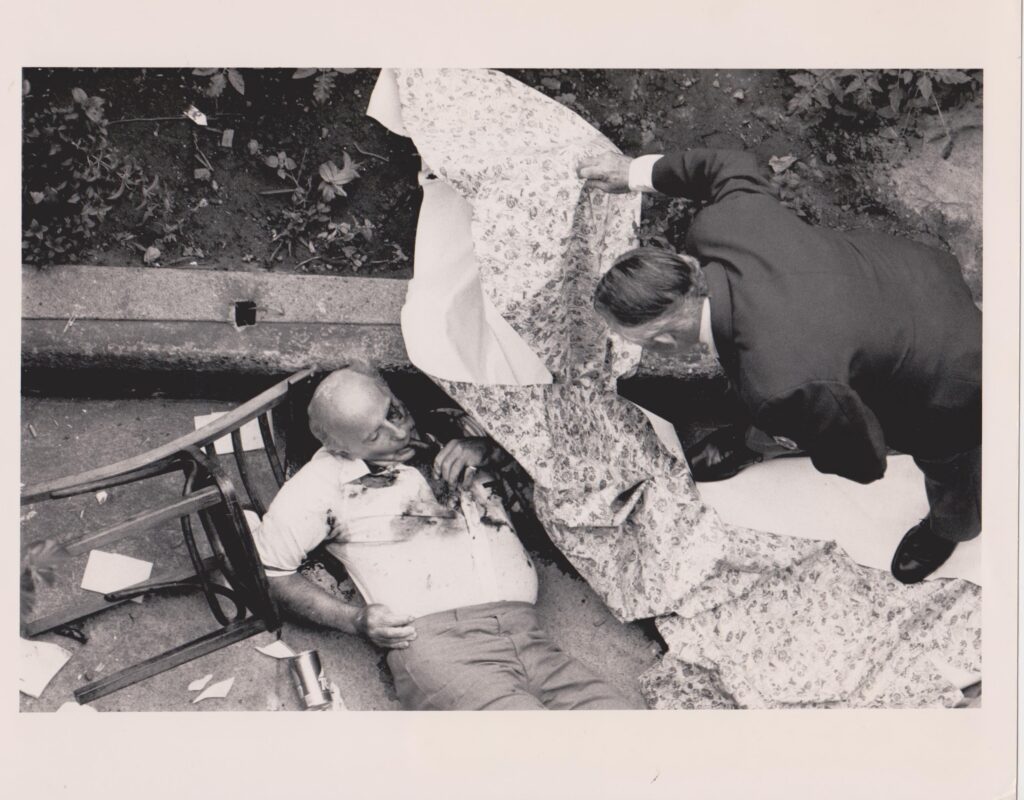
To police surveying the bloody scene at the Democratic Club on Truman Road, it appeared that 41-year-old Charles Binaggio either hadn’t suspected a thing or had little chance to react. His body was slumped in a swivel chair where he had been enjoying a smoke just moments before an assassin pumped four .32-caliber slugs into his face. The body of Charles Gargotta, Binaggio’s 49-year-old bodyguard, was lying near the front door. Gargotta may have been trying to make a run for it when the gunmen shot him in the back of the head.
The murders, on April 6, 1950, shook the political world of Kansas City, Missouri. The national headlines even caught the interest of Tennessee Senator Estes Kefauver, who targeted the city in his impending investigative crusade.
Political blurred lines
Years earlier, Binaggio started earning a name for himself in Kansas City’s Democratic Party through ties with mobster and power broker John Lazia. After Lazia’s 1934 slaying, Binaggio rose up through the then-powerful “Pendergast Machine” of political boss Tom Pendergast.
Having some involvement in bootlegging, gambling and prostitution rackets was not uncommon for many individuals embedded in Kansas City’s political parties. Not everyone was mobbed up, but there existed a gray area where distinguishing public servants from underworld opportunists was tricky, particularly from the onset of Prohibition through the Binaggio era.
“Binaggio was part of a group of individuals that came to be known as ‘The Five Iron Men,’” wrote organized crime author Allan R. May. “Although sources differed at times on who the five men were, the most popular lineup was Binaggio, Charles ‘Mad Dog’ Gargotta, Anthony ‘Fat Tony’ Gizzo, James Balestrere and Gaetano ‘Tano’ Lococo.”
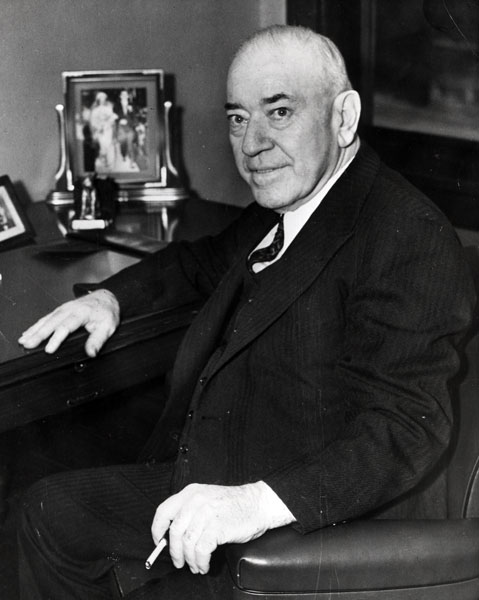
Tom Pendergast led Kansas City’s corrupt political machine, welcoming mobsters into his ranks. He retired after going to prison in 1939. State Historical Society of Missouri
As the 1940s unfolded, the bond between Binaggio and Pendergast deteriorated. Strains in their relationship became evident when Binaggio started to claim his autonomy and sought to establish a political foundation separate from Pendergast’s dominance. Furthermore, Pendergast’s grip on the city weakened amid legal issues and corruption controversies, particularly following his 1939 tax evasion conviction.
“Ultimately, many things brought down the Pendergast political machine,” writes Kansas City historian William Worley. “Certainly, hubris should be high on the list. For so many years, Tom Pendergast and those around him thought they were invulnerable.”
Many of the machine’s politicians had relationships with underworld figures. Some even had a criminal record, although Binaggio’s was rather mild compared to his pal Gargotta. Binaggio, however, rebutted the allegations. “I don’t know anybody in that Mob,“ he once argued when pressed about ties to Chicago Mob boss Al Capone. “I never was the Mob’s man here.”
“His true place in Kansas City cannot be found in the files of the police department,” the Kansas City Star wrote. “His record there reportedly was cleaned out in the days when the underworld controlled the department.”
Binaggio’s downward spiral
Binaggio overplayed his hand in the political game. Confident in his influence, he promised underworld figures that if his candidate, Forrest Smith, won the Missouri governor’s race, the state would be wide open for gambling. To make it happen, Binaggio secured $100,000 in campaign funds.
Smith won, but Binaggio’s plans unraveled. The governor offered him little influence, and a bill to legalize horse-race betting failed. President Harry Truman, whose political career was jumpstarted by the Pendergast machine, wanted nothing to do with him. And the police raids on gambling operations continued.
As pressure mounted, the FBI and a grand jury began investigating Binaggio and Gargotta. Perhaps worst of all, frustrated racketeers wanted what they were promised — either an open city or their investment money back. Binaggio had gambled big, but his luck was running out.
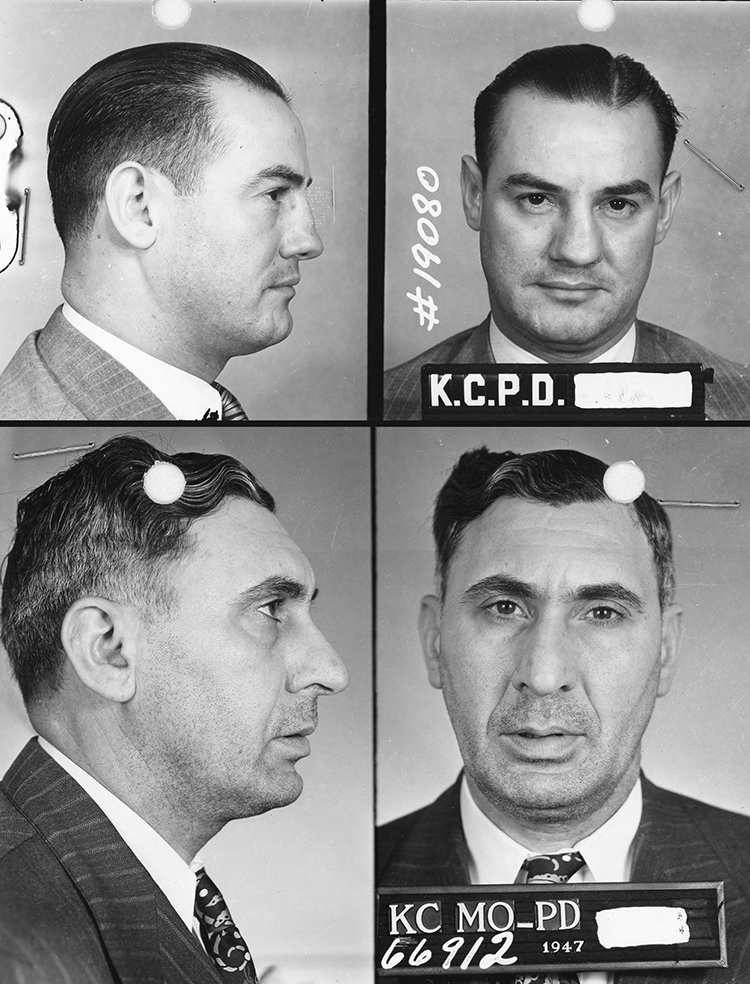
Kansas City booking photos of Charles Binaggio, above, and Charles Gargotta, below. Binaggio led the Kansas City crime family with Gargotta at his side. National Archives
On the evening of April 5, Binaggio was picked up by his driver Nick Penna and taken to the Last Chance Saloon, which straddled the Kansas-Missouri border. There, Binaggio met with Gargotta and decided to leave around 8:30 p.m. Binaggio told Penna not to join them, as they’d only be gone for “15 or 20 minutes.” Gargotta asked gambler Homer Cooper if he could borrow his car.
Binaggio and Gargotta drove to the Democratic Club, and that was the last anybody heard from them until the break of dawn.
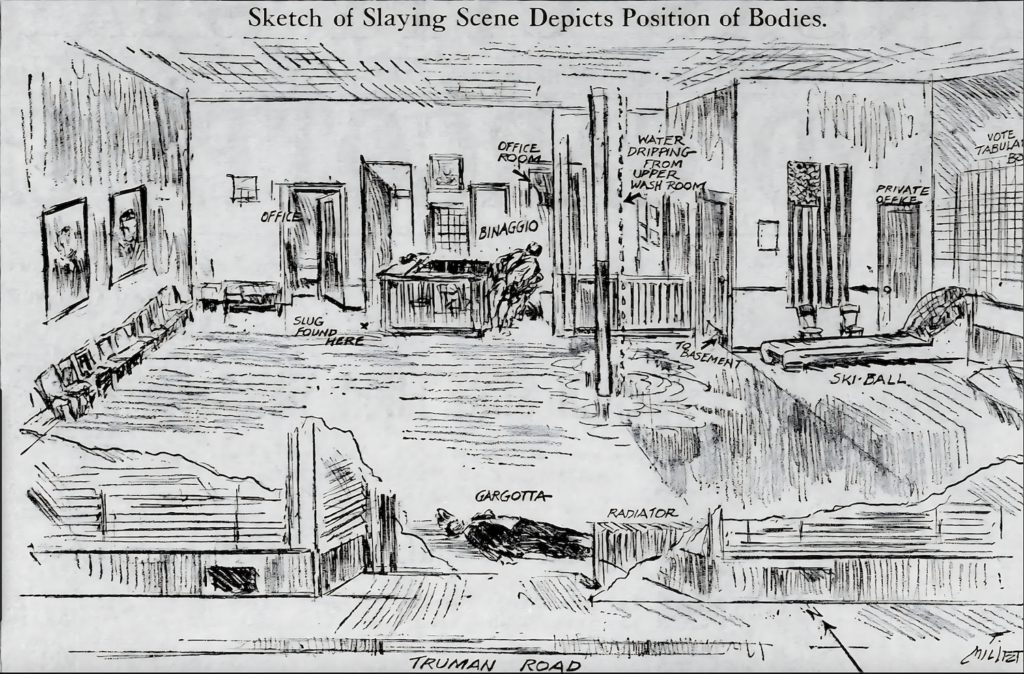
Cab driver Walter Gambill was on his way to an all-night diner, walking by the Democratic Club about 4 a.m. on April 6, 1950, when he heard the distinct sound of heavily dripping water from within the club. Believing there could be a burst pipe flooding the place, he called the police.
When the police arrived, they struggled to push open the front door. They discovered the obstacle was Gargotta’s corpse. At the back of the room they found Binaggio, ironically perhaps, facing in the direction of President Truman’s portrait. The leaking water was from a clogged toilet on an upper floor.
Gambill and the tenant from the apartment above, Harry Erwin, were briefly held and questioned at the scene.
Artist sketch of crime scene in the First Democratic Club located at 716-18 Truman Road. The Kansas City Star
The aftermath
Binaggio and Gargotta were separately laid to rest on Monday, April 10. Some newspapers reported the funerals as reminiscent of John Lazia’s internment 17 years earlier. Others, however, downplayed the fanfare. They described them as having unremarkable attendance, while acknowledging the numerous flower arrangements that arrived with respects and condolences from across the country. Noticeably not in attendance for Binaggio’s funeral service was the Pendergast faction, who were no-shows across the board, including President Truman.
The Kefauver Committee held its first hearing a month after the murders. Kefauver pushed hard to make Kansas City a stop on the crusade, which took place from May 1950 to August 1951 across 14 cities. Previously dismissive, President Truman could no longer avoid the subject and approved. The hearings took place in Kansas City on July 6 and September 28-30, 1950.
“My first impression of Kansas City was of a place struggling out from under the law of the jungle,” Kefauver wrote in one of a series of syndicated articles in 1951. “It was a staggering example of a prosperous city, blessed with many industries and the same type of good citizens found everywhere, but which, through civic inertia, had fallen completely under the thumb of vicious criminals.”
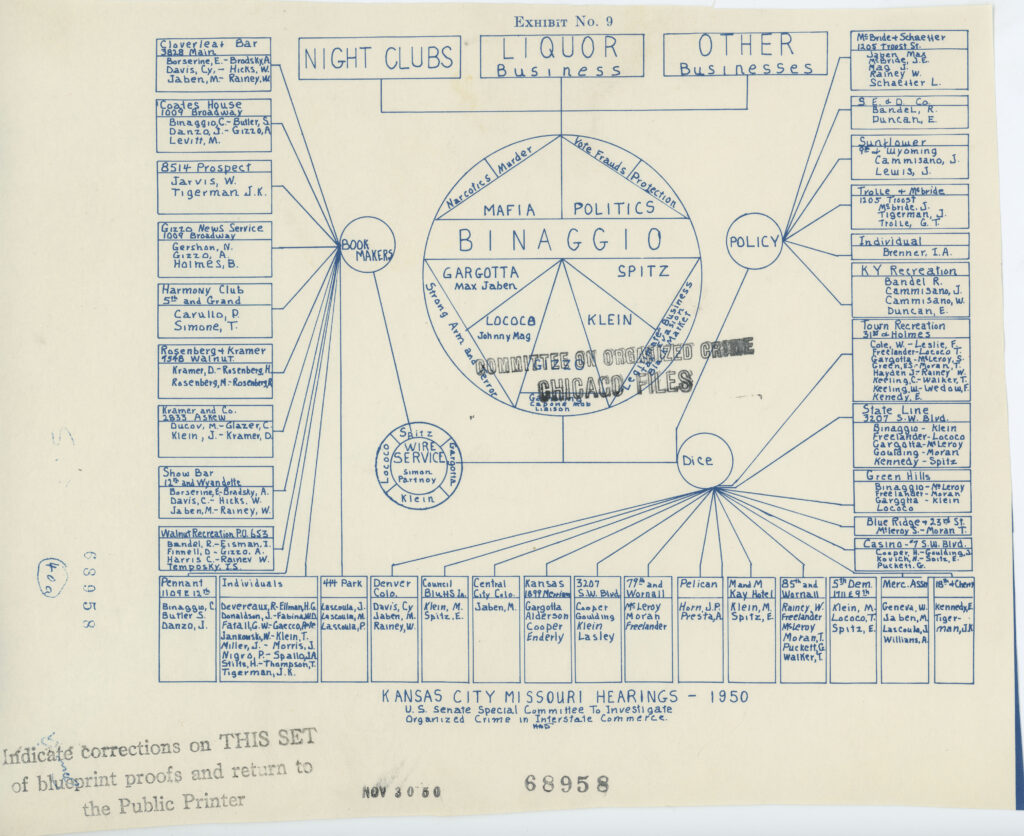
This exhibit from the Kefauver Committee outlined the Kansas City Mob’s hierarchy, rackets and associated individuals. National Archives
Ultimately, there was no question the murders were Mob-style hits. The victims were unarmed, and police found no signs of robbery. Binaggio’s appearance led investigators to surmise he knew the perpetrators. Gargotta, evidently, had tried to escape but was clipped while racing toward the door.
Because finding the actual triggermen was unlikely, debate and conjecture instead ensued over where the assassins originated. Some speculated that the order came down from the highest levels in New York.
Binaggio was “in the way,” bluntly proclaimed Missouri state Representative Dewey Short just days after the murder. “So what happened? He got bumped off.” Short believed Binaggio’s demise stemmed from his long-standing rivalry with the Pendergast faction and was directly related to the Missouri Senatorial primary.
The murders of Charles Binaggio and Charles Gargotta have never been solved.
Christian Cipollini is an organized crime historian and the award-winning author and creator of the comic book series LUCKY, based on the true story of Charles “Lucky” Luciano.
When singer Al Martino was a showroom headliner performing on the Las Vegas Strip years ago, the mobsters who ran the casinos sometimes paid entertainers in cash, says his daughter, Alison Martino.
That wouldn’t happen at the corporate casinos now operating along the resort corridor. But that’s how it was when “the boys” were in charge, she said. Some entertainers took their cash payment out to the casino floor to gamble, mingling with hotel guests at the table games. Her father liked going back to the kitchen and cooking for people dining at the hotel restaurants.
“That’s old Vegas to me,” Alison said in a telephone interview from her home in Los Angeles. Known as “the Godmother of Old L.A. and the Sunset Strip,” Martino, 54, is a writer, historian and television producer. She also founded and runs the popular Vintage Los Angeles website and Facebook page.
On a recent trip to Las Vegas, Martino was impressed by the changes taking place in town, including the addition of the Sphere, an off-Strip music and entertainment venue, where she and friends attended an Eagles concert.
Before heading out from Los Angeles, Alison let her Facebook followers know that reconnecting with old Las Vegas also would be an important part of the trip. She mentioned restaurants such as the Peppermill and Piero’s. Both were the setting for scenes in the 1995 Las Vegas Mob movie Casino. In addition, Alison wanted to check out the “great historic hotels” that are still intact. Many from the Mob era have been demolished.
“Vegas has certainly changed since my father used to play the Strip,” she told her social media followers.
Her father was a World War II Navy veteran headed for a career as a bricklayer in his hometown, Philadelphia, before finding fame as a singer, initially appearing at a tavern in South Philly. He ultimately signed major record deals and headlined at Las Vegas Strip resorts such as the Desert Inn. His many hits include “Here in My Heart,” “Spanish Eyes” and “Volare.” He became even more well-known after being cast as singer Johnny Fontane in the 1972 Mafia movie The Godfather. He also was in The Godfather: Part III.
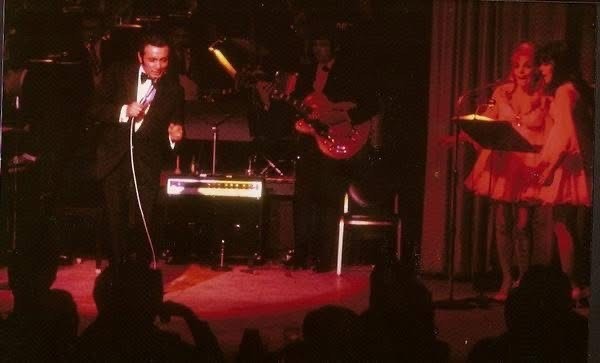
Martino began performing in the Copa Room at the Sands in 1972 with long-time Las Vegas entertainer Louis Prima, just two months before the premiere of The Godfather. Alison Martino
Baby steps
After arriving in Las Vegas for the Eagles concert, Alison Martino visited places familiar from the earlier, “more romantic” period when her father performed there, beginning with his first appearances in 1960s. She went to Piero’s, the Italian restaurant whose founder, Freddie Glusman, is a family friend and where comedian Don Rickles once proudly introduced her around as Al Martino’s daughter. Piero’s occupies the former home of the Villa d’Este restaurant, known in its day as a Mob hangout.
“There’s still old Vegas in Vegas,” Alison said over the telephone. “You’ve just got to find it.”
Throughout the years, Las Vegas has become a different place in many ways, Alison said. During her father’s time, there was more open space between casinos along the Strip. The neon casino signs back then were more appealing to her than the current digital displays. In the early days, you couldn’t take pictures inside the casino or showroom. Now everyone in the resort has a cellphone camera, shooting pictures and video. And, Alison said, today’s audiences might not quite understand the comedy of performers such as Rickles and Joan Rivers.
“The comedy was different,” she said. ”The music was different.”
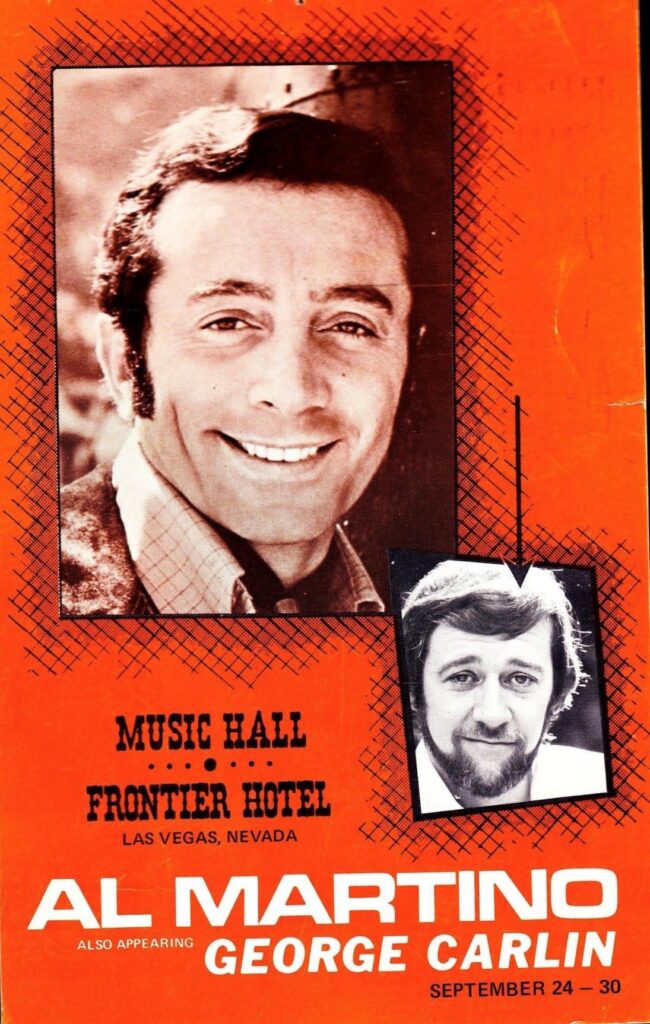
In 1970, Al Martino headlined at the Frontier Hotel with comedian George Carlin. The Frontier’s management kicked Carlin out and terminated his contract after he included his favorite four-letter words in his first midnight set. Carlin later apologized to Martino’s daughter, Alison. Alison Martino
Entertainers like her father, who died in 2009 at age 82, came from a crooner background and “were singing love songs,” Alison said.
She said the Las Vegas entertainment scene turned a corner in 1969 when Elvis Presley began a seven-year residency at what now is the Westgate, attracting sold-out nightly audiences.
Around that time, large numbers of people began traveling to Las Vegas specifically to see certain major entertainers. Previously, many tourists ventured to the desert to gamble and, dressing up for the evening, would find their way to a showroom for whichever performer happened to be there, Alison said.
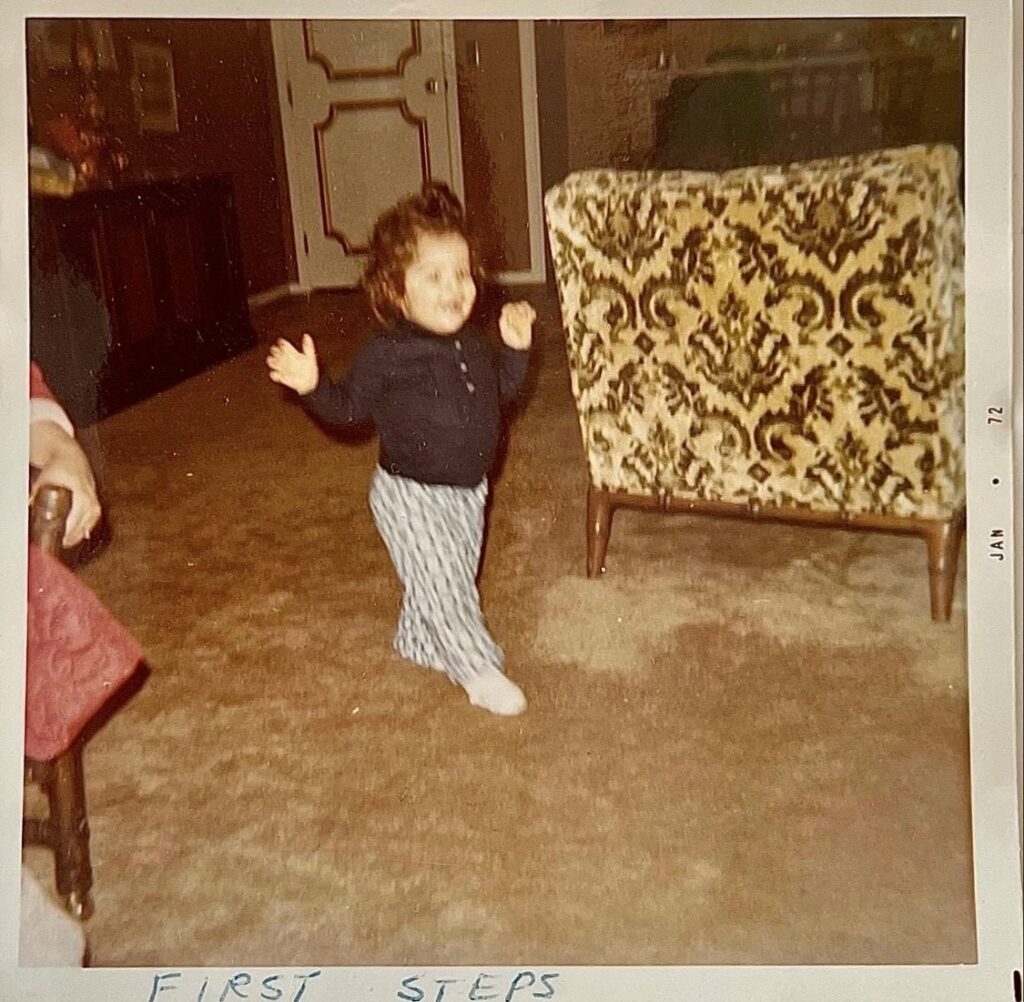
Her father was one whose name would appear on casino signs lining the Strip, including some resorts that no longer exist, such as the Desert Inn, Riviera, Sands, Frontier and Dunes. Though she was born in Los Angeles, Alison experienced many childhood memories at the resorts where her father performed. She took her first baby steps at the Sands, a moment preserved in Alison’s photo collection.
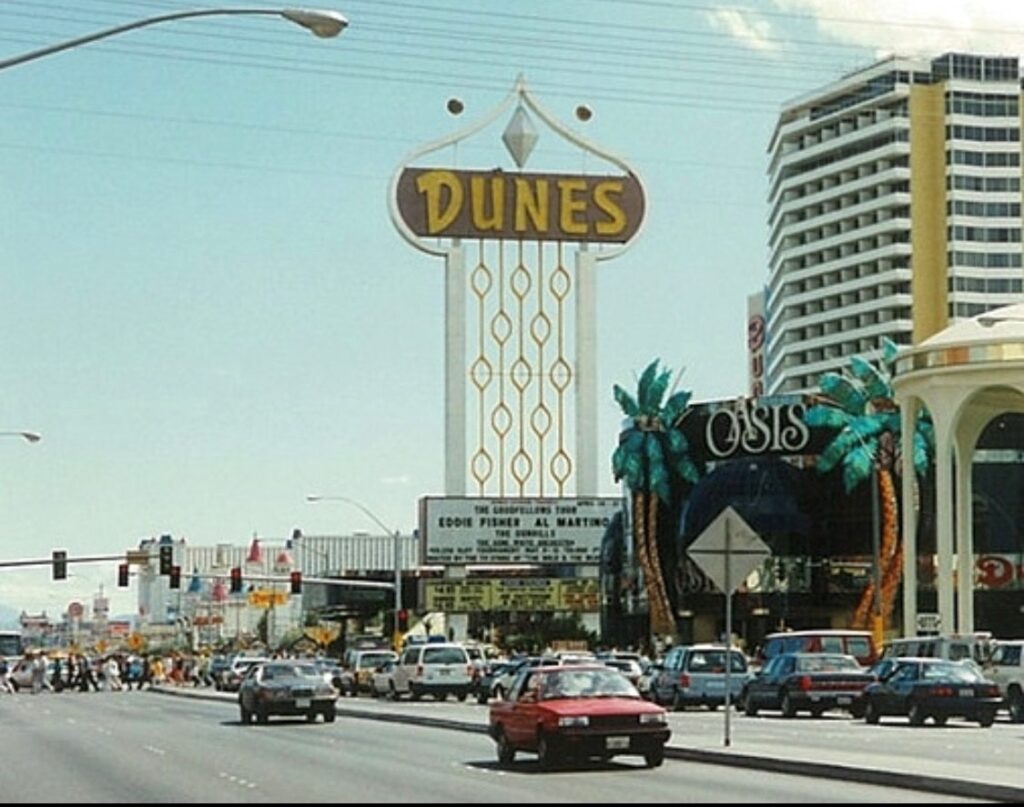
The photo collection also includes pictures of an incident involving a casino sign on the Strip. At one point during the 1990s, Al Martino and Eddie Fisher were on tour together, performing at the Dunes. On the large sign in front of the casino, Martino’s name was listed first. Overnight, someone, though not Fisher, arranged for the order of the names to be changed so that Fisher’s would be first, Alison said. Al Martino didn’t mind.
“My dad was such a laid-back guy from South Philly,” Alison said. “He could care less if his name was up front.”
Alison Martino spent much of her early childhood at Las Vegas casino-resorts during the height of her father’s career. She took her first steps as a toddler in a suite at the Sands where her father performed. Alison Martino
Blacklisted from the Strip
The friendship between Al Martino and Eddie Fisher dated back to the 1950s, when they were struggling performers rooming together. Martino began appearing again on the Strip in the ’90s, having been banished for years apparently at Frank Sinatra’s urging, Alison said.
Supposedly unhappy about the Johnny Fontane character in The Godfather, at first in Mario Puzo’s novel and then the movie, Sinatra had Al Martino blacklisted from Las Vegas showrooms, she said. The Fontane character is a singer seeking a Mafia don’s help in securing a movie role. During his career, Sinatra was rumored to have organized crime connections.
Alison said the blacklisting was nothing personal against her father. Sinatra probably wouldn’t have liked whoever was cast as Fontane, she said, adding that Al Martino later wished he had “gotten on the phone with Frank and worked it out.”
Her father’s comeback, while touring with Fisher, occurred not long after the movie Goodfellas was released in 1990, putting classic Mob films in the forefront again. Over time, books and television programs about movies including The Godfather have come out with inside information on details such as how the actors were chosen. At least where her father is concerned, those details aren’t always exactly accurate, Alison said.
In reality, her father got the Fontane role after singer Phyllis McGuire, who had a romantic relationship with the Chicago Outfit’s Sam Giancana, told him about the part and said he would be perfect for it, Alison said. He lobbied for it and was chosen without having to audition, she said.
Alison said Coppola flew to Las Vegas and helped get her father out of a contract at the Desert Inn so he could be in the movie.
This photo from the 1990s shows the marquee outside of the Dunes Hotel with Al Martino and Eddie Fisher before an incident where someone switched the order of the names overnight. The easygoing Martino didn’t make an issue of it. Alison Martino
Las Vegas ‘mystique’
During the recent trip to Las Vegas, Alison stayed at the Fontainebleau resort on the northeast end of the Strip. The 3,644-room Fontainebleau, which opened in 2023, is another component in what many hope will be a North Strip revival.
From her room at the Fontainebleau, Alison could see the 1960s-era Circus Circus resort across the street, still in operation. The two newer hotel-casinos on that section of the Strip, the Fontainebleau and Resorts World, tower over Circus Circus.
“It’s amazing how much smaller the casinos were,” Alison said.
While in town for the Eagles concert, she went to the steakhouse at Circus Circus, regarded for years as a favorite restaurant among tourists and locals.
“Every time I go on a trip I always try to find all the vintage places I can find and promote them so they can stick around a little bit longer,” she said.
Walking into the Circus Circus restaurant was like entering “a time warp,” she said. The red-leather booths and dark lighting reminded her of another classic Las Vegas steakhouse, the Golden Steer.
With Circus Circus up for sale, Alison said if it ceases to exist, she hopes the famous clown sign along the Strip will be preserved at the Neon Museum.
Though Las Vegas is dynamic and always evolving, its earlier version, when entertainers such as Shecky Greene and Norm Crosby would drop by their friends’ rehearsals, had a special appeal that still exists at places around town, Alison said.
She said there was “a mystique to Las Vegas” that she hopes never goes away.
Larry Henry is a veteran print and broadcast journalist. He served as press secretary for Nevada Governor Bob Miller and was political editor at the Las Vegas Sun and managing editor at KFSM-TV, the CBS affiliate in Northwest Arkansas. Today, he is a senior reporter for Gambling.com.
The Alto Knights, the film written by Nicholas Pileggi and directed by Barry Levinson, is named for a once-prominent Manhattan social club of the Genovese crime family. Social clubs were a home away from home for mobsters to fraternize with their partners in crime. They also were venues for discussing business, which meant anything from robbery and extortion to drug trafficking and murder. Individual crews often had their own hangouts, such as John Gotti’s Bergin Hunt and Fish Club in Queens. Gotti later took over the Ravenite Social Club in Manhattan after ascending to head of the Gambino crime family, as the top dogs typically had their own clubs passed down from boss to boss.
Not all social clubs were affiliated with organized crime. Since the late 1800s, social clubs have been a place for Italian Americans to congregate with one another and preserve their cultural identity. One of the oldest in the country, Tiro a Segno, started in 1888 in New York City and became an important refuge when anti-Italian sentiments were at an all-time high. Tiro a Segno, Italian for “target shooting,” was first a Staten Island hunting club before moving in 1924 to a Greenwich Village location where there is a shooting range in the basement. Tiro a Segno is a legitimate establishment, which counts among its past members reform-minded New York Mayor Fiorello La Guardia and famous tenor Enrico Caruso. But the Mob has a way of co-opting legitimate concepts for its own nefarious purposes.
Social clubs usually were places for discussing crimes, not committing them, but there were a few exceptions. Gambino hitman Roy DeMeo had a flat next to his Gemini Lounge outfitted with tools for murder and adhering to his adage of “no body, no crime.” In 1984, Mary Bari the longtime girlfriend of Colombo crime family boss Alphonse Persico, was murdered by Colombo family member Greg Scarpa Jr. at the Wimpy Boy Social Club to prevent her from divulging to the feds the boss-in-hiding’s location.
Some social clubs functioned as mini-casinos in which mobsters would bet on poker and blackjack, but there were non-traditional games too. Gotti, an avid and often-unlucky gambler, added Scrabble, Monopoly and chess to the gaming tables at the Sinatra Club, an after-hours hangout in the Ozone Park neighborhood of Queens that belonged to Colombo crime family associate Sal “Sally Ubatz” Polisi. Polisi’s joint offered other illegal activities too. He contracted prostitutes to accompany patrons in his den of iniquity — and at a nearby motel. And unbeknownst to some of his closest allies, Polisi secretly used the hangout as a front for drug trafficking.
In at least one case, social club dwellers became the victims of crime. In 1992, married swindlers Thomas and Rosemarie Uva targeted these spots in a string of robberies, dramatized in the 2014 film Rob the Mob. The patrons of these establishments were guaranteed to have plenty of cash and jewelry for the taking. Their spree ended on Christmas Eve that year when Gambino capo Dominick “Skinny Dom” Pizzonia gunned them down. The Mob took the violation of their strongholds personally.
The Alto Knights and the Ravenite
The Alto Knights began its life as the Café Royale on the corner of Kenmare and Mulberry streets, just a few blocks away from the New York Police Department headquarters. It began its long association with organized crime as a meeting spot for bootleggers during Prohibition. In the 1950s, Vito Genovese took over and renamed the club the Alto Knights Social Club. Its proximity to police headquarters meant that law enforcement kept a close eye on the place. Sherman Willse, an NYPD narcotics squad detective, conducted regular surveillance of the Alto Knights from September 1955 to February 1956. Willse provided photos of known mobsters having conversations outside the club, including Genovese, to Senator John McClellan’s Rackets Committee in 1958. This surveillance had the added benefit of discouraging attacks from rivals.
Vito Genovese, center, speaks with his New Jersey capo Anthony “Little Pussy” Russo, left, outside of the Alto Knights Social Club. The latest Mob movie starring Robert De Niro, The Alto Knights, takes its title from this club. The Center for Legislative Archives
There is a misconception that the Alto Knights later became the Ravenite Social Club, the Gambino family headquarters. The ground zero for this misinformation appears to be a 1986 Newsday column, “Inside New York,” which transcribed a voice message from a “Mob insider”:
“You reporters are dumb. You keep mentioning the Ravenite Social Club on Broome Street as Gambino family headquarters, like it was new. What you don’t know is that dump … is where top wiseguys have been doing business for about 60 years. … About 1931, [Lucky] Luciano became boss of the family and named it the Alto Knights. … After Carlo Gambino became the most powerful boss in the country he changed the name, because he always hated taking a back seat to Charlie Lucky and the others. He called the place Ravenite, supposedly after his favorite poem, ‘The Raven,’ by [Edgar Allen] Poe.”
In fact, the Alto Knights and the Ravenite were two blocks away from each other, at 86 Kenmare Street and 247 Mulberry Street, respectively. The former’s renaming took place much later than this caller claims. A September 1951 New York Daily News report on the arrest of a bookie at the address refers to the venue as the Café Royale. Evidently, the Ravenite and Alto Knights existed concurrently. Aniello “Neil” Dellacroce, a Gambino capo who later became underboss, was arrested outside the Ravenite in 1956 in relation to the murder of Abraham Telvi, who allegedly threw acid in the face of investigative reporter Victor Reisel earlier that year. Meanwhile, the Alto Knights was mentioned in a 1958 FBI memo, still actively serving as a Mafia meeting place.
Contributing to the mix-up might be the Ravenite’s original 1919 name, the Raven Knights. This also discounts the theory regarding Gambino’s love for gothic poetry, as the boss didn’t arrive in America until 1921. Although the Ravenite had appeared in some newspaper reports since the mid- to late 1950s, it was Gotti who, in the 1980s, turned it into the most well-known social club in Mob history.
‘Don’t talk, this place is bugged’
Before the Ravenite, Gotti spent his time at the Bergin Hunt and Fish Club in the Ozone Park neighborhood of Queens. In the early 1970s, Gotti’s capo, Carmine “Charley Wagons” Fatico, opened the social club and purportedly named it after Bergen Street where Fatico’s crew originated — the misspelled name stuck. Fatico deliberately picked a location close to JFK airport, a frequent target of his crew’s hijackings. The Bergin consisted of two units sharing a brick façade. Partially obscured behind a window with chicken-wire grating was a sign that read, “Bergin HUNT & FISH Social Club Inc.,” leaving no question about the place’s identity to prying eyes. The Bergin began a slow decline once Gotti was convicted and sentenced to life in prison in 1992. Gotti’s brother, Peter, and son, John Jr., continued to use the club after the conviction, but in 2000, half of the Bergin became a butcher shop. By 2005, it had been vacated and was available for lease.
John Gotti speaks with close ally Angelo “Quack Quack” Ruggiero and his mentor Carmine “Charley Wagons” Fatico outside of the Bergin Hunt and Fish Club. The three men in the middle, from left to right, are Ruggiero, Gotti and Fatico. Getty Images
When the Dapper Don took the reins of the Gambino crime family after his successful plot to kill boss Paul Castellano, he moved his operations from the Bergin to the Ravenite. With only two railroad-style rooms, the Ravenite was not a large establishment. The front room had tables and an espresso machine, while the back room functioned as a private meeting space. Upon taking control, Gotti had the exterior remodeled. The wide bay windows were removed, the façade bricked over and signage removed. From the outside, the renovated — and now non-descript — Ravenite looked more like the Bergin. The brick wall not only concealed the club from curious spectators but protected it from potential bombings.
The Ravenite, like all Mob social clubs, was naturally a prime target for surveillance. All levels of law enforcement knew that having ears inside a social club was a surefire way to gain Mafia intel. In 1979, an NYPD detective snuck into the Ravenite to install a listening device and gave sedative-laced meatballs to the guard dog. However, the drowsy dog later tipped off Gambino associates that something was awry, and they quickly found and disposed of the bug.
The Ravenite Social Club was John Gotti’s main venue for meetings with associates once he took over as boss. The venue was also a frequent target of FBI surveillance. Getty Images
It was well known in the underworld that unwelcome ears were listening inside the clubs. A word of advice is attributed to Gotti: “Don’t ever say anything you don’t want played back to you someday.” Some clubs had signs that said, “Don’t talk. This place is bugged.” At the Triangle Social Club, the home base of Genovese crime family boss Vincent “Chin” Gigante, members were directed to never say the boss’s name out loud and only point to their chin when referring to him. Above the telephone at the Ravenite was a picture of a literal bug as a reminder of this cardinal rule. Unfortunately for Gotti, he did not follow his own advice.
Gotti had taken to having private conversations with his crew in an apartment above the Ravenite. Every now and then, the sole resident, 74-year-old Nettie Cirelli, would go shopping on Gotti’s dime while he used her apartment to talk business. Gotti specifically chose this location to avoid the suspected bugs in the Ravenite. However, Gotti would begin conversations while going up the stairs to the apartment, tipping off the feds that there was evidential gold waiting inside.
In late 1989, when Cirelli went on vacation, FBI agents snuck into the apartment and installed a bug, which turned out to be exactly what the team needed to build a case against Gotti. The FBI first used the tapes to convince Gotti’s underboss, “Sammy the Bull” Gravano, to become a state’s witness. Then the tapes became evidence for the prosecution in Gotti’s 1992 trial. As the Teflon Don sat in the courtroom, the day when his own words were played back to him had come.
This is one of the bugs that FBI agents planted inside the Ravenite Social Club. The covert microphones in the Teflon Don’s headquarters collected the evidence that law enforcement needed to take him down once and for all. The Mob Museum Collection
Beyond New York City
New York was a hotspot for social clubs with its high density of mobsters, but the hangouts existed anywhere with an organized crime presence. And just like New York, law enforcement kept a constant vigil on them. Wiseguys expected surveillance, but some of these operations went much deeper than they expected.
Chicago Outfit boss Sam Giancana had multiple places as his headquarters, although he spent much of his time at the Armory, a cocktail lounge in Chicago’s Forest Park suburb. Unlike the Ravenite, others were welcome in Giancana’s domain. In 1958, Forest Park Mayor William Meyer hosted a dinner for Frank Sinatra and Dean Martin at the Armory. That openness came with a drawback, as the Chicago boss was continually paranoid that the feds were spying on him — and rightfully so. Giancana was a key target of FBI Director J. Edgar Hoover’s Top Hoodlum program.
The FBI had installed secret — and illegal — wiretaps and bugs in many of Giancana’s meeting places, including the Armory. Agents gained access to the Armory by copying a janitor’s keys after taking him in for questioning on dubious suspicions. In addition to gaining information about the boss’s dealings, the planted bug tipped off the FBI about his plans to kill Cuban President Fidel Castro, although they didn’t know it was a CIA-sanctioned operation.
The FBI’s methods of surveillance were bold, but in Las Vegas they would have their most audacious scheme yet. The Mob had been flushed out of Las Vegas casinos by the 1990s, but some remnants held strong in other parts of the city. In 1995, Genovese crime family associate Anthony “Fat Tony” Angioletti opened the Sea Breeze, a social club located in an industrial complex a few blocks down the street from the Rio hotel-casino.
In 1995, the FBI opened a social club in the unit on the right of this strip mall at 3855 S. Valley View Blvd., only a few blocks up the street from the Rio Hotel. The club served as a sting operation to catch the remnants of the Mob in Las Vegas.
The Sea Breeze was a humble establishment. The 504-square foot space had a kitchen, a few places to sit and a television. But the club became a hot spot for mobsters transplanted to Las Vegas, including Carmen Milano, brother of Los Angeles boss Peter Milano; former Spilotro associate Herbie Blitzstein; and New York Mob associate Peter Caruso. Although Angioletti’s boisterous nature was a turnoff for the club’s patrons, they stayed for his free, home-cooked Italian meals. The mobsters enjoyed dinner on the house while plotting their latest schemes.
What the regulars didn’t know is that Angioletti was an FBI informant, and the feds had secretly funded “his” social club. One of the regulars was an undercover FBI agent, Herm Groman, who was part of the team that created the Sea Breeze. Groman, too, benefited from Angioletti’s fine cuisine.
“Ate there many times with the fellas,” Groman said in an email. “I’d say his best item on our menu was when he would make ‘Long Island Littleneck Clams and Linguine.’ He would have the clams overnighted from New York! Bellissimo! If I spent just a little more time there, they would have started calling me ‘Fat Sonny!’”
As part of “Operation Thin Crust,” agents wired up the Sea Breeze with microphones to secretly record conservations about the crew’s money-making schemes. The Sea Breeze helped the FBI to build a solid case against Blitzstein and his fellow mobsters, but it took a sudden turn in 1997. On January 6, the case became a murder investigation when Blitzstein was found shot to death in his home near the intersection of Twain Avenue and Sandhill Road. Caruso told Mob associate John Branco that he had ordered the hit, not knowing that Caruso, also a criminal informant, was wearing a wire. “Operation Thin Crust” was one of the final blows that drove the Mob out of Las Vegas once and for all.
The high profile of social clubs attracted too much attention from law enforcement to continue to exist. There are still hangout spots, but today’s Mob bosses would rather operate in a more incognito manner than their forefathers. The locations of the most infamous social clubs have, too, moved on from their shady past. As of 2025, the Alto Knights is now a pizzeria; the Ravenite is a men’s fashion boutique; the two units of the Bergin are a bubble tea café and a Spanish-speaking Christian church; the Armory Lounge in Chicago is a brunch diner; and the Sea Breeze in Las Vegas is a body shop.
The newest Mob movie written by journalist and screenwriter Nicholas Pileggi, The Alto Knights, is his third major script focused on organized crime, along with Goodfellas and Casino.
Together, these movies, featuring various characters in different eras, tell the story of the Mafia’s rise from street crimes to casino boardrooms to its eventual decline.
Named for a Mafia social club in New York City, the new movie, scheduled for release on March 21, depicts a feud between powerful mobsters Vito Genovese and Frank Costello, with Robert De Niro portraying both characters. During a power grab in May 1957, Costello was wounded in a shooting planned by Genovese and bungled by hitman Vincent “Chin” Gigante. According to Pileggi, this rivalry within a Mafia clan was part of the Mob’s gradual undoing.
“TheAlto Knights is really about the end of organized crime,” Pileggi told The Mob Museum. “It takes a while for it to die. It’s mortally wounded, and it’s bleeding for a couple of years, but now it’s just about expired.”
Currently, there is “very little left” of the Mob from an earlier period when Mafia families and Jewish gangsters were involved in bootlegging and illegal gambling, Pileggi said. Alcohol has been available legally in the U.S. since Prohibition ended in 1933, and casinos and sportsbooks are operating lawfully these days across the country.
The money now is in narcotics trafficking controlled by criminals from various countries, Pileggi said. “Gangster crime today, it’s drugs, and it’s different,” he said. “That’s where it is organized.”
In Pileggi’s upcoming film The Alto Knights, Robert De Niro plays both Vito Genovese, left, and Frank Costello, right. Genovese and Costello were both key players in the origins of Cosa Nostra. Warner Bros
Chasing ‘the American dream’
Directed by Barry Levinson, The Alto Knights is coming out decades after the release of Goodfellas and Casino, the two movies that cemented Pileggi’s reputation as a top Hollywood screenwriter. Those earlier films, which he co-wrote with director Martin Scorsese, are based on Pileggi’s nonfiction books Wiseguy and Casino: Love and Honor in Las Vegas. For the 1990 film version of Wiseguy, the title was changed to Goodfellas to keep it from being confused with an unrelated CBS television series called Wiseguy. Pileggi also co-wrote the 1996 Harold Becker-directed movie City Hall, a New York political drama with Mafia overtones.
Pileggi’s background shaped his interest in organized crime. Growing up in Bensonhurst, Brooklyn, where many mobsters lived, Pileggi, now 92, said he was fascinated by “the awe in which they were held in the neighborhood.”
Later, as an Associated Press reporter and magazine writer covering crime, Pileggi became intrigued by “street-level guys” in places such as Bensonhurst. These were the neighborhood gangsters not often portrayed in movies such as 1972’s The Godfather, which focuses on the upper echelon, including the fictional Corleone family’s ultimate leader, Michael.
Working as a journalist, Pileggi met Henry Hill, a New York Mob associate who couldn’t be a Mafia made member because he was half-Irish instead of fully Italian as required. Hill gave Pileggi the perspective of an outsider operating on the inside. Pileggi knew Hill’s story would make an interesting book.
“I wanted the street-level wiseguy, and Henry Hill came along,” Pileggi said. Hill was an opportunistic hustler stealing, among other things, merchandise from delivery trucks. “Michael Corleone wasn’t hijacking a truck,” Pileggi said, “but Henry Hill was.”
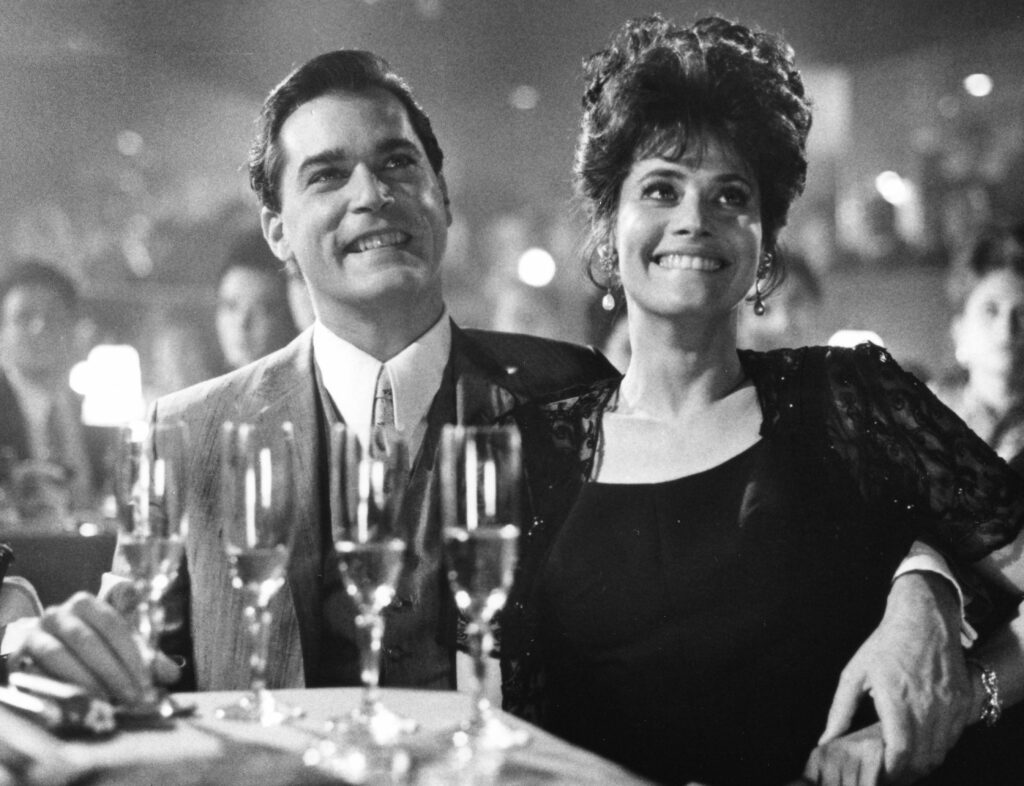
By focusing on low-ranking mobster Henry Hill and his wife, Karen, Pileggi could tell a story from a different perspective than the leadership portrayed in movies such as The Godfather. The Mob Museum Collection
A criminal group in Hill’s circle later pulled off a larger heist of cash and jewels flown into New York by Lufthansa Airlines, an incident included in Goodfellas. The fast-paced movie, which also features Hill’s relationship with his wife, Karen, remains popular today, long after its release 35 years ago.
From there, Pileggi’s attention shifted to a Kansas City court case in the mid-1980s involving criminals skimming untaxed casino revenue from Las Vegas. These mobsters were operating at a higher professional level than New York wiseguys hijacking trucks.
To Pileggi, the events in Las Vegas represented a “next step” in the overall Mob story. “This is organized crime really moving into big business,” he said.
Needing central characters for the book and screenplay, Pileggi finally convinced Frank “Lefty” Rosenthal to talk with him. During the 1970s, Rosenthal oversaw the Stardust and three other casinos in the Las Vegas Valley for Midwestern crime families and thus would be important to Pileggi’s story. Initially, Rosenthal wouldn’t talk. However, after learning from Pileggi that De Niro would be portraying him in the movie and that he’d get to meet the actor, Rosenthal opened up. In the book, Pileggi used real names such as Rosenthal’s and the Stardust, but for the film, the names were changed. The 1995 movie also stars Sharon Stone as a character based on Rosenthal’s wife, Geri, and Joe Pesci as a dramatized version of the Chicago Outfit’s Tony Spilotro. An affair between the Stone and Pesci characters creates dramatic conflict in the movie.
Pileggi said Rosenthal, a longtime bookmaker from Chicago, had hoped to live “the American dream.” “Lefty Rosenthal always used to say that the American dream is great wealth with very little work, no work, just the check comes,” Pileggi said.
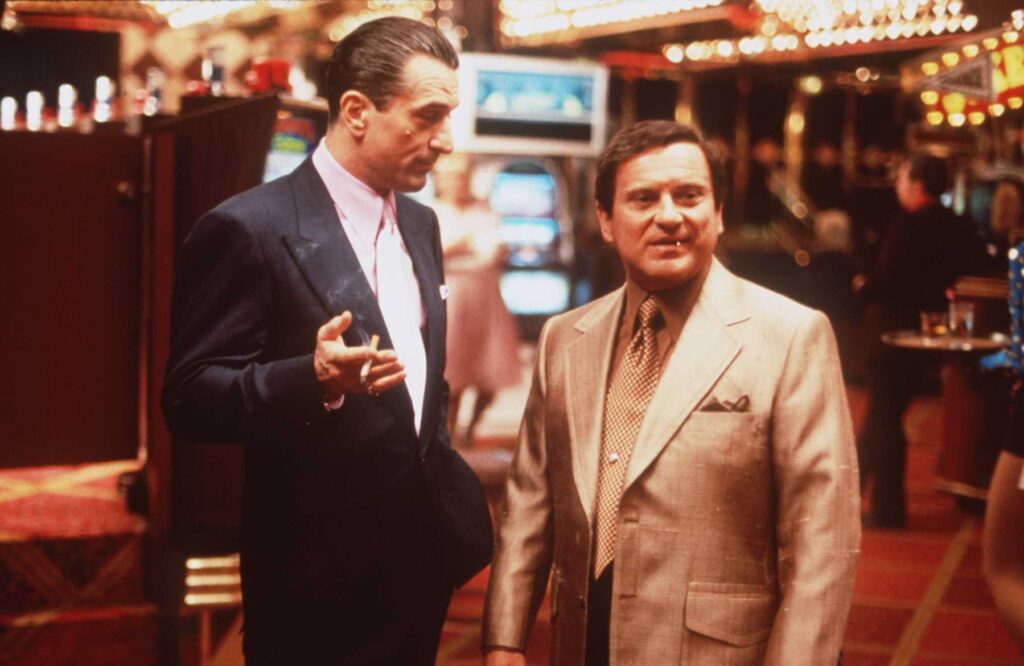
Robert De Niro’s and Joe Pesci’s characters in Casino are based on Lefty Rosenthal and Tony Spilotro, respectively. The film changed many names and locations from real life, but Pileggi published the unaltered facts in the book version one month before the movie’s premiere. Warner Bros / The Mob Museum Collection
Emotional expression
Pileggi’s focus on interesting characters, like those in Goodfellas, Casino and The Alto Knights, gives his work an added dimension. In the book Made Men: The Story of Goodfellas, author Glenn Kenny wrote that Pileggi “doesn’t just transcribe his subjects.”
“He creates credible, recognizable, memorable voices for them,” Kenny wrote. “And he tells a compelling and frequently mind-boggling story.”
To make a story compelling, Pileggi said, you need people like Frank and Geri Rosenthal, Tony Spilotro, and Henry and Karen Hill.
“For my kind of movies, I always have to find those kind of characters,” Pileggi said. “There would have been a Casino book if all I had was the trial and the taking over of the casino [in Las Vegas]. It would have been an interesting book, but it becomes a movie when you have Lefty, Tony and Geri, just like Goodfellas became a movie. Lufthansa would have been exciting, but you had to have Henry and Karen.”
A person wanting precise facts can turn to scholarly books, documentaries and court records, Pileggi said, but effective Hollywood movies need to convey an “emotional expression.” “It may not get the facts right,” he said, “but it’ll get the emotion right.”
With homes in New York City and Los Angeles, Pileggi continues to work on movie scripts about the Mob.
“There are always stories,” he said.“ The Mob is a life-and-death business, which gives urgency to the story you’re writing about. Mob stories or war stories, they’re more classic because they are life and death. It gives power to the story.”
Larry Henry is a veteran print and broadcast journalist. He served as press secretary for Nevada Governor Bob Miller and was political editor at the Las Vegas Sun and managing editor at KFSM-TV, the CBS affiliate in Northwest Arkansas. Today, he is a senior reporter for Gambling.com.
New York, like other major cities across the United States, faced waves of crime during the 1970s and ’80s. What distinguished the Big Apple, however, was the pervasive influence of organized crime, controlling everything from construction to narcotics. The city was the epicenter of America’s most powerful Mafia families, ruled by a board of directors known as the Commission.
Numerous investigations into the Mob’s activities were already in progress by the early 1980s, including the Pizza Connection case, which aimed to stop the Mob’s collaboration with the Sicilian Mafia to traffic heroin. In 1983 a new player emerged on the side of law and order, Rudy Giuliani, U.S. attorney for the Southern District of New York, who soon became the Mob’s archnemesis.
The government’s bold new initiative made waves in February 1985 with the announcement of indictments against nearly all the New York Mafia’s leading figures and some of their associates. This aggressive crackdown on organized crime created a significant ripple effect throughout the criminal underworld and propelled Giuliani into the national spotlight. However, the results of these efforts did not unfold as expected.
Casting the RICO net
The Racketeer Influenced and Corrupt Organizations Act, commonly known as RICO, gave law enforcement a tool to not only catch the little fish but the sharks calling the shots too. However, some officials thought the law was unclear, and critics called it unfair. For a while after its inception in 1970, prosecutors were reluctant to use RICO, and when they did, it wasn’t to its full potential.
“We had RICO for almost 10 years before we knew what to do with it,” FBI Director William Webster said in February 1985.
RICO mandates that the government demonstrate a defendant’s involvement in the operations of a criminal enterprise through “a pattern of racketeering activity.” This pattern is the commission of at least two acts of racketeering in a 10-year timeframe. A racketeering act, often referred to as a “RICO predicate,” encompasses a range of serious federal and state felonies. Consequently, a defendant in a RICO trial may face charges related to various alleged crimes at different times and locations.
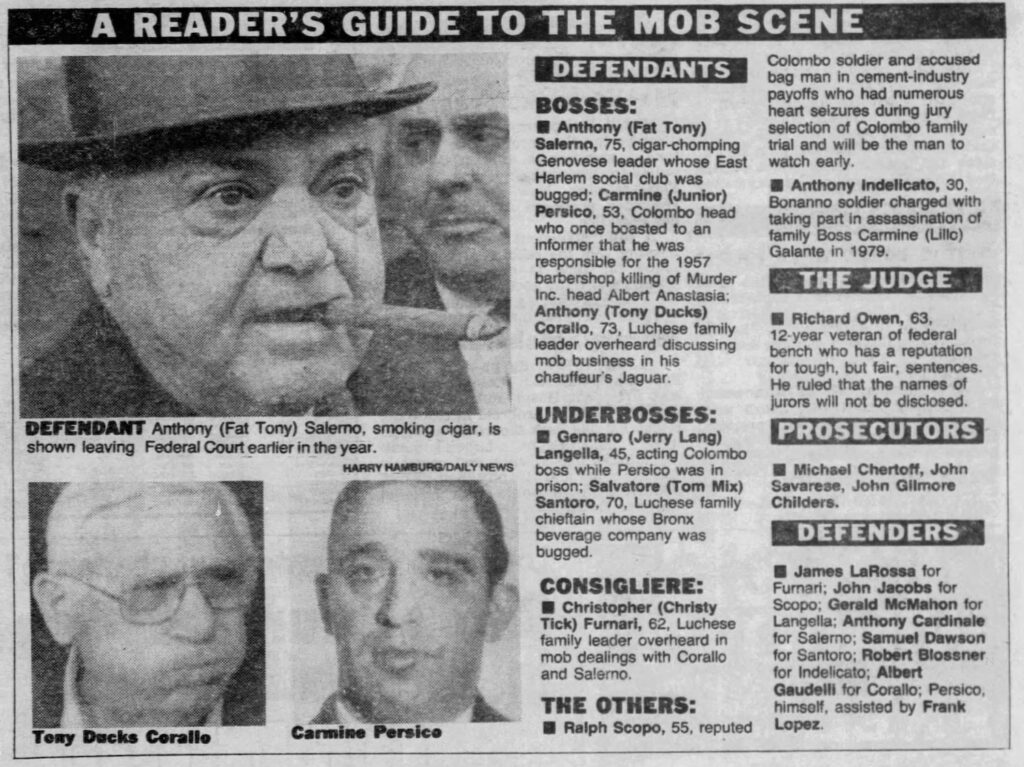
The FBI had been surveilling the Mob since 1980 as part of “Operation GENUS.” The investigation brought together federal, state and local agencies, including FBI agents, New York City Police detectives, assistant U.S. attorneys, and attorneys and investigators from the New York State Organized Crime Task Force. Among their most fruitful methods were wiretaps and bugs. Lucchese family boss Tony “Ducks” Corallo and Gambino boss Paul Castellano were both caught in their net. Hidden listening devices recorded damning conversations in Corallo’s car and Castellano’s house.
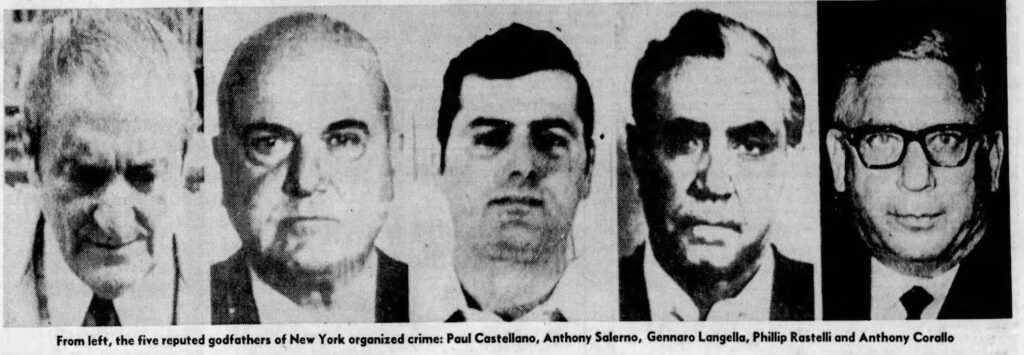
Five of the initial nine mobsters indicted represented what the government considered the ruling Commission of New York’s Five Families. Castellano was murdered before the trial’s start and Rastelli was severed for another case. Press of Atlantic City
Once Giuliani stepped into the position of U.S. attorney, his office took the lead in formally going after the five-headed beast.
“It is a great day for law enforcement,” Giuliani said during a press conference. “Probably the worst day for the Mafia.”
The government’s case
The initial 15-count indictment was announced on February 26, 1985, following an extensive five-year investigation. This effort involved cleverly hidden listening devices, 171 court-approved wiretaps and the dedication of more than 200 federal agents. Some of the defendants had already been arrested days before Giuliani’s press conference, including Castellano and Genovese family acting boss Anthony “Fat Tony” Salerno. Both put up a $2 million bail.
In the 1994 book Busting the Mob: United States v. La Cosa Nostra, James B. Jacobs summarizes the government’s argument:
“United States v. Salerno aimed to fell all of New York City’s Cosa Nostra leaders with a single stroke. The indictment charged the bosses of New York City’s Cosa Nostra crime families and several of their subordinates with constituting and operating a ‘commission’ that served as a board of directors and supreme court for the Mob. … In a real sense, the case was about whether it is a crime, meriting life imprisonment, to be a Cosa Nostra boss.”
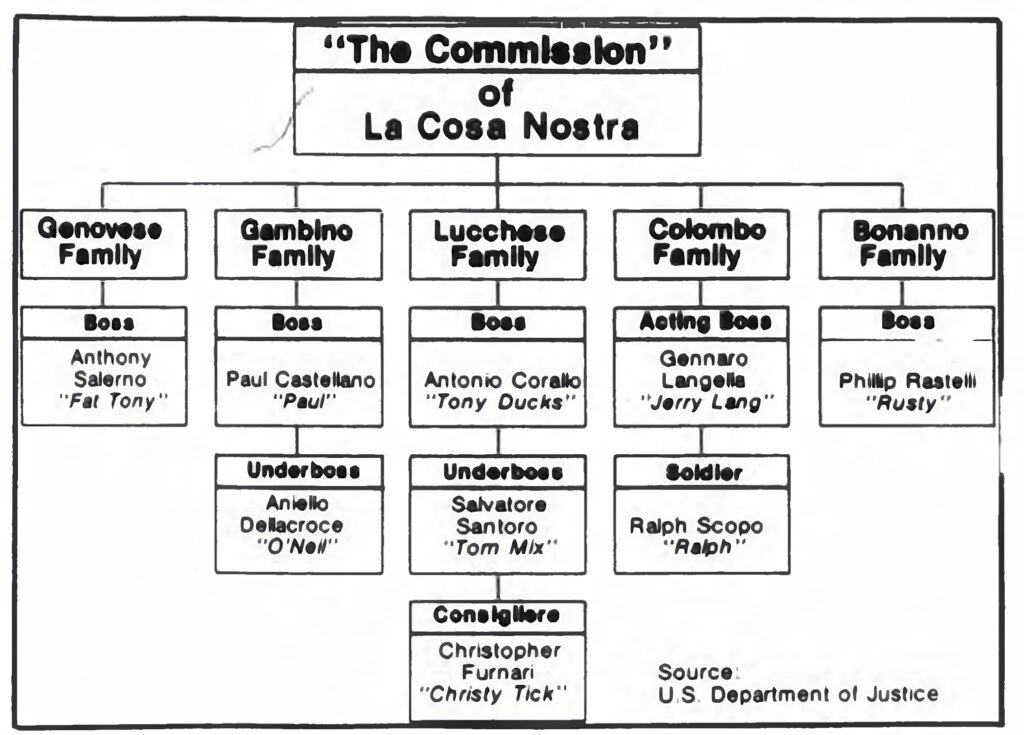
This U.S. Department of Justice graphic depicts the primary figures and crime family affiliations in the 1985 indictment. Department of Justice
The indictments targeted the Mob’s role in controlling the lucrative concrete industry and those who received the prized contracts. This group of Mob-associated companies became known as the “Concrete Club.” The indictment also pointed to the Commission’s role in approving murders.
The crux of the government’s case rested on classifying the Commission as a criminal enterprise. Every defendant in the case was a member of the Commission, who, as Jacobs wrote, had been linked to “two or more racketeering acts in furtherance of the Commission’s goals.”
Trial and error
The case went through a few changes before going to trial. Some defendants were added, some were severed and a few died before opening statements began. Additionally, there were some overlapping trials, including Castellano’s indictment a year earlier involving a car theft ring run by notorious Gambino hitman Roy DeMeo.
When the trial commenced in September 1986, the number of indictments had increased to 25, encompassing charges such as extortion, labor racketeering, drug trafficking, illegal gambling and murder. Specifically, three murders were highlighted in the indictment:
The murder of Bonanno family boss Carmine Galante in 1979, charged to Gambino underboss Aniello “Niel” Dellacroce and Philip “Rusty” Rastelli. Prosecutors later charged Bonanno capo Anthony “Bruno” Indelicato, who was one of the gunmen, too.
The murder of Leonard Coppola, a drug dealer killed along with Galante, charged to Dellacroce and Rastelli.
The murder of Bonanno capo Alphonse “Sonny Red” Indelicato in 1981, charged to Castellano, Corallo and Rastelli.
According to the 1985 indictment, the Commission approved a hit on acting Bonanno crime family boss Carmine Galante, who, along with two others, was shot and killed on July 12, 1979, in Brooklyn. Courtesy of Cipollini Collection
By the end of 1985, two of the original defendants were dead in short succession. Dellacroce died after a battle with cancer on December 2, 1985. Castellano was gunned down in Manhattan on December 16, 1985. Rastelli had been severed from the case to face unrelated charges while prosecutors added Colombo family head Carmine Persico, who chose to represent himself. Noticeably missing was Genovese boss Vincent “Chin” Gigante, who had been feigning insanity for years, commonly seen wandering the sidewalk in his pajamas and mumbling incoherently.
The Mob’s ill-fated contingency plan, according to the Chicago Sun-Times, was to snuff out informants using outsourced enforcers. The report stated that New York bosses sought assassins from Chicago because their own ranks had been compromised. Their hitmen were also too recognizable to law enforcement. The deal allegedly included giving the Chicago Mob a bigger piece of the national underworld pie, such as more control over Las Vegas gambling.
The Daily News created this graphic summarizing the case in an article by Patrice Shaughnessy and Jerry Capeci. The article marked the opening of the trial in 1986. New York Daily News
The verdicts
Officials prosecuting the case, Giuliani in particular, had said early on that this trial wasn’t a be all-end all in taking down the Mob, but that it would open the door for more prosecutions nationwide. The case was the first step in chipping away at the Mob’s power in New York.
The jury delivered guilty verdicts to eight of the defendants on November 19, 1986. Seven received 100-year sentences for racketeering, plus more than $240,000 in fines. Indelicato received 40 years for the murder of Carmine Galante plus a $50,000 fine.
There would be appeals in the coming years, but the defendants remained locked up. Six died in prison, including Salerno, Corallo and Persico. Indelicato and former Lucchese consigliere Christopher “Christie Tick” Furnari were eventually paroled in 1998 and 2014, respectively.
Christian Cipollini is an organized crime historian and the award-winning author and creator of the comic book series LUCKY, based on the true story of Charles “Lucky” Luciano.
In the 1980s, video arcades loaded with coin-operated gaming cabinets were a common shopping mall destination for people with quarters to burn. In 1986, alongside Pac Man, Donkey Kong and Galaga, appeared a new game: Empire City 1931. Like many games of the time, it had a simple concept: The player used a joystick to move a crosshair across the screen to find and take out gun-wielding mobsters in a version of New York City. These types of games did not garner much attention. It wasn’t until the early 2000s, when advances in technology allowed games to have a more cinematic feel, that the genre took off.
In 1997, Grand Theft Auto, which would become to crime-themed games what The Godfather was to Mob films, put players in the driver’s seat of a gang member working for the Mafia in fictional versions of New York City, Miami and Los Angeles. Early in development, the game started as a version of cops and robbers in a big-city playground, but it became apparent that the latter characters were more popular.
“Nobody wants to be the cop,” said Creative Director Gary Penn in an interview. “It’s more fun to be bad.”
The popularity of the GTA series grew as Rockstar Games released sequels. GTA’s success laid the framework for other game developers to follow with their own twists on this emerging genre, inspired by its action-oriented gameplay and engaging narrative. Today, there are more organized crime-themed games coming out each year than ever before.
The latest entries in the Mafia, GTA and Yakuza series, three of the biggest in the genre, are slated for release this year. Until then there are plenty of games out there for a virtual organized crime experience. Here are five of the top games in the genre that have paved the way for this year’s lineup.
5. Empire of Sin — Romero Games, 2020
In Empire of Sin, a turn-based strategy game by Romero Games, Al Capone is a playable character who is, unlike his real-life counterpart, personally involved in taking out the competition. Paradox Interactive
Most games that feature organized crime craft fictional stories in made-up locations inspired by real life. Empire of Sin breaks this tradition by assembling its cast from real historical figures and through its setting of Prohibition-era Chicago. Brenda Romero, director of Empire of Sin, drew inspiration for the game from stories of when her grandfather “walked alcohol across the [U.S.-Canada] border” during Prohibition in upstate New York.
Empire of Sin sets aside the action-packed gameplay of other Mob-themed games in favor of turn-based strategy. “The theme itself is strategic,” Romero said in an interview with the gaming news website VentureBeat. “If you watch Boardwalk Empire, it’s pretty clear that there’s all kinds of strategy going on. The movement of resources, how those resources are going to be protected, how they’re going to be sold — it was a real-life strategy game.”
The player selects a main character from a rogues’ gallery of Mob bosses and assembles a crew to build a criminal empire and control Chicago’s underworld. The aim is to achieve this by the end of Prohibition in 1933 through a combination of combat and diplomacy. You can invade other gangs’ territory and defend your own turf from incursions while also having sit-downs with rival bosses to negotiate deals.
Among the bosses to choose from are some of the most well-known crime figures of 1920s Chicago, including Al Capone, Dion O’Banion and Joe Saltis. The developers diversified the roster by bringing in organized crime figures from other cities, including Stephanie St. Clair, Harlem’s “Madam Queen of Policy,” and Sai Wing Mock, aka “Mock Duck,” leader of the Hip Sing Tong in Manhattan’s Chinatown. A new character, Meyer Lansky, the Mob’s financial guru, was added as part of an expansion, but the developers changed his name to Maxim Zelnick to avoid legal trouble.
Although Empire of Sin received mixed reviews, it’s one of the few games that allows the player to build a crime syndicate while dealing with rival gangs and corrupt cops. Most games in the genre have a shoot-first solution to every problem, but this one encourages strategic planning and decision making — like a mobbed-up game of chess. The business management component makes running speakeasies, underground casinos and breweries just as important as taking out the competition.
4. Yakuza 0 — Ryu Ga Gotoku Studio, 2015
Yakuza 0 popularized the series in the West with its over-the-top combat and silly side quests. The revamped battle system leads to absurd fights where even motorcycles are used as melee weapons. Sega
While Grand Theft Auto was exploding in popularity in America, many game developers tried to catch the trend by programming their own variants of the game. Rather than compete with Western trends, Sega game developer Toshihiro Nagoshi decided to make a game that would instead appeal primarily to a Japanese audience. Ryu ga Gotoku — “Like a Dragon” in English — launched in 2005. Sega changed the name to Yakuza for the international versions. The game was a success in Japan, but it took a decade before the series gained a foothold in America with the release of Yakuza 0, a prequel.
For most of the series, players control Kazuma Kiryu, a yakuza member with a heart of gold who navigates Japan’s underworld. The game’s dramatic storytelling is balanced with over-the-top combat and eccentric side content. Kiryu fights with his fists but also anything he can pick up, including baseball bats, traffic cones and bicycles. In one fighting sequence in the first game, Kiryu opens each door by kicking an enemy through it.
The Yakuza series capitalizes on the elements of organized crime unique to Japan, including real estate extortion, called jiageya (which translates to “person who buys land to resell”). Yakuza commonly blackmailed and intimidated property owners into selling their land at cheap prices to use in lucrative development projects. These dealings exacerbated Japan’s “bubble economy,” which led to an economic crisis in 1992.
Yakuza 0 takes place in the late 1980s amid the bubble, and many of the game’s conflicts arise from groups competing over a prime plot of land. The game contains another nod to this in one of its biggest side missions: “Real Estate Royale.” In that mission, Kiryu vies for control of the real estate properties in Kamurocho. Kamurocho is one of the game’s locations, which is nearly identical to Kabukicho, Tokyo’s red light and entertainment district in the Shinjuku neighborhood.
But what really meshed with American audiences was not its realism but rather its sometimes-wacky side content. Kiryu can let off steam from the stress of work by helping residents and enjoying activities including karaoke, disco dancing and going to the batting cages. In one quest, Kiryu can win a live chicken after scoring a turkey in a bowling minigame. A viral screenshot that contributed to the game’s popularity shows Kiryu saying, “Hello, chicken. Your name will be… Nugget.” Nugget can then be assigned to manage properties in the real estate side mission. In another bizarre mission, Kiryu helps shoot a music video for “Miracle Johnson,” a not-so-subtle nod to “King of Pop” Michael Jackson.
Yakuza is now popular enough in the West that Sega has dropped the adopted name Yakuza and now calls the English version the same as in Japan: Like a Dragon. The latest entry in the series coming out this year is a spinoff starring Kiryu’s rival and Yakuza 0 deuteragonist, Goro Majima, which goes full steam into the silly: Like a Dragon: Pirate Yakuza in Hawaii.
3. Grand Theft Auto: Vice City, Rockstar North, 2002
In Grand Theft Auto: Vice City, players control the protagonist Tommy Vercetti, a made man in the Mafia, who becomes a Tony Montana-like figure in Miami-inspired Vice City. Drawing too much attention, however, puts the heat on Vercetti, which may cut short his ambitions. Rockstar Games
After Sony launched the PlayStation 2 in 2000 with new graphical capabilities, Rockstar Games upgraded the GTA series to 3D graphics with Grand Theft Auto III. It became the best-selling game of 2001. The game dropped to second best in 2002, only because its sequel, Grand Theft Auto: Vice City, climbed to the top spot.
Vice City ditches the modern setting of previous games and instead rewinds the clock to 1986 for its fictional version of Miami. As the name and setting imply, 1980s pop culture was the primary influence on the game’s developers.
“You cannot play for more than five minutes and not think about Scarface or Miami Vice, and from that point on you’re playing those roles,” said Vice City producer Leslie Benzies. “And who has never wanted to be Tony Montana on the balcony with his ‘little friend’?”
With the success of their previous titles, Rockstar had the budget to add real star power to the voice cast. Ray Liotta voices the player character, Tommy Vercetti, a made man in the made-up Forelli crime family. Vercetti is sent to Vice City to oversee a drug deal and ends up becoming a Tony Montana-style drug lord. Along the way he encounters a diverse cast of criminals either aiding or inhibiting his rise to power. Among the other well-known actors voicing Vercetti’s co-conspirators and adversaries are Burt Reynolds, Danny Trejo and Miami Vice’s Philip Michael Thomas.
The game was not without its controversies. Along with other games in the series, Vice City has been criticized for its violence, sexual content and depictions of ethnic groups. Rockstar Games offered a formal apology and an updated version of the game in response to the latter. In the game, the player is given carte blanche to commit a variety of violent crimes, although this is discouraged by the “wanted” system that sends the police after the player, escalating with each crime committed (unless you enter a cheat code). Critics have said that’s not enough, however, and have blamed acts of violence on the game’s influence.
In 2004, Rockstar released another follow-up on the PlayStation 2, Grand Theft Auto: San Andreas, diving into the world of West Coast street gangs inspired by the Los Angeles underworld. With yet another title topping the charts, the GTA series cemented itself as a gold mine for Rockstar Games, which continues later this year with the release of Grand Theft Auto VI. Fans wanting to return to Vice City are in luck, as the latest entry in the series will have the city as one of its main locations.
2. Sleeping Dogs — United Front Games, 2012
In Sleeping Dogs, Hong Kong undercover cop Wei Shen infiltrates the Sun On Yee triad and must strike a balance between gaining the triad’s trust and not crossing the line to become a criminal. Throwing a thug into an air duct is a sure-fire way to gain points with the triads. Square Enix
Sleeping Dogs takes the player into the world of Chinese organized crime set in modern Hong Kong. Like most of the other games on this list, it takes cues from the GTA series. The game sets itself apart from other GTA facsimiles, however, by putting the player in the role of an undercover cop. Chinese American police officer Wei Shen is transferred to Hong Kong to infiltrate a triad organization and take it down from within. The game’s fictional Sun On Yee is based on the largest triad organization in the world, the Sun Yee On. Likewise, the adversarial 18K triad is not too far from its real-life counterpart: the 14K.
Unlike the Yakuza series, Sleeping Dogs is a game about Asian organized crime developed by a Western team for an international audience. As such, the developers drew inspiration from depictions of undercover cops in both Western and Asian film and television, including Donnie Brasco and Infernal Affairs, the Hong Kong crime drama that was remade into Martin Scorsese’s The Departed. The HBO series The Wire influenced the game’s writers in creating morally ambiguous characters on both sides of the law.
As an undercover, Shen must balance acts that advance his case against the triads while gaining favor with them to maintain his cover. The player has the freedom to make Shen as reckless or as cautious as they want. Violent combat moves, such as shoving an enemy into an electrical box, increases favor with the triads while avoiding civilian casualties and property damage earns points with law enforcement. The game quantifies the paths by giving “Police XP” and “Triad XP” for certain actions and encourages the player to obtain both by offering special upgrades and abilities for each path. Shen’s dealings with corrupt cops and shaky alliances with criminals also make it harder for the player to favor one path over the other.
As one of the only games that center on the triads, Sleeping Dogs is a worthwhile entry in the organized crime genre. There are also few games that put the player in the shoes of an undercover. The game was successful enough that a movie adaptation was announced in 2017 with Ip Man star Donnie Yen as Shen. In January Yen told gaming website Polygon that, unfortunately, the project had been canceled. However, Marvel’s Shang-Chi star Simu Liu announced on X soon after that he has been “working with the rights holders to bring Sleeping Dogs to the big screen.”
1.Mafia: Definitive Edition — Hangar 13, 2020
In the first game of the Mafia series, you play as Tommy Angelo, right, who rises in the ranks of the Salieri crime family. For most of the game, Angelo does the bidding of Don Salieri, left, including taking out powerful enemies. 2K Games
Of all the games with an organized crime theme, the Mafia series plays the most like a video game version of The Godfather — and that’s by design. “Our creative direction is to deliver the fantasy of playing a Mob movie,” said Alex Cox, director of the latest entry in the series, in an interview with the gaming news website Video Games Chronicle.
Released in 2002 but remade in 2020 as Mafia: Definitive Edition, the first game is set in Lost Heaven, inspired by Chicago, and takes place throughout the 1930s. It begins with taxi driver Tommy Angelo forced at gunpoint to serve as a getaway driver for enforcers in the Salieri crime family. After impressing the mobsters with his driving skills, Angelo gets recruited into the family.
In a plot device straight out of a Mob film, Angelo narrates his rise to power through flashbacks wrapped around a confessional with a detective in a restaurant booth. The player experiences Angelo’s life of crime from his recruitment and promotion to made man to his disillusionment with the Mob and becoming an informant. As with real-world mobsters, Angelo doesn’t join Team America out of the goodness of his heart — it’s all to avoid a lengthy prison sentence.
Throughout the game, Mob boss Ennio Salieri sends Angelo on a variety of missions related to the crime family’s rackets, including smuggling shipments of booze during the tail end of Prohibition and roughing up debtors late on their payments. Soon into the game assassinations join the roster of tasks to complete for the Don, whether it’s taking out rivals, corrupt public officials or people who have been talking too much. In the latter case, Angelo gets his first dose of disillusionment and disobeys the boss by letting the target flee.
Mafia is not a historically accurate take on the Mob, but it is an homage to Mob movies. References to Scorsese and Francis Ford Coppola films are peppered through the game. None are more obvious than during an assassination mission aboard a ship. Angelo receives orders to take out a corrupt politician, so he commandeers a sailor’s uniform to sneak aboard. Just like Michael Corleone in the restaurant scene in The Godfather, Angelo fumbles around a bathroom to find a revolver hidden in a toilet.
Most missions in the game feature bloody conflicts with the Morello crime family, a name borrowed from New York mobster Giuseppe Morello. These battles parallel the real-world gang wars of the 1920s, such as Chicago’s “Beer Wars” involving Al Capone. Angelo racks up a body count, however, far exceeding any mobster in real life, which is just a consequence of being a video game protagonist. Removing the hordes of enemies in favor of realism would make for a boring experience.
The two sequels to the 2002 game, Mafia II and Mafia III, explore new settings: post-World War II New York and 1960s New Orleans, respectively. The 2020 remake sold well enough to warrant a fourth entry in the series: Mafia: The Old Country. Coming later this year, the game is a prequel set in early 1900s Sicily. It’s a departure from the America-set titles, but still appropriate for a series heavily influenced by The Godfather.
Beginning in the 1970s, the New York Post’s coverage of the Mob typified tabloid journalism during organized crime’s heyday in the nation’s biggest city.
With Australian Rupert Murdoch as its new owner, the Post during the mid- to late ’70s began pumping up its coverage of violence, sex and celebrity scandal, led by scoop-driven reporters such as Steve Dunleavy, a fast-living, competitive newsman from Australia.
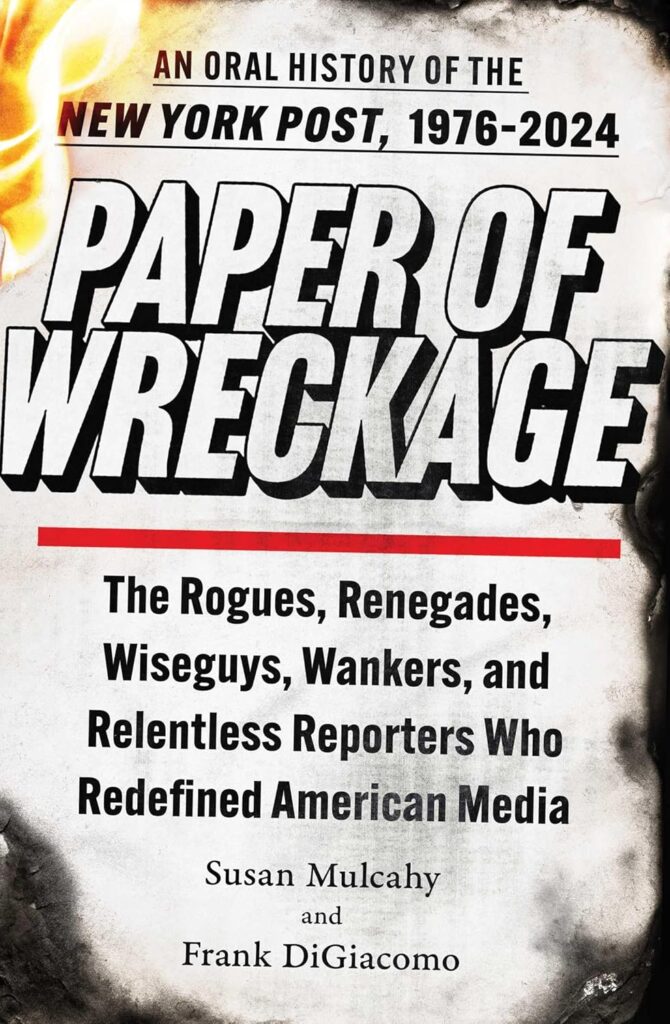
The Post’s place in big-city journalism from 1976-2004 is detailed in a new oral history, Paper of Wreckage: The Rogues, Renegades, Wiseguys, Wankers, and Relentless Reporters Who Redefined American Media. The book, compiled by former Post journalists Susan Mulcahy and Frank DiGiacomo, includes first-person accounts of newsroom (and barroom) antics while also exploring the paper’s amped-up coverage of New York’s political, sports and entertainment figures.
Paper of Wreckage, published last October, tells the history of the New York Post’s last 50 years through the eyes of those involved with the publication.
The tabloid’s “blue-collar, man-on-the-street sensibility,” as the New York Times puts it, was sharpened by reporters and editors imported from Australia and London’s Fleet Street, where scoops and aggressive coverage, especially of big crime stories, are a matter of survival.
At the Post, these hard-news veterans from overseas played fast and loose with journalistic ethics, including paying for interviews, while competing for major stories such as the Son of Sam murders, Beatle John Lennon’s shooting death, and feuds in the Yankees’ clubhouse. The Post’s chief rival then and now is another New York City tabloid, the Daily News.
“When Murdoch’s pirate crew of Australian journalists arrived, it was as if, a former reporter says, Sid Vicious had taken over the Philharmonic,” the New York Times wrote in its review of the oral history.
Mob and Post ‘inextricably linked’
During the early Murdoch years, the Post was known for more than crime coverage. A popular feature launched during the 1970s, the Page Six gossip column, still exists. However, the paper’s stories about the Mob served notice that crime coverage would be important under the new ownership.
The staff members from overseas weren’t the only ones working the streets. Reporters such as Brooklyn-born Jerry Capeci had contacts throughout the city and pounced on stories involving the Mob.
On January 3, 1977, Capeci scored a headline on the tabloid’s front page — “Mob War Shapes Up Over Drugs” — signaling the paper’s new priorities with Murdoch in charge.
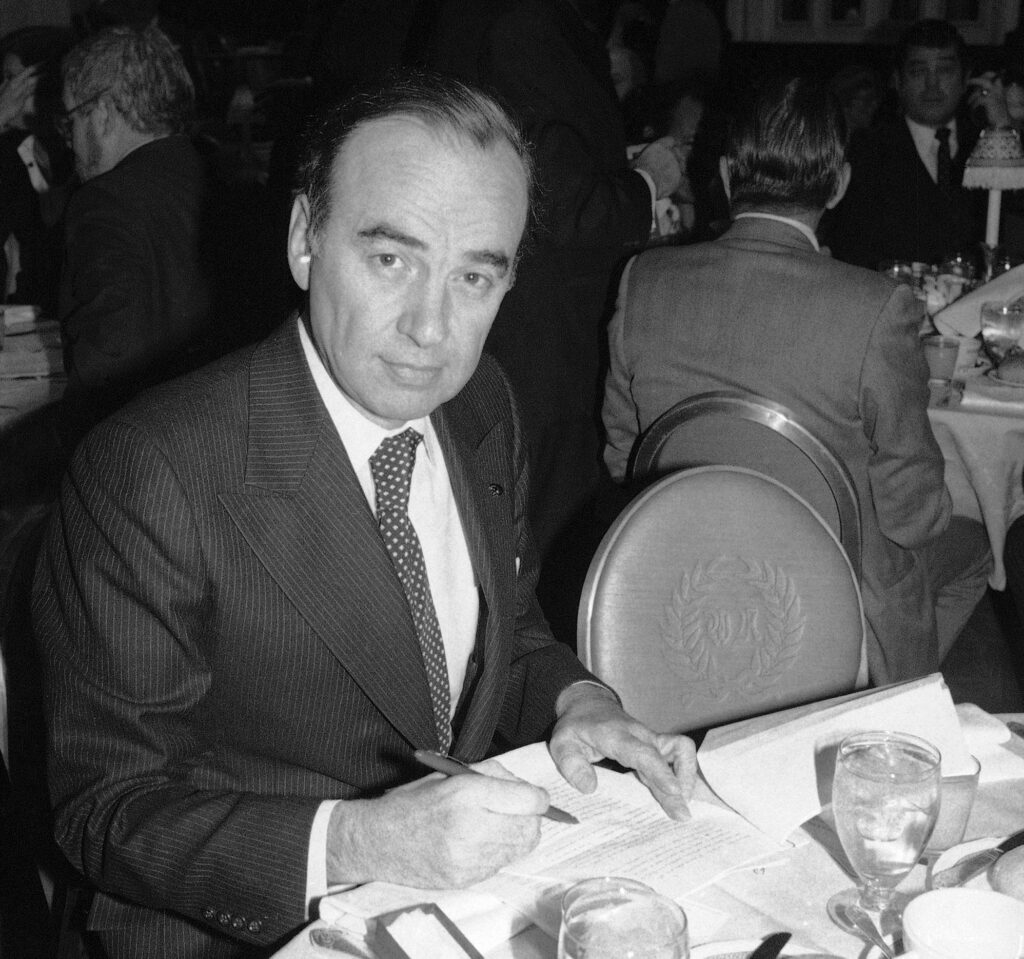
Australian media mogul Rupert Murdoch purchased the New York Post in 1976. Murdoch added a gossip section and amped up the periodical’s crime reporting, which included extensive coverage of organized crime. AP
In tabloid vernacular, front-page headlines are called “wood.” As the book explains, that name comes from the pre-computer era when the larger front-page headlines had to be made using wooden type because the type made of lead only went up to a certain point size. One of the most memorable of those front-page Post headlines, “Headless Body in Topless Bar,” appeared in 1983 with a story about a beheading at a Queens bar that had been a strip club.
Capeci, who worked at the paper from 1966 to 1986, recalled how his front-page Mob story in 1977 earned respect from the paper’s new top brass.
“After 10 years of [working for previous owner] Dolly Schiff, I had a wood about two Mob bosses, Carmine Galante and Aniello Dellacroce, which I think was the first front-page story of the Murdoch-era New York Post,” Capeci recalls in the book. “The story was that Galante was out and about — he had gotten out of jail — and he and Dellacroce were the main contenders to be the so-called boss of bosses, the main mobster in the city of New York. As it turns out, it wasn’t the case. They were both major players, but Dellacroce got passed over and Galante ended up getting killed a couple of years later. But the story certainly got me creds, if that’s the right word, with the new editors Murdoch brought in.”
In the oral history, the authors state that the Post and the Mob “seemed inextricably linked.”
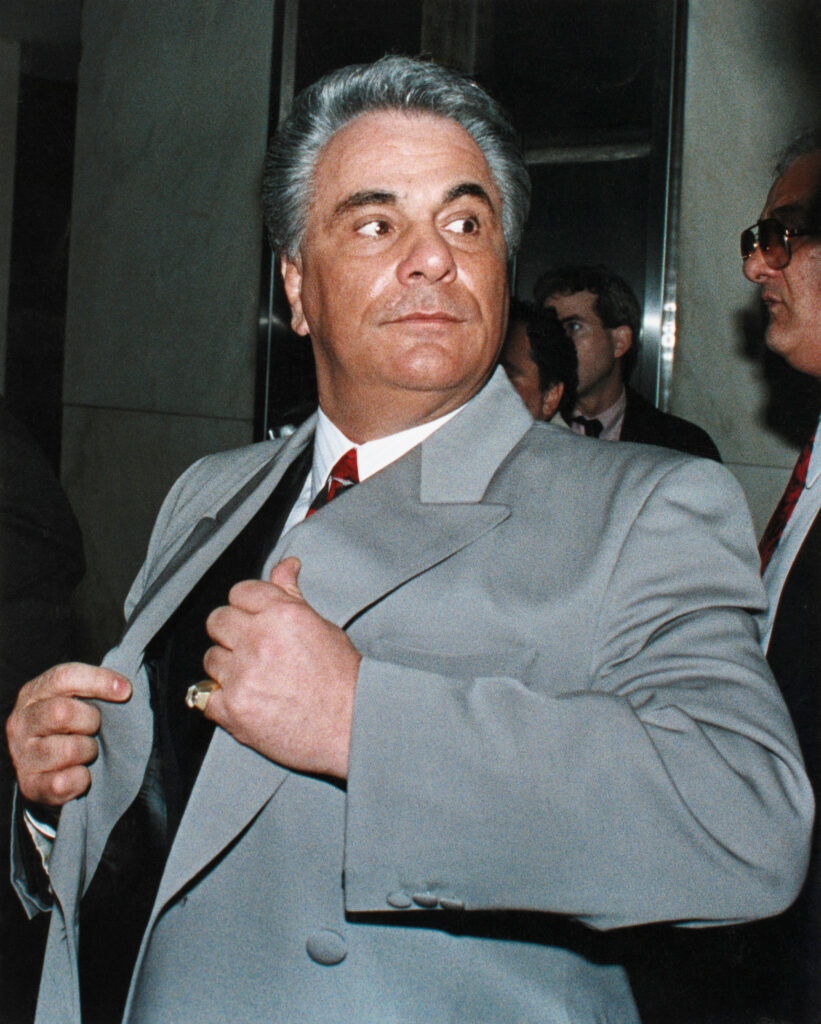
“In the 1980s, a crime boss emerged who captured the glamour and grit of the era and the tabloid aesthetic that Murdoch was selling to a growing audience,” according to the book. “Gambino crime boss John Gotti — dubbed ‘The Dapper Don’ by the Post, and later the ‘Teflon Don’ — and his glowering crew became an edgy storyline in the paper’s ongoing tale of the city.”
Capeci notes that Gotti “became a folk hero to some, public enemy number one to others, and the real impetus for the expanded Mob coverage.”
Gotti’s Dapper Don nickname came from Capeci.
“I wrote in my story that he looked like a dapper don,” Capeci says. “The copy editor was sharp. He changed my story, the wording in my story, to dapper mobster. He used ‘The Dapper Don’ as the headline.”
Gambino crime family boss John Gotti got his nickname, “The Dapper Don,” from the New York Post, coined by renowned crime reporter Jerry Capeci. Corbis
‘Blue-collar job’
Nicholas Pileggi never worked at the Post, but he covered the Mob as a wire service reporter and magazine writer and was familiar with other journalists on the police beat. He is quoted in the oral history saying cop reporters in those days “were really good because they had such an intimate connection with the police.”
“Back then, a lot of the reporters I worked with, they hadn’t been to college or anything,” Pileggi says. “It was a blue-collar job. It was Watergate in the ’70s that really turned journalism into a kind of a fancy job.”
Two street-savvy journalists in the blue-collar mode who worked at the Post were Carl Pelleck and night rewrite man Cy Egan. Both were from “an earlier era of newspapering,” the book states, and were “as hard-boiled and colorful as some of the criminals they covered.”
Pelleck had an extensive network of sources on both side of the law, including Mafia members. The extent of his network once became clear to George Arzt, the Post’s City Hall bureau chief, during a barroom encounter.
“One day, Carl Pelleck, me, and [reporter] Rita Delfiner are having drinks in a bar, and we run into some Mob guy Carl knew,” Arzt says in the book. “The guy had run afoul of his crime family, and he said, ‘Carl, it’s goodbye.’ He left. I said, ‘What was that about?’ Carl said, ‘They’re gonna knock him off.’ And they did. But they took care of his family. It was stunning to know that the Mob really was the Mob.”
Murdoch, the paper’s owner, saw in Pileggi that same kind of connection to people in high and low places. Murdoch also valued Pileggi’s knowledge of how the city really works. Once a week for at least nine months, Murdoch went to the New York magazine office where Pileggi worked to talk about politics “and who the mobsters were,” Pileggi says.
Murdoch’s publicly traded media empire has since expanded into ownership of broadcast outlets such as Fox News, but the News Corp. branch still owns the New YorkPost and other print publications around the globe. These papers include not only tabloids, called “red tops” in the United Kingdom, but also mainstream dailies such as the Wall Street Journal. During the Post’s early days, Murdoch often was in the newsroom, even writing headlines.
“He’s the only publisher of a New York newspaper I ever met who was interested enough to sit down with a police reporter,” Pileggi says. “Corruption, that’s what he was talking to me about. What was the comptroller’s job? Where was the payoff there? How did it work? He was encyclopedic in his absorption of all that knowledge. He was a throwback, from another age. He was a newspaper guy. I had no idea what his politics were and I didn’t care.”
At one point, Murdoch tried to recruit Pileggi to work at the paper. “He said, ‘Magazines are for sissies. Come on down to the Post. I pull up my sleeves every morning, I get in there. You’ve got ink in your blood. You’ve got to come.’ It was a great sales pitch. But I didn’t go,” Pileggi says.
Later, Pileggi and director Martin Scorsese co-wrote the Mob movies Goodfellas and Casino, based on nonfiction books by Pileggi. Another Mob movie scripted by Pileggi, The Alto Knights, is set to be released in March. The Alto Knights focuses on an underworld feud decades ago between mobsters Frank Costello and Vito Genovese, with Robert De Niro playing both roles.
Other journalists from that “blue-collar” period of New York tabloid journalism also have moved on. Capeci runs a website, Gang Land News, about organized crime, while Post reporters such as Mike Pearl, known as “The King” because he dominated courthouse coverage, have retired. Several others have died.

The New York Post covered big stories in organized crime, including the many trials of John Gotti. Known of their clever headlines, the New York Post published a cover story when the Teflon Don’s luck ran out. The Mob Museum Collection
Another former Post reporter, Nora Ephron, who worked at the paper for five years beginning in 1963, later became a film director and screenwriter. Her movie credits include Sleepless in Seattle, You’ve Got Mail and the Mob movie My Blue Heaven. Ephron was married to Pileggi from 1987 until her death in 2012 at age 71.
The book also digs into negative aspects of the Post’s history over the last few decades. This includes the paper’s homophobic and racist reputation during those years and its sexist treatment of women. In another dark chapter of the paper’s past, active criminals were on the payroll, including a Mafia made member in the delivery department. The newsroom at 210 South Street was near a Mob neighborhood. Wiseguys sold stolen goods on the premises.
The Post, now at a different location in the city, is remembered fondly by some who worked there and not so fondly by others.
Ephron saw the good and bad. “I loved the Post,” she said, according to published accounts. “Of course, it was a zoo. The editor was a sexual predator, the managing editor was a lunatic. Sometimes it seemed half the staff was drunk.”
After she left, Ephron said that when “a delicious crime or a great trial” cropped up, she wished she were covering it for the Post. “But then I quickly come to my senses,” she said.
Larry Henry is a veteran print and broadcast journalist. He served as press secretary for Nevada Governor Bob Miller and was political editor at the Las Vegas Sun and managing editor at KFSM-TV, the CBS affiliate in Northwest Arkansas. Today, he is a senior reporter for Gambling.com.
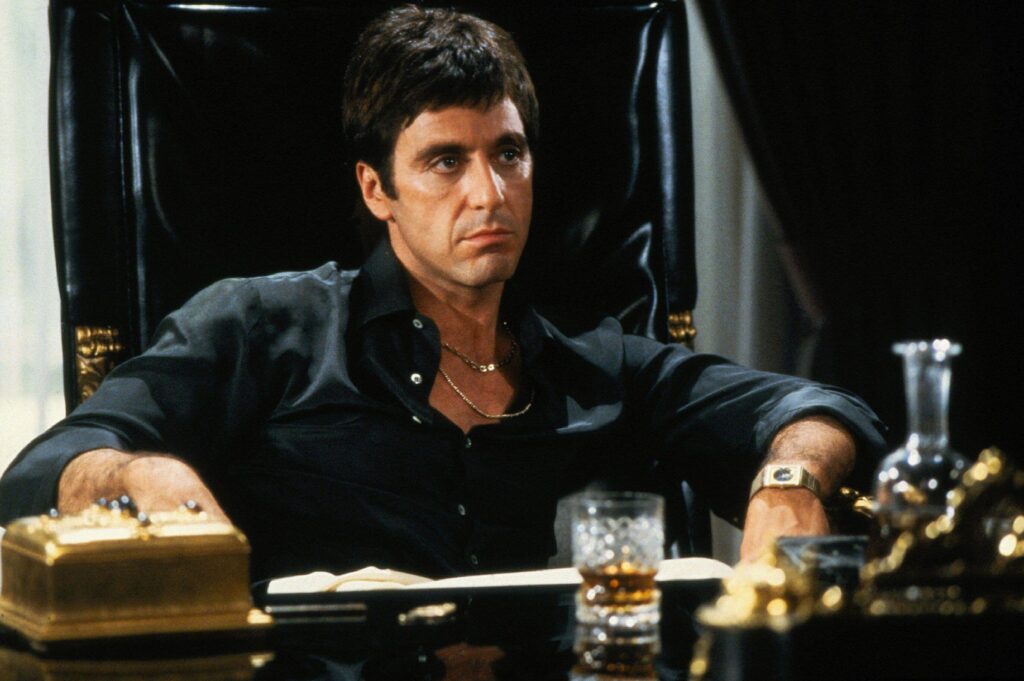
When Scarface premiered in 1983, starring Al Pacino as a Cuban drug trafficker in South Florida, the movie was regarded as a flop.
That didn’t surprise Pacino.
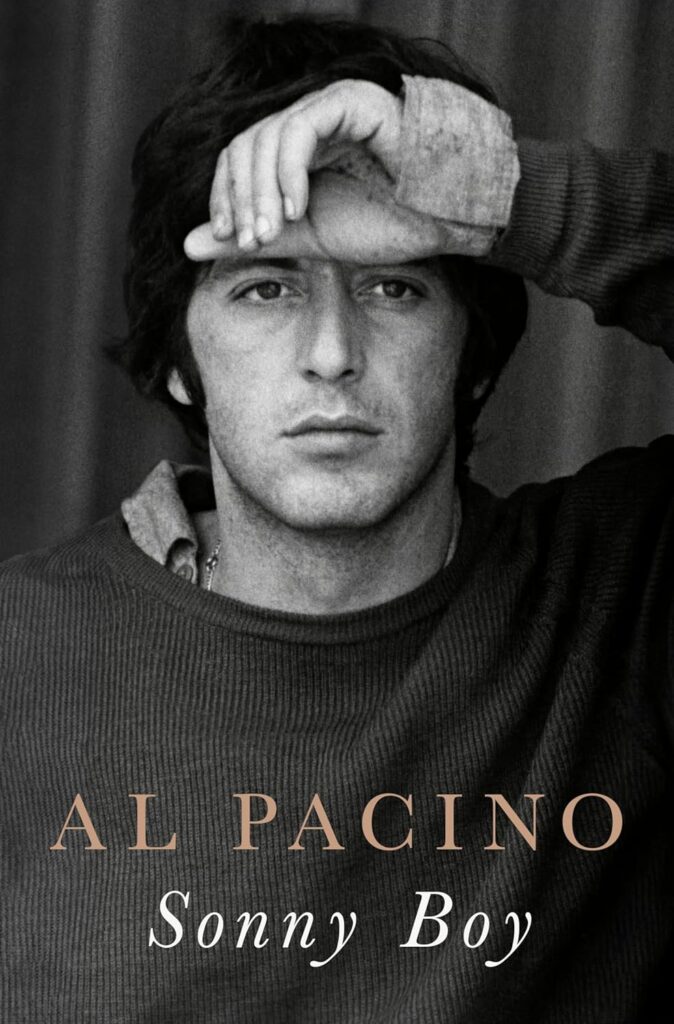
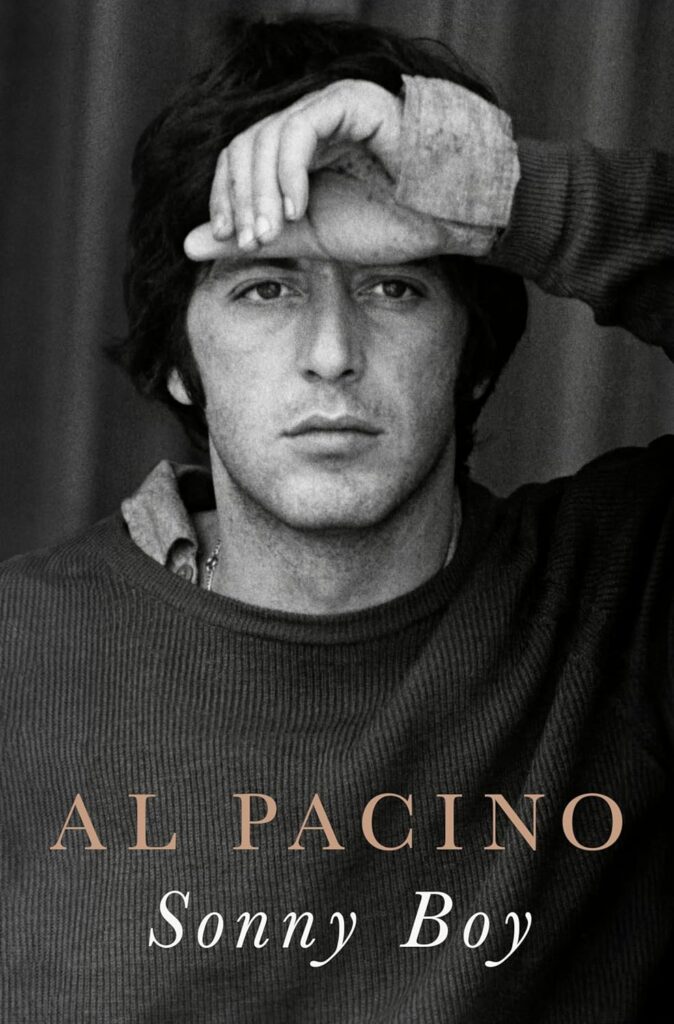
“The whole film was a blatant indictment of the 1980s, and it went against the status quo — the ‘Just Say No’ campaign of Nancy Reagan and the establishment of the time,” he writes in his new memoir, Sonny Boy. “It certainly didn’t fit into the Hollywood mold either.”
In the memoir, Pacino calls the movie a “flop — not commercially, but critically. Artistically. Spiritually.”
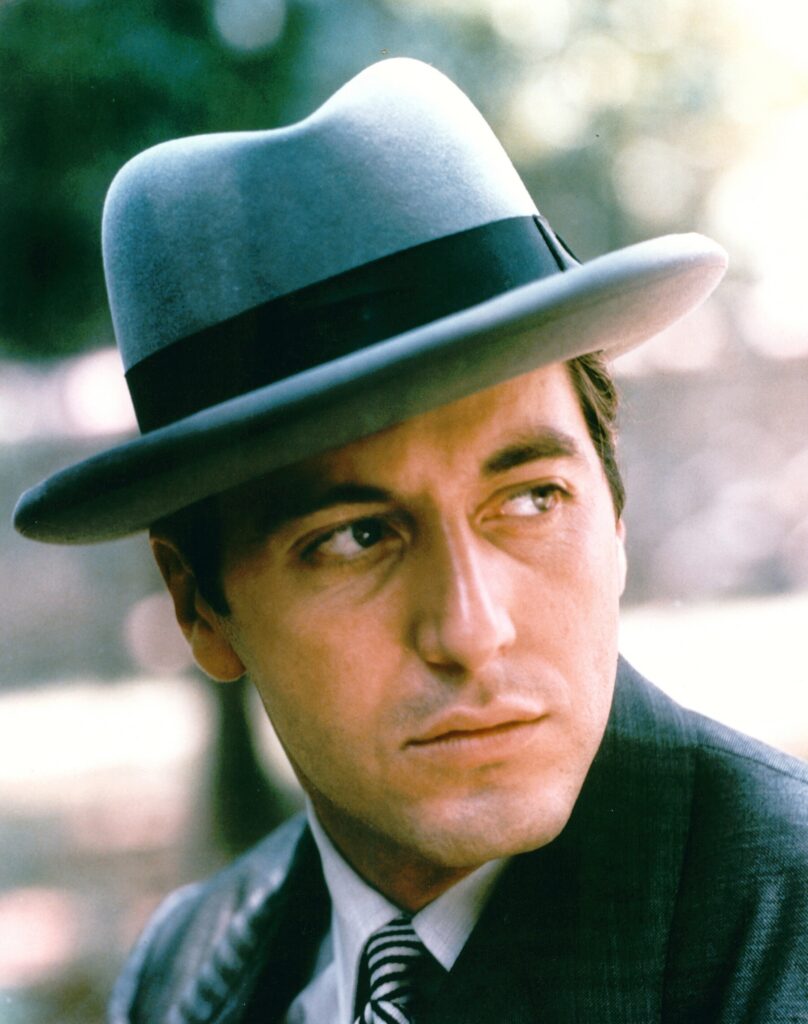
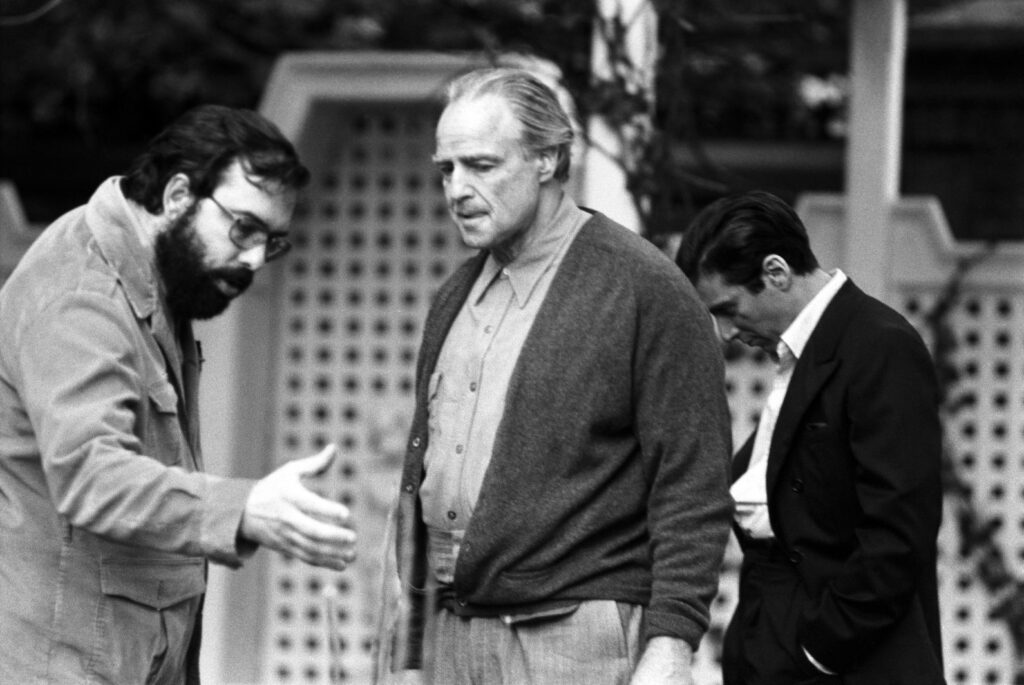
Pacino’s book begins with his difficult upbringing in New York City, where he is nicknamed Sonny Boy, and follows his professional path from a slow start to eventual breakthrough in The Godfather. In his 30s, Pacino finally achieved major star status in that 1972 film as Michael Corleone, a Marine Corps veteran and son of Don Vito Corleone (Marlon Brando). The movie was adapted from a best-selling novel by Mario Puzo, who co-wrote the screenplay with director Francis Ford Coppola.
After that performance, Pacino starred in other movies in the Godfather series, dramatizing Michael’s rise to head of the crime family. Pacino also signed on to high-profile lead roles in stage plays and films unrelated to The Godfather, winning numerous acting awards.
South Florida Cocaine Wars
By then a box-office attraction, Pacino became interested in making Scarface while walking down Sunset Boulevard in West Hollywood and seeing the marquee at the Tiffany Theater, “a revival house that showed old movies.” In this case, the movie was the original Scarface, first released in 1932, featuring Paul Muni as a gangster based on Al “Scarface” Capone of Chicago.
“Back when it was made, Muni’s Scarface was a favorite film of a lot of people, including my grandfather,” Pacino writes in Sonny Boy, adding that Muni’s performance was especially impressive.
“He was like Brando in The Wild One,” Pacino writes, “a figure totally unrestricted by boundaries or conventions. He made me feel something. He was free.”
In his new memoir, Sonny Boy, Pacino reflects on growing up in New York City and the troubled beginnings to his now-iconic roles in The Godfather and Scarface.
It would take some time before the updated version, written by Oliver Stone and directed by Brian De Palma, would go into production, with Pacino in the main role.
The setting for the 1980s Scarface was changed from the Prohibition-era Midwest to South Florida during the cocaine wars. While Muni played a gangster named Tony Camonte, the name given to Pacino’s character was Tony Montana, because Stone was a fan of San Francisco 49ers quarterback Joe Montana, according to The Ultimate Book of Gangster Movies.
Other aspects of the updated movie reflect the era it portrays. Pacino writes that their version mocked “the whole idea of trickle-down economics and the grab-everything-you-can philosophy of the moment.”
“Oliver Stone would later boil it down to just three words — ‘Greed is good’ — in his film Wall Street,” Pacino writes. “We wanted to call out the avarice we witnessed and still make it entertaining.”
‘Give it some time’
When the 1983 version came out, some viewers found it entertaining, but others panned it. Michael Putney, a reporter at News Channel 4 in Miami, interviewed people leaving a theater where Scarface was showing, seeking their immediate on-camera reactions to the film. One man called it “weird.”
In a televised live shot, the reporter criticized the way Pacino delivered his lines and the accent the actor used throughout the movie. “What a mumbler,” Putney said. “And what an accent Al Pacino has here — a mongrel mixture of the South Bronx, Milan and Matanzas.”
The reporter wrapped up his live shot by concluding that Scarface is a “bad film.”
“You can sum up Scarface in two words: Bang bang, snort snort,” he said. “Bang bang is for gunfire, snort snort is for cocaine. There’s a lot of both in Scarface.”
That negativity extended to Hollywood people in Pacino’s circle.
“For weeks on end, I had some of the biggest directors in the world — even [Sidney] Lumet — haranguing me about how bad it was,” the actor writes. “Milos Forman said to me, ‘You made Dog Day Afternoon and you go and make a movie like this? How do you do that?’”
The criticism was relentless. One newspaper headline read, “Pacino Fails Miserably as Scarface.”
Pacino and others involved with the movie were hurt. “Those of us who had worked on Scarface were devastated for days,” Pacino writes.
But slowly things turned around, beginning with a rare compliment here and there. During a Scarface event at the Manhattan restaurant Sardi’s, Pacino was confronted by a “massive crowd of cold, unsympathetic faces” except for the actor and comedian Eddie Murphy, who approached “with that big smile of his.”
“He walked right over to me and said, ‘Al, that was fantastic!’ and he gave me a hug,” Pacino writes. “I think he was the only one in that whole room who understood and appreciated that film.”
Critics initially had a negative reaction to Scarface, but the film gained a cult following that propelled it into a classic. Maximum Film / Alamy Stock Photo
Over time, others stepped up with encouraging words, including Warren Beatty, who “was more sympathetic” than most. In the book, Pacino writes that Beatty, urging his fellow actor to be patient, said, “We had a slow start with Bonnie and Clyde. Give it some time, Al.”
As Beatty predicted, the turnaround ultimately happened. Pacino attributes that to “the hip-hop generation,” who “related to the mythology of Tony Montana and gave it credibility.”
“Rap artists and their fans embraced the movie,” Pacino writes. “They recognized the film as a parable, a story about how you view the world when you’re taught that life is cheap and dispensable.”
Pacino says these supporters were “the catalyst and the springboard for the movie’s eventual success, because once they bought it, the world started buying it.”
The movie then became part of the counterculture, Pacino says, as the “legend of Tony Montana spread worldwide.”
“Tony Montana lets people break out of themselves and their situations — break out of your rut, break out of life as you’re told to live it,” Pacino writes. “There’s something about the journey that is sweet. That’s why the people who actually come from the world that it depicts, who have really walked that turf, related to it and survived it. They knew the joke from the drama.”
‘Unwieldy’ movie remains popular
Today, more than 40 years after the film was first released, its impact on popular culture remains strong, including several memorable lines that continue to crop up. One of these, “Say hello to my little friend,” is regarded as a classic. The Pacino character says this now-famous line while blasting rivals with a powerful weapon.
According to The Ultimate Book of Gangster Movies, that line ranks No. 61 in the American Film Institute’s list of Top 100 all-time quotes. “The line has come to define the Tony Montana character created by Pacino, a hopped-up kingpin, standing alone against the world, brandishing an assault rifle equipped with a grenade launcher,” the book states.
Imitated and parodied in countless films and TV shows, the “Say hello to my little friend” line is an iconic quote that even those who haven’t seen the movie know well. TCD/Prod.DB / Alamy Stock Photo
This kind of recognition doesn’t always happen overnight. In Sonny Boy, Pacino says movies like Scarface take time to sink in.“Sometimes an audience doesn’t know exactly what it’s seeing right away, and they need time to take it in and absorb it,” he writes.
Of all his movies, Scarface remains “the biggest film” in the 84-year-old star’s career. “The residuals still support me,” he writes in the memoir. “I can live on it. I mean, I could, if I lived like a normal person. But it does contribute, let’s put it that way.”
Even with that success, Pacino says the version of Scarface he performed in will always spark debate. “I think if they were to release Scarface tomorrow, it would get the same reaction, stir up the same controversy,” Pacino writes. “It’s just too damn unwieldy. That’s all there is to it.”
Larry Henry is a veteran print and broadcast journalist. He served as press secretary for Nevada Governor Bob Miller and was political editor at the Las Vegas Sun and managing editor at KFSM-TV, the CBS affiliate in Northwest Arkansas. Today, he is a senior reporter for Gambling.com.
Harry Anslinger is best known as the first head of the Federal Bureau of Narcotics (FBN), the first in the lineage of agencies that ultimately merged to become the Drug Enforcement Administration. His tenure, from 1930 to 1962, coincided with a growing public and governmental concern over drug addiction, leading him to advocate for strict policies and enforcement.
He also was among the first law enforcement officials to publicly recognize the threat of organized crime, which was deeply involved in drug trafficking.
Anslinger played a pivotal — and polarizing — role in shaping U.S. drug policy, notably through his efforts to criminalize marijuana, using racially charged rhetoric and exaggerated claims about its dangers. His legacy remains controversial, as his initiatives laid the groundwork for the “War on Drugs,” influencing perceptions of drug use and addiction that persist today. Critics argue that his methods contributed to systemic inequalities and mass incarceration, while others view his efforts as necessary responses to public health concerns. Overall, Anslinger’s impact on drug policy and societal attitudes toward narcotics continues to be debated and studied.
Birth of the Bureau of Narcotics
The Harrison Narcotics Tax Act placed some narcotics under tight restrictions when it went into effect in 1915. The law had more to do with revenue than combating the steadily growing problems of drug trafficking and addiction. Illicit narcotics, primarily opiates, were entering the country from the Far East and Europe with little interruption. By 1930, some federal officials were looking to halt the flow of drugs.
Anslinger had been involved in Prohibition enforcement, but it was clear that Prohibition would soon end. Always keen on maintaining relevance, Anslinger was ready to focus his efforts on a new public menace. Other ideological crusaders, including Charles H. Tuttle, would pave the way for him.
Tuttle, U.S. attorney for the Southern District of New York from 1927 to 1930, strongly advocated for addressing the government’s failing efforts to slow drug trafficking. He argued for the Porter Narcotics Bill, which called for centralized drug enforcement. After some initial pushbacks and tweaks, the bill passed and became law. The new law created the Bureau of Narcotics, and in September 1930, Anslinger was named the first official chief of the new agency.
Unlike the FBI, the Bureau of Narcotics did not report to the Justice Department, but instead to the Treasury. Anslinger’s methods were also markedly different from FBI Director J. Edgar Hoover’s. The latter maintained strict protocol and an image of who and what made an agent.
Anslinger didn’t shy away from “unconventional” methods. He afforded his agents the creative license to play by the same rules as their adversaries. Despite the agency’s sometimes-questionable practices, some historians find the FBN’s archives and surveillance of organized crime considerably more in-depth and expansive than what most other law enforcement agencies of that era produced.
When Prohibition ended in 1933, Anslinger set his sights on a substance more accessible than harder drugs: marijuana. The drug, which he perceived as popular in the Black and Hispanic communities, became illegal in 1937, thanks in large part to his efforts to demonize the plant and its users.
A proxy war
The FBN engaged in its battle on multiple levels. As the leader, Anslinger spread his message at events in both the U.S. and abroad. His charged rhetoric proved effective.
Both the FBI and FBN maintained extensive secret files and records of their suspects. However, the FBN’s database contained a more detailed blacklist of suspected drug traffickers, which outlined their connections, ethnic backgrounds and the general structures of their organizations.
Gathering information was a strong strategy, but sharing that information was even more crucial. While Anslinger’s agents collected intelligence worldwide, the fight from headquarters often relied on the media. Well-crafted messages could sway public opinion without needing solid evidence, effectively bypassing traditional government processes.
Anslinger had a particular disdain for minority celebrities and pop culture because of their impact on public views about drug use. He saw drug addiction as a moral issue that harmed society, and he worried that famous individuals might make drug use seem acceptable, especially in the jazz community. He once wrote a memo saying jazz musicians “reek of filth.”
Anslinger specifically targeted Black celebrities, such as Billie Holiday, for their drug use. In 1959, while she was dying in a hospital bed, Anslinger’s narcotics agents arrested Holiday and handcuffed her to the bed. Library of Congress
One of the artists Anslinger targeted was the jazz singer Billie Holiday. Anslinger focused on her heroin use and her performance of “Strange Fruit,” a song that condemned racism and lynching in America. He believed her fame promoted drug culture. His attempts to undermine and prosecute her were part of a larger effort to control drugs and uphold societal standards, reflecting his view that celebrities should set a good example. Ultimately, Anslinger’s hostility was believed to be largely fueled by personal biases, racial prejudice and a desire to maintain social order.
In 1947, Anslinger took aim at exiled Mafia boss Charles “Lucky” Luciano by making empty threats that caused Cuba to expel him from the island. Anslinger threatened an embargo on medicinal narcotics if they did not remove Luciano. However, he had no real power to enforce it. Declassified State Department documents show that officials were unaware of Anslinger’s threat until Cuban officials expressed their annoyance and offense. FBI documents also confirmed that “no actual embargo had been placed on shipments of narcotics to Cuba, despite claims to the contrary.”
This incident turned Anslinger and Luciano into bitter rivals. They exchanged barbs through the media. In a 1959 interview with Jack Anderson, Luciano did not hold back when discussing Anslinger. “Whenever Anslinger’s ulcer flares up, he takes it out on me,” Luciano said. “I wish he would either get rid of the ulcer or die from it.”
“I do not have ulcers,” Anslinger retorted, “But if I do, I won’t call them ‘Lucky.’ They will be ‘Unlucky.’”
The Federal Bureau of Narcotics compiled and maintained blacklist files of international and domestic drug traffickers, including Lucky Luciano in 1946. Courtesy of Cipollini Collection
The later years
After 32 years, Anslinger retired as head of the FBN in 1962. Upon retiring, he received a plaque from the “Citizens of Blair County,” where his hometown of Altoona, Pennsylvania, is located. It now hangs in the Blair County Courthouse.
A plaque presented to Anslinger upon his retirement hangs in the Blair County Courthouse near his hometown of Altoona, although some locals have petitioned for its removal. DEA Museum
After Anslinger retired, he continued to fight against drug trafficking and gave media interviews to further his message. In a digital exhibit about Anslinger, the DEA Museum quotes a 1968 TV interview: “When asked to justify penalties for marijuana when alcohol also contributes to traffic fatalities, Anslinger responded, ‘Why condone a second hazard?’”
Over the course of his life, he co-wrote three books about narcotics trafficking and organized crime. In his 1961 book The Murderers: The Shocking Story of the Narcotics Gangs, Anslinger reported that the FBN had built a drug case against mobster and Las Vegas casino owner Benjamin “Bugsy” Siegel “that was about to be sprung” when Siegel was assassinated on June 20, 1947.
In the same book, Anslinger touts his agency’s longstanding efforts to fight the Mafia, while other law enforcement leaders, such as the FBI’s J. Edgar Hoover, downplayed the significance of a national syndicate. “I am proud that it was the Bureau of Narcotics which led the way in exposing the activities of this organization,” he wrote. “We revealed the existence of [the] Mafia when many officials insisted that the organization, its rituals and rules and punishments, were largely myths. …”
Anslinger, seen here testifying at the 1957 McClellan hearings on organized crime, had been vocal about the threat of the Mob since the 1930s, decades before the FBI made it a priority. DEA Museum
The Federal Bureau of Narcotics experienced a significant transformation and restructuring in 1968 when it merged with the Bureau of Drug Abuse Control. This newly formed entity was designated as the Bureau of Narcotics and Dangerous Drugs, which combined with more federal agencies in 1973 to become to the Drug Enforcement Administration.
In 1971 Washington Post writer Michael Kernan interviewed Anslinger and praised him: “This is the man who, perhaps more than any other individual, erased opium addiction in America, made cocaine a rarity for decades, outlawed marijuana and made possible today’s international network for the control of narcotics.”
While Kernan’s piece was glorifying, it did note some of the dissenting opinions. He cited a headline from another newspaper that called Anslinger “the man who turned the whole world off” and included the Mafia’s unflattering take: “That bastard Anslinger.” Anslinger frequently targeted the Mob when other federal law enforcement agencies had different priorities. Anslinger himself said: “There were only three of us in law enforcement who believed in the Mafia in those days.”
Anslinger’s legacy is a complex web of moral conviction intertwined with punitive measures that many argue contributed to systemic injustices in drug enforcement policies. Today, as society grapples with the consequences of his era’s drug policies and seeks reform, his life serves as a critical study in the intersection of law, ethics and public health.
Anslinger died in a hospital near his home in Altoona on November 14, 1975. He was 83.
Christian Cipollini is an organized crime historian and the award-winning author and creator of the comic book series LUCKY, based on the true story of Charles “Lucky” Luciano.
On the set of The Godfather, during the early days of filming, Al Pacino was worried about being fired. Francis Ford Coppola, the relatively inexperienced director under pressure himself from Paramount studio heads, had told Pacino, a then-little-known actor, that he was “not cutting it.”
Soon that pressure would become less intense. Pacino’s strong performance during the filming of a scene in a restaurant involving a double killing rescued him from the studio chopping block. And an off-camera lunch with Hollywood legend Marlon Brando gave Pacino a much-needed morale boost.
Finally, already in his 30s and with a less-than-stunning résumé, the New York City native was on his way.
This turnaround is at the center of Pacino’s new memoir, Sonny Boy, beginning with his impoverished big-city childhood, where he was known as Sonny and ran with wild, dead-end friends, but also was exposed to cinematic wonders by a movie-loving mother, a factory worker. Later, as an unknown hopeful, he would walk New York City streets, practicing Shakespeare.
The memoir takes readers from Pacino’s early career insecurities to sudden stardom with the 1972 release of The Godfather, based on a novel by New York writer Mario Puzo, who co-wrote the screenplay with Coppola. The two worked on the script while staying at the now-demolished Tropicana hotel-casino on the Las Vegas Strip.
In his memoir, Sonny Boy, released in October 2024, Pacino recounts his childhood in New York City and his early career, including pivotal moments from the production of The Godfather.
Now, at 84, Pacino is the father of three adult children and a baby boy born in June 2023. These life experiences have led to contemplative moments for the celebrated performer, winner of multiple major acting awards.
“There’s something out there that’s bigger than us!” he told The New York Times earlier this year. “You can’t say ‘better,’ because you don’t really know, but something’s out there going on that’s more than we understand.”
A battle with COVID-19, which almost killed him in 2020, added to his big-picture view of life.
“They said my pulse was gone,” Pacino told the Times. “It was so — you’re here, you’re not. I thought: Wow, you don’t even have your memories. You have nothing.”
Pacino’s book presents his memories with the introspection of a widely recognized public figure recalling when anonymity and shabbiness defined his existence.
That anonymity vanished with fame and accolades. As the book explores that transition, readers are given a behind-the-scenes look at some of the most iconic Hollywood films from the last half-century. This long list includes TheGodfather: Part II with Pacino’s character, Marine combat officer Michael Corleone, now leading the crime family and ordering his brother killed for betrayal. Also included is Scarface, featuring Pacino as a Cuban drug lord in South Florida.
Revenge scene saves Pacino’s job
In Sonny Boy, Pacino explains how the transition from emerging performer to famous actor occurred during and after the making of The Godfather. At first, a rumor had been going around on the set that Pacino would be let go. The studio chiefs weren’t happy with him from the start.
“Paramount didn’t want me to play Michael Corleone,” Pacino writes. “They wanted Jack Nicholson. They wanted Robert Redford. They wanted Warren Beatty or Ryan O’Neal.”
According to the rumor mill, Coppola was targeted for dismissal, too. Coppola had fought to cast Pacino in the role over actors with more star power. At one point Pacino saw Coppola weeping on the set because things weren’t going his way.
“The word was that I was going to be fired, and, likely, so was the director,” Pacino writes. “Not that Francis wasn’t cutting it — I wasn’t. But he was the one responsible for me being in the film.”
Pacino had been playing Michael in a low-key manner as someone not “particularly full of charisma.” The thought was that the character’s personality would evolve along with his responsibilities.
“My idea was that this guy comes out of nowhere,” Pacino writes. “That was the power of this characterization. That was the only way this could work: the emergence of this person, the discovery of his capacity and his potential.”
Pacino played Michael Corleone as a character whose personality would change as he rose to power. By the end of filming, this method paid off in a big way. The success of The Godfather launched Pacino’s career. PHOTOFEST
That discovery occurs in a restaurant when Michael retrieves a handgun hidden in a restroom, then uses it at the table to kill Virgil “The Turk” Sollozzo (Al Lettieri) and corrupt police Capt. Mark McCluskey (Sterling Hayden). Michael was avenging the attempted murder of his father, Don Vito Corleone (Brando).
As Pacino explains in the memoir, the actors spent 15 hours in the restaurant one April night shooting that scene. He notes that Lettieri and “the magnificent Sterling Hayden” were supportive of him, another helpful factor in improving his self-confidence.
“They knew I was going through a difficult time, feeling like I had the world on my shoulders, knowing that any day the ax could fall on me,” Pacino writes. “Sterling and Al Lettieri helped keep up my morale; they set a tone and were role models for me. I looked to them as the people who knew what to do, and how to conduct yourself, and they took me in as a fellow actor.”
With that scene in the can, Coppola showed it to Paramount executives. “When they looked at it, something was there,” Pacino writes. “Because of that scene I just performed, they kept me in the film. So I didn’t get fired from The Godfather.”
Messy lunch with Marlon
Hayden and Lettieri weren’t the only actors supportive of Pacino. A lunch with the best-known member of the cast, Brando, also helped restore Pacino’s faith in his acting abilities. During the lunch, Brando’s face and hands were covered in red pasta sauce while the veteran actor gave Pacino some comfort by indicating things would be OK.
The lunch almost didn’t take place. At first Pacino resisted, frightened by “the greatest living actor of our time,” but Coppola insisted.
“I had my lunch with Marlon in a modest room in the hospital where we were filming on Fourteenth Street,” Pacino writes. “He was sitting on one hospital bed, I was sitting on the other. He was asking me questions: Where am I from? How long have I been an actor? And he was eating chicken cacciatore with his hands. His hands were full of red sauce. So was his face. And that’s all I could think about the whole time. Whatever his words were, my conscious mind was fixated by the stain-covered sight in front of me. He was talking — gobble, gobble, gobble, gobble — and I was just mesmerized.”
Finally Brando “spread both his hands across the white hospital bed and smeared the sheets with red sauce, without even thinking about it, and he kept on talking.”
“When our lunch was over,” Pacino writes, “Marlon looked at me with those gentle eyes of his and said, ‘Yeah, kid, you’re gonna be all right.’”
Francis Ford Coppola, left, directs Marlon Brando and Al Pacino, right, during the filming of The Godfather. Through the guidance of Coppola and mentorship from Brando, Pacino delivered a performance now considered a classic. Getty Images
Power of Mob movies
The closeness that these actors exhibited seems emblematic of the film’s theme regarding the importance of family life, a message that hit home with viewers, helping turn the production into a blockbuster. Pacino writes that the “idea of family” gave the movie its impact.
“People identified with the Corleones, saw themselves somehow in them, and found themselves connecting to the characters and their dynamics as brothers and sisters, parents and children,” he writes. “The film had Mario Puzo’s exciting drama and storytelling, the magic of Coppola’s interpretation, and real violence. But in the context of that family, it all became something else.”
The movie also is appealing in other ways, according to Pacino.
“We’re fascinated with these people who are determined not to live within the rules of society, who are finding another way to go,” he writes. “The outlaw is a particularly American kind of character. We grew up pretending to be Jesse James and Billy the Kid. These were folk heroes. They became part of our lore. The history of the Mafia is part of that lore, too.”
In a larger sense, Pacino’s memoir makes it clear that everyone needs help at times. He received it during many stages of his life, including from Coppola and actors on the set.
“So many people are abused in this life,” Pacino writes, “but if you’ve got a Godfather, you’ve got someone you can go to, and they will take care of it.”
Larry Henry is a veteran print and broadcast journalist. He served as press secretary for Nevada Governor Bob Miller and was political editor at the Las Vegas Sun and managing editor at KFSM-TV, the CBS affiliate in Northwest Arkansas. Today, he is a senior reporter for Gambling.com.