On July 8, The Mob Museum published an essay by investigative journalist Dan E. Moldea — author of The Hoffa Wars and Confessions of a Guerrilla Writer, along with eight other books — about his 45-year investigation of the July 30, 1975, murder of Jimmy Hoffa.
In the essay, Moldea revealed new details about a series of interviews with Frank Cappola, who also gave him a tour of the PJP Landfill in Jersey City, New Jersey, in September 2019, climaxed with Cappola showing Moldea the alleged exact location of the unmarked grave of Jimmy Hoffa.
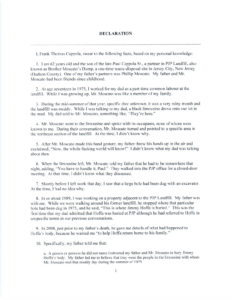
Moldea, who filmed the tour, requested that Cappola prepare a sworn statement, explaining how and why his father, Paul Cappola Sr., the co-owner of the landfill in 1975, had buried Hoffa. Cappola later executed the affidavit, which is published in its entirety below.
In an attempt to encourage the law enforcement community to use his information as probable cause to obtain a search warrant, Moldea has asked The Mob Museum to publish two of his exclusive photographs of Frank Cappola at “The Exact Spot,” as well as Cappola’s declaration under oath. In addition, Moldea has agreed to share his videotapes of Cappola, including the PJP tour, with the FBI and/or any other official agency.
***
I have investigated Jimmy Hoffa, the Teamsters and the Mafia since December 1974. And from the outset, I investigated the circumstances of Hoffa’s murder on July 30, 1975 — 45 years ago this month. The following is a brief summary about the best lead I have ever heard regarding the location of Hoffa’s body, along with the publication of some of my corroborating evidence.
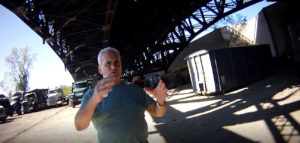
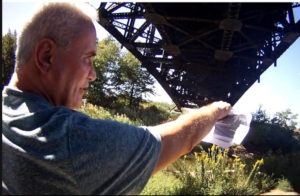
Frank Cappola explains how and why his father buried Hoffa at this site. Journalist Dan Moldea videotaped their entire tour of the PJP Landfill. Copyright Dan E. Moldea 2019. All rights reserved.
On February 3, 2019, I received a call from Paul Cappola Jr. who said that his older brother had specific information about Hoffa’s burial at “Brother Moscato’s Dump” in Jersey City, New Jersey. I asked for an introduction, but, for whatever reason, I did not receive it.
Several months later, on September 6, I contacted Paul Cappola again and appealed to him to arrange an introduction to his brother. The following day, September 7, I received a call from Frank Cappola, the oldest son of Paul Cappola Sr.
The elder Cappola, who died in 2008, was the partner of Phillip “Brother” Moscato, who died in 2014. The official name of “Brother Moscato’s Dump” was the PJP Landfill.
During my 2007-2014 series of interviews with Moscato, a soldier in New York’s Genovese crime family, he told me that Hoffa was buried at his dump — although he did not give me a specific location. In addition, Moscato confirmed to me that Hoffa’s murder was committed by Salvatore Briguglio, a top lieutenant to labor racketeer Anthony Provenzano, a capo in the Genovese crime family.
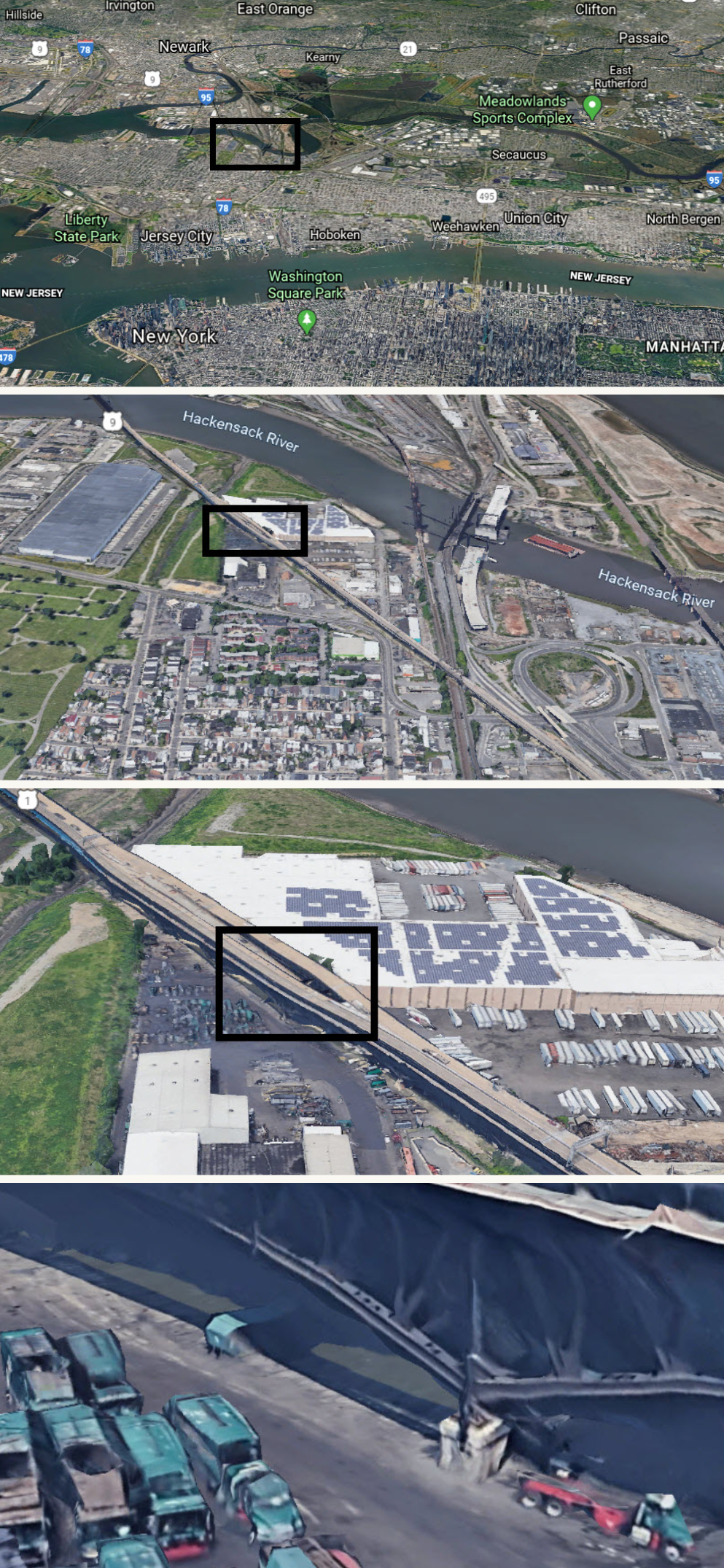
These Google Earth images show with increasing detail where Hoffa’s body is allegedly buried.
Notably, in late 1975, the FBI had served a search warrant on Cappola and Moscato, based on a tip from a Provenzano-connected federal witness who speculated with considerable authority that Hoffa could be buried at their landfill. However, without information about a specific location of Hoffa’s remains, federal agents aborted their search.
During our first interview, Frank Cappola told me that Hoffa was, indeed, buried at PJP where Cappola, who was 17 years old in 1975, had worked part-time for his father.
Click to expand.
After my first conversation with Cappola on September 7, I interviewed him again, by phone, six more times between September 10-26.
On September 26, I bought Cappola a plane ticket to Newark, New Jersey. He arrived on Friday, September 27. We had dinner the following night, September 28.
Throughout our talks, Cappola consistently made it clear that his father received Hoffa’s dead body from persons unknown and that he buried Hoffa’s body, stuffed in a 55-gallon drum, at the direction of Moscato, who supposedly never knew the actual burial site.
On Sunday morning, September 29, Cappola picked me up at my hotel in Secaucus and, at my request, drove to the remnants of the PJP Landfill in the Marion section of Jersey City.
When we arrived, Cappola gave me a tour of the area — which I filmed — culminating with his identification of the exact spot where, according to Cappola, Hoffa was buried in the grave dug by his father.
The location is flat and paved beneath the Pulaski Skyway, the bridge that connects Jersey City and Newark over the nearby Hackensack and Passaic rivers. Cappola’s father told his son that he had buried Hoffa in an eight-by-fifteen-foot hole. Then, on top of the 55-gallon drum, which encased the dead body, Cappola piled fifteen to thirty steel chemical drums. The area that Frank Cappola mapped out for me was the approximate size of a Little League infield, sixty square feet.
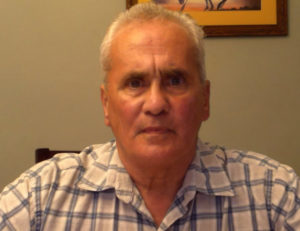
Frank Cappola during his filmed interview with Dan Moldea on September 29, 2019. Cappola died about six months later. Copyright Dan E. Moldea 2019. All rights reserved.
For the first time, I have released photographs of Hoffa’s unmarked grave.
On September 30, I asked Cappola to sign a sworn statement, attesting to the details he had given to me about Hoffa’s location and his father’s role in the burial. Along with offering to take a polygraph test, he executed his affidavit on October 7, 2019, which I have released here, also for the first time.
Sadly, stricken with a respiratory ailment, Frank Cappola died on March 16, 2020.
For organized crime groups, the business of counterfeiting and pirating legitimate products is booming. Europol, Europe’s top law enforcement agency, estimated the annual income from fake goods worldwide in 2016 reached a staggering $461 billion, or a 2.5 percent share of all global trade.
Europe itself is a hotbed for sales of cheap, inferior products made without quality testing performed by genuine manufacturers. The crime-produced items include fake car parts, phony and poor-quality designer clothing, accessories, perfumes and cosmetics, counterfeit cigarettes, olive oil, wine, food items, electronics, children’s toys, sunglasses and luxury cars. For consumers, the biggest danger is sham pharmaceuticals and over-the-counter drugs with low-dose or ineffective ingredients. These drugs are used by people, many with low incomes, who are expecting but not receiving the treatments they need for maladies such as diabetes and high blood pressure.
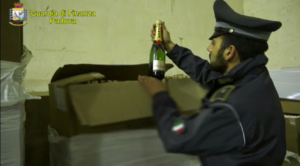
A police officer holds a bottle of counterfeit wine found among hundreds in a warehouse in northern Italy. Criminal conspirators poured cheap Italian sparkling wine into bottles labeled as name-brand French champagne. The operation would have yielded 1.8 million Euro had the tens of thousands of trademark-infringing labels been used and the bottles sold. Courtesy of Europol
According to a new Europol report, the European Union’s organized crime gangs involved in lucrative intellectual property (IP) crime don’t stop there. They also commit other felonies alongside IP crime to stay in business, or what’s known as “poly-criminality.”
These ancillary offenses include money laundering, cybercrime, tax evasion, document fraud, drug production, drug trafficking, forced labor, bribery and even terrorism. The crimes either facilitate IP violations or are committed at the same time as sideline businesses. For example, product counterfeiters might use their profits to finance drug trafficking, and use the same sales routes to sell fake items and illegal drugs.
In the report, “IP Crime and Its Link to Other Serious Crimes,” Europol takes a “case book” approach, reviewing specific examples of IP criminal cases cracked by the agency and EU member nations in 2016. The purpose of the report is to show that rather than a “victimless crime,” IP crime is committed in conjunction with other violations. The report’s goal is to guide policymakers in drafting new laws aimed at breaking these complex conspiracies.
What remains today the biggest bust in Europe of counterfeit products happened in 2016, and evolved over a three-year period in Spain, a peculiar center for fake product-related rackets within the EU. With 400 officers involved, the Europol case, known as “Operation Pinar,” dismantled a group composed mainly of Moroccan nationals, engaged in industrial property crime and money laundering. In a series of raids, authorities arrested 67 people and confiscated more than 250,000 fake products worth 8 million Euro. The imitated items included clothes, shoes, belts, watches, sunglasses and jewelry. At a secret factory in Spain, the ring placed designer logos and names onto non-branded, second-rate products imported mostly from China, Turkey and Portugal. Before its capture, the gang successfully sold 5.2 million Euro in counterfeit items and laundered (the concealment of criminal profits, typically through bank transfers and purchases) 9 million Euro.
Pharmaceutical crime
Criminal syndicates sell fake prescriptions and over-the-counter drugs to consumers mainly via public or “open” websites, but they also use the private “dark” web to hawk illicit goods (and illegal services) to hide the transactions from law enforcement. Advertised as the real thing at a discount, rip-off medicines are cheaply and poorly formulated and can be dangerous. In the course of probing the sale of bogus legal drugs, Europol found that counterfeiters also tended to traffic illegal recreational drugs and engage in money laundering, fraud, bribery and corruption.
One of many cases highlighted in the report, called “Operation Ayurveda,” included not only Europol but law enforcement agencies in France, the U.K. and the United States. The action originated in Spain, a country with seaports accessed by the Atlantic Ocean and Mediterranean Sea and frequently used by organized crime. Counterfeit drug smugglers exploit Spanish harbors as a delivery space for materials imported from manufacturers in Asia to mix bogus medicines, “always under a fictitious [name] brand and with fake documents,” according to Europol.
“Similarly, finished products, pretending to have been manufactured in Spain and under a fake Spanish brand, were directly imported from India or China,” the agency reported. “Dismantling these illegal activities also contributed to safeguarding Spain’s good reputation in the manufacture of medicines. These illegal medicines targeted patients suffering from severe ailments such as those provoked by leukemia, psychosis, anxiety and cardiac conditions and were supposedly composed of drugs such as penicillin, heparin, vincristine and morphine.”
During Operation Ayurveda, investigators arrested 16 suspects and gathered evidence of ancillary crimes committed by the conspirators to keep their IP fraud scheme going — money laundering, fraud, bribery, corrupting public officials and document fraud.
Drug trafficking
European police, over the past several years, have broken up a number of criminal operations that combined product counterfeiting and illegal drug sales. “Operation Dianu,” in Spain in 2017, ended with Europe’s largest seizure of anabolic steroids, a prohibited performance enhancer used surreptitiously in professional sports. After 25 searches of homes, gyms and warehouses in four Spanish cities, police and Europol arrested 14 people and confiscated 3 million doses of unregulated steroids and male sex hormones. Officers uncovered evidence of more than 120 different types of doping drugs, made mostly in China and India, meant for planned distribution on the black market in Spain, Belgium and Germany. The probe in the city of Malaga led to a service run by a prominent bodybuilding trainer who allegedly oversaw international sales of the drugs. In addition to the sports meds, police seized 2.7 kilos of cocaine.
In 2018, during “Operation Reaparecer,” Spanish National Police made 29 arrests and impounded 5 million doses of Chinese-made illegal and counterfeit sports enhancement medicines from houses in Madrid, Valencia and Malaga, bound for gymnasiums in Spain and the Netherlands. The seizures included seven liters of liquid testosterone, 42,500 doses of the illegal “club drug” MDMA, 3,500 doses of LSD, 9,000 grams of speed, 5,000 grams of crystal meth and quantities of ketamine, cocaine, heroin, hashish and marijuana.
Another notable case combining IP theft and drugs, nicknamed “Operation Horse,” centered on an organized crime group specializing in copyright infringement by manufacturing fake Ferrari, Lamborghini and Renault high-performance sports cars. After raiding a warehouse in the state of Catalonia in far northeastern Spain near Barcelona, Spanish police located a workshop where 14 middle-level cars were in various stages of rebuilding for sale as expensive “supercar” vehicles, including two F430, one F40 and one F355 Berlinetta model Ferraris, a Lamborghini Gallardo and a Renault Alpine 310. The makeshift factory contained Fiberglas molds used to fabricate Ferrari body sections. The ring’s inventory also included fake Ferrari spare parts, speedometers, emblems, badges and sales documents. Police caught and arrested a suspect who had just sold a counterfeit luxury vehicle online.
The boss of the bogus car ring also allegedly put together a cannabis operation. When officers entered the garage of his home, they uncovered an indoor marijuana plantation, with plots for 950 plants, 71 power transformers, 81 lamps, 28 bags of growing soil and eight air conditioning units for cultivation.
Sparkling wine and olive oil
For counterfeiters, disguising low-cost foodstuffs as high-quality brands can be as easy as affixing labels to containers of a faked product. That’s what happened in two unnamed but memorable Europol cases from Italy.
The first came in 2016, discovered by police in Padua in northeastern Italy. A wine company notified authorities after finding a bottle of French sparkling wine without the maker’s batch number. The cops soon uncovered a secret lab in the Padua countryside where counterfeiters glued labels for expensive brand French champagne onto bottles of common Italian sparkling wine. The local police seized 9,200 bottles of the sparkling wine, plus 40,000 labels and 4,200 boxes with the French geographical information printed on them to deceive buyers. The quantity of faked wine could have earned the gang as much as 1.8 million Euro had the bottles with trademarked labels been sold.
In another counterfeit food case, launched in May, 2019, Italian police arrested 22 people in Italy and German police arrested two Italian nationals in Germany, following a four-year investigation into sales of phony olive oil. Investigators learned that criminals bought 1 million liters of cut-rate sunflower seed oil each year from vendors in Spain, Greece and Turkey. To make the liquid look like high-quality extra virgin olive oil, the gangsters added chlorophyll and beta-carotene. They made an estimated 8 million Euro per year, after paying one Euro per liter for the seed oil and charging 5 to 10 Euros a liter for the faked product. The crime group sold the oil mainly to restaurants and shops in Stuttgart, Frankfurt and Berlin, Germany, transporting it in trucks loaded with 23,000 bottles each. During 20 raids of houses and trucks, police in Italy and Germany confiscated 150,000 bottles of the bogus oil. Court officers charged the two dozen suspects with racketeering, selling non-genuine food and concealing money earned through committing crimes.
Illegal pay-TV channels
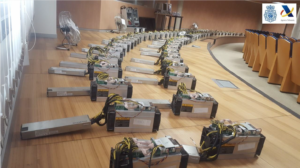
In a joint investigation into pay-TV theft, Spanish National Police, Europol and German authorities broke up a Spain-based crime group that used these Chinese-made decoders to illegally decrypt TV signals for customers in Europe. The ring also used Internet Protocol Television (IPTV) to intercept and pirate 1,600 TV channels. Courtesy of Europol
One of the latest rackets favored by European organized crime is pirating pay-TV channels through illegitimate decoders made in China. For its case, “Operation FAKE,” in 2016, Europol teamed with Spanish and German police to bust a criminal network that posed as pay-TV service providers and charged fees while illegally diverting broadcast services in Spain. The cops arrested 30 suspects and captured more than 48,000 decoders — used to funnel channels to customer TVs — along with a counterfeit luxury car, a private plane and 183,000 Euros in cash. The crime ring employed servers in Europe, including Germany, and used Internet Protocol television (IPTV, or steaming media) to reroute the signals of about 1,600 channels. The gang tried to launder its proceeds by mining the cryptocurrency Bitcoin, but authorities seized 31,000 Euros from its Bitcoin account.
After investigating the Jimmy Hoffa murder case since Hoffa’s disappearance forty-five years ago this month, investigative journalist Dan E. Moldea – the author of ten books, including The Hoffa Wars in 1978 — prepares “to go all-in” with his search for Hoffa’s remains. Below is an essay about his career-long journey, excerpted from the just-released third edition of his memoir,Confessions of a Guerrilla Writer: Adventures in the Jungles of Crime, Politics, and Journalism.
I began my investigation of Jimmy Hoffa and the Teamsters Union in December 1974 while I was a twenty-four-year-old graduate student at Kent State University and writing a column for The Reporter, a small Akron-based newspaper that served the African-American community in northeastern Ohio. During the late winter and early spring of 1975, I published an eight-part series, “The Teamsters, Their Pension Fund, and the Mafia.”
Shortly after I completed that work, I received a phone call from Jonathan Kwitny, a veteran investigative journalist for the Wall Street Journal. He said he was doing his own three-part series about the corruption of the union’s pension fund and asked for my help, which I was happy to provide. Kwitny’s series, with my assistance, ran in the Journal from July 22-24, 1975.
The following week, Jimmy Hoffa disappeared on July 30, 1975.
Shortly after the news broke, Kwitny called, and we concocted a wild theory that Hoffa was alive and hiding at a Mob-owned lodge in Eagle River, Wisconsin. We met in Chicago and flew to Rhinelander, Wisconsin, where we rented a car and drove to Eagle River.
Although we had an amazing adventure — which included me getting bitten by a German shepherd while trespassing on the grounds of the lodge — our search for Hoffa was nothing more than a wild goose chase.
After Kwitny returned to New York, I flew to Detroit and immediately went to the Machus Red Fox restaurant in Bloomfield Hills, a northern suburb, where Hoffa was last seen. While I was at the restaurant, I met the legendary NBC News correspondent Irving R. Levine, who was covering the Hoffa case for the network. He immediately hired me as a researcher after he called Kwitny, who enthusiastically vouched for me.
The Hoffa case in three acts
The murder of Jimmy Hoffa was a three-act drama with different characters in each act.
In Act One, Hoffa went to the Red Fox restaurant, expecting to meet two Mafia figures: labor racketeer Anthony Provenzano of New Jersey, a capo in the Vito Genovese crime family, and Anthony Giacalone, a top mobster in the Detroit Mafia who was related, by marriage, to Provenzano. In addition, Hoffa might have been expecting to meet with a Giacalone-connected businessman, Lenny Schultz.
Within days of Hoffa’s disappearance, dozens of theories surfaced as to who was in the car that picked up Hoffa and drove him into Act Two, where he was murdered. And there were just as many theories as to the location of the scene of the crime and who actually executed the killing.
In Act Three, the co-conspirators disposed of Hoffa’s body, launching hundreds of theories as to what happened to Hoffa’s remains.
Rolland McMaster
On August 5, my first full day on the job with NBC News, I received an introduction to an associate of Rolland McMaster, a Teamsters official who had stood shoulder-to-shoulder with Hoffa since their earliest days in the union. However, in recent years, Hoffa and McMaster had a huge falling out over control of Teamsters Local 299 in Detroit, Hoffa’s home local. Consequently, they became mortal enemies.
In fact, my new source alleged that McMaster had played a key role in the disposal of Hoffa’s body six days earlier — but he could not prove it. NBC authorized me to pursue the McMaster lead but put me on a short leash, giving me a limited amount of time to get results.
With the help of my friends and sources in the rank-and-file reform movement within the Teamsters, I received introductions to several key players in the Hoffa drama. I quickly learned that since 1971, McMaster, an international organizer, had directed a 32-member Teamsters organizing unit that was traveling around the country, shaking down trucking companies in return for labor peace.
In addition, I obtained interviews and documents showing that McMaster and his goon squad were behind a series of unsolved acts of violence in Local 299. They included bombings, beatings, shootings and sabotage, almost exclusively directed against Hoffa’s supporters. And I was able to produce evidence showing that three of McMaster’s men — Larry McHenry, Jack Robison and Jim Shaw — were responsible for many of these incidents.
Still, the high command at NBC News was not convinced. So, after accepting and completing a short-term assignment in New York to help with the production of an NBC special on Hoffa, I returned to my career as a scuffling independent investigative journalist.
Contacting the FBI and Hoffa Jr.
Back in Ohio in early September 1975 — a little more than a month after the murder — I prepared a fifteen-page theory about what had happened to Hoffa and submitted it to the FBI’s Detroit field office. On September 24, an FBI special agent interviewed me.
Based on our conversation, he wrote a report, stating:
Specifically, Moldea advances the theory that Hoffa’s disappearance and other incidents of Teamster related violence have been the work of Rolland McMaster and other former Teamster International organizers who worked for McMaster in the Teamster Central States Division for Steel and Special Commodities in the early 1970s. In his theory, Moldea sets forth sufficient factual info, which indicates he has good sources close to McMaster and knowledgeable of his union activities.
Two more FBI special agents interviewed me again at my home in Akron for two days, October 15-16, 1975. Although I refused to give them the name of my principal source without his permission, the agents, who encouraged me to come back to Detroit to continue my independent investigation, wrote in another official report:
Moldea provided a great deal of information from a source who claims to have worked for Rolland McMaster in “task force” comprised of about 15 [sic] men whose overt purpose was to organize non-union truckers; but whose actual purpose was to instigate labor violence and unrest. Allegedly, McMaster would then extort money from trucking firms for a guarantee of labor peace.
Moldea and his source feel that McMaster and his “task force,” acting on orders from above, are responsible for various instances of labor violence, including Hoffa’s disappearance. Moldea appears sincere, resourceful, cooperative, and is attempting to convince his primary source to cooperate with the FBI.
Two weeks later, on October 28, I returned to Detroit, where I received an introduction to Jimmy Hoffa Jr., the attorney/son of the murdered Teamsters boss, at his downtown law office. During our first meeting, I explained my theory about McMaster to Hoffa, who immediately called the local FBI headquarters and asked an agent with whom he was on a first-name basis to come to his office to meet me.
Within half an hour, two FBI special agents walked into Hoffa’s office. As instructed by Hoffa, I repeated my information about McMaster. The agents, who said they were already familiar with my work, confirmed to Hoffa that my information was solid and that my investigation of McMaster was both important and trustworthy.
Declaring that he believed I had solved the violence in his father’s local before he disappeared, Hoffa gave me $2,100 in reward money from the “Hoffa Reward Fund,” a bankroll put up by local unions and private individuals, among others, who wanted to solve the Hoffa case. Hoffa Jr. served as the administrator of the fund.
In addition, Hoffa helped to arrange a freelance assignment with the Detroit Free Press where I was tasked to focus on a single story: the McMaster goon squad and its shakedown of trucking companies around the country.
Ralph Picardo and the federal grand jury
On November 5, 1975, the same day I started my work for the newspaper, a new federal witness in the Hoffa case secretly flipped and turned state’s evidence: Ralph Picardo, a longtime associate of Tony Provenzano and his crew. Picardo, Provenzano’s former driver, was serving twenty years for manslaughter at Trenton State Penitentiary in New Jersey.
According to federal law enforcement officials, Picardo had a visitor a few days after Hoffa vanished: Stephen Andretta, who allegedly confessed to Picardo his own role and that of his brother, Thomas, in the Hoffa murder conspiracy — as well as those of two other brothers, Salvatore and Gabriel Briguglio. All four men were also closely associated with Provenzano.
In short, Picardo alleged that Andretta told him that Hoffa had been a) murdered in Detroit, b) stuffed into a 55-gallon oil drum, c) loaded onto a Gateway Transportation truck, and then d) shipped to New Jersey.
Phil “Brother” Moscato Sr., a soldier in New York’s Genovese crime family, co-owned a dump in Jersey City, New Jersey, where Hoffa is allegedly buried. Courtesy of Dan E. Moldea
When the FBI asked Picardo whether Andretta had revealed the identity of Hoffa’s killer, Picardo replied that he had not. However, Picardo knew from his work with the Provenzano operation that Provenzano had personally put a contract on Hoffa in either late 1973 or early 1974 that was specifically given to Sal Briguglio.
When the FBI asked Picardo whether Andretta revealed the location of Hoffa’s remains after it was shipped to New Jersey, Picardo, once again, replied that he had not. However, Picardo knew from personal experience that when Provenzano ordered someone murdered, their bodies often wound up in 55-gallon oil drums, buried at a landfill in Jersey City called “Brother Moscato’s Dump,” which was owned by Phillip “Brother” Moscato, a reputed soldier in the Vito Genovese crime family. Specifically, Picardo named one of Provenzano’s victims as Armand Faugno, a local loan shark who wound up in an unmarked grave at the dumpsite.
Later, using Picardo’s information as probable cause, the FBI obtained a search warrant for Moscato’s landfill, ostensibly looking for Faugno when, in fact, they were looking for Jimmy Hoffa. However, the size of the area and its toxic conditions, along with the wintery weather and lack of a known specific location, caused agents to abort their search.
On December 4, 1975, the Andrettas and the Briguglios appeared before a federal grand jury in Detroit, investigating the Hoffa case. All four, who had been identified in press reports the previous day, took the Fifth against self-incrimination.
A fifth suspect was not previously identified by the news media: Rolland McMaster, whom, after several phone interviews, I met face-to-face for the first time at the federal courthouse as he waited his turn to appear before the grand jury. He told me later that same day that, like the Andrettas and Briguglios, he had taken the Fifth.
Significantly, on the day Hoffa disappeared, McMaster’s alibi was that he was with his brother-in-law, Stanton Barr, the head of the steel division for Gateway Transportation, at a meeting of Gateway officials in Gary, Indiana — the same Gateway company that Picardo had referred to in his statement to the FBI, the same one that had allegedly carried Hoffa’s body to New Jersey.
My story about McMaster’s goon squad was published in the Detroit Free Press on June 20, 1976. However, my bosses at the Free Press would not allow me to print details about McMaster’s alleged roles in either the Local 299 violence or Hoffa’s disappearance.
Interviews with the Andrettas and Briguglios
In early July 1976, I began my next freelance assignment with Washington columnist Jack Anderson, addressing the two issues about Rolland McMaster that the Free Press refused to publish. Marc Smolonsky, one of the top reporters in Anderson’s office who became a life-long friend, introduced me to the well-known columnist.
During my research, I interviewed McMaster and Stan Barr of Gateway, as well as McMaster’s top henchmen: Larry McHenry, Jack Robison and Jim Shaw, about whom I had collected new evidence that they were behind the violence in Local 299.
Notably, Shaw, at the time of Hoffa’s murder, was a long-haul driver for Gateway Transportation.
In addition, on October 25, 1976, I conducted an exclusive three-and-a-half-hour recorded interview with Steve Andretta and Salvatore Briguglio, who were accompanied by their attorney, William Bufalino, the cousin of Mafia boss Russell Bufalino, and Provenzano’s younger brother, Salvatore Provenzano, a former president of Local 560 and a member of the general executive board of the international union. Also, that same day, I had interviews with Tom Andretta over the phone and Gabe Briguglio in person, which were not recorded.
Among several other subjects, I received new details about Andretta’s prison visitation with Ralph Picardo and Briguglio’s relationship with both Jimmy Hoffa and Phillip Moscato, the co-owner of “Brother Moscato’s Dump.” Both Briguglio and Moscato were reputed soldiers in the Genovese crime family.
The Hoffa Wars
In late August 1978, my first book, The Hoffa Wars, which chronicled Jimmy Hoffa’s rise and fall, was released. Earlier, a blatant attempt to suppress my work by the publishing house of a rival author was detailed in a June 29, 1978, article in the New York Times by the newspaper’s chief literary critic, Herbert Mitgang, who wrote: “Publishing lawyers said that the attempted delay of the Moldea book was one of the first examples of [a] possible loss of independence — with implicit censorship — where there is a conflict on a controversial nonfiction book.”
After the attempted sabotage of The Hoffa Wars was revealed by Mitgang and the Times, my book was supercharged. Playboy bought a long excerpt of the book. The Observer of London acquired worldwide rights, and the New York Times purchased the U.S. rights. It also was a Book of the Month selection.
My work was widely viewed as the most revealing account of the battles revolving around Detroit’s Local 299, which had spiraled into a war zone when Hoffa tried to retain his power after he was sent to prison in 1967 in the aftermath of his 1964 convictions for jury tampering and pension fraud. I chronicled the specific acts of violence against pro-Hoffa supporters, directed by Rolland McMaster and carried out by his goon squad, climaxed by Hoffa’s murder in July 1975.
I concluded that Hoffa’s murder was engineered by Tony Provenzano and carried out by Sal Briguglio — with his brother, Gabe, along with Steve and Tom Andretta, playing supporting roles. I also alleged that, although Sal Briguglio was the actual killer, Frank Sheeran, a Teamsters thug from Philadelphia who was close to Hoffa, was part of the overall murder conspiracy.
Based on information from my sources in the law enforcement community, I alleged that Charles “Chuckie” O’Brien, Hoffa’s “foster son,” had driven the car that picked up Hoffa and driven him to the scene of his murder. In later years, I backed away from that description of O’Brien’s role after he passed a polygraph test in 1999. Then, in 2007, Phillip Moscato Sr. alleged that the real identity of the person who drove Hoffa to his death was Vito Giacalone, the brother of Tony Giacalone.
Notably, even though I had viewed Ralph Picardo’s information as the firewall of the Hoffa case and admonished other investigators when they diverged from his version of events — that Hoffa was murdered in Detroit, stuffed into a 55-gallon oil drum, loaded onto a Gateway Transportation truck and shipped to New Jersey — I failed to follow my own warning when I published my book.
During my interview with Charles Crimaldi, a Chicago mobster-turned-federal-witness, he convinced me the Mafia would not have taken the risk of transporting Hoffa from Detroit to New Jersey, adding that his information was that Hoffa was disposed of in a car compactor in or near Detroit. Consequently, after I learned that Gateway’s steel division — which was headed by McMaster’s brother-in-law — was near the Ford River Rouge Plant in Dearborn, Michigan, I wrote that, after Hoffa was murdered and stuffed into the oil drum, the Gateway truck likely took him to the Ford location where he was “crushed and smelted.”
Nearly thirty years later, in 2007, Moscato convinced me I was wrong about that, too.
Remarkably, there were no serious threats of litigation against The Hoffa Wars — with one exception. On March 22, 1979, attorney F. Emmett Fitzpatrick, who represented Frank Sheeran, sent me a letter, saying, in part:
Mr. Sheeran has recently become familiar with the book authored by you entitled The Hoffa Wars.
Mr. Sheeran wishes me to inform you that he emphatically denies the allegations about his involvement in Mr. Hoffa’s alleged death and to state specifically that your allegation that he was present in Detroit on the last day that Mr. Hoffa was seen is false, unfounded and has been specifically contradicted by evidence supplied by Mr. Sheeran to the Federal Government.(1)
Frank Sheeran and I Heard You Paint Houses
After telling conflicting stories for years about his role in the Hoffa murder, Frank Sheeran declared in his final years that he had killed the former Teamsters boss. His version of events was the basis for the bestselling Charles Brandt book I Heard You Paint Houses and the 2019 Martin Scorsese film The Irishman. Courtesy of John Zeitts
In the spring of 2001, broadcast correspondent Eric Shawn of Fox News interviewed Frank Sheeran, who, over the years, had developed a reputation for telling conflicting versions about his knowledge of the circumstances of Hoffa’s death. During their meeting, Sheeran falsely admitted to Shawn that he had personally killed Hoffa.
At the time, Sheeran was working on a book project with Charles Brandt, a respected former Delaware prosecutor. Their book, I Heard You Paint Houses, was a one-source story about Sheeran’s life and times that was slated for release in the spring of 2004.
Shawn embraced Brandt’s book, along with Sheeran’s version of the Hoffa murder, and skillfully used his platform at Fox News to help launch the Brandt-Sheeran project.
Shawn asked me, among others, to sign a nondisclosure agreement, read the embargoed book, and then, upon its release, provide my comments on camera about its conclusions.
In my pre-NDA evaluation to reporter David Ashenfelter of the Detroit Free Press — which became the basis for my post-NDA comments — I stated that Sheeran had lied about his role in the case, adding: “Make no mistake: This is the biggest break in the case since Hoffa disappeared on July 30, 1975. Now, in the wake of Sheeran’s death in December 2003, the task will be to separate fact from fiction.”
In other words, I knew that Sheeran — whom I had interviewed in March 1978 — had fabricated his role in the killing of Hoffa, along with those of other infamous criminals he falsely claimed to have killed in Brandt’s 2004 book, including but not limited to New York mobster Joey Gallo and Sal Briguglio, Hoffa’s actual killer.
Soon after, Shawn and his team at Fox discovered traces of blood at the exact location in the same house that Sheeran had specified as the scene of Hoffa’s murder. However, DNA testing refuted claims that the blood was Hoffa’s.
Don Wells and McMaster’s farm in Wixom
In 2006, the FBI served a search warrant at a farm in Wixom, Michigan, which in 1975 was owned by Rolland McMaster and his wife, Marilyn. Living on the farm with the McMaster family back then were a business partner, Donovan Wells, and his wife, Monica.
While in a federal prison, Wells provided evidence to federal agents that served, at least in part, as the necessary probable cause for obtaining their court-authorized search warrant for the property. Importantly, Wells took and passed a polygraph test arranged by the FBI.
Don Wells provided information that led the FBI to obtain a warrant to search a farm in Wixom, Michigan, in 2006. The farm had been owned by Rolland McMaster, who was suspected of having a role in the disposal of Hoffa’s body. The FBI did not find Hoffa’s body, but they still believe it was there on the day of the murder. Courtesy of Dan E. Moldea
Although the search did not yield Hoffa’s body, the FBI still believed Hoffa had been on that farm on the day of his murder. According to an article in the New York Times:
After a thorough and comprehensive search, no remains of Mr. Hoffa have been located,” Judith M. Chilen, an assistant special agent, said at a news briefing at the farm entrance.
Ms. Chilen added that she was convinced that his body had been buried on the farm and that there was “no indication that it has been moved.(2)
I had first interviewed Wells in 1976 while he was still doing business with McMaster. Subsequent to the failed FBI excavation thirty years later, I interviewed Wells once again after his release from prison. I also interviewed his wife.
During this 2009 interview, Don and Monica Wells told me the following:
McMaster had dug a large hole in the back of his farm a few weeks before Hoffa disappeared.
* On the night before Hoffa’s murder, Wells was having dinner with Rolland McMaster and his brother-in-law, Stanton Barr of Gateway Transportation, at a Detroit restaurant when Tony Provenzano came up to their table and said, “It’s going to be a great day tomorrow! A great day tomorrow! Right, Mac?” He then asked McMaster to join him at the bar for a private conversation.
When Wells asked Barr what Provenzano was talking about, he replied that Provenzano planned to meet Hoffa the following day.
When Provenzano and McMaster returned, Provenzano pointed to McMaster and Barr and asked, “Do you guys know where you’re going to be tomorrow?”
McMaster replied, “Yeah, we’re all straight on that.”
* During the mid-afternoon on the day of the murder, Monica Wells, who had blond hair, was looking out the window at the McMaster farmhouse when she saw two or three dark-colored cars turning onto a dirt road at the farm, speeding towards the pre-dug hole in the back of the property. After about twenty-to-thirty minutes, the same cars left the way they came.
When she saw McMaster the following day, Monica told him what she had witnessed. He replied, “Blondes who talk too much don’t get old.”
Also, during my visit with Wells, I suggested that we go to the farm, which was no longer owned by McMaster, who died in 2007. When we arrived, with the new owner’s permission, Wells gave me a tour of the property, as well as a copy of the diagram that he had given to the FBI upon which federal agents based their search.
It quickly became clear during my 2009 visit that the FBI had misread Wells’s hand-drawn map — and dug in the wrong place three years earlier.
However, I believed, as both Wells and the FBI special agent believed, that persons unknown had taken Hoffa, alive or dead, to McMaster’s property on the day he disappeared.
* * *
Journalist and author Scott Burnstein, arguably the top expert on the Detroit Mafia, later published an exclusive story, revealing that one of his sources alleged that Lenny Schultz, a Mob-connected businessman who was close to Tony and Vito Giacalone, had given him a remarkable confession that included a startling revelation about McMaster.
Burnstein reported:
One of Schultz’s former associates, who declined to be named, says Schultz told him in the 1990s that Hoffa was murdered at his home in Franklin, Michigan, a short drive from the Machus Red Fox restaurant where Hoffa was last seen getting into the passenger’s seat of a maroon-colored Mercury Marquis and driving away.
Lenny and I were driving and he just said it, Tony Jack had the house keys, they choked him out in the living room and gave the body to Rolland McMaster to get rid of,” said the associate. “It seemed like he just wanted to get it off his chest and he never said another word about it to me.”(3)
After Burnstein’s important story, I began to ask: Was Hoffa taken to the McMaster-Wells farm after he was killed at Lenny Schultz’s home?
Phillip Moscato Sr.
During my investigation of a corrupt former federal judge in Florida with investigative journalist David Corn, then the Washington editor of The Nation, I discovered documentation showing that a New Jersey Mafia figure had allegedly made cash payoffs to the judge: Phillip Moscato Sr., the co-owner of “Brother Moscato’s Dump” in Jersey City. Remembering him from the Hoffa case and Ralph Picardo’s statement to the FBI, I called Moscato at his home in Ocean, New Jersey.
Between 2007 and 2014, I conducted a series of interviews, many of which were recorded, with Moscato. During our talks, which went way beyond his relationship with the judge, he told me that — although the murder conspiracy against Hoffa was more complicated than publicly known — “Picardo basically had it right.” Moscato also confirmed Don Wells’s claim that Tony Provenzano was in Detroit on the night before the murder.
In addition, Moscato essentially revealed to me that in Act One, Vito Giacalone, the brother of Tony Giacalone — not Chuck O’Brien — had driven the car that picked up Hoffa at the Red Fox and took him to the scene of his murder. In Act Two, Sal Briguglio killed Hoffa. And, in Act Three, Hoffa’s body was indeed buried at his dump in New Jersey — which was the target of a subsequent EPA Superfund cleanup during the late 1970s and 1980s.
Further, Moscato told me that Frank Sheeran played no role in Hoffa’s actual murder.
However, despite my best efforts, Moscato refused to give me the entire story of Hoffa’s murder by the time of his death on February 16, 2014.
I did not publish what Moscato did tell me until July 30, 2015 — the 40th anniversary of Hoffa’s murder. Moscato’s story, which I excerpted in several publications, appeared in the second edition of my memoir, Confessions of a Guerrilla Writer, in which I had earlier debunked Sheeran’s claim that he was Hoffa’s killer in the 2013 first edition of my book.
Also, in Confessions, I detailed my interviews with John Zeitts, who — before Charles Brandt and I Heard You Paint Houses came along in or about 1999 — had written an unpublished manuscript about Frank Sheeran with Sheeran’s full cooperation. The Zeitts-Sheeran book was titled, Stand-Up Guy: Frank “Big Irish” Sheeran.
Before his death in 2011, Zeitts gave me full access to, among other materials, his many hours of audio- and-video-recorded interviews with Sheeran, as well as their draft manuscripts — which contradicted key events in the Brandt-Sheeran book and would likely conflict with the much-anticipated Martin Scorsese-Robert De Niro film, The Irishman.
Phillip Moscato Jr.
At my request, a few months after Phillip Moscato’s death in 2014, I received an introduction to Phillip Moscato Jr., who — I was told by a member of his family — knew something about the Hoffa case. The family member would only say that a New Jersey gangster with a long criminal history named Vincent Ravo was somehow involved in Hoffa’s disposal, which took place on a piece of land by “a miniature golf course,” just off Route 3, which runs through the Meadowlands.
During my five years of interviews with young Moscato from 2014 to 2019 — following seven years of interviews with his father — Moscato Jr. told me that Ravo, a once-close friend of Moscato Sr., had taken him to a specific location. At this place, Ravo, who moored his boat there, allegedly pointed to a spot in a parking lot, which Ravo described to young Moscato as “sacred ground.”
After Phillip Moscato Sr. died in 2014, his son, Phillip Moscato Jr., provided information supporting the theory that Hoffa’s body was moved to and reburied at a parking lot in Carlstadt, New Jersey. Courtesy of Dan E. Moldea
For reasons unknown, Ravo never mentioned Hoffa’s name.
From the outset, Moscato Jr. made it clear to me that he was looking for a deal with a production company or a media organization before disclosing the actual location — despite my constant admonition that he should not ask for a financial reward before “The Trophy,” my code name for Hoffa’s body, was found.
Adding to the mystery, Moscato Jr. told me that ten days before his father died, Moscato Sr. gave him critical details about Hoffa’s murder and the location of his body, instructing young Moscato to “trust and work with Dan Moldea.”
But other than saying that the elder Moscato confirmed that Sal Briguglio had killed Hoffa, young Moscato kept his cards close to his chest — even from me — about the details of what his father had told him before he died. And I simply could not figure out the connection between what Vinnie Ravo and Moscato Sr. had separately told Moscato Jr.
Thus, what young Moscato appeared to be suggesting was that — after the Provenzano crew discovered in 1975 that Steve Andretta had confessed to Ralph Picardo and that Picardo was cooperating with federal law enforcement officials — Moscato Sr. was directed to move Hoffa’s body from the dump and to relocate it, possibly with the help of Vinnie Ravo.
With the random minutiae provided to me by young Moscato, I was able to piece together information that led me to the actual location of “the sacred ground,” which was somewhere at or near a parking lot at 200 Outwater Lane in Carlstadt, New Jersey, which was part of a golf club — that included a miniature golf course — owned by an attorney, Alfred Porro, who had represented both Vinnie Ravo and Phillip Moscato Sr., among other underworld figures.
The golf club and its clubhouse had a different address from its adjacent parking lot: 56 Patterson Plank Road.
In May 1988, local police fished the murdered body of New Jersey mobster John DiGilio out of the Hackensack River, just a few yards offshore from the parking lot at 200 Outwater Lane. Missing for three weeks, DiGilio was a longtime associate of both Vinnie Ravo and Phillip Moscato Sr.
Between 2017 and 2018, Moscato Jr. and I were still at odds over his relentless attempts to profit before Hoffa’s body was found and identified. Thus, because I felt that I was in danger of losing Moscato as a source, I decided to buy some insurance.
Without fanfare, I posted an item on my Twitter page, which was nothing more than an old ad for the sports site: “Lawrence Taylor’s Golf Center and Marina,” noting the Patterson Plank Road address. Also, I added the following statement to my photograph of the ad: “LT, Renaissance Man: Football, golf, boating . . . and mob guys, like Vincent Ravo, aka Vinnie Ravo.”(4) I posted this tweet on July 30, 2018, the 43rd anniversary of Hoffa’s murder. Also, a few days earlier, I had published an online profile of Ravo.(5)
Moscato Jr. was furious with me after I sent him aerial photographs of the Outwater Lane and Patterson Plank Road locations in Carlstadt. Even though I did not print or broadcast any of this, my reporter-source relationship with young Moscato continued to deteriorate, as he resumed his efforts to search for deals that would pay him before he proved anything.
Contentious meeting with Robert De Niro
Since 2008, when Robert De Niro publicly announced his intention to produce a major motion picture based on the life and death of Jimmy Hoffa, attempts were made by mutual friends — specifically former CIA case officer Jack Platt and the respected crime reporter and author Gus Russo, among others — to arrange a meeting between De Niro and me. Because De Niro was so incredibly busy, I didn’t think the meeting would ever happen.
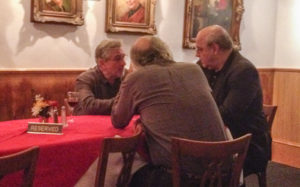
Dan Moldea, right, meets with actor Robert De Niro to try to convince him that Frank Sheeran did not tell the truth about his role in the Hoffa murder. De Niro, convinced of the legitimacy of Sheeran’s story, pressed ahead with production of The Irishman. Courtesy of Dale Myers
Then, on December 2, 2014, Russo called, telling me that De Niro would be his last-minute guest that night at a twice-a-year dinner that I hosted since 1989 for published authors at The Old Europe restaurant in the Glover Park section of Washington, D.C.
I didn’t tell anyone about our special visitor.
Eighty unsuspecting authors attended the dinner that evening where they were shocked to see De Niro, who couldn’t have been friendlier, nicer or a better sport. He posed for hundreds of photographs and treated all who approached him with respect.
Then, as the crowd thinned out, Russo invited De Niro and me to a table in a corner of the restaurant where the three of us could talk privately. A photograph was taken of the meeting.
Still proud of his purchase of the rights to I Heard You Paint Houses six years earlier, De Niro—who had hired Oscar-winner Steven Zaillian to write the screenplay for his movie, The Irishman — told Gus and me: “This is the book. This is the real story about the murder of Jimmy Hoffa.”
Taken aback, I replied: “With all due respect, you don’t know what you’re talking about. . . . Bob, you’re being conned if you believe that.”
“I’m not getting conned,” he replied.
The conversation deteriorated from there. De Niro and I did not part as friends.
Eric Shawn of Fox News and Frank Sheeran
Over the years, Eric Shawn of Fox News, to his great credit in light of our differing views about the Hoffa murder, continued to ask me to appear on camera during his filmed reports about Hoffa, essentially allowing me to play the role as the principal naysayer of his “Sheeran-did-it” theory.
Actually, along with author Charles Brandt, Shawn had remained at the epicenter of the Hoffa investigation, keeping the case alive since 2004 with his unwavering support of Brandt’s book and the upcoming movie he unofficially helped to develop, The Irishman.
Without Eric Shawn, Charles Brandt’s book would have received very little attention, and the movie, The Irishman, probably never would have been made.
On November 27, 2018, Shawn broadcast a hour-long special on Fox Nation, a new subscription streaming service of the Fox News empire: Riddle: The Search for Jimmy Hoffa, his latest installment about the Hoffa murder case during which he continued to embrace the badly flawed theory that Frank Sheeran had murdered Jimmy Hoffa.
Once again, Shawn, showing his objectivity and sense of fairness, featured my reporting on his program, even though it directly contradicted his own work.(6)
On December 16, Shawn, as part of the promotion of his special report, interviewed me on his Sunday afternoon news program on Fox. In addition to my criticism of his claim that Sheeran killed Hoffa, Shawn also permitted me to give him some good-natured grief, because he had repeatedly reported that Steve Andretta was dead, as Frank Sheeran had claimed in his 2004 book.
In fact, Andretta was alive and well and still living in New Jersey.
On February 3, 2019, Shawn again asked me to appear on his program, this time to discuss the recent death of Tom Andretta, Steve Andretta’s younger brother and an alleged co-conspirator in the Hoffa case.
Between my December and February appearances on Fox News with Shawn, I suggested to Phillip Moscato Jr. that — with the Scorsese-De Niro false-fact-filled film fantasy, The Irishman, slated for a fall release — we might want to consider working with Shawn, whom I considered to be a friend.
Actually, whether I liked it or not, Fox News was the only game in town. ABC, CBS, NBC, CNN and MSNBC, along with the other cable networks, did not appear to be doing anything in conjunction with the movie’s release.
However, Moscato still refused to relent on his “no money, no show” demand, which continued to cause considerable friction between us. Consequently, Moscato and I went for several months with no communications between us.
Working with Fox for free
On July 16, 2019 — two days after I had announced on my blog that I had new information about the Hoffa caper — Eric Shawn called and left a message on my answering machine, saying that he and his bosses at Fox wanted to offer me a paid-consulting agreement to work with them on their Hoffa investigation. Before calling Shawn back, I decided to speak first with Moscato Jr., who told me that he was working with a Florida production company. He added that the producers wanted me to write his book.
I repeated, as I had for the past several years, that without Hoffa’s body confirmed, there was no book. However, I volunteered to do a nine-hour recorded interview with Moscato, which I personally paid to have transcribed. Then, I used it as the basis for a book proposal I wrote for Moscato, gratis, about his life as the son of a Mafia soldier. I gave it to Moscato for any purpose he chose — even if I was not the author — as long as he kept me “in the loop.”
During my subsequent conversation with Eric Shawn, he revealed that he and Moscato had met through the producers with the Florida production company, adding that he had interviewed him during the past few weeks.
For eighteen years, Eric Shawn of Fox News believed that Frank Sheeran had killed Hoffa but changed his mind in 2019 and embraced the theory that Hoffa was murdered by Salvatore Briguglio. Courtesy of Dan E. Moldea
That news really shocked me. Still, Shawn insisted that we should all work together, repeating the offer from Fox News to hire me as a consultant.
Because Shawn had developed his own reporter-source relationship with Moscato, I had no grounds to complain to Shawn for using Moscato Jr. as a source and taking credit for what he told him. But I did feel somewhat betrayed by Moscato, with whom I had invested five years of my time.
Regardless, I liked and respected both Moscato and Shawn, and I wanted to work with both of them. But I offered to do so for free, rejecting Fox News’s proposed paid-consulting arrangement. I wanted to remain independent so that I could speak to and write for any media organization in the aftermath of the release of The Irishman.
Our handshake agreement made, Shawn and I, with the help of Moscato, were determined to solve Act Three of the Hoffa case: the disposal of his body.
Moscato accompanied Shawn and me to the parking lot at 200 Outwater Lane in Carlstadt, New Jersey, where Vinnie Ravo supposedly showed him the location of Hoffa’s burial site — without ever mentioning Hoffa’s name. Independent of me, Shawn had already learned the address of the parking lot, presumably through his interviews with Moscato Jr.
However, Moscato still refused to tell us what his father specifically said just before his death about the location of Hoffa’s body, something inexplicably consistent with what Ravo had told Moscato Jr.
Significantly, Moscato did say that his father declared with no equivocation that Salvatore Briguglio was Hoffa’s killer.
Meantime, Moscato refused to pledge his full cooperation with the law enforcement community. He balked at executing a sworn statement about what he knew. And he refused to take a polygraph test.
Consequently, in the midst of all this, I started to distance myself from Moscato while Shawn embraced him. And, to be clear, I was not a party to whatever deal they made with Fox News and each other.
In short, I had simply lost confidence in Moscato’s story — unless we could prove that Hoffa’s body had been moved from his father’s landfill.
The Irishman: Great cinema, bad history
What was even more unexpected was that Eric Shawn was reconsidering his then eighteen-year position that Sheeran had killed Hoffa. In fact, Shawn was preparing to do a very public about-face, saying that Sal Briguglio, not Frank Sheeran, had killed Hoffa, based, in part, on what Moscato Sr. had told Moscato Jr.
Also leading to his amazing turnabout, Shawn had heard of and asked me about an internal Department of Justice memo dated November 26, 1976, from federal prosecutor Robert C. Stewart to DOJ official Kurt W. Muellenberg that had named Briguglio as Hoffa’s killer. I had a copy of this document and was more than happy to share it with Shawn, which he used to reinforce his new “Sheeran-didn’t-do-it” position.(7)
Shawn’s brave adjustment was strengthened by the pending releases of a slew of accompanying investigative articles that disputed the facts in The Irishman.
The most influential of these stories were published by Larry Henry for The Mob Museum, Bill Tonelli in Slate, Nick Vadala in the Philadelphia Inquirer, Scott Burnstein in the Gangster Report, George Anastasia of the Philly Voice, Vince Wade in the Daily Beast, Julie Miller of Vanity Fair, John Wisely and Julie Hinds of the Detroit Free Press, Allan Lengel of Deadline Detroit, Michael Wilson of the New York Times, Mark Dawidziak of the Cleveland Plain Dealer, Amanda Darrach of the Columbia Journalism Review, Leo Sisti of L’Espresso and Manuel Roig-Franzia in the Washington Post.
Arguably, the biggest negative impact on the false facts and fabrications in The Irishman came from Harvard law professor Jack Goldsmith, the author of the newly released, In Hoffa’s Shadow, the story of Goldsmith’s relationship with his stepfather, Chuck O’Brien. Along with his book, Goldsmith published devastating essays about the motion picture’s inaccuracies and examples of sheer irresponsibility in the New York Review of Books, Lawfare and as an op-ed in the New York Times.
In his book, Goldsmith noted one of my own turnabouts, writing:
The dean of Hoffa journalists, Dan Moldea, has been gripped by the disappearance since literally the day after it occurred, when he was twenty-five years old. Like so many longtime observers, he no longer believes, as he claimed in his 1978 book The Hoffa Wars, that Chuckie was involved in the disappearance. Moldea interviewed many of the leading suspects and players in the case, including Sal Briguglio, the Andretta brothers, and Brother Moscato, a Provenzano protégé. Moldea knew more details about the Hoffa case than anyone I met outside the government, has offered many theories of the disappearance over the years, and is always close by with analysis when a new rumor or ostensible piece of evidence pops up. “Even though the FBI hasn’t located Hoffa’s body,” Moldea told me in August 2018, at the start of his forty-fourth year on the case, “I still hope to find it.”(8)
Seeing his film under siege, Martin Scorsese cynically but wisely embraced what I called “an artistic-license dodge,” simply claiming that his people had bought the rights to I Heard You Paint Houses and then turned its major character, Frank Sheeran, into their own character whom they essentially re-created.
However, Robert De Niro continued to defend the film as the true and accurate version of what really happened to Jimmy Hoffa.
Simultaneously, news about my warning to De Niro in December 2014 that he was “being conned” by Sheeran’s story, generated much attention, too. And De Niro was specifically asked about our meeting:
During a recent interview with IndieWire Executive Editor Eric Kohn, De Niro addressed Moldea’s accusation and did not seem phased by claims The Irishman depicts an untrue story.
“Dan is a well-respected writer. I met him in D.C. for a writers thing where they get together every year. He said that we were getting conned. I wasn’t getting conned,” De Niro said. “I have no problem with people disagreeing. He of course is an authority on Hoffa and everything else. As Marty says, we’re not saying we’re telling the actual story, we’re telling our story. I believed it.”
De Niro continued, “I know one thing — I know all the stuff that Frank said, the descriptions of the places he was at, the way he talked, that’s all real. The way he describes what happened to Hoffa is a very plausible thing to me. I’d love to hear what actually happened to him. But this made a lot of sense to me.”(9)
After momentarily suspending all disbelief and seeing The Irishman, I issued a statement, saying, “It is a stunning work of filmmaking by Martin Scorsese — although it appears to be his homage to Oliver Stone’s own film fantasy, JFK, with its great cinema but bad history.”
Frank Cappola, son of Paul Cappola, Moscato’s partner
On February 3, 2019, I received a call from a Florida businessman, Paul Cappola Jr., the youngest son of the late Paul Cappola, Sr., the partner of Phillip Moscato Sr. at Brother Moscato’s Dump in Jersey City, aka the PJP Landfill. Young Cappola told me that he believed that his older brother, Frank Cappola, might have specific information about the location of Jimmy Hoffa’s remains at the dump.
I asked for an introduction to Frank Cappola but, for whatever reason, I did not receive it at that time. Several months later, on September 6, 2019, I contacted Cappola Jr. and appealed to him to arrange an introduction for me to his brother.
Frank Cappola, whose father was Brother Moscato’s partner in the New Jersey dump, escorted Moldea last September to the exact location where Hoffa’s body is believed to be buried. Courtesy of Dan E. Moldea
Through my research since the previous February, I learned that Frank Cappola, who had a criminal record, worked for many years as a top lieutenant for New Jersey gangster Vincent Ravo — the same Vinnie Ravo who had supposedly shown Phillip Moscato Jr. the location of Hoffa’s body, aka “sacred ground,” buried in a parking lot at 200 Outwater Lane in Carlstadt.
In the small-world category, the owner of the property had tasked Ravo years earlier to arrange for a major clean-up and overhaul of that same parking lot. And the person to whom Ravo gave this assignment was Frank Cappola.
Under the circumstances, I just had to talk to this guy. There was no stopping me.
On September 7, 2019, I received a call from Frank Cappola. During this interview, he told me that Jimmy Hoffa was, indeed, buried at the PJP Landfill.
And he added that he knew the exact location of Hoffa’s unmarked grave.
Cappola had never even heard the theory that Hoffa was moved from the dump and taken to the parking lot in Carlstadt.
After that first conversation, we had six additional interviews, all by phone.
On September 26, Fox News, for reasons unknown, balked at bringing Cappola onto our team, refusing to pay for his airfare from Florida to New Jersey after initially agreeing to do so several days earlier. Cappola had planned to fly to Newark the following day to meet with me, but he had no ticket. And he was so angry about it that he threatened to cancel his trip.
After Fox News dropped the ball, I personally paid for Cappola’s round-trip ticket, which caused considerable tension among Fox News, Cappola and me — with Eric Shawn insisting that he was caught in the middle.
I was not under contract with Fox, so, inasmuch as I found Cappola and paid for his expenses, I told Shawn to tell his bosses, with respect, that Frank Cappola was now my source, exclusively.
Cappola arrived in New Jersey on Friday, September 27, the same day as The Irishman premiered at the New York Film Festival.
During our dinner the following night, September 28, Cappola — who felt disrespected by Fox News and refused to speak with Shawn — told me that he was going to drive to PJP the following day.
I replied, smiling, “Motherfucker, you are taking me with you.”
On Sunday morning, September 29, Cappola picked me up at my hotel in Secaucus, and we drove to the remnants of the former PJP Landfill in Jersey City, aka “Brother Moscato’s Dump.”
When we arrived, Cappola gave me a tour of the area, which he had not visited in nearly twenty years. But his memories seemed to sharpen just by being there, and he went on to repeat what he had told me during our numerous phone interviews over the past three weeks — with few, if any, changes to or variations on his original story.
The tour culminated with his identification of the exact spot where, according to Cappola, Hoffa was buried in the unmarked grave dug by his father, Paul Cappola Sr.
“This is it,” Cappola told me. “This is where my dad buried Jimmy Hoffa.”
The site was the approximate size of a Little League baseball diamond, 60 feet times four.
I filmed the entire tour and interviewed Cappola on videotape that same afternoon.
* * *
Since Hoffa disappeared on July 30, 1975, I had been involved in no fewer than a half-dozen previous searches — all of which wound up as intriguing adventures but cruel disappointments.
But after closely scrutinizing Cappola’s story, his version of events was something very special and unique. In fact, during my many years of investigating Hoffa’s fate since 1975, Cappola’s information provided me with the best lead I had ever seen or heard with regard to a possible site of the unmarked grave of the ex-Teamsters boss.
On the basis of the information I collected from the tour and the recorded interview, I drafted a proposed sworn declaration for Cappola to sign, which he corrected, amended and executed under the penalty of perjury on October 7.
Meantime, I asked Cappola — as a favor to me and out of respect for a friend and colleague — to agree to an interview with Eric Shawn on October 11, adding that I would be sitting at the table with them and protecting his information. Cappola agreed, and the interview went well.
On or about November 21, 2019 — three days after Shawn and I revealed our information about Moscato Jr. on Shawn’s next installation about Hoffa for Fox Nation — I published my article about Cappola’s breathtaking revelations at FoxNews.com. Shawn broadcast portions of his brief interview with Cappola as part of his Sunday, December 1, prime-time special on Fox News.
In my article about Cappola and his father, I wrote:
“This is it,” Frank Cappola said to me in a hushed voice on a sunny Sunday afternoon, September 29, as he compared the foreboding area where we were standing with aerial photographs of this same scene. “This is where my dad buried Jimmy Hoffa.” . . .
The location — widely thought to be operated by mobsters — was a familiar one to the FBI and those who had studied the Hoffa-murder case: “Brother Moscato’s Dump” in Jersey City, New Jersey — once a sprawling . . . toxic waste site bordered by the Hackensack River and directly beneath the Pulaski Skyway which stretched between Jersey City and Newark. The dumpsite was targeted for cleanup by the EPA during the late 1970s and 1980s. Most of the land was now a public park and a wildlife refuge.
“Brother Moscato’s Dump” was also known as the PJP Landfill: “P” for Phillip “Brother” Moscato; “J” for local political figure John Hanley; and “P” for Paul Cappola, Frank Cappola’s father. Moscato, according to federal and state law enforcement officials, was a reputed soldier in the Vito Genovese crime family. He worked under Anthony Provenzano of New Jersey, one of two mobsters Hoffa expected to meet on the day he disappeared. Moscato died in 2014.
The late Paul Cappola was a respected businessman who owned a waste-management company in Jersey City and was Moscato’s partner at the PJP Landfill. Cappola was certainly connected to the underworld but, unlike Brother Moscato, was not a “made” member of the Mafia. Still, like Moscato, he was obedient to the powers that controlled the waste-management industry in New Jersey and New York during the 1970s.
Alleged specific location of Hoffa’s remains
Frank Cappola, who was seventeen and working part time at the dump when Hoffa disappeared during the summer of 1975, recalled: “While I was talking to my dad, a black limousine drove onto our lot in the mud. My dad said to Moscato something like, ‘They’re here.’
“Moscato went to the limousine and spoke with its occupants, none of whom were known to me. During their conversation, Moscato turned and pointed to a specific area in the northeast section of the landfill. At the time, I didn’t know why.
“After Moscato made this hand gesture, my father threw his hands up in the air and exclaimed, ‘Now, the whole fucking world will know!’ I didn’t know what my dad was talking about then.
“When the limousine left, Moscato told my father that he had to be somewhere that night, adding, ‘You have to handle it, Paul.’ They walked into the PJP office for a closed-door meeting. At that time, I didn’t know what they discussed.
“Shortly before I left work that day, I saw that a large hole had been dug with an excavator. At the time, I had no idea why.”
In 1989, Frank Cappola was working on a waste site adjacent to the long-defunct PJP Landfill. During a visit from his father, the two men walked onto what was once PJP. When they came to the location of the hole Frank saw that night in 1975, Paul Cappola told his son, “This is where Jimmy Hoffa is buried.”
Frank recalled, “This was the first time that my dad admitted that Hoffa was buried at PJP, although he had referred to Hoffa in unspecific terms in our previous conversations.”
In or about March 2008, while Paul Cappola was dying, he provided his son with the specific details about what had happened to Hoffa’s body, adding that he wanted his son “to help Hoffa return home to his family.”
* * *
Notably, after Ralph Picardo told the FBI that a Gateway Transportation truck had hauled Hoffa’s body to New Jersey, special agents obtained Gateway’s shipping records from the company’s operations in Detroit to its terminal Secaucus, New Jersey — which was less than a ten-minute drive from the PJP Landfill in Jersey City.
Cappola’s sworn statement
In his affidavit, executed at my request, Frank Cappola listed what his father told him:
a. A person or persons he did not name instructed my father and Mr. Moscato to bury Jimmy Hoffa’s body. My father led me to believe that they were the people in the limousine with whom Mr. Moscato met that muddy day during the summer of 1975.
b. Mr. Moscato told my dad that he had something to do that night and asked my father to take care of it.
c. Mr. Moscato had a burial location for Hoffa on the landfill site. While he was talking to the people in the limousine, both my father and I witnessed him pointing in the direction of this location.
d. My father was upset with Mr. Moscato for pointing to that area at the landfill, because the dump was constantly under police scrutiny, and Mr. Moscato’s gesture could have given away the location of Hoffa’s body.
e. After Mr. Moscato left PJP, my father, who didn’t trust anybody, decided to dig a second hole with a company excavator and to place Hoffa at that location — unknown to Mr. Moscato. My dad never told him.
f. Unidentified people brought Hoffa’s dead body to PJP. Because of the awkward position of Hoffa’s corpse after they removed him from whatever container he was in before, they were unable to place him, feet first, in a 55-gallon steel drum retrieved at PJP. So, they put him in the drum headfirst. Then, they sealed the container. My father saw but never handled Hoffa’s dead body.
g. After those people left, my father likely placed the steel drum containing Hoffa’s body on a front loader. Then, he positioned the drum at the bottom of the large hole my father dug, which was eight to fifteen feet deep.
h. I will reveal the exact location of that hole to law enforcement, along with two additional and provable details about that site.
i. My father then placed as many as fifteen to thirty chemical drums in the hole where Hoffa’s body was encased, along with chunks of brick and dirt.
j. Notably, as a common practice, the chemical drums would be marked. The steel drum that contained Hoffa’s body was likely not marked.
k. Then, my father covered the grave with a bulldozer, which completed his task. The site was his secret.
l. My father also placed something detectable just under the surface of the gravesite, which I am willing to disclose to law enforcement.
Along with executing his sworn statement, Cappola told me he was prepared to cooperate fully with the law enforcement community, and he was also willing to take a polygraph test.
According to a statement from the FBI’s field office in Detroit about the information Eric Shawn and I had developed about Phillip Moscato Jr. and Frank Cappola:
Over the years, our office has followed all credible leads we received from the public. We are aware of the recent reports of two individuals, who claim to have knowledge about the whereabouts of Mr. Hoffa. Just as we would with anyone who purports to have information relevant to this — or any — ongoing investigation, the FBI welcomes the opportunity to speak to those individuals.(10)
“Frank, are you okay?”
In early January 2020, Frank Cappola was in New Jersey, visiting his longtime girlfriend, Joy DiBiaso, a legal assistant for a law firm in New York City. Joy, whom I had met during my first visit with Cappola, adored him and was very protective of him. Tough-guy Frank and sweet Joy, both in their early sixties, looked like a couple of carefree school kids when they were together. They were in love.
With Joy’s upcoming retirement, she and Cappola were making plans to live together in Florida.
Before he returned to his home from this trip, I called and invited Cappola and Joy to dinner on Friday, January 10. I took the train to Secaucus and checked into a hotel that was near a sushi buffet that Frank and Joy liked, a place we had been to before.
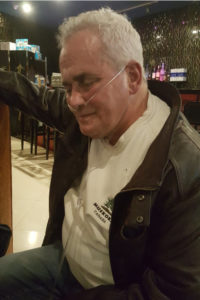
I was first to arrive at the restaurant. While I was in the lobby, Frank slowly walked through the front door with a breathing tube in his nostrils and a small tank of oxygen slung over his shoulder. Joy was outside parking the car. I knew that Frank was still ailing after a serious bout with pneumonia the previous year.
Shortly after the maître ‘d seated us, Frank became very weak — so much so that he couldn’t even get up to go to the buffet table. I knew that he enjoyed oysters on the half shell and shrimp cocktail. So, while he rested, I went to the seafood bar and fixed him a small plate of food. He ate three of the six oysters and three of the six shrimp before pushing his plate away.
When I looked at him, he had a glassy gaze. I reached across the table and patted him on the shoulder, asking, “Frank, are you okay?” Moments later, Cappola, breathing irregularly, went headfirst into the table, clearly suffering from some sort of respiratory event.
During a dinner meeting with Moldea in January, Frank Cappola collapsed at the table. The following day, he was rushed to the hospital. He died in March. Courtesy of Dan E. Moldea
Joy immediately sprang out of her chair and adjusted his breathing equipment so he could get more oxygen.
“Jesus, Frank,” I exclaimed, “let me call an ambulance!” Joy, almost on the verge of tears, agreed.
Cappola shook his head, saying he just needed to get to Joy’s home and go to bed. He added that he was extremely tired.
We had only spent about fifteen minutes together.
Joy ran out to get the car. While Cappola and I sat together in the lobby, I snapped a photograph of him, looking almost peaceful.
I helped Cappola to Joy’s car, repeating that we should go to the hospital. But he refused again, saying that he just needed to get some sleep.
That was the last time I saw Frank.
In the days that followed, Joy took him to a local hospital that was not equipped to deal with Cappola’s condition. Consequently, medical personnel moved him to the Hackensack University Medical Center where he was fitted with a ventilator and placed in a drug-induced coma.
Although he briefly opened his eyes from time to time, he never fully regained consciousness, and he never spoke another word.
On March 16, 2020, Frank Cappola died before the FBI arranged for the polygraph test he had offered to take, a missed opportunity.
I blogged out the news, adding that if Frank was right, then I was now probably the only person in the world — with one possible exception — who knew where Hoffa was buried.
I immediately found a safe place for the videotapes of my September 29, 2019, “tour” with Cappola at the PJP Landfill, aka “Brother Moscato’s Dump,” as well as for the films of our interviews.
Determined to discover whether Frank was right or wrong, I mapped out a strategy with trusted friends that we hoped to execute immediately. However, when the worldwide pandemic struck with its full force shortly after Frank’s death, everything was frozen and put on hold.
As of this writing, we are waiting for an opportunity to strike. Several months before he died, Frank Cappola authorized me in writing to cooperate fully with the law enforcement community, which I am preparing to do with enthusiasm.
* * *
I started investigating Jimmy Hoffa and the Teamsters while I was a graduate student at Kent State, eight months before Hoffa disappeared on July 30, 1975. And I have been involved in the investigation of his killing since Day One.
After all of these years, I am still Ahab, and the Hoffa murder case is still my white whale.(11)
(5)Dan E. Moldea, Moldea.com, “Who is Vinnie Ravo? After 42 years, a possible new cast member emerges in the mystery of the disposal of Jimmy Hoffa,” July 20, 2017. See: https://www.moldea.com/HOFFA-RAVO.pdf
(6)Via Fox Nation, Eric Shawn released the second part of Riddle: The Search for Jimmy Hoffa, on November 18, 2019. Part Three was broadcast on March 17, 2020.
(7)Also, I gave Eric Shawn a letter that the late former FBI Special Agent Ken Walton of Detroit, a long-time friend of mine, had sent to me on July 11, 2004, shortly after the release of I Heard You Paint Houses. Walton, who spent many years investigating the Hoffa murder, wrote: “Regarding Jimmy and the latest [revelations] by Frank Sheeran, I don’t buy it, and when I spoke to Eric Shawn . . . I told him the same thing. . . . I still [think] he was killed by Sal Briguglio.”
On September 25, 2019, I blogged about a videotape in the Zeitts archive in which Sheeran had claimed on film that another reporter and I were misled by the FBI to believe that the Teamsters and the Mafia were behind Hoffa’s murder when, according to Sheeran in this recording, the person who engineered the killing was former U.S. Attorney General John Mitchell, which, of course, was ridiculous.
(8)Jack Goldsmith, In Hoffa’s Shadow: A Stepfather, a Disappearance in Detroit, and My Search for the Truth (New York: Farrar, Straus and Giroux. 2019) p. 294.
(9)Zack Sharf, IndieWire, “Robert De Niro Defends The Irishman Against Claims It’s Based on an Untrue Story,” November 13, 2019.
(10)Eric Shawn, Fox Nation, “Exclusive: FBI wants to talk to subjects of Fox Nation’s Jimmy Hoffa investigation,” January 15, 2020.
(11)Dates of deaths of persons of interest in the Hoffa-murder case
(*) interviewed by Dan Moldea:
* Thomas Andretta: January 25, 2018
* Stanton Barr: November 13, 2019
* Salvatore Briguglio: March 21, 1978
Russell Bufalino: February 25, 1994
* William Bufalino: May 12, 1990
* Frank Cappola: March 16, 2020
Paul Cappola, Sr.: March 8, 2008
* Allen Dorfman: January 20, 1983
Anthony Giacalone: February 23, 2001
Vito Giacalone: February 19, 2012
* Lawrence McHenry: January 17, 1994
* Rolland McMaster: October 25, 2007
* Phillip Moscato, Sr.: February 16, 2014
* Charles O’Brien, February 13, 2020
Ralph Picardo (federal witness): January 26, 2004
Anthony Provenzano: December 12, 1988
* Salvatore Provenzano: May 27, 2013
* Jack Robison: July 27, 2003
* Leonard Schultz: September 6, 2013
* Jim Shaw: March 31, 1987
* Frank Sheeran: December 13, 2003
* Donovan Wells (federal witness): September 5, 2019
Still alive, as of this writing (May 15, 2020):
* Gabriel Briguglio, living in New Jersey
* Stephen Andretta, living in New Jersey
Sitting around in pajama pants, Robert Iler and Jamie-Lynn Sigler, friends who starred together on The Sopranos, decided to start a podcast.
The weekly podcast they launched last fall, “Pajama Pants,” features Iler, Sigler and internet personality Kassem Gharaibeh, known as Kassem G. The podcast includes guests such as Katherine Narducci, a Sopranos veteran whose acting credits also include playing the wife of Mafia boss Russell Bufalino (Joe Pesci) in Martin Scorsese’s 2019 movie The Irishman.
In The Sopranos crime series on HBO from 1999 to 2007, Iler and Sigler played the children of New Jersey mobster Tony Soprano (the late James Gandolfini) and his wife, Carmela (Edie Falco).
Topics on “Pajama Pants” range from life observations to comments about The Sopranos series. The three hosts even discussed how to pronounce “pajama.” Gharaibeh says pa-JAM-a, while the other two say pa-JAH-ma.
Iler, once a drug user, heavy drinker and serious poker player, moved from Las Vegas to Los Angeles in the fall of 2019 to start the podcast with Sigler.
He mentioned all this, including how he and Sigler came up with the idea, while appearing as a guest on “Talking Sopranos,” another podcast about the TV show, this one hosted by actors Michael Imperioli and Steve Schirripa.
Actors Michael Imperioli and Steve Schirripa host the Talking Sopranos podcast series, in which they discuss Sopranos episodes.
In the HBO series, Imperioli played Christopher Moltisanti, while Schirripa portrayed Bobby “Bacala” Baccilieri.
This recent boom in Sopranos-centered podcasts includes a third one, “Made Women: A Sopranos Re-Watch Podcast,” with Sopranos cast member Drea De Matteo and her friend Chris Kushner, an entrepreneur from New Jersey. People magazine named “Made Women” one of 15 binge-worthy podcasts about TV shows.
“The series is the only female-led Sopranos podcast,” the magazine notes, “and their celebrity pals get candid about motherhood, marriage, relationships family, of course — all things Italian.”
These three Sopranos podcasts are available in an audio-only format and on YouTube.
Based on YouTube views, the most popular so far is the one by Imperioli and Schirripa. In the YouTube version, the two appear on a split screen, wearing headsets, with similar red curtains behind each as a backdrop. Every week, Imperioli and Schirripa discuss different Sopranos episodes, providing insights into casting decisions and other behind-the-scenes details.
Imperioli said the podcast was planned before the coronavirus pandemic hit. After that, he and Schirripa considered not doing it. “We’re aware that there’s a lot of suffering right now,” he said in the first episode, recorded March 30 and posted April 6. “It’s a terrible, terrible crisis.”
However, fans who have been bingeing on the television show while sheltering in place asked for the podcast, Imperioli said. The original plan was to have the two hosts work together in the same studio, but Imperioli participates from Southern California, while Schirripa is in New York City.
The recent episode with Iler led to news stories partly focusing on his past alcohol and drug use. Iler, who was 12 years old when he won his role after making creator David Chase laugh at his use of the f-word, has kept a low public profile since the series ended. The 35-year-old Iler told the “Talking Sopranos” hosts that he stopped getting drunk and abusing hard drugs about seven years ago and quit using Xanax five years ago with the help of a specialist. He also said he has not been interested in doing much acting since the show ended but could see himself being involved in something like the Netflix crime series Ozark.
“It blew me away,” he said of Ozark.
The “Talking Sopranos” podcast also came up on “Coffee With Cullotta,” a YouTube program featuring Frank Cullotta, an 81-year-old former mobster in Las Vegas. In a recent episode, Cullotta said he knew Schirripa when the future Sopranos star was a bouncer at a Las Vegas nightclub, Paul Anka’s Jubilation. The nightclub on Harmon Avenue across from what is now Planet Hollywood has been demolished, but during its heyday Schirripa would allow Cullotta and Mob enforcer Tony Spilotro cut to the front of the line at the door to get in. During the 1970s and ’80s, Spilotro oversaw criminal activity in Las Vegas for the Chicago Outfit, with his boyhood friend Cullotta serving as a lieutenant. In 1986, Chicago mobsters beat the high-profile Spilotro and his brother, Michael, to death and buried them in an Indiana cornfield.
Actress Drea De Matteo and friend Chris Kushner host Made Women: A Sopranos Re-Watch Podcast.
Later, when the 1995 movie Casino was being filmed in Las Vegas, Schirripa, then the entertainment director at the Riviera hotel-casino, approached Cullotta in the hotel and asked if the former mobster could help him land a part in the movie. Cullotta had been in the federal witness protection program but was out by then, working as a consultant on the Martin Scorsese film. Cullotta, who appeared briefly in the movie, helped Schirripa land a role as an extra in a bar scene where Joe Pesci, portraying a character based on Spilotro, stabs another man with a pen. Cullotta said that role helped launch Schirripa’s acting career.
“From then on he went on to be as famous as he is,” Cullotta said.
In addition to his YouTube show, Cullotta appears in an 11-episode podcast, “Mobbed Up: The Fight For Las Vegas,” produced by the Las Vegas Review-Journal in partnership with The Mob Museum. This is one of several podcasts from around the country about organized crime histories in different cities.
Michael Green, a UNLV associate professor of history and a Mob Museum board member, said interest in Mob podcasts demonstrates that people “don’t necessarily want to praise mobsters, but they sure enjoy finding out about them.”
As a topic, organized crime is a great way to draw listeners to podcasts, he said.
While fans are turning to podcasts like “Made Women,” with its focus on The Sopranos, a movie prequel based on the TV series is scheduled to be released March 12, 2021. Titled The Many Saints of Newark and featuring James Gandolfini’s son, Michael, the film is set in 1960s Newark, New Jersey, “when the African American and Italian communities are often at each other’s throats,” according to its website.
Kushner, who co-hosts “Made Women,” said the podcast is connecting with an equal number of men and women and is reaching a new audience of younger fans. “All these young people are now addicted to The Sopranos,” she said in an interview for this story.
In an appearance on “Pajama Pants,” Imperioli said one reason he and Schirripa decided to do “Talking Sopranos” is that younger people are watching the TV show and are active on social media sites dedicated to The Sopranos. Series creator David Chase, who gave the podcast his support, asked Imperioli during an off-air phone conversation why this continued interest is happening.
Imperioli replied that he didn’t mean to sound flippant, but it is because the TV series is “very, very, very good.”
Larry Henry is a veteran print and broadcast journalist. He served as press secretary for Nevada Governor Bob Miller, and was political editor at the Las Vegas Sun and managing editor at KFSM-TV, the CBS affiliate in Northwest Arkansas. Henry taught journalism at Haas Hall Academy in Bentonville, Arkansas, and now is the headmaster at the school’s campus in Rogers, Arkansas.
Pablo Escobar, the ruthless Colombian drug kingpin and world’s first billionaire criminal, pioneered mass-market drug trafficking, fueled by bribery and murder, in the mid-1970s. His legacy is still unfolding today.
Escobar’s strategy more than 40 years ago of smuggling tons of cocaine from Colombia into the United States remains a staggeringly successful, and frustrating, reality, if done somewhat differently now. Since the 1980s, Colombia, which produces more cocaine than any other country, has outsourced through Mexico’s drug cartels its secret exports into America — by land, air and sea. The annual proceeds, divvied up among the Latin American crime groups, amount to $19 billion to $29 billion, according to the U.S. Department of Homeland Security.
The exploits of the late Escobar, his former Medellin Cartel, his henchmen, his heinous crimes and criminal successors make for a fascinating tale, and the subject of the Mob Museum’s latest major exhibition, Rise of the Cartels: International Drug Trafficking in the Americas, which debuted June 20.
The exhibition tells the story by weaving true stories and artifacts with contemporary pop culture narratives about the clash of the Colombian and Mexican cartels with the U.S. Drug Enforcement Administration, as showcased in Netflix’s popular series Narcos and Narcos: Mexico. Key to that story are the DEA’s special agents assigned to dangerous parts of Mexico and Colombia, who risked their lives to pursue Escobar and other infamous traffickers.
One such agent highlighted in the exhibition is Enrique “Kiki” Camarena, who, after busting marijuana ranches in central Mexico, was kidnapped, tortured and murdered by conspirators that included Guadalajara Cartel boss Miguel Felix Gallardo, in 1985. Camarena’s death led the DEA to pull out the stops to find his killers. The effort ended in more than 30 arrests, including Gallardo, later convicted of murder, and the collapse of Gallardo’s cartel.
The exhibition includes a range of artifacts, including the service firearm carried by DEA special agent Steve Murphy when he was hunting Pablo Escobar in Colombia in the early 1990s.
To assist in producing the exhibition, the Mob Museum enlisted former DEA agents whose work in Colombia and Mexico in the 1980s and 1990s is dramatized in the Narcos series.
The first two seasons of Narcos depict the timeline chronicled by DEA special agents Steve Murphy and Javier Pena in their 2019 book Manhunters: How We Took Down Pablo Escobar. Murphy and Pena worked alongside Colombian National Police – on raids, investigations, interrogations — in the search for Escobar in Colombia from 1992 to the drug lord’s violent death by police in 1993.
Both Murphy and Pena provided valuable background information and artifacts saved from their careers in the DEA. Artifacts include the former agents’ DEA badges they wore while serving in Colombia, the Distinguished Service Crosses awarded to them after Escobar’s death, a wanted poster for Escobar, cocaine bags seized from his drug lab, Murphy’s 9mm firearm and a Los Tombos hat like those worn by members of the Colombian Police’s elite Search Bloc unit.
Murphy and Pena say the producers of Narcos took a number of liberties in the show to move the storylines along, including scenes involving their characters that never happened. On one of the panels in the exhibition, Murphy and Pena explain what things the show got exactly right and what amounted to dramatic license. Overall, they both believe Narcos succeeded in bringing the requisite points of their narrative to light.
Former DEA agent Pete Hernandez, who graduated from the DEA Academy with Camarena, served with him in Guadalajara and became his close friend, delivered for the exhibition the cowboy hat he wore while with the anti-drug agency in that city from 1979 to 1983. Hernandez also furnished a photo showing him and Camarena in the Zacatecas Mountains of central Mexico.
Another colleague of Camarena’s, former DEA special agent James “Jaime” Kuykendall, furnished a photo for the exhibit of a sign from the Rancho Santa Fe, a marijuana ranch that he and Camarena helped raid in 1983, resulting in one ranch hand shot to death by police. Kuykendall also made available a photo of him posing beside seven-foot marijuana plants at a trafficker’s farm in Mexico in 1992.
DEA special agents Steve Murphy and Javier Pena pose with a copy of a Colombian newspaper that reported on Pablo Escobar’s demise at the hands of the Colombian National Police in 1993. Courtesy of Steve Murphy
Kuykendall is himself an important character in Narcos: Mexico (portrayed by actor Matt Letscher), shown working as a DEA supervisor alongside Camarena (played by Michael Pena). He and Camarena were good friends in real life. Kuykendall served as the source for the exhibition’s panel on fact vs. fiction in Narcos: Mexico.
Two artifacts in the exhibition come from the Museum’s collection. One is a copy of a rare leather-bound book, commissioned by Escobar, containing a collection of editorial cartoons about him from Colombian newspapers. Escobar had a limited number of the books printed, and only 10 are believed to still exist today.
There is also a security officer’s ball cap from Escobar’s Hacienda Napoles, a ranch and theme park that was home to an array of exotic animals, including hippos, elephants and giraffes.
The exhibition portrays the beginning of Escobar’s career as a drug trafficker in the mid-1970s. A map shows the smuggling route created by his partner, Carlos Lehder, a pilot who bought most of an island, Norman’s Cay, in the Bahamas to use as a stopover to surreptitiously fly loads of cocaine from Escobar’s processing labs in Colombia into southern Florida, where their cohorts fanned out the drugs to distributors. It worked beautifully for several years until Lehder’s capture and the closing of the island in 1983. Lehder, originally sentenced in 1988 to life plus 135 years in a U.S. prison, won release from federal prison on June 15 and now lives in Germany.
The exhibition notes Escobar’s rise as a street hoodlum in Medellin, indulging in kidnapping, murder and police bribery until he happened upon a small cocaine ring. Coming at the time (about 1975) of increased popularity of powdered cocaine among America’s rich urbanites, it was an unbelievable opportunity that would lead to his trafficking of billions in cocaine, plus heroin and other illegal drugs, from Colombia to the United States.
After seizing control of the ring, Escobar vastly increased production of cocaine paste – the “base” for the drug – to make powdered cocaine and used ever-larger low-flying planes to transport more of it than anyone else. Escobar also resorted to more violence than the lessor drug lords dared – wholesale murder and terrorism, such as ordering the downing of a passenger airliner in 1989, innumerable bombings, the assassinations of Colombian Supreme Court judges, a presidential candidate, a cabinet minister, and paid hits on hundreds of police officers, amounting to literally thousands of deaths. His goal was to intimidate and promote fear within the public and police and discourage government officials from agreeing to sign a treaty with the United States for the extradition of wanted criminals like him.
Escobar’s exploits could not last. The exhibition shows his dead body on the roof of a house, the fatal result of a shootout with Colombian National Police in suburban Medellin after police intercepted his radiophone message from one his hideouts on December 2, 1993.
Kiki Camarena was a DEA special agent stationed in Guadalajara, Mexico, who was kidnapped, tortured and killed by a Mexican drug cartel in 1985. Courtesy of James Kuykendall
The dramatic focus of Narcos: Mexico is Miguel Felix Gallardo’s difficulties in maintaining control of his massive illegal drug business, in person and by phone, on the road and in the air, consisting of a confederation of “plazas,” or trafficking territories, in Mexico. Gallardo’s claim to fame was making a major deal with Colombians to supply him with tons of cocaine bound for the United States, smuggled by his coterie of plazas. Amid the tensions, in addition to assuaging corrupt politicians and police, he dealt with the competing personalities and egos of his partners, male and female, and their intervening family members.
Meanwhile, the DEA and Mexican authorities targeted Gallardo and his partner Rafael “Rafa” Caro Quintero for their complicity in the torture-murder of Camarena. They arrested Quintero in 1985 and obtained a murder conviction in court. Gallardo lasted longer, having cut deals with high-level Mexican officials, until his arrest in 1989 and subsequent 40-year prison sentence. (Quintero was released from a Mexican prison on a technicality after serving 28 years, and he remains a fugitive from American prosecutors). With his downfall, Gallardo’s drug federation split into separate cartels, triggering a years-long armed conflict among criminals, called the Mexican Drug War, which has taken the lives of more than 100,000 people since the 1990s.
Today, after the bloody years since the splintering of Gallardo’s Guadalajara Cartel, Mexico’s drug cartels, more or less, include the Beltran-Leyva, Gulf Cartel, Jalisco New Generation, Juarez, La Familia Michoacana. Los Zetas, Sinaloa and Tijuana/Arellano Felix. All owe their existence in many ways to what Escobar started 45 years ago, nurtured and killed for until his inevitable demise.
About 10 cartel assassins armed with AK-47s and grenade launchers stormed the deputy police chief’s house at 5 a.m., snuffed out him, his police officer wife and their seven-year-old son, then lit the house on fire, killing three daughters.
This incident, which occurred in Mexico in July 2009 and is detailed in Italian journalist Roberto Saviano’s book ZeroZeroZero, is one example among many of the grim toll occurring today in global drug trafficking. During one especially deadly nine-month period in 2011, drug violence resulted in 12,903 people being killed in Mexico, according to the country’s prosecutor general. This year, in only one month since a March 23 stay-at-home order was imposed because of the coronavirus pandemic, an estimated 100 people were killed in drug-related incidents in Ciudad Juarez, across the border from El Paso, Texas.
This sort of violence is played out in several crime series now available on streaming services such as Amazon Prime Video and Netflix.
One of these, an eight-episode series airing on Amazon Prime, was adapted from Saviano’s book and also is titled ZeroZeroZero. The series paints a dramatic picture of the murderous betrayal and treachery common among cartels and Mafia clans, specifically in cocaine trafficking. The term “zero zero zero” describes the purest, whitest flour, but narco traffickers use it to signify pure cocaine. “The more zeros, the purer it is,” Saviano writes in the book. “The best cocaine: 000.” As the book points out, though, cocaine often is diluted, sometimes with flour or other substances, including a mild laxative, to stretch out the supply for street sales.
Italian actor Adriano Chiaramida plays an aging Mob boss in ZeroZeroZero.
The Amazon Prime series follows a fictional large shipment of cocaine from Mexico to Italy and dramatizes the difficulties in getting it there as organized crime factions attempt to control the payload (hidden in cans of sliced jalapeño peppers). A New Orleans shipping company, which also handles legitimate cargo, is the broker providing the transportation. Multiple spoken languages and stunning visual settings give the series an appealing global backdrop, but the deadly outcomes — human-eating pigs, children caught in the crossfire and killed in gun battles — erode any notion of glamor in this illegal enterprise.
The goal in such a cutthroat environment is the attainment of money and power, and, as the series makes clear, anyone can be betrayed, including family members. The payoff of millions of dollars is the motivating factor. As one of the show’s characters puts it, “Money solves everything.”
The lure of money will always be what draws people into this violent underworld, says Thomas Salme, a documentary filmmaker living in Italy. This lure is especially attractive to those from impoverished circumstances who see little opportunity in their surroundings and therefore look beyond the serious downsides, he said. Salme directed the 2019 documentary Rescued from Hell about Jota Cardona, a former Colombian drug dealer.
“A lot of money is involved, and nice cars and gold chains,” Salme said over the phone from his home in Milan. “Everybody wants to live this kind of dream life.”
Financial considerations were a factor in Salme’s own career with his decision to fly commercial aircraft in Europe without a license for more than a decade, according to court testimony that resulted in a $2,700 fine but no jail time for him in 2010. His lawyer said Salme was “unable to find other work and had financial difficulties due to a divorce, young children and an ailing father,” according to the Associated Press. From this experience, he since has turned to documentary filmmaking, focusing on international crime.
The cocaine-trafficking series based on Saviano’s book is one of several multiple-episode crime shows involving drug cartels recently airing on streaming services. Others include Narcos: Mexico and Ozark, both on Netflix.
In ZeroZeroZero, Gabriel Byrne plays the head of an American shipping company involved in global drug trafficking.
Salme said shows about drug cartels and the Mafia are popular in part because viewers enjoy the vicarious experience. “You are inside the danger,” he said, “but you aren’t in danger yourself.”
As for Saviano, author of ZeroZeroZero and other books, his writings about the Mafia have put him in a constant state of danger. The 40-year-old journalist has been under police protection in Italy since the 2006 publication of his book Gomorrah: A Personal Journey into the Violent International Empire of Naples’ Organized Crime System.
“I have traveled everywhere with seven trained bodyguards in two bullet-proof cars,” he wrote in 2015 for The Guardian, a British newspaper. “I live in police barracks or anonymous hotel rooms, and rarely spend more than a few nights in the same place.”
Saviano is active on social media sites and recently has spoken out against organized crime groups taking advantage of the coronavirus pandemic to win support in Italy from those who cannot get help elsewhere.
In April, Saviano wrote that “Italian Mafia clans – and in particular the Camorra of Naples” — have established a door-to-door service delivering essentials to the public.
“In the most disadvantaged neighborhoods of Naples, where many people had jobs in the black economy and are now out of work, it is the clans that step in to provide welfare, giving families bread, milk and other basics,” he wrote in the Guardian.
For this service, “desperate people who today receive the Camorra’s help will be grateful or, rather, will have to express their gratitude when everything gets back to normal and the clans need labor for their illicit enterprises,” Saviano wrote.
Noting that Mexican cartels are doing the same thing, Saviano offered a final warning: “Today we are in an emergency, and the imperative is to survive. But parallel to this pandemic, criminal interests are mobilizing. For us to know that – and know them – will be part of that survival.”
Larry Henry is a veteran print and broadcast journalist. He served as press secretary for Nevada Governor Bob Miller, and was political editor at the Las Vegas Sun and managing editor at KFSM-TV, the CBS affiliate in Northwest Arkansas. Henry taught journalism at Haas Hall Academy in Bentonville, Arkansas, and now is the headmaster at the school’s campus in Rogers, Arkansas.
Three weeks after his marriage to the beautiful singer Dale Winter, James Colosimo remained giddy, and nervous. Known as “Big Jim” or “Diamond Jim” for his obsession with the gems, Colosimo reigned as boss of a whorehouse empire in Chicago’s Levee vice district. Celebrities, powerful pols and opera performers crowded his Colosimo’s restaurant, with a café-cabaret and separate late-night fine dining room.
On May 11, 1920, Colosimo and Winter set a date for dinner in the city’s fashionable and exclusive Loop area, along the shore of Lake Michigan. But Colosimo phoned Winter to tell her he’d be late, due to a sudden appointment. “Angel, just got a call,” he said to her. “Gotta meet a guy at the restaurant. It’s important.”
Colosimo with his second wife, the singer Dale Winter. They had been married just a couple of weeks before he was killed. William J. Helmer Collection / The Mob Museum
Colosimo had his chauffer drive him in his Pierce-Arrow to the restaurant that afternoon. Inside the still-closed restaurant, he asked a porter, Joe Gabrela, if he’d seen a man looking for him. Gabrela said no. Colosimo entered his office. Soon, Gabrela noticed a man in the dining room. “Mr. Colosimo’s in the office,” he told the man before leaving the room. Then the restaurant’s accountant noticed Colosimo exit the office. About a minute later, he heard a gunshot.
Colosimo had just peered out a windowed door to the large foyer of his café toward the street, when a gunman strode behind him and fired a .38-caliber revolver into the base of his brain, killing him instantly. The suspect fled, but Gabrela provided police with a detailed description. Chicago Police, acting on tips, shrewdly theorized that Brooklyn mobster-killer Frankie Yale did it. Gabrela did identify Yale in a photo lineup. But as things often wound up in gangdom in those days, his fear got the best of him. Taken to view a live police lineup in New York that included Yale, Gabrela declined to finger him. Practically everyone knew it was Yale, but lack of evidence meant no murder charges filed against anyone.
Johnny Torrio, Colosimo’s righthand man and Yale’s former saloon partner in Brooklyn, leapt into action. He organized an extravagant funeral for his dead boss that would serve as the template for future over-the-top, flowery send-offs for murdered mobsters of the 1920s. In a tribute to Colosimo’s political influence, mourners at the funeral inside his home included the all-powerful First Ward alderman and Cook County Democratic committee member Michael “Hinky Dink” Kenna, the second First Ward alderman “Bathhouse” John Coughlin, several other aldermen, a couple members of Congress, a state legislator and a few judges. About 5,000 people, some holding banners for the Democratic Party and street laborers union, trailed a hearse carrying Colosimo’s body in a $7,500 silver and mahogany casket to Oakwood Cemetery.
When people outside Colosimo’s brownstone watched Torrio enter Kenna’s waiting car, they realized who had moved in as Big Jim’s heir apparent in the First Ward. The Chicago Outfit was born.
Torrio most surely planned Colosimo’s assassination, enlisting Yale, his friend, former business partner and experienced hitman. His motivation to off his boss, acknowledged by history, came from his understanding that Prohibition, effective that January 17, clearly offered massive profits, based on his and Colosimo’s existing model of payoffs to police and local office holders to look the other way from Colosimo’s many prostitution houses in the area. Torrio read that the federal Prohibition enforcement agents would be political appointees, not subject to U.S. civil service rules. In other words, low-paid, low-skilled hacks, ripe for bribery and inattention to liquor smuggling.
But Colosimo, still in rapture with his new bride, disagreed with Torrio, fearing the prospect of federal law enforcement without the protection he was used to. Better to keep things the way they are locally, in the Levee and Loop, he thought. He nixed Torrio’s idea to make a major racket out of bootlegging.
Colosimo’s restaurant on South Wabash Avenue, where he met his second wife and where he was shot to death. The restaurant continued to operate as Colosimo’s for many years after his demise. William J. Helmer Collection / The Mob Museum
However, it is rarely reported that Colosimo did in fact approve Torrio’s scheme to reopen closed breweries to make and sell illegal, real beer to underground merchants and barkeeps in Chicago. Earlier, before Prohibition, Colosimo invested $25,000 in a brewery operated by one of his saloon owners, Jake “Greasy Thumb” Guzik (one author claimed Guzik garnered his nickname for serving beer with his thumb in the stein). Still, this didn’t go far enough for Torrio. Just as he convinced Colosimo to expand the brothel business to the rising suburbs and towns bordering Chicago, he rightly predicted that unbridled bootlegging of beer and hard liquor would produce far more money — millions. Colosimo was dead set against going much beyond prostitution in Chicago and the suburbs, and his popular restaurant. For Torrio, to build this new domain, his shortsighted boss had to go.
Colosimo, born in 1878 in Palermo, Sicily, moved with his parents to the Windy City at age 1. He would not have reached his height as top pimp in Chicago – the nation’s brothel capital – without Hinky Dink Kenna’s well-paid protection. Hinky Dink and Bathhouse Coughlin represented the First Ward, when wards had two city alderman each, from the 1890s to the early 1920s. Two masters of influence and graft, Hinky Dink, thin, stoic and not quite five feet tall, and the floppish, flamboyant Coughlin, helped themselves to payments, not only from the vice businesses in the Levee, but on everything awarded by the city council in their ward – licenses, permits and utilities needed for hotels, banks, shops and clubs in the Loop as well as federal and state offices, the police, courts and jails. Colosimo, as Torrio after him, served at the pleasure of Kenna as his vice gang underlings and made sure he received his cut of the proceeds. Kenna let the illicit gambling operators and brothel madams run as long as they, as precinct captains, delivered him the votes to win elections.
Colosimo’s links to Hinky Dink started in the 1890s when Jim was an engaging young bootblack inside Kenna’s rowdy Workingman’s Exchange saloon. Kenna took a liking to the kid and later arranged for a city patronage job as a street cleaner. Colosimo ingratiated himself with Italian immigrants and got them to support Kenna. The boss in return promoted Colosimo to street cleaning supervisor. Colosimo organized his Italian men into a street cleaners union.
By the early 1900s, prosperous Chicago had been a bastion of illegal but tolerated prostitution for decades. Colosimo, with Kenna’s approval, made the move to the brothel business by marrying Victoria Moresco, a madam – six years older than Big Jim — of a pair of dollar-a-go whorehouses. Kenna elevated him to precinct captain to deliver the Italians to the polls. Colosimo was second only to Ike Bloom, the First Ward’s vice money bagman, in political power, under bosses Kenna and Coughlin.
After Colosimo died, his righthand man, Johnny Torrio, took control of the crime syndicate and went heavy into bootlegging. After barely surviving a hit by rival bootleggers in 1925, Torrio retired and Al Capone took over what came to be known as the Chicago Outfit. Courtesy of Library of Congress.
In 1909, the dangers of Chicago vice life intruded on Colosimo’s rising stardom. Black Hand extortionists, by letter and then at gunpoint, demanded Colosimo pay them $50,000. He needed a bodyguard. Victoria knew someone who might be right for it – her cousin, Johnny Torrio (born in southern Italy in 1882), who co-owned a saloon called the Harvard Inn in Coney Island, Brooklyn, with Frankie Yale. They offered to pay Johnny’s expenses and put him up in their Chicago brownstone. Torrio, weary of years of gang wars in the New York area, decided to make the move, and sold his share in the Harvard to Yale.
Unsure of the calm, squat, chubby Torrio, Colosimo told him about his problem. Torrio, a veteran Black Hand-style extortionist himself in Brooklyn, assured Big Jim he had it covered. Driving a horse-drawn carriage with two Colosimo gunmen hiding inside, he lured the three extortionists one night with the promise of a payment. The gunmen stood up, shot and killed two of them and mortally wounded the third. Colosimo hired Torrio as his bodyguard. As time went by, Colosimo noticed Torrio’s talent for finances and leadership and delegated responsibility for managing prostitution houses to him as a “male madam.”
In the 1910s, Colosimo rose to vice boss and Kenna’s collector in the First Ward, thanks both to Hinky Dink’s sway with police, judges and prosecutors, and Torrio’s business acumen. With the Loop district’s thriving businesses and fancy residences, the First Ward developed into perhaps the richest area in the whole Midwest.
For Torrio’s headquarters, Colosimo bought a four-story building at 2222 S. Wabash Avenue. Torrio opened an office, a saloon – the Four Deuces – a gambling house and fourth-floor brothel. While there, his old friend Frankie Yale sent him a letter, asking if he could give a 19-year-old roustabout bar worker of his, Alphonse Capone, a job. The teen cut up a man in a fight and needed to leave New York. Torrio made Capone his front door bouncer and then, after seeing his violent side, his bodyguard.
By his death in 1920, Colosimo had unknowingly fathered the shell of an organization that Torrio, and Capone who succeeded Torrio in 1925, would transform into the Outfit, one of the most powerful crime syndicates in American history.
During the coronavirus pandemic, the world’s prisons are among the hotspots for the disease. Inmates living in close proximity create an ideal environment for the contagion to spread. That has prompted officials in multiple countries to grant early release to hundreds of thousands of criminals, including organized crime bosses.
Rocco Santo Filippone, 72, a leader of the powerful ’Ndrangheta Mob of the southern province of Calabria, was released to house arrest. A court convicted him and another boss, Giuseppe Graviano, in the 1993-1994 attacks on Italian police patrols in Reggio Calabria that killed two officers and wounded two others.
In the United States, those permitted to walk from county jails or state and federal prisons to home confinement, as least temporarily, include former Donald Trump lawyer Michael Cohen and Michael Avenatti, ex-attorney for one-time porn actress Stormy Daniels.
But in Italy, with its extraordinary number of Mob-connected inmates, the impact of COVID-19 — and perhaps a surplus of government compassion — has led to the recent release from prison of four notorious crime bosses.
As many as 70 other Italian bosses may prove eligible for conversion to home confinement based on their advanced age and recognized health problems.
Despite the unsavory reputations and criminal acts committed by these men, a law passed by the Italian government aimed at releasing prisoners older than 70 and in poor physical shape to protect them from the virus.
One prominent boss already permitted to walk from prison, into house arrest, is Francesco Bonura of Palermo, who, at 78, served eight years of the 23-year sentence imposed on him for racketeering and cocaine trafficking in a case involving other top Sicilian bosses in 2012.
Lawyers for Vincenzino Iannazzo, 65, a ‘Ndrangheta boss, convinced a judge to release him to house confinement, even though he is younger than 70, claiming he was at risk to the virus based on his gender, age and various pathologies such as “immune deficiency from chronic anti-rejection therapy for transplantation.
Decades earlier, Bonura got off on a technicality in a case in which authorities charged him with five murders. Still considered the head of the Uditore, one of more than 100 crime families in Sicily, Bonura was imprisoned in the wake of major anti-Mafia legal reforms since the 1990s that imposed harsher prison sentences, the seizure of criminal assets and greater protections and incentives for witnesses to testify in organized crime trials.
Italian judges have also set free three other infamous crime leaders. Two are members of the powerful ’Ndrangheta of the southern province of Calabria: 65-year-old Vincenzino Iannazzo, and Rocco Santo Filippone, 72. The fourth is Pasquale Zagaria, 60, of the Casalesi clan with the Camorra family based in Naples.
Lawyers for Iannozzo, serving 14 years in a federal prison in Umbria, convinced a judge to release him to house confinement, even though he is younger than 70, claiming he was at risk to the virus based on his gender, age and various pathologies such as “immune deficiency from chronic anti-rejection therapy for transplantation.”
Filippone offered a more straightforward plea for release to house arrest: He’s older than 70 and suffers from heart disease. Of the two ’Ndrangheta bosses, Filippone’s exit from prison is more troubling.
Pasquale Zagaria, 60, of the Casalesi clan with the Camorra family based in Naples, had been in prison since 2007, when a court sentenced him to 27 years. But his declining health has placed him at risk for the coronavirus, and doctors claim he needs cancer treatments that cannot be adequately provided in prison.
A court convicted him and another boss, Giuseppe Graviano, in the 1993-1994 attacks on Italian police patrols in Reggio Calabria that killed two officers and wounded two others. Filippone and Graviano acted on orders from their boss, Salvatore “Toto” Riina, who in the 1990s sought to intimidate the Italian government to halt or soften anti-Mafia measures through terrorism-style murders of public officials. Riina orchestrated the assassinations of prosecutors Giovanni Falcone and Paolo Borsellino, both killed in bombings in 1992, which shocked the country and triggered the passage of anti-Mafia legislation and new crackdowns on crime families. While serving a life sentence, Riina died in prison in 2017 at age 87.
The Italian news media refers to Zagaria, less of a boss with the Camorra than his brother Don Michele Zagaria, as the “economic mind” of the crime family’s Casalesi subgroup. He has been in prison since 2007, when a court sentenced him to 27 years. But his declining health has placed him at risk for the coronavirus, and doctors claim he needs cancer treatments that cannot be adequately provided in prison.
Concerns about the coronavirus have reached such a height in Italy, where more people have died from the malady than any country except the United States, that the society seems willing to let loose crime bosses, even if that means they may resume their illegal deeds remotely from their homes.
Some Italian officials have complained publicly about the judicial reasoning behind the releases. Matteo Salvini, leader of the Italian far-right party, the League, posted his reaction on Facebook: “That is crazy. It’s a lack of respect for people, magistrates, journalists, policemen and victims of the Mafia.”
Leo Beneduci, secretary general of the largest prison police officers’ union in Italy, in an interview with the British newspaper The Guardian, pointed out just how pervasive organized crime is in his country, in and out of its prisons.
“It is a very alarming situation,” Beneduci said. “In Italy there are approximately 12,000 members of criminal organizations in prison. Members of the penitentiary police have begun reporting detainees who embrace each other with the alleged goal of increasing the possibility of contracting the virus and getting released from prison.”
From mobster Al Capone’s Chicago soup kitchen that served three meals a day during the Great Depression to Colombian cocaine kingpin Pablo Escobar’s donations to soccer teams and housing projects in the 1980s, organized crime figures have often resorted to acts of charity to polish their tarnished public personas.
Now in Mexico, where the pandemic wrought by COVID-19 has killed about 700 people and damaged the economy, some of the country’s murderous drug cartels are making a show of distributing packages to the poor containing essentials such as food, cooking oil, sugar, protective masks, hand sanitizer, toilet paper and shampoo.
Representatives of the Jalisco New Generation, Gulf, Los Durango and Sinaloa cartels have passed out care boxes to Mexican residents to cope with the effects of the coronavirus on public health, businesses and laid-off or furloughed employees.
In images posted on social media, members of the cartels, some carrying firearms, dressed in military clothes or wearing hoods, are shown distributing packages of food and sanitary supplies to the public.
Jalisco New Generation, known as the CJNG, printed the cartel’s logo and the message, “From your friends, CJNG, COVID-19 contingency support” on the boxes. The Gulf Cartel, based in the eastern Tamaulipas state, printed “Señor 46, Vaquero” on boxes, apparently a reference to a leader of the crime group, Evaristo “El Señor 46” Cruz.
Representing the Sinaloa cartel, at least from a branding standpoint, is Alejandrina, the daughter of imprisoned former Sinaloa cartel boss Joaquin “El Chapo” Guzman. On a video posted on Facebook, she loaded provisions into boxes bearing her company’s brand name “El Chapo 701,” with a stenciled drawing of her infamous father’s smiling face as its logo.
The “701” refers to El Chapo’s purported ranking on a 2009 list of the world’s billionaires published by Fortune magazine.
An employee of the El Chapo 701 clothing brand, owned by Alejandrina Guzman, daughter of convicted cartel kingpin Joaquin “El Chapo” Guzman, hands a box with food, face masks and hand sanitizers to an elderly woman as part of a campaign to help cash-strapped people during the coronavirus outbreak in Guadalajara, Mexico. The number 701 refers to El Chapo’s 2009 world billionaires ranking given by Forbes magazine. Reuters/Fernando Carranza
Workers passed out the El Chapo-branded boxes to people on the street in Mexico’s second largest city, Guadalajara.
Alejandrina’s effort also is aimed at enhancing the El Chapo 701 brand, which also adorns clothing items and booze. While placing items into the cardboard boxes during the Facebook video, Alejandrina wore a protective mask with the El Chapo 701 logo.
Guzman, convicted in federal court in New York in 2019 of a host of felony charges relating to his 30-year drug trafficking ring from Mexico to the United States, is serving a life sentence at a “super max” high-security prison in Florence, Colorado.
The cartels’ public relations campaigns amid the coronavirus scourge fell on deaf ears with Mexico President Andrés Manuel López Obrador. The president has weathered criticism that his government has not done enough to assist Mexican businesses and the unemployed during the pandemic.
In a message published by the Associated Press, the president rebuked the cartels, saying that issuing care packages is unhelpful when compared with the gang violence that has ravaged the country and its families for decades.
“What helps is them stopping their bad deeds,” he said.
“I don’t want to hear them saying, ‘we are handing out aid packages,’” the president said. “No, better that they lay off, and think of their families, and themselves, those that are involved in these activities and who are listening to me now or watching me.”
Lopez Obrador has faced skepticism for his softer approach than previous presidents to dealing with the cartels, in favor of focusing policy and government funding on tackling the social ills that he believes promote crime.
Mexico’s murder rate, traced to inter-cartel battles, has been among the world’s highest for many years. The number of homicides totaled a record 34,582 in 2019, the president’s first year in office.
Flames two or three inches high emerged from the defroster vent as he sat in his car with takeout food in the parking lot of Tony Roma’s restaurant on East Sahara Avenue in Las Vegas.
That was the first thing Frank “Lefty” Rosenthal saw, according to what he told author Nicholas Pileggi. The flames were reflected on the interior windshield. Rosenthal asked himself, “Why is my car on fire?”
As Rosenthal struggled with the door to get out, the car filled with sheets of flame, and a strong jolt might have thrown him against the steering wheel, hurting his ribs, but he couldn’t remember any of that. Outside the car, with his clothes on fire, he rolled on the ground to snuff out the flames. Two men assisted him as the car’s gas tank ignited, causing an explosion “like an atom bomb.” Rosenthal saw the 4,000-pound Cadillac Eldorado jump a few feet, flames shooting through the roof two stories high.
“That’s when I realized for the first time it hadn’t been an accident,” he told Pileggi. “That’s when I knew somebody put a bomb in my car.”
Lefty Rosenthal survived the car bomb attack, but he left Las Vegas soon afterward. Courtesy of Las Vegas Review-Journal Archive
Today, authorities still do not know who planted the bomb that blew up Rosenthal’s car on October 4, 1982. Investigators speculated his life was saved because the 1981 model of that car had a steel stabilizing plate beneath the driver’s seat, which deflected the blast.
Along with uncertainty over who killed Benjamin “Bugsy” Siegel in 1947 and the 1975 disappearance of labor leader Jimmy Hoffa, the Rosenthal car bombing remains one of the top unsolved organized crime mysteries in the country. The car bombing came up during a panel discussion at The Mob Museum in 2017. The discussion can be viewed here.
This year, the Rosenthal incident is back in the public eye with the 25th anniversary of the movie Casino, based on Pileggi’s 1995 nonfiction book, Casino: Love and Honor in Las Vegas.
Rosenthal’s description of what happened that October night is detailed in the book and depicted in the movie, which Pileggi co-wrote with director Martin Scorsese. For the movie, the characters were given fictional names to avoid legal difficulties, though their real names are used in the book. Robert De Niro stars in the movie as Ace Rothstein, the character based on Rosenthal.
Rosenthal, a Chicago Mob associate, ran the now-demolished Stardust hotel-casino on the Las Vegas Strip for Midwestern crime families that received untaxed gambling revenue skimmed from there and other resorts. The Stardust and other Argent Corp. properties — the Fremont, Hacienda and Marina — were owned by San Diego businessman Allen Glick, but Mob bosses who helped Glick secure Teamsters Union loans installed Rosenthal to run things.
That era, punctuated by the car bombing, resulted in several Midwestern mobsters being imprisoned a few years later in casino skimming trials.
Several theories have surfaced regarding who tried to kill Rosenthal. The most prominent is that it was the work of mobster Anthony “Tough Tony” Spilotro, who, like Frank Rosenthal, was an underworld transplant from Chicago. Spilotro also was having an affair with Lefty’s wife, Geri.
Tony Spilotro, who worked side by side with Rosenthal for years as associates of the Chicago Outfit, has long been suspected of orchestrating the car bombing but evidence linking him to it is lacking. Courtesy of Las Vegas Review-Journal Archive
Another theory pins the crime on the outlaw bikers Geri Rosenthal knew in Southern California during a downward spiral that resulted in her apparent drug overdose death there at age 46 a month after the car bombing. In the movie, Sharon Stone plays the Geri Rosenthal character, while Joe Pesci portrays the character based on Spilotro. Spilotro and his brother, Michael, were beaten to death in 1986 and buried in an Indiana cornfield.
Another suspect in the car bombing is former Milwaukee crime boss Frank “Mad Bomber” Balistrieri. A History Channel publication released in 2020 titled The American Mafia states that “most evidence” points to Balistrieri. According to the publication, Balistrieri blamed Rosenthal for the Chicago Outfit’s demand that he “surrender 25 percent of the take from his skimming operation.”
Some who were around in those days view it differently, believing Kansas City mobsters were responsible for the bombing. Frank Cullotta, a Chicagoan who reconnected with childhood pal Spilotro in Las Vegas in the 1970s, becoming his Mob lieutenant in town, said in a recent telephone interview that the Kansas City Mafia suspected Rosenthal of being a government informant and therefore wanted to take him down.
Las Vegas Review-Journal reporter Jane Ann Morrison later confirmed through her law enforcement sources what some mobsters sensed, that Rosenthal had been a Top Echelon federal informant. Morrison even discovered that Geri Rosenthal also talked to the FBI.
Frank Rosenthal’s involvement as an informant went back a long time, according to what Pileggi said over the telephone recently from his Manhattan apartment. The screenwriter said Frank Rosenthal likely had been a Top Echelon informant as far back as his Chicago years, when he was a prominent oddsmaker. When the Mob finally learns that about someone, arrangements are made to silence the person.
“Once you are a Top Echelon informant, you are a target,” Pileggi said, adding that mobsters from somewhere in the Midwest — Cleveland, Chicago, Milwaukee, Kansas City — probably were responsible for trying to kill Rosenthal with the car bomb.
Unlike others from that period, Rosenthal never was held criminally responsible for the widespread skimming that took place then. He moved away from Las Vegas not long after the bombing, first to California, then to Florida, where he offered sports-betting advice on his own website before dying in 2008 of an apparent heart attack at age 79.
Cullotta said the Kansas City crime family, led by Nick Civella, adhered to omertà, the Mafia code of silence. In their world, people who talked had to be dealt with.
“These guys were tough,” Cullotta said of the Kansas City family. Cullotta was somewhat familiar with Kansas City, having participated in a couple of jewelry store heists in town with Spilotro and Chicago mobster Vincent “The Saint” Inserro, scoring about $70,000 in stolen goods, he said.
Cullotta and a burglary crew called the Hole in the Wall Gang were captured in 1981 breaking into what was then Bertha’s Gifts and Home Furnishings on East Sahara, not far from where Rosenthal’s car would be firebombed the next year. (The Tony Roma’s restaurant later closed, becoming a Hustler Hollywood store, selling adult apparel and novelties.)
Some believe Frank “Mad Bomber” Balistrieri, boss of the Milwaukee Mob, was behind the bombing of Rosenthal’s car. Balistrieri was well known for using explosives to solve his problems.
Believing he was targeted for death himself, Cullotta cooperated with the government and entered the federal Witness Protection Program. He spoke at length with Pileggi for the book and even briefly appeared in the movie as a Mafia hitman, a role he had taken on in real life. Cullotta now hosts a YouTube program titled Coffee With Cullotta.
Another who thinks the Kansas City Mob probably engineered the car bombing is Gary Jenkins, a former Kansas City Police Department intelligence detective now running Gangland Wire, a website about the Mafia.
Jenkins, named in Pileggi’s book as a local cop who investigated the Civella crime family back then, said Rosenthal not only was suspected of being an informant, but he was drawing attention to himself in Las Vegas. Rosenthal waged a public battle with state gaming regulators, including future U.S. Senator Harry Reid, and hosted a television show broadcast from the Stardust featuring celebrity guests such as Frank Sinatra. This public notoriety was jeopardizing the skim that enriched mobsters in the Midwest. Jenkins’ 2016 book Leaving Vegas includes wiretap transcripts of Kansas City mobsters expressing disappointment with Rosenthal’s high-profile antics.
“He was creating a stir,” Jenkins said in a recent telephone interview.
Jenkins noted that Kansas City during its Mob wars in the 1970s was known as a town where car bombings took place. Of the Rosenthal bombing, Jenkins said, “It fits the mold of what Kansas City was doing at that time.”
Jenkins is among those who doubt there will ever be an answer to who tried to kill Rosenthal. Most people who might have known probably are dead, he said.
Pileggi sees it the same way. There might be some aging, former federal agent who knows something, Pileggi said, but so far, nothing definitive has emerged, and each passing day closes the door a little more.
“The clock is running out,” Pileggi said.
Larry Henry is a veteran print and broadcast journalist. He served as press secretary for Nevada Governor Bob Miller, and was political editor at the Las Vegas Sun and managing editor at KFSM-TV, the CBS affiliate in Northwest Arkansas. Henry taught journalism at Haas Hall Academy in Bentonville, Arkansas, and now is the headmaster at the school’s campus in Rogers, Arkansas.