

Decades of temperance activism led to passage of Prohibition 100 years ago

All the tumult of 2020 makes it easy to forget that it is a huge anniversary in the history of organized crime. Just two and a half weeks into 1920, Prohibition officially began in the United States, the culmination of efforts to curtail or ban alcoholic beverages that had started with the temperance movement in the late 1700s. Over a century of changing priorities and evolving goals, the initial cause of individual moderation in the consumption of alcohol transformed into a drive to ban the trade and manufacture of it altogether, first at local levels, then in several states, and finally at the national level by way of a constitutional amendment.

Prohibition led to vast bootlegging and rum-running empires around the United States that made racketeers rich and powerful. The quick rise of bootleggers that followed Prohibition demonstrates, even more clearly than political arguments, that there was a large segment of the populace that was not in favor of the 18th Amendment. But after nearly a century of campaigning and propaganda, temperance proponents had convinced enough of the American people, and the politicians who served them, to enact it.

As with most social and political movements, temperance and Prohibition advocates used propaganda to get their message to the masses. Some themes remained popular over very long periods, with only slight changes to reflect changing times and the shifting aims of temperance advocates and Prohibitionists.

The temperance movement grew out of a wave of increased religious fervor in the early 1800s, known as the Second Great Awakening. However, by the middle of the 19th century, much of the propaganda was not explicitly aimed at the religious aspect of temperance. To some extent, advocates for spreading temperance believed that a more moral society would naturally develop into a more godly society, and focused on the societal cost of liquor rather than the spiritual aspects.

In the mid-19th century, common appeals to temperance often involved home life. The increase in after-work saloon drinking often led to strife in the family home. For temperance crusaders, the drunken worker returning home and abusing his family was a potent idea used as a cautionary tale in favor of temperance. A popular picture published in 1847 showed a home with overturned table and chairs. The drunken father is presented in mid-assault upon his wife and with the couple’s children fruitlessly trying to restrain him. This specific image was so popular that it was redrawn with minor changes and republished numerous times.
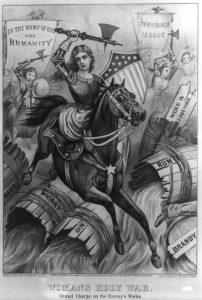
Drawing upon imagery of the Christian crusades, a woman smashes liquor barrels with an ax. A banner behind her claims her fight “in the name of God and Humanity.”

Children also could be the direct victims of drink in temperance propaganda. An image titled “Tony, The Child Drunkard” portrays the heartbreak of a mother as her son lies in bed. The boy is in a drunken stupor, driving home the negative impact of alcohol on family life.

The temperance crusade, likened to a holy war against the corrupting influences of alcohol, waged its mid-19th century campaigns against saloons through demonstrations and public pressure. Women played an especially public role in the temperance crusade. An 1874 picture of women in armor and charging into battle on horses emphasized this. The enemies smashed to pieces by the strokes of their hammers were barrels labeled Rum, Whiskey, Beer and Wine. The lead crusader’s striped and star-spangled shield shows an appeal to patriotism. Her followers bear banners labeling their cause as a holy one, waged by the Temperance League.

Other tactics included public demonstrations and harassment of saloon clientele. Printed booklets of sheet music and lyrics, to be sung in the streets outside targeted establishments, proclaimed the crusaders to be “Mother’s out praying,” who “Strike for the cause of Temperance!”

The tactics could be effective, particularly when the protesters were publicly harassed by the saloon-goers and owners. In 1874, temperance protesters faced trial in Portland, Oregon, for a drunken brawl and riot. They had not participated in the disturbance, but were claimed to have caused it by their protest activities. The trial and short jail sentence gained the temperance crusaders a great deal of sympathy. Follow-up harassment by a local saloon owner swung matters even further in their favor. Portland seemed well on the way to a huge electoral victory for temperance until the very day before elections. A new piece of propaganda was posted around the city on the eve of local elections that struck entirely the wrong tone. The handbill titled the “Voters’ Book of Remembrance” dampened the public sympathies that the temperance crusaders had built up. The text tarred everyone in the city who was not explicitly on the side of temperance as “prostitutes, gamblers, rum sellers, whiskey topers, beer guzzlers, wine bibbers, rum suckers, hoodlums, loafers, and ungodly men.” This poorly timed message transformed an impending temperance victory into a crushing defeat.

The shift in the temperance movement from moderation in drink to legally restricting the sale of alcoholic beverages resulted in the passage of the “Maine Law” in 1851, the first statewide prohibition of the sale of liquor. By 1855, 12 other states had enacted their own versions of the “Maine Law.” Most followed a similar formula, but Texas’ law simply outlawed the sale of liquor in quantities of less than a quart, leaving quite a bit available to those who were prepared to buy in larger volume.

The prohibition laws were not popular with large segments of the population, and in the 1856 presidential election, opponents of Republican candidate John C. Fremont portrayed him as being courted by proponents of the “Maine Law,” alongside other unpopular movements such as “free love,” the influence of the pope, abolition, women’s suffrage and socialism. The cartoon of Fremont readily accepts all of these causes. The mixed bag of allegations made little sense, but they illustrate the general unpopularity of politically mandated temperance at the time.

Temperance supporters advertised their cause in creative ways. Social movements attracted a sort of conspicuous consumption as a way to declare a household’s political ideology and solidarity with a cause. Abolitionist homes, for example, might have a tea set that was marked with abolitionist art and slogans. Often, the container for sugar proclaimed it to be from non-slave labor sugar plantations and was marked with the seals of abolitionist societies. Similarly, decorative plates with temperance themes became popular in temperance households. As with other temperance propaganda, the dissolution of the home and family life was a popular theme, with the women and children brought to ruin or vice, while the fathers had degenerated in moral character to monstrous levels.
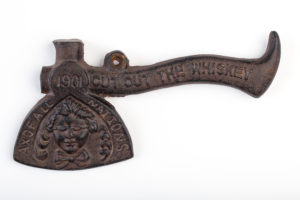
This hatchet-shaped stove lid lifter was a popular souvenir purchased by Carrie Nation’s supporters. From The Mob Museum collection

Leisure activities also could display and teach moralistic ideals. The original edition of The Game of Life, published by Milton Bradley in 1860, had pitfalls such as “Gambling” and “Idleness,” which brought the player to “Ruin” and “Disgrace,” respectively, while “Intemperance” led to “Poverty.” In the later days of the temperance movement, as prohibition gained ground, supporters of Carry Nation’s “hatchetations” purchased souvenir replicas of her famous hatchet emblazoned with her name, providing her with funds and buyers with a piece to display their temperance bona fides in their home.

As temperance shifted into prohibition via the enactment of laws banning alcohol, the family continued to be a favorite source of propaganda. Portrayals of women and children as the helpless sufferers of the evils of alcohol tried to tug the voters’ sympathies. Pictures featured innocent children, and urged the reader, “for our sake,” to vote against liquor. The phrasing of the propaganda was carefully constructed and presented as a vote against liquor rather than a vote in favor of societal restrictions. Images of mothers with babies urged the public to “Help me to keep him pure,” and again to vote against the sale of liquor. The implicit ban on any trade in alcoholic beverages is carefully not explicit.

As America became more entangled in world affairs, the approaching involvement in World War I brought a new wave of propaganda. The familiar contrast between liquor and society as seen in the “family vs. alcohol” choice grew to include national security. Where the voter had been urged to vote “for the children” versus voting “for liquor,” now he was presented with the question, “Will you back me, or back the booze?” with an image of an American soldier in the trenches. Exactly how a domestic prohibition on alcohol would aid the soldier is not addressed. Sailors at their guns were portrayed as needing a clear head to do their duties and that “drink hinders.” Photos of training soldiers attacking a trench came with the line, “Let’s all go clean over the top CLEAN, and keep fit to fight in France for Freedom.” The fact that U.S. military men on duty were expected and required to be sober, regardless of the legal status of alcohol in the United States, is conveniently unmentioned.

Other wartime prohibition propaganda focused on the home-front effects of alcohol and the need to keep up domestic support for the war. A prohibition postcard proclaimed the saloon backer to be “a traitor to his country,” in line with the nativist turn against German immigrants and their beer-drinking culture. Alcohol was characterized as an unnecessary distraction for a nation at war. It diverted effort that would be better used in ensuring the flow of needed materiel and logistical support for the war. Booze was quite simply “Non-Essential!”
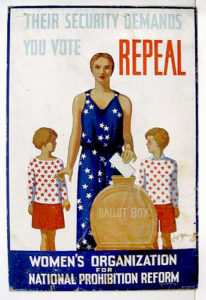
In the early 1930s, the Women’s Organization for National Prohibition Reform ironically inverted popular temperance appeals to draw attention to the failure of the Prohibition amendment to keep the nation safe from crime.

The proponents of Prohibition succeeded in making it the law of the land, enshrined in the Constitution by the 18th Amendment. But the argument itself did not end. Thousands of soldiers, sailors and Marines returned to the United States right before the amendment was ratified, and many were unhappy about the impending change. Servicemen staged their own protests, with signs such as “4,000,000 American soldiers fought for liberty and were rewarded with Prohibition. How come?” and “To Congress! You care for our crippled soldiers, our morals will care for themselves!”

Later, as the rise of organized crime controlling the illicit trade in alcoholic beverages became a pressing public safety concern, some of the same propaganda themes that had been used by the Prohibition advocates reappeared. This time, the safety of the family and young children in this era of organized crime violence was used by proponents of repeal. A mother and her young children appear gathered around a ballot box, with the tag line, “Their security demands you vote repeal,” in an ironic inversion of the same themes that had been used to enact the 18th Amendment in the first place.

The varied approaches and arguments in temperance propaganda help to shed light on what the true believers in these causes thought, what they feared liquor would do to the nation and the family structure. They also reflect the mindset and worries of at least a part of the American public. Not every working man who went to a saloon on his way home from a shift was a violent brute, nor one who drank to excess, but such things happened enough that it was on the minds of the women of the time, so the propaganda had mental ground to root in and grow. Those real-life examples, whether common or rare, made the family-based arguments among the most effective, as can be inferred from just how long that line of argument stayed around.

Prohibition was repealed in 1933. But remnants still exist today in the varied package and blue laws around the nation. The longest-lived third party in the United States is one that most Americans are completely unaware of, the Prohibition Party, yet it still puts up a candidate in every presidential election, even if that candidate doesn’t qualify to be on many state ballots. The Prohibition Party’s presidential candidate this year is Phil Collins of Las Vegas. Collins, a Navy veteran, will appear on a few state ballots, including those of Colorado and Vermont.

Advocates of temperance still exist, and many argue that the 18th Amendment’s failure was a result of poor enforcement rather than intent. But they aren’t as vocal as they once were: They don’t seem to have much of a propaganda budget these days.
‘Goodfellas’ still going strong after 30 years

In the painting, a man with white hair and beard, his left hand steering an outboard motor, is piloting a small boat through a narrow waterway. Two dogs are along for the ride in the open air.

One dog is looking one way. The other dog is looking the other way.

This painting hangs in screenwriter Nicholas Pileggi’s New York City apartment. His mother drew it from a picture in National Geographic magazine.

For 30 years, after being briefly displayed in Martin Scorsese’s 1990 movie Goodfellas, the painting has been popular among film fans. Scorsese’s own mother, Catherine, playing the parent of a volatile New York City mobster, shows the painting to her son and two of his underworld associates at the dinner table in her modest home. A near-dead victim is in the trunk of the gangsters’ car outside. Soon they will finish him off.

But first, the painting.

Looking at his mom’s artwork over an impromptu late dinner, Tommy (Joe Pesci), says, “I like this one. One dog goes one way, and the other dog goes the other way.”

“One is going east,” the mother says, “and the other one is going west. So what?”

The painting’s place in movie lore is a testament to Goodfellas’ continued popularity, as the film celebrates its 30th anniversary this month. Other memorable moments from the movie — the deadly “shine box” insult, the “funny how?” scene — also have become part of popular culture.

It wasn’t always this way.

Even with a major star like Robert De Niro in the film, Goodfellas was panned before it hit movie theaters. A California test audience gave it the worst preview grades in Warner Brothers’ history at the time, prompting the studio to consider recutting some of the violent scenes, according to The Ultimate Book of Gangster Movies by George Anastasia and Glen Macnow.

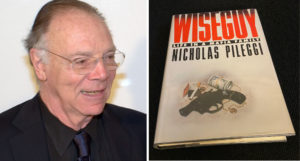
The movie, based on Pileggi’s 1985 true-crime book Wiseguy, ultimately was released without changes.

The book and movie focus on Henry Hill, who, beginning during his youth in Brooklyn, joined up with mobsters in his working-class neighborhood, later becoming a government informant and entering the Witness Protection Program. Christopher Serrone plays the young Henry Hill, while Ray Liotta portrays Hill as an adult.

Goodfellas did not win the Best Picture Oscar the year it was nominated. That went to Dances With Wolves, starring Kevin Costner. But since then, Goodfellas has taken off, ranked by many critics and fans with the first two Godfather movies as the best Mafia films of all time. In The Ultimate Book of Gangster Movies, the authors call Goodfellas “a brilliant movie packed with dozens of colorful characters.”

“Word of mouth and strong reviews helped it develop legs,” the authors note.

Though a lower-level Mob associate during much of his active criminal life, Hill, because of Pileggi’s book and the movie, became a well-known figure. Several other books since then have come out that Hill wrote with different authors, including a cookbook, a guide to Goodfellas-related locations in New York, and a book about his experiences in the Witness Protection Program.

“My life in the Mob made me famous,” Hill says in the 2004 book Gangsters and Goodfellas, written with Gus Russo, author of The Outfit and a Mob Museum Advisory Council member.

Hill, who died in 2012 at age 69, continues to generate interest. His paintings can be found for sale online, and new books about the world he lived in are still being released.

Some books focus less on Hill and more on one of the key parts of the movie’s plot, the December 1978 Lufthansa Airlines heist at John F. Kennedy International Airport in New York. (Hill supposedly was in Boston at the time of the heist, orchestrating a college basketball point-fixing scheme.)

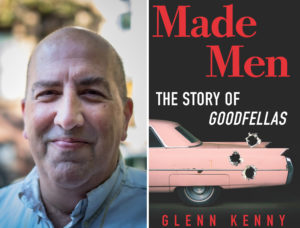
The Goodfellas mystique continues to grow. A book released this month, Made Men: The Story of Goodfellas, by film critic Glenn Kenny, examines in detail how the movie came together, exploring scene development, technical aspects and casting decisions. A postscript at the back of Made Men provides a summary of books in the “Goodfellas Library.”

Glenn Kenny Made Men
Film critic Glenn Kenny is the author of the recently released book Made Men: The Story of Goodfellas. Photo of Kenny by Zach Barocas.

In response to an email, Kenny, who writes for the New York Times and other outlets, said Goodfellas continues to be popular “because it’s so good.” He said the movie is “funny, harrowing, beautifully made, beautifully performed.”

“Despite the awful things the characters do, and a lot of their awful attitudes — their racism, homophobia, disregard for others, all that and more — Henry Hill and company are presented as real, three-dimensional people with ‘relatable’ aspects,” Kenny said in the email. “Some of the people in the movie you feel like you automatically know. Others you hope you will never meet!”

Kenny noted that the movie also has an “endless series of quotable scenes and bits, from ‘How am I funny?’ to Henry’s whine of ‘Karen!’ to Paulie’s ‘And now I gotta turn my back on you.’”

Scorsese, who has directed several movies with Mafia figures either in the forefront or on the periphery, including Mean Streets and Raging Bull, is one of the top two Mob movie directors in the industry, Kenny said.

“I still think the first two Godfather movies hold up well enough that I’d have to say that Scorsese and Coppola are tied as the best Mob movie directors ever,” he said in the email. “They both come from similar places — while Coppola wasn’t a New York fella, he has a similar family background to Scorsese, at least with respect to the Italian-American experience. Their roots give their observations and instincts a depth that no American directors looking at the Mob could ever hope for. And I think that the Godfather movies complement not only Goodfellas but also Mean Streets and Raging Bull. They’re unique, vivid pictures of times and ways of life that are gone forever but never stop gripping us.”

Kenny said Scorsese knows “more about filmmaking and films than almost any other director alive.”

A portion of Kenny’s book is devoted to the significance of music in Scorsese films. Pileggi, a veteran crime reporter who co-wrote not only Goodfellas but also a later Mob movie with Scorsese, Casino, agrees that music is extremely important to the veteran director. The 1995 film Casino also is based on a Pileggi true-crime book, Casino: Love and Honor in Las Vegas.

Over the telephone from his apartment in New York City, Pileggi said that when he and Scorsese were working on the script for Goodfellas, “Marty already had a vision of the music in his head.”

As an example, Pileggi said that as he was typing a scene in which the De Niro character, Jimmy, is at a bar smoking a cigarette and contemplating whether a character named Morrie should be killed, Scorsese turned to Pileggi and told him to type in the word “cream.” This ended up being the place in the movie where the song “Sunshine of Your Love” by the 1960s British rock band Cream loudly comes in.

During interviews, Scorsese has stressed the importance of music in his movies. “Probably the most enjoyable part of making movies is to select these songs,” Scorsese told The New York Times. Kenny uses this quote, with the attribution, in his book.

Speaking on the phone about Goodfellas, Pileggi said, “The music is practically another character.”

Nicholas Pileggi wrote Wiseguy: Life in a Mafia Family, the story of mobster Henry Hill, in 1985. The movie version, Goodfellas, was released five years later.

Pileggi said an additional aspect that works in Goodfellas’ favor is that many of the scenes are short, providing a fast “bam, bam, bam” effect. There are no long scenes to challenge anyone’s attention span, he said.

Whether directed by Scorsese or other filmmakers, Mob movies continue to be popular. Kenny said part of the reason is that “law-abiding citizens all have a secret side that wants to know what it’s like to be on the other side of life — to transgress, to break the rules, to take what they want however they want it and not worry about the consequences.”

“In crime movies they can do that vicariously,” he said in the email.

Kenny added that these movies also are appealing because of “the power aspect.”

Goodfellas is what it’s about to be a Mob foot soldier, but it makes you wonder about the underboss Paulie — his quiet way of leadership. That’s fascinating,” Kenny said. “Even though they do evil, cowardly things, Mob figures are mythic and larger than life to some people, exactly because they live on the edge of what society deems acceptable. Everybody wonders what it’s like to be bad. Movies about criminals and crime let you find out without putting yourself in danger — physical or moral!”

As for Goodfellas, its continued popularity shows up in the way fans remember famous lines or props — like the dogs in the painting looking in opposite directions.

Pileggi said the painting, now hanging above his desk, is in his will, to be handed down to stepson Max Bernstein, a musician. Bernstein is the son of journalist and filmmaker Nora Ephron and her then-husband Carl Bernstein, the former Washington Post reporter of Watergate fame. Pileggi was married to Ephron for more than 20 years until she died in 2012 at age 71. Among the many movies she had a hand in as director or screenwriter is My Blue Heaven, starring Steve Martin and based in part on Hill’s experiences in the Witness Protection Program. Ephron wrote the screenplay for My Blue Heaven, which came out only weeks before Goodfellas.

While the dogs painting has fans among the general public, a lot of family pride is invested in Mrs. Pileggi’s artistic contribution to the movie. As Nicholas Pileggi noted on the phone, the final credit in Goodfellas is to his mother, Susan Pileggi. She got a kick out of telling people about it, Pileggi said, and in asking them, “Have you seen my movie?”

Larry Henry is a veteran print and broadcast journalist. He served as press secretary for Nevada Governor Bob Miller, and was political editor at the Las Vegas Sun and managing editor at KFSM-TV, the CBS affiliate in Northwest Arkansas.

Capone, Torrio and the Sunshine City, St. Petersburg, Florida

Ninety-five years ago, during the summer of 1925, Florida was in the midst of a massive land boom. Real estate speculators and developers from around the country were descending on the Sunshine State with dreams of striking it rich dealing in property. One of the hottest places was St. Petersburg, a burgeoning city located on the Pinellas peninsula buffered by Tampa Bay to the east and the Gulf of Mexico to the west. Known as the Sunshine City, St. Petersburg was awash in development and money.

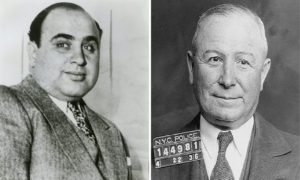
One company attracted by the real estate market was the Manro Corporation. Not much was known locally at first about this conglomerate. But word soon got out who the principals were. The first was a local real estate agent, Robert Vanella. But the other three — Johnny Torrio, Jake “Greasy Thumb” Guzik and Alphonse Capone — were infamous. Torrio was a Brooklyn-born mobster who relocated to Chicago and became an underworld powerhouse. One of his partners was Guzik, nicknamed Greasy Thumb for his proclivity for paying bribes to politicians and police. And then there was Al Capone, Torrio’s successor to the Chicago underworld crown, and soon to be one of the most recognizable gangsters in American history.

Al Capone, Johnny Torrio
Al Capone, Johnny Torrio.

The Manro Corporation started buying swaths of property, including more than twenty acres on Boca Ciega Bay, between St. Petersburg and the barrier islands of the beach towns. This parcel of land is now the Twin Brooks golf course, owned by the City of St. Petersburg. They also bought residential lots and platted subdivisions.

While Torrio, Guzik and Capone were buying property, a local developer, Walter Fuller, built a nightclub/restaurant, the Gangplank, on the west side of town, in a neighborhood known as the Jungle. The club, opened in 1924, was on Boca Ciega Bay. The Gangplank was touted as the hottest ticket in town. Billed as an “ideal mecca for the St.Petersburg younger set to top off an enjoyable evening,” the Gangplank offered great entertainment. In addition to the house band, The Gangplank Orchestra, entertainers from Duke Ellington to Nat King Cole played the Gangplank. It was a meeting place for local bootleggers as well.

The Gangplank was also a speakeasy. It was alleged that servers would bring illicit alcohol to patrons in teacups, keeping up the veneer of respectability and high society. There are rumors of tunnels that ran from the Gangplank out to the Bay, but those could never be confirmed. However, the body of water the club was located on, Boca Ciega Bay, was a known hotspot for rum-running during Prohibition (and running other kinds of contraband during the 1970s).

Next to the Gangplank is a boat ramp (and an interesting historical marker. Spanish explorer Panfilo de Narvaez landed there in 1528 to begin an expedition of North America.). A small ferry shuttled gamblers from the boat ramp out to a gambling ship that sat three miles west of John’s Pass (one of the passes that connects Boca Ciega Bay to the Gulf of Mexico). The ship, the S.S. Monte Carlo, was rumored to have been financed by Torrio and, some say, Al Capone. The Monte Carlo held a soft opening on Christmas Day 1930. The St. Petersburg Times described it succinctly as a “big floating pleasure palace.”

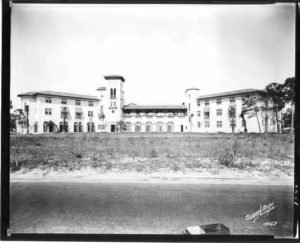
This image shows the Admiral Farragut Academy in St. Petersburg in 1946. The school formerly was the Jungle Country Club Hotel, which opened in 1926. Chicago Outfit boss Johnny Torrio and some of his men stayed at the hotel in its first year of operation while checking out his real estate investments in the area.
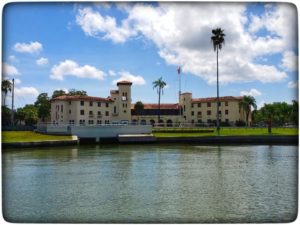
The Admiral Farragut Academy, a private prep boarding school, in 2020. Courtesy of Sari Deitche

Just down the street from the Gangplank, Fuller constructed the Jungle Country Club Hotel, complete with a golf course and nearby private airstrip. The hotel opened on February 10, 1926, and was an immediate hit, called “the social triumph of the season.” February was the height of the tourist “winter season,” so the hotel was packed with Northerners fleeing the cold. Entertainment was provided by the McGee Sisters, dancers who at that time had starred in “two moving pictures,” and Norman Mayer’s Jungle Serenaders.

Not soon after opening, sometime in mid-1926, Torrio and a handful of his men (the names of who came with Torrio were not recorded) stayed at the hotel. Walter Fuller confirmed this to the St. Petersburg Times in 1967, affirming that Torrio came to stay there while he was looking over the Manro Corporation’s properties in the Sunshine City. Torrio also personally bought a speakeasy in south St. Petersburg called the Green Cabin, as well as properties on St. Pete Beach.

It was also around this time that sightings of Al Capone in St. Petersburg started to surge. Some say he built a house for his mother in north St. Petersburg. Others say he owned large mansions in South St. Pete. When Babe Ruth came to town for spring training, Capone supposedly was there watching. Another prestigious hotel on St. Pete Beach, the Don CeSar, even had the notation that Al Capone stayed there until recently, when it removed the reference after research concluded Capone was never there.

There were also persistent rumors that Capone drank at the Gangplank and stayed at the Jungle Country Club Hotel. Jennifer Grabowski is a St. Petersburg native and Lower School principal at Admiral Farragut Academy (whose main building is the old hotel). Jennifer heavily researched the history of the Jungle Country Club Hotel and surrounding neighborhoods. “For years we were always told that Al Capone stayed at Farragut (when it was the country club). And that we had tunnels under the school that he ran liquor from. Once I became interested and researched the history, I realized it was only his henchmen who stayed there.”

There is some evidence that Capone did at least stop in town on a couple of occasions. In 1927 he gave a press conference to reporters in Chicago stating that he was “leaving for St. Petersburg, Florida.” And in February of 1931, local newspapers covered a trip Capone and some friends took to Tarpon Springs and St. Petersburg, driving up from Miami Beach. It was mentioned he only stayed a few hours in St. Pete.

Artifacts Jungle Country Club
Artifacts recovered from the former Jungle Country Club Hotel. Courtesy of Sari Deitche

The good times didn’t last long. The Depression put an end to the Florida land boom, and tourism took a hit. The Gangplank closed around 1932, the same time the S.S. Monte Carlo stopped operations. The Jungle Country Club Hotel closed soon afterward. In 1945 the hotel was sold and became Admiral Farragut Academy, which is a naval-affiliated pre-K-to-12th private college prep boarding and day school. The school uses the former dining room as its mess hall, and the hotel rooms are dorms for boarding students.

Jennifer Grabowski has also helped collect a lot of artifacts from the school’s days as a hotel. “The dumping ground for the hotel was the creek. Before they secured it, artifacts would come up.” School kids would dig up perfume bottles, Suwanee milk bottles and bits of china from the hotel’s restaurant.

Walter Fuller lost everything in the Depression as well. He was forced to sell his house, which was located across the street and three doors down from the hotel, on the water. It was rumored that while he lived there, a rum pirate was being chased through Boca Ciega Bay. The pirate offloaded some of his rum barrels to Fuller, who hid them in the attic of his house. When Fuller sold the house to his uncle, Grabowski says, “Fuller forgot about the barrels of rum. When his uncle took over, Fuller had to sneak in the middle of the night and get it out.”

Johnny Torrio, who had ostensibly retired from Mob life, moved to St. Petersburg full time around 1929, leaving in 1932, though he still visited from time to time. He was named during the Kefauver Hearings in 1950 as part of a real estate deal with the sheriff of neighboring Hillsborough County. He died in Brooklyn in 1957.

Al Capone was convicted in Chicago of tax evasion in October 1931. He was sentenced to prison in 1932 and paroled in 1939. But his days as an underworld kingpin were over. Racked by the effects of untreated syphilis, Capone spent the last years of his life at his Miami Beach house. He died in January 1947.

But the legend of Capone in St. Petersburg lives on through some excellent examples of 1920s Floridian architecture, old property records, a municipal golf course and a lot of urban legends and tall tales.

Scott M. Deitche is an author specializing in organized crime. His books include Cigar City Mafia: A Complete History of the Tampa Underworld and Garden State Gangland: The Rise of the Mob in New Jersey. He is also a member of The Mob Museum’s Advisory Council. Scott lives in St. Petersburg, Florida.

Frank Cullotta, Chicago Outfit associate who led the Hole in the Wall Gang burglary ring in Las Vegas, has died

Frank Cullotta, leader of the infamous Hole in the Wall Gang burglary ring in Las Vegas, died early Thursday in a Las Vegas hospital. He was 81.

Cullotta died from complications of COVID-19.

In his criminal heyday working for the Chicago Outfit’s Las Vegas overseer, Tony Spilotro, Cullotta was responsible for at least two murders, as well as hundreds of burglaries and other crimes. The Hole in the Wall Gang got its name from its technique of avoiding security systems by entering homes and businesses through a wall or roof instead of through monitored doors and windows.

Cullotta’s burglary spree came to an abrupt end on July 4, 1981, when he and his crew were busted in the act of entering Bertha’s department store on East Sahara Avenue. The FBI and the Las Vegas Metropolitan Police Department knew about the planned burglary thanks to an informant within the ranks of Cullotta’s gang.

Not long after, Cullotta agreed to become a witness for the government in its prosecution of mobsters in Las Vegas, Chicago and beyond. He received immunity from prosecution in return. Cullotta entered Witness Protection for a couple of years, but left the program to resume a more normal life. He often remarked that he didn’t fear for his life because anyone who wanted him dead was either in prison or a grave.

Frank Cullotta
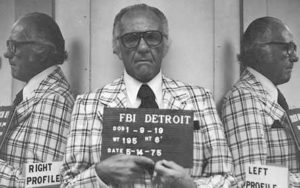
Frank Cullotta after the Bertha’s bust in 1981. Courtesy of Las Vegas Review-Journal Archive.

In the late 1980s and early 1990s, Cullotta was interviewed by Nick Pileggi for a book about the Chicago Mob’s control of the Stardust hotel-casino on the Las Vegas Strip. Cullotta then was contracted by director Martin Scorsese to serve as a consultant on the movie version of Pileggi’s book. Cullotta also had a small part – as a hitman – in the critically acclaimed movie Casino, which is marking its 25th anniversary this fall.

Pileggi told The Mob Museum he was saddened to hear about Cullotta’s death. Pileggi and Scorsese co-wrote the screenplay for Casino.

Pileggi, who lives in New York City, said he spoke at length with Cullotta when putting the book together over the course of about eight years. At the time, Cullotta was in the Witness Protection Program. FBI agent Dennis Arnoldy connected the two.

Cullotta provided Pileggi with a lot of information about the era in which Frank “Lefty” Rosenthal, a Chicago Outfit associate, oversaw skimming at the Stardust for mobsters in the Midwest.

“He was a great help to me in writing the book,” Pileggi said. Though a mobster deeply involved in the underworld, Cullotta was smart enough to have been a successful businessman if he had chosen that route, Pileggi said. “He could be very civilized and highly intelligent.”

Pileggi said he stayed in touch with Cullotta and even spoke with him about three weeks ago. “He sounded OK,” Pileggi said.

During this recent phone call, Pileggi said he and Cullotta talked about the former mobster’s upcoming book projects and his YouTube show, “Coffee With Cullotta.”

Pileggi said their friendship remained strong throughout the years. “We hit it off and became personal friends,” Pileggi said. “He was exceptional.”

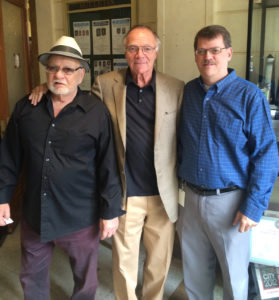
Frank Cullotta, Nick Pileggi and Geoff Schumacher
Frank Cullotta, Nick Pileggi and Geoff Schumacher at The Mob Museum in 2016. The Mob Museum.

Despite his extensive criminal history, Cullotta had many friends and admirers in his golden years, his Chicago-accented gravelly voice disguising a quick wit and grandfatherly demeanor.

Veteran true crime author Dennis Griffin, who co-wrote three books with Cullotta, remembered him fondly:

“I first met Frank in 2005 while researching for my book The Battle for Las Vegas. The next year we co-authored his biography Cullotta, and two more books followed. In the ensuing years Frank went from being just a business associate to one of my closest friends and my wife came to love him as well. Whether we talked in person or by phone, he always managed to leave me laughing, regardless of how bad my day may have been to that point. Frank may be gone, but he’ll never be forgotten.”

Cullotta spoke to a sold-out crowd at The Mob Museum in 2016 and held several book signings in the Museum’s retail store. He personally conducted Mob driving tours of Las Vegas for several years and recently was prominently featured in the “Mobbed Up” podcast series produced by a partnership of the Las Vegas Review-Journal and Mob Museum. Cullotta also partnered with local entertainer Adam Flowers on the “Coffee with Cullotta” YouTube series.

Dennis Arnoldy, a retired FBI agent, worked closely with Cullotta after he became a government witness. He said Cullotta provided a lot of valuable information to the FBI and Las Vegas Police.

“A lot of people went to jail at least in part because of Frank’s information,” Arnoldy said. “He was very important to us in solving these crimes. He helped us connect the dots.”

Larry Henry contributed to this report.

Mobsters in the military

Historically, the U.S. military has alternated in size between small standing armies in peacetime and vastly expanded forces during war. The two world wars produced periods with the largest numbers of men in military uniform in U.S. history. The U.S. military during World War I was more than 4.7 million, for a small period of involvement, just more than a year and a half. In World War II, the United States had more than 16 million men and women in military uniform.

With so much of the population in military service, it is perhaps inevitable that there would be mobsters in the ranks. Some became involved with organized crime after their military service, such as George Barone and Matthew “Matty the Horse” Ianiello, who served in the Navy and the Army respectively during World War II, and who both found their way into New York’s Genovese crime family. Others enlisted after or in the midst of long careers in organized crime. Edward “Monk” Eastman, a gang leader in New York who spent time in prison before he served in World War I, and Morris “Moe” Dalitz, a bootlegger and illegal casino operator before he served in World War II, are two of the most well-known examples.

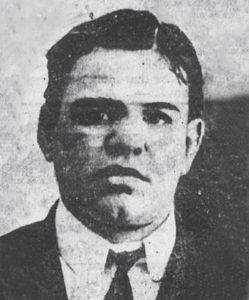
Mugshot of Monk Eastman circa 1903.

Eastman ran with petty criminal gangs in New York in the late 1800s and early 1900s. He worked his way to the head of a local gang, which initially focused on small-scale larceny, and gained infamy as the Eastman Gang. The gang thrived in the violent New York underworld at the turn of the century, and expanded rapidly, at one point having roughly 1,200 thugs and thieves answerable to Eastman. The gang broadened beyond larceny into running brothels and dabbled a bit in dealing opium. The gang’s muscle also earned the attention of the political bosses of Tammany Hall, and they were put to work rigging elections and intimidating voters. In return, Eastman and his gang were paid and usually protected from police attention. An arrest would be quickly followed by Tammany Hall’s lawyers appearing at court. Where legal wrangling didn’t get results, bribes and threats often could.

Monk’s first known arrest and conviction, for larceny, earned him three months at Blackwell’s Island, in New York, in 1898. Four years later, with the increased attention the gang was getting, his arrests began to gain more attention in the news. Eventually, the multi-hour Battle of Rivington Street, a shootout with the rival Five Points Gang, sent an enormous shock through the public. Tammany Hall decided to let Monk face his next arrest without the assistance of its lawyers, and he was imprisoned for his role in a robbery and shootout with a pair of Pinkerton detectives. He was convicted and sentenced to a ten-year stint in Sing Sing prison. After serving five years, he was released, but found that his gang had split up and moved on. Without the structure of his gang, Monk’s criminal activities scaled down to larceny and opium, to which he became addicted. The opium trade earned him eight more months at Sing Sing, and an attempt to steal silver sent him to Clinton Correctional Facility at Dannemora for nearly three years. He was released in October 1917, six months after the United States had declared war on Germany. The U.S. was still building up the expeditionary force needed to actively enter the conflict.

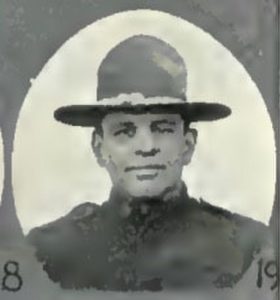
Monk enlisted, and entered service with the 106th Infantry Regiment of the 27th Infantry Division. His medical examination upon enlistment is the source of an oft-told anecdote, in which the doctors could barely believe the network of scars from blades, bludgeons and bullets that covered his body. He is reported to have answered a question about which wars he had been in with the quip, “Oh, just a lot of little private wars around New York.” American forces arrived in Europe in the summer of the following year, and Eastman saw active combat in some of the most decisive and hard-fought battles at the end of the war, including the Somme offensive and the breaking of the Hindenburg Line. While Monk had enlisted under an assumed identity, he stood out for his age and prowess, reportedly outrunning the younger men during training and impressing all with the force of his bayonet strikes on practice dummies.

His fellow enlistees discovered his true identity, and after that no more jibes about his age were made by the younger recruits. He seemed to take on a “tough older brother” role to his fellow soldiers. The men of the 27th trained at Camp Wadsworth, in South Carolina. They learned to build an entire trench network, watch it be shelled, rebuild it, go through gas drills and suffer the indignity of being judged “dead” by observers if they so much as showed their heads above the wall of the trench while not actively firing. Once they reached France, their training was taken further by British veterans of the brutal trench warfare. The 27th were the beneficiaries of years of experience the Europeans learned the hard way. Actual combat was far more grueling.

Private 1st Class Edward “Monk” Eastman in uniform in a photograph from the roster of the 106th Infantry Regiment in World War I.

Monk Eastman was in his element. He had taken to the disciplined life of a soldier very well, and in the trenches he really began to shine. Out of necessity, troops were rotated in and out of the trenches, to give them a much-needed break from the muddy filth and constant artillery barrages. Monk requested to stay, when his company rotated out, to act as a stretcher bearer for the incoming unit. He frequently threw himself into no man’s land to rescue and retrieve fallen soldiers of his unit, including his squad sergeant. He gained notoriety for crawling up on machine gun nests at Vierstraat Ridge with a handful of grenades to stop them from shooting at his brothers-in-arms, incurring shrapnel wounds to his legs. He even insubordinately escaped from a hospital, where he had been confined after his leg injury. There it was discovered that he had been gassed and simply had not told anyone. Standard procedure was to keep gas victims under observation until their lungs either recovered or they died. Monk simply left in the confusion, so he could return to the front line with his unit, for the action at the Hindenburg Line. Eastman’s unit and commanders thought so highly of his service that they compiled a large volume of letters from his officers and fellow soldiers, requesting a pardon and reinstatement of his citizenship and rights. Monk’s exploits had gained so much interest in the newspapers that New York Governor Al Smith granted the petition from the 27th Infantry Division. Details of Monk’s military service were outlined in newspaper articles, the petitions submitted to the governor and military service records. In addition, many of the specifics are detailed in Neil Hanson’s book Monk Eastman: The Gangster Who Became a War Hero.

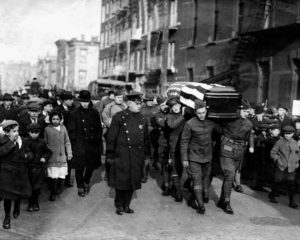
Large crowds watched the funeral procession of Monk Eastman in 1920. Many New Yorkers had been interested in what they saw as Monk’s redemption in the war. New York Daily News Archive via Getty Images

Sadly, Eastman’s exemplary combat service to his nation, and the high regard in which his fellow veterans held him, did not prevent him after the war from exploring the hot new criminal enterprise of the day: bootlegging. Eastman was just starting to feel out his entry into the opportunity that Prohibition provided when an argument with one of his partners resulted in his death on December 26, 1920. The partner, a Prohibition agent looking to make money on the other side of the law, pulled a gun and shot Eastman several times. Eastman’s recent fame and stature as a war veteran brought a great deal of interest from the press. Where they once eagerly reported on his arrests and trial, now the hunt for Monk’s killer made headlines. Jerry Bohan, the corrupt Prohibition agent who had gunned him down, was swiftly caught, and he confessed to the killing. Monk’s fellow veterans of the 27th ensured that their fallen comrade received the hero’s funeral procession they believed he deserved. In an ironic touch, the funeral procession included a police escort.

Morris “Moe” Dalitz entered into bootlegging right at the beginning of Prohibition, in 1919. Dalitz’s family owned a laundry business, and the laundry trucks that were used for deliveries proved an excellent method of smuggling booze. Dalitz prospered in bootlegging, but always kept his legitimate businesses in mind, pouring his profits from bootlegging into the laundry business, which in turn provided the means to expand bootlegging. Dalitz formed relationships with the Galveston syndicate, which brought in alcohol from Mexico and Canada, and made contacts with other organized crime figures, including Meyer Lansky and Benjamin “Bugsy” Siegel. Around 1930, Dalitz moved from Detroit to Cleveland, expanding his presence and laying the foundation for what would be his next illicit business. The end of Prohibition meant the end of bootlegging, and Dalitz believed that gambling would be the next high-return opportunity he could exploit. He operated a number of illegal casinos, such as the Beverly Hills Supper Club in Covington, Kentucky, and the Pettibone Club in Ohio. These gambling businesses, while known of by law enforcement, were generally tolerated. His involvement in gambling continued even while he enlisted in the Army in June 1942, six months after Pearl Harbor. As Dalitz explained in an oral history in the 1970s, he “missed the First World War by a year.” “I was too young. I had an older brother who did make the first one. His name was Louis Dalitz,” but in the emotionally charged aftermath of the attack by Imperial Japan, “with all the excitement of Pearl Harbor, I, like many other people, walked into a recruiting office.” Dalitz requested to go overseas to fight.

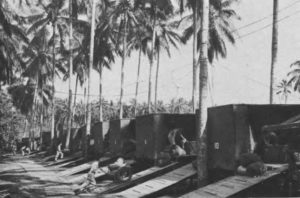
A line of Moe Dalitz’s mobile laundry units during the Pacific campaign of World War II. The mobile laundries still had some issues, mostly with mobility in rough or constricted terrain, but they got laundry facilities far closer to the front. Courtesy of Center of Military History, Department of the Army

Unlike Monk Eastman, Dalitz did not serve in a combat role. He was not even sent outside the United States. Instead, the Army realized Dalitz had much-needed experience that was valuable to the Quartermasters Corps. With his lifelong knowledge of the laundry business, he was invaluable to the Laundry Department in New York. Although less glorious than Eastman’s service, logistics are a critical component of an operating military force. Dalitz’s value to the Quartermasters Corps is reflected by his career. Shortly after Private Dalitz joined the corps, the Army commissioned him as a second lieutenant and placed him in charge of the Laundry Department in New York. Dalitz elected to live at the Hotel Savoy-Plaza, and managed to comfortably continue to run his businesses, both licit and illicit, while serving. His department serviced U.S. troop ships and U.S. personnel overseas. Dalitz’s expertise reached beyond the fixed laundry facilities of the Army, and he was instrumental in getting mobile laundry services much closer to the troops in combat. The experiences of disease and illness from World War I’s trenches had taught a lesson in combat hygiene, and although there had been an early form of mobile laundry in 1918, improvements were drastically needed. Dalitz worked with the auto industry to design new mobile laundry units that were put into service in North Africa. While they were found to have some drawbacks, they were a vast improvement. Dalitz took great pride in his accomplishments. “I didn’t get overseas like I wanted to, but I did the next best thing, and I received a nice award for the work I did. It is considered to be a very coveted non-combatant award from the Second Service Command.” Dalitz was discharged from service at the end of May 1945, just a few weeks after the surrender of Nazi Germany.

Following the war, Dalitz channeled his experience with his illegal casinos in the Midwest toward the expanding Las Vegas gambling scene. He partnered with his Cleveland contacts to finance the completion of the Desert Inn hotel-casino. In Las Vegas, Dalitz’s casinos were legal, but his involvement was a significant factor in the legitimate casinos becoming infiltrated by the Mob, particularly the Midwestern Mob. Over time, he sold his interests in his casinos and turned to the development of Las Vegas into a tourist destination and convention hub. Dalitz also engaged in an array of philanthropic and business ventures that changed the face of Las Vegas, earning him the nickname “Mr. Las Vegas.”

Dalitz was cagey about his ties to organized crime. In testimony to the Kefauver Committee, he only admitted to crimes that were old enough that he wouldn’t be prosecuted. Dalitz only faced criminal charges once in his life, and those were ultimately dropped.

Monk Eastman and Moe Dalitz were from different eras of organized crime, and had quite different military service experiences, but each contributed significantly in his own way. The U.S. military benefited from both men’s service, and both of them seemed to have valued their time and gained from it.

Netflix’s ‘Fear City’ reveals how FBI, prosecutors built the Mafia Commission case

The Netflix documentary series Fear City: New York vs. the Mafia tells the story of the investigation and prosecution of what came to be known as the Commission case, the bold effort by the Justice Department and the FBI to take down the five organized crime bosses in New York in the 1980s. It was called the Commission case because the five dons representing the “Five Families” of the New York Mafia held seats on the Commission, a sort-of board of directors of organized crime, governing Mafia activities in New York and across the country.

Charles “Lucky” Luciano formed the first Commission in 1931. He did so after leading a violent campaign to eliminate “Mustache Petes” – old-fashioned Mafia bosses of limited vision – in favor of younger leaders capable of operating criminal enterprises in more modern and sophisticated ways. The Commission’s power and membership varied greatly over the decades but it continued to settle disputes and issue edicts well into the 1980s.

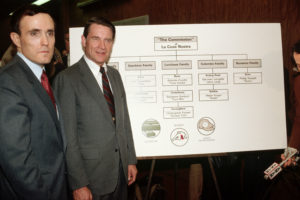
U.S. Attorney Rudy Giuliani and FBI Director William Webster
U.S. Attorney Rudy Giuliani and FBI Director William Webster show a Mafia organizational chart during a press conference following the indictment of New York Mafia bosses. Bettmann/Corbis

Fear City is well done. Its producers deserve a ton of credit for tracking down many of the key players in the Commission case and convincing them to open up on camera. But it is important to understand that the three-part series tells the story from a specific perspective. This is a documentary about the FBI agents and prosecutors from the U.S. Attorney’s Office who were involved in gathering evidence and building the case. A total of 16 agents, investigators and prosecutors were interviewed on camera. But the series offers little for those seeking insights into the New York Mob and the impact of the investigation at that time.

The filmmakers interviewed just two former mobsters to carry the load for that side of the story: Michael Franzese and John Alite, both of whom, incidentally, have spoken at The Mob Museum. Each contributes valuable color to the storytelling, especially in the first half of the series. Franzese and Alite highlight the fact that the Mafia in the 1970s – in the decade before the Commission case went to trial – was extremely powerful in New York.

“It was the golden era of the Mob,” Franzese says. “The FBI couldn’t keep up with us.” He adds later, “We prospered because we infiltrated every fabric of society.”

Alite has a similar recollection: “We were untouchable. Who was going to stop us? You felt like you had the power to do anything you wanted.”

Of course, the Commission case changed all that. Taking advantage of a little-used law up to that time, the Racketeer Influenced and Corrupt Organizations Act, or RICO, prosecutors were able to construct a case against the Mafia bosses even though they could not be directly linked to the murders, robberies, extortions and other crimes committed by their underlings. As FBI agent Jim Kossler says, RICO “would change everything.”

Michael Franzese and John Alite
Former New York mobsters Michael Franzese and John Alite appear in Fear City.

The strength of Fear City is in the interviews with FBI agents revealing how they gathered evidence. And the star among the agents is Joe Cantamessa, a special ops guy who relates a couple of fascinating anecdotes about planting bugs in mobsters’ houses. I won’t spoil the documentary by going into detail, but suffice to say that Cantamessa and others were very creative in how they went about their business – and they took considerable risks to get the job done. And as Cantamessa notes in describing one of his bug-planting adventures, “I’m making this up as I’m going along.”

Other agents were assigned the more tedious but no less important task of listening to recordings of the bugs and wiretaps. Amid the long silences and routine family dialogue, they found nuggets of evidentiary gold. The FBI had an incredible 25 bugs and wiretaps going at any one time in the 1980s, creating a daunting number of hours of audiotape to be reviewed.

One of the biggest revelations of the Commission investigation was the existence of “The Concrete Club,” which was shorthand for the Mafia’s almost-total control of commercial construction in New York City. “The Concrete Club has to be one of the most audacious schemes that the Mob has ever pulled off,” prosecutor John Savarese says in the third episode.

Another coup for investigators was their surveillance of a meeting of the Commission. Video shows the Mafia kingpins entering and leaving a business. “This is a Commission meeting unfolding right in front of our eyes,” agent Joe O’Brien says.

The 1985 arrests of the Mafia bosses and the subsequent 10-week trial were a media circus, with U.S. Attorney Rudy Giuliani as giddy ringmaster. Giuliani relied on a trio of young prosecutors, including future Homeland Security Secretary Michael Chertoff, to try the case, but he deserves credit for conceiving of and championing such a bold and risky endeavor.

Ultimately, the jury found all eight mobsters tried in the case guilty, including three top bosses – Anthony “Fat Tony” Salerno, Antonio “Tony Ducks” Corallo and Carmine “Junior” Persico. Seven of the defendants received 100-year sentences, and one, Anthony “Bruno” Indelicato, got 40 years.

Sadly missing from the documentary is any reference to Persico representing himself during the Commission trial. As the New York Times reported at the time, Persico “provided some of the trial’s most memorable moments, using a sardonic, streetwise humor to address the jury and question witnesses.” Often referring to himself in the third person, Persico wondered why he did not appear on any of the FBI’s surveillance tapes. “Maybe he didn’t want to meet anybody anymore,” he said. “Maybe he had had enough. Maybe Carmine Persico was tired of going back and forth to jail.”

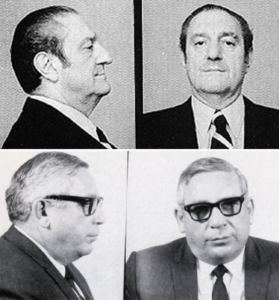
Paul Castellano and Anthony "Tony Ducks" Corrallo
Gambino crime family boss Paul Castellano, top, and Lucchese crime family boss Anthony “Tony Ducks” Corrallo were among the key targets in the Commission case. 

A few critics have found fault with Fear City. Q.V. Hough, writing for Screenrant.com, complains that “the backstory of the New York Mafia” is completely missing. The series, he says, “ignores 100 years of history.” I noticed this, too, but it’s clear that director Sam Hobkinson decided to limit the scope of his story to a particular snapshot of time and place. The backstory Hough seeks can be found in hundreds of books and dozens of cable television specials. It’s practically the raison d’etre of The Mob Museum. As a historian, my instinct would have been to include the wider historical context, but Hobkinson had a different vision.

Hough also says Fear City “rushes through the specifics” of the RICO law that served as the foundation for the Commission case. He is right. While the filmmakers landed an interview with RICO creator Robert Blakey (who also has spoken at the Museum), they spend too little time explaining the law and its advantages and pitfalls.

Writing for Vox.com, Alissa Wilkinson is particularly hard on Fear City, but she reveals her biases in the process. She is offended by the fact that Giuliani’s more recent issues as a lawyer and adviser to President Trump are not included in the documentary. But director Hobkinson clearly made a decision not to bring the stories of all the characters depicted in the documentary up to date. As mentioned before, he limited the scope of his storytelling, omitting most of what happened before and what happened after. Within this context, it would have been odd for him to add three minutes about Giuliani’s 21st century political activities.

Wilkinson makes a better case when she criticizes Fear City for doing so little on the interplay between the Mafia and Donald Trump in the 1970s and ’80s. Trump certainly was not the only New York developer victimized by the Mafia’s influence in construction, but he was the most prominent. While this is mentioned in the documentary, Wilkinson rightly asks, “How did Trump deal with the Mob? To what extent? Were his actions criminal?” Attempting to answer these questions could have helped illuminate exactly how the “Concrete Club” operated.

In the end, Fear City is a revealing case study in how FBI agents do their work. For those interested in the nuts and bolts of how law enforcement took down the Mob in the last three decades of the 20th century, this documentary is a revelation. But for those looking for new insights into the Mafia, or for a hit piece on Trump and Giuliani, Fear City will not satisfy.

Frank Sinatra’s terrible, horrible, no good, very bad year

In a gift shop at the Sands hotel-casino in Las Vegas, Sammy Davis Jr., practicing with a golf putter by a display, spotted a Nevada gaming official and asked to have a word with him.

The state official, Ed Olsen, having gone toe-to-toe with Davis’ friend Frank Sinatra for allowing a mobster inside Sinatra’s Lake Tahoe casino, remembered thinking, “Oh, God, here comes a brawl for sure.”

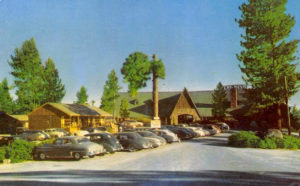
The Cal-Neva Lodge, on the north shore of Lake Tahoe, was an out-of-the-way resort, but news of Sam Giancana’s presence there made its way to the Nevada Gaming Control Board.

As recalled in James Kaplan’s 2015 book Sinatra: The Chairman, Olsen instead received a thank you from Davis for putting Sinatra in his place.

“He’s needed this for years,” said Davis, a popular performer whose talents included acting, singing and dancing. “I’ve been working with him for sixteen years, and nobody’s ever had the guts to stand up to him.”

Standing up to Sinatra in 1963 was not easy. The former saloon singer from Hoboken, New Jersey, was a stage and screen sensation by then. Only three years earlier, in 1960, Sinatra, Davis and others from an elite circle of entertainers known as the Rat Pack starred in the Las Vegas heist movie Ocean’s 11. This month marks the movie’s 60th anniversary.

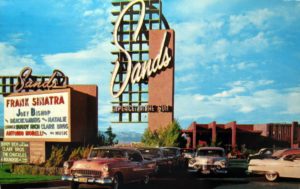
 The Rat Pack, which also included Dean Martin, Peter Lawford, and Joey Bishop, attracted attention to Las Vegas during these years with high-spirited shows in the Copa Room at the Sands, where Sinatra and Martin were part owners. Among the group’s friends were John F. Kennedy, Marilyn Monroe and others from politics and entertainment.

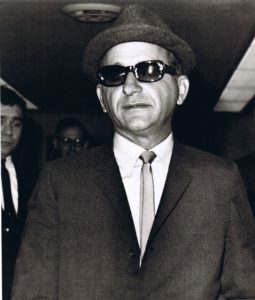
But it was Sinatra’s association with the Chicago Outfit’s Sam Giancana that caught the attention of Nevada gaming officials and culminated in the singer forfeiting his partial ownership in Lake Tahoe and Las Vegas casinos.

The problem reached a boiling point in the summer of 1963, when the state challenged Sinatra about Giancana being at the Cal-Neva Lodge, on the north shore of Lake Tahoe at Crystal Bay. Lake Tahoe is in the Sierra Nevada mountains near Reno.

Sinatra was the principal licensee at the Cal-Neva, where the California-Nevada border — thus the name, Cal-Neva — runs through the swimming pool and now-shuttered main lodge. Gambling was permitted on the Nevada side.

Sinatra fired back in an August 31 phone call with Olsen that included an implied threat and a barrage of obscenities and insults. Sinatra even called Olsen, a former Associated Press reporter who used a cane because of childhood polio, “a crippled S.O.B.”

Giancana had been at the Cal-Neva that July with girlfriend Phyllis McGuire during her booking in the Celebrity Room. Phyllis is one of the singing McGuire Sisters. Giancana was listed in Nevada’s Black Book of persons prohibited from entering any casino statewide. He even had been involved in a fistfight with another man while there.

Giancana and McGuire were staying in Chalet 50, a cottage on the Cal-Neva grounds, said Guy W. Farmer in a telephone interview from his home in Carson City. Farmer, an 84-year-old former Gaming Commission and Control Board spokesman, still has an original copy of the state’s first Black Book, which he received while working as a $10,000-a-year state gaming employee. Giancana’s name is in it.

The Sands Hotel was headquarters for the Rat Pack, led by Sinatra. The crooner had a small ownership interest in the Sands that he gave up in 1963.

Farmer said Sinatra “had been warned about running that kind of establishment.”

The year before, in the summer of 1962, Giancana was at the Cal-Neva many days, sometimes in golf attire and usually accompanied by Sinatra, according to retired journalist John Jekabson, then a student at Occidental College in Los Angeles working at the lodge as a seasonal pot washer and busboy.

One of the other workers told Jekabson who Giancana was and advised him to stay out of his way. To everyone there, the Chicago mobster, rumored to be a secret part-owner of the Cal-Neva, was just known as “Sam.”

“I was surprised he was there so openly,” the 79-year-old Jekabson said by phone from his home in Oakland. Jekabson, an artist, secretly drew sketches of Sinatra and Giancana during that summer. He still has the sketches, as well as Cal-Neva pay stubs, and even saved some of the matchbooks he collected while working there. The matchbooks identify the property as “Frank Sinatra’s Cal-Neva.”

Earlier sightings of Giancana are what prompted state officials to warn Sinatra not to host notorious figures on the property. However, Sinatra, a major star, “was going to do it his way,” Farmer said.

“Sinatra was mobbed up his whole life,” said Farmer, who had worked for the Associated Press at the Capitol in Carson City before taking the state job.

This level of scrutiny aimed at JFK’s friend did not escape the president’s attention, according to Hang Tough!, the oral history of former Nevada Governor Grant Sawyer, who died in 1996 at age 77. The book was published in 1993 by the University of Nevada Oral History Program.

In an open-air car on the way to the Las Vegas Convention Center, Kennedy spoke with fellow Democrat Sawyer about Sinatra’s casino licensing problems.

“What are you guys doing to my friend, Frank Sinatra?” the president asked. The implication: Go easy on him.

“Well, Mr. President,” Sawyer said, “I’ll try to take care of things here in Nevada, and I wish you luck on the national level.”

Having seen a memo of Sinatra’s obscenity-laced phone call, the governor told Olsen not to back off. “Do not be intimidated by him,” Sawyer told the Gaming Control Board chairman.

In his oral history, Sawyer, a former prosecutor from Elko in northeastern Nevada, said Sinatra was a “very abusive guy.”

“My experience with him has been that he sets his own rules,” Sawyer said. “He does his own thing, regardless, and he has violated laws with impunity and bought his way out of most problems if he could.”

The 1963 episode turned out to be one Sinatra couldn’t badger or buy his way out of.

Sam Giancana, a high-ranking member of the Chicago Outfit, was believed to have a hidden interest in the Cal-Neva, using Sinatra at the front man.

Just weeks after his phone call with Olsen, Sinatra announced he was giving up his ownership in Nevada casinos. The announcement came from his attorney, Harry Claiborne, on October 7.  More than two decades later, Claiborne, by then a federal judge, was imprisoned for falsifying tax returns and, in a U.S. Senate impeachment conviction, was removed from the bench. He died in 2004 at age 86 of a self-inflicted gunshot wound.

Through his attorney, Sinatra asserted that he gave up the casino investments because he was finalizing a deal with Hollywood executive Jack Warner, who was “opposed to involvement in gaming,” according to the New York Times.

Farmer, now an award-winning political columnist at the Nevada Appeal newspaper in Carson City, said the truth is Sinatra recognized he had drawn a losing hand against the state and its Black Book ban on mobsters being in casinos.

“Sinatra caved in,” Farmer said in an oral history published by the University of Nevada, Reno. “He realized he couldn’t win under our law, as written, and he caved in and threw in his license.”

Giancana was upset with Sinatra for yelling at the gaming official and calling him a cripple, believing a calmer approach might have led to a 30- to 60-day suspension but not a loss of the casino license, according to Kaplan’s book, Sinatra: The Chairman.

Giancana told a friend, “Frank has to get on the phone with that damn big mouth of his and now we’ve lost the whole damn place.”

According to the book, Sinatra pointed the finger at Giancana, saying the mobster “shouldn’t have been there in the first place.”

“Look at the trouble he caused,” Sinatra said. “This is his fault, not mine.”

Sinatra’s fortunes turned around years later.

In 1981, when Sinatra was 65, he regained a key employee casino license in Nevada, telling state gaming regulators he did not invite Giancana to the Cal-Neva in 1963 or even see him there. Once he learned Giancana was on the property, he ordered casino officials to ask him to leave, Sinatra told the panel.

Sinatra’s attorney at this 1981 hearing, Bill Raggio, a Republican state senator and former Reno prosecutor, said a Gaming Control Board “inquiry had not turned up evidence” of Sinatra having Mafia ties, according to the New York Times.

”Few persons could stand up to the rigorous, exhaustive scrutiny, the penetrating depths of this type of investigation,” said Raggio, who died in 2012 at age 85.

Farmer, who listened in on an office phone line in 1963 when Sinatra berated his boss, later went to work overseas, but he recently said he was not happy about the result of that 1981 hearing.

“They drooled all over him,” Farmer said.

Over the years, more would come out about Sinatra’s relationship with underworld figures.

In his 1997 book The Dark Side of Camelot, Pulitzer Prize-winning journalist Seymour Hersh quotes Sinatra’s daughter, Tina, saying it was her understanding that Sinatra met with Giancana before the 1960 presidential election, at Kennedy family patriarch Joe Kennedy’s urging, to get “the unions to vote” for JFK in the key states of Illinois and West Virginia. Kennedy defeated Republican Richard Nixon in a close election that year. High-ranking mobsters later felt betrayed when Kennedy appointed his crime-fighting brother, Robert, as attorney general, leading to increased federal scrutiny of the Mafia.

In Hersh’s book, Tina Sinatra said her father grew up in New Jersey around gangsters and that mobsters controlled the nightclubs he later performed in.

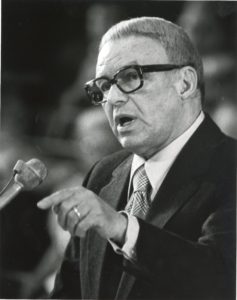
In 1981, Sinatra came before the Nevada Gaming Control Board and received approval to serve as a key employee at Caesars Palace. He was grilled about the Lake Tahoe incident almost 20 years before but it did not prevent him from gaining the license. Courtesy of Las Vegas Review-Journal Archive.

“The power of an entertainer and the power of a mobster — it’s all very much part of America,” she told Hersh.

She said her father had an “absolute commitment to friends and family.” “Frank’s affiliation with Sam Giancana and other mobsters — we all understand that,” she said.

Giancana was shot to death at age 67 at his home in Oak Park, Illinois, a Chicago suburb. No one ever has been held criminally responsible for the 1975 killing.

In 1963, Sinatra’s association with Giancana was not the only challenge the star faced. The final months of that year came with other setbacks for him — and the country. President Kennedy was assassinated in Dallas on November 22, and Sinatra’s 19-year-old son was kidnapped from a South Lake Tahoe casino in December. Frank Sinatra Jr. was released unharmed a couple of days later.

After the kidnapping, Frank Sinatra, concerned about not having change for a pay phone in an emergency like the one involving his son, always had 10 dimes with him and even was buried with 10 dimes.

Sinatra died in 1998 of a heart attack at age 82. In addition to the dimes, he was buried with a bottle of Jack Daniel’s whiskey, a pack of Camel cigarettes and a Zippo lighter, according to the Associated Press.

On CNN’s Larry King Live, Tina Sinatra said her father’s habit of carrying dimes “came from Frankie’s kidnapping, maybe before.”

“He never wanted to get caught not able to make a phone call,” she said.

Stories like this reveal a different side to Sinatra, indicating a complex personality beyond the bullying he exhibited toward Olsen and others. Farmer noted that Sinatra did have a positive impact on the state as a popular entertainer and as a champion for civil rights at a time when Nevada was viewed as “the Mississippi of the West.”

Over time, with the Rat Pack members moving on and dying, that era dissolved into a modern period of phenomenal growth and transformation in Las Vegas. The Sands was closed and demolished in 1996. The Venetian hotel-casino, with gondola rides available in water-filled canals, opened at that site on the Las Vegas Strip in 1999.

Many physical reminders of that eventful last half of 1963 in Northern Nevada also have gone through changes. At Lake Tahoe, the Cal-Neva remains closed, though news stories indicate it might open again someday.

Back in Las Vegas, a plaque went up at the Venetian near where five of the famous Rat Pack stars were standing for a photo in front of the iconic Sands sign when their careers were soaring. “A Place in the Sun” is how the sign describes the Sands. All five are in suits and neckties, a couple of them squinting in the sunlight, and only one, Sammy Davis Jr., with a loosened tie. On the ground beneath the plaque are replica footprints showing where the five were standing that bright day long ago.

Larry Henry is a veteran print and broadcast journalist. He served as press secretary for Nevada Governor Bob Miller, and was political editor at the Las Vegas Sun and managing editor at KFSM-TV, the CBS affiliate in Northwest Arkansas. Henry taught journalism at Haas Hall Academy in Bentonville, Arkansas, and now is the headmaster at the school’s campus in Rogers, Arkansas.

Following the facts to possible Hoffa hit house

In the fall of 2019, as a mentor of mine out East closed in on where Jimmy Hoffa’s body is very possibly buried, I was at ground zero for the storied Hoffa case in Detroit, running down a tip pointing to where he was killed. The two locations might be the final pieces of the puzzle that finally solve one of the most speculated-upon murder mysteries in American history.

In October 2019, Dan Moldea, the world’s preeminent expert on the case, traced Hoffa’s remains to the site of a former mobbed-up trash dump in Jersey City, New Jersey. Just weeks later, I was approached by a source with deep connections in organized crime in southeast Michigan and was told that Hoffa was murdered at the residence of Leonard “Little Lenny” Schultz, a Jewish racketeer and old-time Purple Gang affiliate with whom Hoffa had been friendly for decades.

The two scenarios fit together instantly. My source provided information that directly tied to Dan Moldea’s theory and reporting.

When I was a young reporter entering the hallowed halls of “Hoffaology” in the 2000s, Dan took me under his wing. Our research hasn’t always synced. Our views have differed on a small number of things in pockets of the case. But our respect for each other and passionate love of the endeavor have made us a determined tandem (determined to get to the bottom of the case that Dan proudly and rightly refers to as his “white whale”).

Today, in the wake of the 45th anniversary of Hoffa’s kidnapping and murder, our reporting syncs perfectly.

Tony Giacalone
Tony “Tony Jack” Giacalone, Hoffa’s longtime handler for the Mafia, was scheduled to meet with the labor icon on the day of Hoffa’s disappearance. Courtesy of Scott M. Burnstein

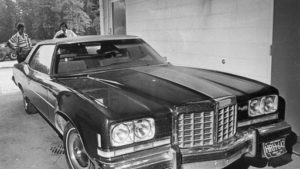
The 62-year-old Hoffa, the face of the American labor movement in the mid- to late 20th century, vanished on his way to a sit-down with a trio of Mob figures in Bloomfield Township, Michigan, 45 years ago this week. The firebrand Teamsters boss, who clashed with his former allies in organized crime regarding a potential return to the goliath union’s presidency, was last seen in the parking lot of the Machus Red Fox restaurant on the afternoon of July 30, 1975. He was getting into a maroon-colored Mercury Marquis owned by the son of fearsome Detroit Mafia street boss Anthony “Tony Jack” Giacalone.

Hoffa’s datebook indicated a lunch meeting with “Tony G, Tony P and Lenny S” at the Red Fox, a popular fine-dining establishment 20 miles from Hoffa’s summer cottage on Lake Orion and seven miles north of Detroit’s city limits. “Tony G” was Tony Giacalone, Hoffa’s longtime handler for the Mafia. “Tony P” was New Jersey Mob capo and Teamsters power broker Anthony “Tony Pro” Provenzano, a one-time close friend of Hoffa’s turned bitter enemy. “Lenny S” was Little Lenny Schultz, a high-ranking Mob associate, labor consultant and Tony Jack’s liaison to Hoffa and buffer for all his union affairs.

I grew up down the street from the Machus Red Fox and was always fascinated by the mythology surrounding Hoffa’s disappearance and how, especially in Metro Detroit, the question of what happened to Jimmy Hoffa is embedded in the cultural fabric. I’ve been reporting on the case for 15 years now, and I’m credited with breaking a number of major stories related to the investigation.

The dapper and diminutive Schultz owned Tony Giacalone’s headquarters, the Southfield Athletic Club, and was a fixture in the Detroit area’s Jewish community until he died in 2013 at age 96. He began in the rackets as a teenager, running errands for the headline-grabbing Purple Gang, the city’s notorious Jewish Mob of the 1920s and ’30s. He was a driver for Purple Gang lieutenant, Abe “Abie the Agent” Zussman and learned the union consulting business from Purples such as Jack “Babe” Bushkin and Joseph “Monkey Joe” Holtzman, two of his early mentors.

Schultz was a deal maker and a diplomat, someone who connected a lot of dots for people of varying personalities in an array of business sectors. It was a skill that served him well.

Through his background with the Purples, Schultz met Hoffa and Tony Giacalone.

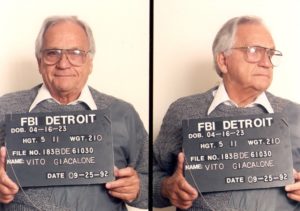
According to FBI documents, Schultz helped Giacalone and Tony Jack’s younger brother, Vito “Billy Jack” Giacalone, a respected and capable Mob capo in his own right, arrange for Hoffa to meet Tony Provenzano at the Red Fox the day he disappeared. Hoffa was feuding with Tony Pro over bad blood from a stay in Lewisburg Federal Penitentiary. Hoffa needed Provenzano’s support, though, to reclaim the Teamsters and requested assistance from Schultz and the Giacalones, who were related to Tony Pro via marriage, in squashing their beef, per the documents.

Vito "Billy Jack" Giacalone
Vito “Billy Jack” Giacalone, younger brother of Tony Giacalone, allegedly was one of three men who kidnapped and killed Hoffa. Courtesy of Scott M. Burnstein

Tony Giacalone and Schultz didn’t leave each other’s side all day on July 30, 1975, holding court at the Southfield Athletic Club, a little less than five miles south of the Red Fox, where they were supposed to be meeting Hoffa. Tony Pro was playing cards in his union hall in New Jersey. Billy Giacalone didn’t have an alibi for the day Hoffa went missing and was unaccounted for by both FBI and Michigan State Police surveillance units the entire afternoon.

I was contacted by a source in November 2019 and asked to meet with him about the Hoffa case. This source had worked for Lenny Schultz and acted as a collector for the Giacalone brothers. He didn’t want his name to be released, but he told me I could report what he told me: Jimmy Hoffa was killed at Lenny Schultz’s house in Franklin Village, Michigan.

“Lenny and I were driving on Telegraph (the street the Red Fox was on) one day. I was taking him to an appointment. This is years after Hoffa was gone . . . and he just said it,” the source recalled. “He said, Jimmy bit the dust at his place and it wasn’t a shooting. … He said Tony Jack had the house keys and they choked him out in the living room. Then they gave the body to Rolland McMaster to get rid of it. He was real quiet the rest of the drive that day. It seemed like he just wanted to get it off his chest. He never said another word about it to me.”

This is where the story dovetails with Dan Moldea’s reporting. Dan has always placed “Big Mac” McMaster in the murder plot. McMaster was a legendary Teamsters goon, labor muscle for the Mob for years with a reputation for violence that stretched coast to coast. McMaster and Hoffa were once tight. At the time of his disappearance, however, they were rivals. McMaster had led a campaign of intimidation (beatings, bombings, bully tactics) against Hoffa and his allies in the preceding year in an attempt to get Hoffa to drop out of the union presidential election.

The FBI searched McMaster’s Hidden Dreams Ranch in Commerce, Michigan, in 2006 looking for Hoffa’s body, but came up empty. When Dan developed New Jersey Mob figure Phil “Brother” Moscato as a source late in Moscato’s life, Moscato, a confidant of Tony Pro and one of the biggest loan sharks in the Garden State during his gangland prime, told Dan that Hoffa’s body was transported from Detroit to New Jersey in a Gateway Transportation truck and laid to rest at his PJP Landfill underneath the Pulaski Freeway. McMaster owned Gateway Transportation.

Schultz’s house was a five-minute drive west of the Red Fox and a straight shot up Maple Road to Hidden Dreams Ranch. Per FBI informants and grand jury testimony, the Giacalones felt comfortable using Schultz’s house for “wet work,” and had killed furniture mogul Harvey Leach at Schultz’s residence 16 months before in the spring of 1974. Another one of Dan’s sources claims he witnessed unusual activity at the ranch late in the evening of July 30, 1975 — cars speeding in and away from the property in the dark of night.

In the interest of full disclosure, for the last dozen years I’ve been espousing another theory regarding the spot where Hoffa was murdered. I’ve reported and been on national television discussing my belief that Hoffa was killed at Detroit Mob soldier Carlo Licata’s house, a five-minute drive north of the Red Fox and a residence at which Hoffa had met the Giacalone brothers several times before. Licata was the brother-in-law of the Detroit Mafia’s acting boss at the time, Giacomo “Black Jack” Tocco, and died under suspicious circumstances at the residence, known as the “house on the hill,” off Long Lake Drive in Bloomfield Township, Michigan, on the six-year anniversary of Hoffa’s disappearance.

I am not abandoning my Licata theory. Too many people on both sides of the law have confirmed for me that is where he was taken and bumped off. That said, I am an investigative reporter, and I have to go where the facts lead me.

This new theory makes a lot sense. I find it completely plausible and possible that Hoffa was killed at Lenny Schultz’s house, not Licata’s.

Around the same time that I was rethinking my research, Dan was hitting paydirt in New Jersey. Literally. Although Brother Moscato admitted to Dan that he was in charge of burying Hoffa’s body at the PJP Landfill, he never filled Dan in on exactly where his remains rested on the property before dying of cancer in 2014. That part of the equation came from Frank Cappola last fall.

Cappola’s dad, Paul, was Brother Moscato’s partner in the PJP dump, and Paul spilled the beans to his son on his deathbed back in 2008. Last October, an ailing Frank Cappola, a former wiseguy himself, took Dan to the precise spot — now part of a state park and nature preserve — where his father told him he had buried Hoffa’s body in a 55-gallon industrial drum the night after Hoffa disappeared. Cappola died of a respiratory ailment on March 16 of this year.

Acting on a tip from Tony Provenzano’s driver, the feds searched the PJP Landfill for Hoffa’s body in the months after he went missing, and they didn’t find anything. But they didn’t have the specifics that Dan does now, and I think they’ll be searching there again soon.

If anyone in this crazy, surreal and quite well-documented near half-century journey of tracking down leads in the Hoffa disappearance deserves to be the man who can finally say he found Hoffa’s tomb, it’s Dan Moldea. This man is an institution in the world of hard-nosed, unrelenting reporting, much the way Hoffa was in labor politics. Investigative journalists everywhere owe him a great debt. When it comes to Hoffa research, reporting and knowledge, he’s the trailblazer.

That’s the truth, whether we ever find Hoffa’s body or not.

The Detroit FBI office continues to actively pursue the Hoffa case. The feds strongly subscribe to the belief that the Hoffa homicide conspiracy was put into motion by Black Jack Tocco and Tony Giacalone (on the orders of Tocco’s uncle and Tony Jack’s mentor, Godfather Joe Zerilli) in Michigan, and that the hit team consisted of Billy Giacalone, Detroit Mob soldier Anthony “Tony Pal” Palazzolo and New Jersey mobster Salvatore “Sally Bugs” Briguglio, Tony Provenzano’s top enforcer.

Palazzolo bragged of involvement in the Hoffa hit on an FBI wire in the 1990s, and an informant told the FBI in 2012 that Tony Pal beat and strangled Hoffa to death. Many in the FBI working the case today believe Tony Pal did the deed. Brother Moscato told Dan that Billy Giacalone kidnapped Hoffa from the Red Fox parking lot in his nephew Joey’s car, and that Salvatore Briguglio shot him in the back of the head at a nearby residence.

That residence could very well have been Schultz’s house in tony Franklin Village, a small, exclusive community reminiscent of the New England countryside. It’s a 10-minute drive from the Giacalone crew’s nerve center at the Southfield Athletic Club and less than a half-hour’s drive to downtown Detroit and Hoffa’s Teamsters HQ on Trumbull Avenue around the corner from historic Tiger Stadium. The Giacalones are thought to have handled a similar problem at Schultz’s house the year before.

Blood washes blood.

Local whiz-kid entrepreneur Harvey Leach was last seen alive heading to a meeting at the Schultz residence with Schultz and Tony Jack on the morning of March 15, 1974. Leach, 34, was found dead in the trunk of his car the following afternoon, hours before he was supposed to be getting married. According to FBI records, Leach was being muscled out of his trendy Joshua Doore furniture store chain by the Giacalone brothers after Schultz had brokered a loan for Leach to expand the business and the Giacalones robbed the place blind instead. Rumors were also floating around that the debonair and sophisticated Leach had angered Billy Giacalone for bedding one of his girlfriends while Billy Jack was out of town serving a state prison term in the early 1970s.

Just five months before Hoffa’s kidnapping and execution, Lenny Schultz’s home was burglarized. In a press interview, Schultz accused the FBI of staging the break-in to illegally search for evidence linking the property to the Leach murder. A source once told Moldea that the same gun used to kill Hoffa was used to kill Leach.

Schultz and the Giacalone brothers were each called to testify before grand juries investigating both the Hoffa and Leach homicides. Nobody has ever been charged in either case.

The Giacalones and Schultz did subsequent prison sentences for unrelated felony convictions. Tony Jack died of kidney failure in 2001 under indictment in a RICO prosecution. Billy Jack died of natural causes in 2012. Together, they had run day-to-day operations for the Detroit Mafia since the late 1950s.

Rolland McMaster died in 2007 of heart failure. Tony Provenzano dropped dead of a heart attack in prison in 1988. Stomach cancer took out Tony Palazzolo, who had risen to consigliere of the Tocco-Zerilli crime family by the end of his gangland career, last winter. Sally Bugs didn’t make it out of the disco era. He was gunned down walking out of a Manhattan social club in 1978.

Joey Giacalone’s car, a Mercury Marquis
Joey Giacalone’s car, a Mercury Marquis, is the only piece of physical evidence ever recovered in the Hoffa investigation. Hoffa’s DNA was found in the vehicle’s trunk and backseat. Courtesy of Scott M. Burnstein

Joey Giacalone’s car, his then-new Mercury Marquis, is the only piece of physical evidence ever recovered in the investigation. Hoffa’s DNA was found in the vehicle’s trunk and backseat.

Lenny Schultz did a few years in the joint for cocaine dealing in the late 1980s and early ’90s, but mostly lived his final years off the map in retirement, quietly shuffling between Michigan and Miami Beach and enjoying his last days in the sun, wealthy and healthy well into his 90s. He had a knack for sidestepping landmines, a valuable resource in his line of work. People said he could talk his way out of anything.

He once admitted in open court that he had given information to the government as an informant. Under most any other circumstances, the Giacalones would have slit his throat and stuffed him down a drainpipe. These are two men allegedly responsible for two dozen gangland slayings apiece, minimum. But Lenny got a pass. That’s got to say something about the man.

I met Lenny Schultz when I was in college at a family weekend where he was visiting his grandson, who was a classmate of mine at Indiana University. Our fathers had attended law school together. We were all at a bar, eating, drinking, watching football. And I remember my dad taking me over to the side and whispering in my ear that Lenny was supposed to be with Jimmy Hoffa and Tony Giacalone the day he vanished into thin air.

Maybe I should have just gone straight to the horse’s mouth and asked him what happened myself.

Scott M. Burnstein, a journalist and author in the Detroit area, is the author of several books, including Mafia Prince: Inside America’s Most Violent Crime Family and the Bloody Fall of La Cosa Nostra, Motor City Mafia: A Century of Organized Crime in Detroit, and Family Affair: Greed, Treachery, and Betrayal in the Chicago Mafia.

Culling out the card sharks

Gambling was always a backdrop in the nascent years of Las Vegas, a popular if illicit activity for railroad workers, cowboys and the valley’s earliest settlers. So it is no surprise that gamblers were the target of the first sting operation ever conducted by law enforcement in Las Vegas.

Nevada state lawmakers voted in 1909 to ban gambling, effective on September 30, 1910. This measure would put the brakes on illegal gambling throughout the state, while also triggering a counter-campaign to legalize the activity.

The loosening of the laws had begun in 1913 when Nevada statutes were amended so that “nothing in this paragraph shall be construed as prohibiting social games played only for drinks and cigars or for prizes of a value not to exceed two dollars.” Nor did the new law prohibit “nickel-in-the-slot-machines for the sale of cigars and drinks and no play-back allowed.” By state law, gamblers couldn’t gamble more than a nickel at a time, frustrating casino operators who wanted gamblers to put quarters and half-dollars into the machines. “Play-back,” or the reward of tokens that could be exchanged for cash for winning pulls on the one-armed bandits, hadn’t yet been authorized by the state.

In time, card tables began to flourish, offering games with fanciful names that competed for attention with the nickel slot machines that were showing up in saloons. The diversity was enticing, so gamblers and communities alike started pushing the edge of the envelope for more games of chance. In 1915, the state Legislature blew the whistle and made gambling laws more specific:

“It shall be unlawful for any person to deal, play or carry on, open or conduct, in any capacity whatever, any game of faro, monte, roulette, lansquenet, rouge et noir, rondo, tan, fan-tan, seven-and-a-half, twenty-one, hokey-pokey, craps, klondyke, or any banking or percentage game played with cards, dice, or any … slot machine played for money.”

While the 1915 legislation declared that saloon operators who overstepped the line could be guilty of a felony, the law affirmed passages in the 1913 law that allowed “social games” that paid off in free drinks, cigars or prizes worth up to $2.

Two of the signature gambling devices in today’s Las Vegas – craps and roulette tables – would not be permitted until 1931.

Enforcement demanded

In January 1919, Nevada Attorney General L.B. Fowler issued an opinion banning the use of slot machines. Directed “to the District Attorneys of the State of Nevada,” Fowler wrote, “for several years there have been in use and operations in public places in this state” devices “commonly called “slot machines,’ so well known as to require no further description. So extensive have the use and operation of these machines and devices become, and so many inquiries have been made as to their legality, that it becomes my duty to render an opinion thereon.”

Fowler said, “From a legal standpoint it is positive that such a machine is a lottery.” The attorney general pointed out that since Nevada’s Constitution states, “No lottery shall be authorized by this state,” the state Legislature was wrong when it passed an act to legalize slot machines. Fowler concluded that “peace officers,” when they see slot machines, “must recognize the unlawfulness of their existence.”

In July 1919, Fowler said it was his opinion that cities in Nevada should pass local ordinances that followed the state law regarding the licensing of gambling on the five approved card games. Fowler pointed to the key problem area: “The temptation is great for a house where said games are operated to run them on a percentage basis. This is a clear violation for the law and a felony.”

The attorney general said municipalities should pass ordinances licensing card games, and the penalty for violation of the city rules would be “revocation of such licenses.” Attorney General Fowler concluded by stating his office will “rigorously enforce this law.” 

Within weeks of Fowler’s opinion, the city of Las Vegas ordered its city attorney to begin drafting a gambling license ordinance.

In the late fall of 1919, the Nevada Supreme Court took on appeal the case of  Louis Pierotti, who, at his Reno cigar stand, also had slot machines. He was arrested based on Fowler’s July opinion that slot machines were illegal.

But in October 1919, the Nevada Supreme Court upended Fowler’s opinion and ruled that nickel slots were legal. The state high court ruling said in part, “It would be idle for us to deny that chance is a material element in the operation of such machines. The player hopes to get cigars or drinks for nothing.”

The justices added, “There is no doubt that nickel in the slot machines amounts to the disposal of property by chance …” However, the court ruled, slot machines are not lotteries and therefore legal under the law passed by the legislature.

While gambling houses in Las Vegas brought back poker and slot machines late in 1919, saloons were finishing their first year of Prohibition. In November 1918, ahead of the federal law, Nevadans had voted to ban the sale of alcohol.

With the Nevada Supreme Court and attorney general blessing limited gambling, the city fathers in Las Vegas reversed their earlier gambling ban. Guidelines were incorporated in the city’s new gambling code, known as Ordinance 77, that was approved on October 1, 1919.

While drinking alcohol in Las Vegas was still outlawed, gambling was clearly coming out of the closet. Ordinance 77 said clubs could be licensed to provide “any game of poker, stud-poker, five-hundred, solo or whist, played for money” — but not Hokey-Pokey, another version of poker. Moreover, with a look to the future, the city commission ruled that the license would cover “any other gambling game or games” which may be “recognized as legally by the laws of Nevada.”

There was a reason the city wanted to boost its gambling license revenue: it was suffering from the loss of liquor license revenue. Gambling houses would now have to pay a quarterly fee to City Hall of $150 – or about $2,000 in today’s dollars.

At the end of October only three locations had signed up for the last quarter of 1919: The Las Vegas Hotel on Fremont Street, the Colorado Hotel on First Street and the Union Hotel on Main Street. But Las Vegas was slowly growing. The U.S. Census counted 2,304 people living in the city in January 1920. That year, between five and eight gambling halls were licensed for at least one quarter of the year.

The gambling houses squawked at the amount of licensing fees they had to pay.

Crooked game 

Maybe it was inevitable: With the legalization of gambling on card games, crooked games became prevalent in Las Vegas clubs. Complaints of marked cards being used in licensed poker games began circulating in the early summer of 1920.

A report from county District Attorney Jerry Stebenne revealed complaints of an “Armenian” losing $250, a “Mexican from Arden” losing $300, and several others reporting unusually high losses at poker games at one club. Something was wrong. Somebody was cheating, they said.

One of the losers was “Charlie” Kantanjian. Kantanjian, known to his friends as “a persistent patron” of poker, even when losing, told the district attorney that the game at a pool hall was crooked. He told to the district attorney he was a good poker player but over a period of a couple of days, he lost $350 to Victor Lasserre, aka “Frenchy.” Charlie said he wasn’t the only loser, that Lasserre was also “pulling in chips” from the other poker players as well.

Edward Ferre was French Lasserre’s accomplice in a marked card scam in Las Vegas in 1920. Courtesy of Robert Stoldal.

After his last loss, Kantanjian told the DA he was able to get his hands on the deck of cards used in the poker game. He said it didn’t take him long to determine the cards were marked. According to Kantanjian, every card seven and above, as well as the ace, were marked. The code, on the back of the cards, visible to those who knew what to look for, revealed the suit and value of each card.

Kantanjian said he approached “Frenchy” and his partner Edward “Eddy” Ferre and told them he had figured out their scam. He demanded his money back. They admitted the cards were marked, but rather than return his money, they offered him what they said was a better deal. Ferre and Lasserre suggested Kantanjian sit in on the next few games and they would make sure he would leave a big winner, covering all his losses and more.

At this point, Kantanjian said, the owner of the gambling club, Gabriel Lopez, joined in the conversation. He told the three men he would think about their offer.

Like Lopez, Lasserre knew his way around Las Vegas. 

Lasserre, a resident of Las Vegas since before World War I, told the local draft board when he registered for service in 1917 that he was born in Paris, and that his father had become a naturalized citizen.

At the time of his registration, he told the Clark County Draft Board, he was unemployed and his occupation was that of a “Saloon man.” The 26-year-old said his wife and young child were living in California.

Ninety days after he registered, Lasserre left Las Vegas on September 19, 1917, with other Clark County draftees. Within ninety days, Lasserre would be shipped to the country of his birth and served in the Army’s transportation unit. He stayed in France until he was shipped home after the war’s end.

Ferre, who was 24, single and an unemployed clerk in Kingman, Arizona, was also drafted in the fall of 1917 and sent to France.

Both were honorably discharged from the Army after two years of service.

The sting

The two men connected in the service would find their way to Las Vegas early in 1920 and become friends with Lopez. At the time, the 46-year-old Lopez owned and operated a pool hall, the First Street Club. He had properly paid the city the gambling license fee, and was operating four pool tables and two card tables. His club was located on the east side of the 100 block of North First Street, next to the city’s only bank and across the street from the offices of one of the city’s two weekly newspapers, the Clark County Review. The newspaper described its neighbor as “a noisy gambling dive.”(1)

Kantanjian’s next move: a secret meeting with District Attorney Stebenne at the DA’s private practice offices at the Nevada Hotel (now the Golden Gate Hotel). By the end of the meeting, the DA had come up with a plan that would become the first undercover sting operation in Las Vegas.

Stebenne instructed Kantanjian to tell “Frenchy” and his partner Ferre that he would take them up on their offer to let him join in a marked deck game. Meanwhile, the DA rounded up other players, including two well-known local gamblers, C.E. Whitney and Victor Matteucci. Matteucci and his family were pioneer Las Vegans, arriving in 1904.

Las Vegas law enforcement’s first sting operation took place on a Sunday night, July 11, 1920.

Sitting at the table with “Frenchy” and “Eddie” were Kantanjian and the DA’s three plants — Matteucci, Whitney and Stebenne’s friend, F.B. McGrady. Watching from a distance were Stebenne and a “special officer he hired, Joe Keate. Like Stebenne, who was running for re-election as DA, Keate was running for public office – to become the sheriff. One could say that Stebenne had stacked the deck as the players took their seats at the conniving table.

A few hands were played that Sunday night before the DA made his move.

Matteucci had a good hand, but “Frenchy” knew he had a better one. Matteucci lost the game. The DA and Keate, the candidate for sheriff, swung into action, placing the two in-house cheaters, Lasserre and Ferre, under arrest.

Lopez was not sitting in on the game but was arrested as the owner of the club.

After booking the three men in the county jail, Stebenne and Keate searched the hotel rooms of Frenchy Lasserre and Eddie Ferre. The Las Vegas Age reported that the district attorney “found in Ferre’s room five new decks of cards all nicely marked for skinning the suckers.”(2)

When Justice Court opened the next day, Matteucci filed a complaint against the trio. They were charged with “feloniously cheating and defrauding, with the aid of marked cards.” The three men hired the town’s leading defense attorney, Artemus Ham.

During arraignment on Monday, July 19, the three men pleaded not guilty. Then, on advice of their attorney, the three skipped the preliminary hearing and prepared for trial in October. Club owner Lopez was released on his own recognizance, while Lasserre and Ferre each had to provide a bond of $1,000.

Election changes

On September 7, the county’s primary election was elected. Only two candidates were running for district attorney, Stebenne and Harley Harmon. Harmon became the new DA by an overwhelming margin, 442 to 76. He would take office on January 1, 1920.

For the office of sheriff, both the incumbent Sam Gay and challenger Joe Keate made it through the primary and would face each other November 7.

A week before the trial was scheduled to begin, eight locations on Fremont and First streets were up to renew their gambling license for the last quarter of 1920. Lopez’s club was among them.

Most of the legal gambling was taking place along Fremont Street at the Northern Club, the Nevada Hotel, the Las Vegas Hotel. Lopez’s club and the Turf Saloon were on north First Street.

William Ferron, the mayor, and the three city commissioners approved all but Lopez’s license. Las Vegas City Commissioner Howard Conklin asked that it be voted on separately.

After approving the other seven licenses, the commission voted 3 to 1 in favor of granting Lopez a license. Only Commissioner Conklin voted no. The official minutes do not reflect any discussion regarding the Lopez license, or reveal why Conklin was opposed to Lopez.

Lopez went back to his First Street Club with a license for the rest of 1920.

The trial

As the trial date drew closer, Attorney Ham told the court that his clients wanted separate trials. This was granted. The fall term of the Clark County District Court began on Wednesday morning, October 13. Victor “Frenchy” Lasserre’s criminal trial was at the top of the docket.

By the end of the day, the jury was selected and testimony began. Prosecution witnesses appeared all day Thursday, Friday and into the morning of Saturday. The testimony and arguments of the DA and defense attorney Ham lasted, according to a reporter in attendance, “four weary days.”

Midday Saturday, it was time for the defense to present its case. Attorney Ham spoke to his clients, Lasserre and Ferre, saying there was not much of a defense in the face of the prosecution’s case. His advice: Plead guilty and they would likely get a lesser sentence.

As for Lopez, his prosecution was dropped for lack of evidence.

When the court reconvened on Saturday night, October 16, Lasserre and Ferre admitted to “cheating and defrauding in a gambling game by means of marked cards” and entered pleas of guilty. Each was sentenced to the Nevada state prison for one to ten years.

Within a week the two men were booked, photographed and fingerprinted at the Nevada State Prison in Carson City. Lasserre told prison officials he was a miner; Ferre said he was a merchant.

With “two of the crooked gentry” now behind bars at the state prison, the Las Vegas Age optimistically printed this understatement: “The use of marked cards in gambling games in Vegas is somewhat discouraged.”

Aftermath

While the prosecution won the day, Keate failed in his bid to take his old boss’s job as sheriff. Keate waited until Sheriff Gay retired before running for the office a decade later. This time he won.

Before long, Stebenne pulled up stakes and moved to California.

As for Lasserre and Ferre, they served nine months on their sentence and were paroled on August 22, 1921.

Lopez remained involved with the Las Vegas gambling community for the next two decades, including managing two other “colorful” operations, the Northern Club and the Miners Club. He died in Las Vegas in 1946 at age 80.

Today, given the work done by Nevada’s Gaming Control Board agents, the casinos with their experienced staff and eye-in-the-sky cameras, as well as professional card players who know what to look for, the marking of cards has been all but eliminated in major casinos.

But cheats continue trying to rip off the house, including players using everything from grease marks to infrared lights to gain an unfair advantage at a card table. The illegal marking of cards continues today as it did 100 years ago in a pool hall on North First Street in Las Vegas.

Robert Stoldal, a Las Vegas historian and longtime television news executive, serves on the Board of Directors of The Mob Museum.

Endnotes

(1) “District Attorney Springs Trap,” July 17, 1920, Clark County Review, Page 1.

(2) “Stebenne Lands Marked Card Gamblers,” July 17, 1920, Las Vegas Age, Page 1.

‘White Boy Rick’ seeks new life after more than 30 years behind bars

The gates couldn’t swing open soon enough. Former Detroit teenage drug boss and illegal underage FBI mole Richard “White Boy Rick” Wershe walked free last week after 32½ years in prison. He was the longest-serving nonviolent juvenile offender in American history.

A Hollywood film depicting Wershe’s life story hit theaters in September 2018.

The 51-year-old Wershe was released from a Florida halfway house on July 20. He was expected to return to Detroit, the city where he dominated the headlines for much of the late 1980s. At the  time, the public had no clue he was on Uncle Sam’s payroll for a majority of his reign on the streets at the height of Motown’s glitzy, neon-infused coke era. He will be on parole restrictions for the next 13 months.

Wershe’s “White Boy Rick” alter ego — flashy, fast-talking and quick-witted — became a genuine icon of the city in the “Greed is good” decade. He should have been in high school. Instead, he transfixed the news media with his flair as part of the dope-boy chic jet-set crowd (mink coat, fat gold chains, customized “Snowman” license plate), the company he kept in his rise up the underworld food chain (all the era’s biggest African-American drug kingpins twice his age) and the women he dated (most notably Cathy Volsan, Detroit Mayor Coleman Young’s favorite niece and wife of his mentor in the dope game, eastside crime lord Johnny Curry). All before he was 18.

And that wasn’t even the half it.

According to the federal government, Wershe was the most crucial and productive informant the DEA in Michigan had ever had. He was recruited straight out of the eighth grade in June 1984 and put to work as a mole by a federal task force made up of the DEA, FBI, ATF and Detroit Police Department investigating the Curry Brothers Gang on the city’s eastside.

Wershe with his attorney, William Bufalino II, during his trial in 1988. Courtesy of Scott M. Burnstein.

The task force instructed the cocky 14-year old to gain Curry’s confidence and he did, getting paid more than $60,000 over the next few years to feed the feds intelligence on Curry Brothers Gang affairs and the activities of other influential gangland figures he managed to get close to. Wershe met members of the task force through his father, Richard Wershe Sr., a local gun dealer, petty hustler and federal informant who was portrayed by Oscar-winner Matthew McConaughey in the movie two years ago.

The Curry Brothers Gang was busted in the spring of 1987, months after the task force cut ties with Wershe. Just weeks after Curry was taken off the streets, Wershe, 17 at the time, was pulled over in a routine traffic stop in front of his grandmother’s house on the late afternoon of May 22, 1987, for slow-rolling a stop sign. Shortly thereafter, police found him in possession of a box of cocaine buried under a neighbor’s back porch. Wershe ditched the 8 kilos of coke after a post-stop scuffle with the arresting officers that also involved his father and pregnant older sister.

In January 1988, Wershe was found guilty at a week-long trial held in front of Wayne County Recorder’s Court Judge Thomas Jackson under circus-like conditions and a national media spotlight. He was sentenced to a mandatory term of life in prison under the now-defunct “650 Lifer Law.” Three years into his sentence, he entered the Witness Protection Program and helped the feds bring down the blood-lusting Best Friends gang and build the landmark Operation Backbone case targeting a ring of dirty cops with ties to Mayor Young’s office and decorated DPD Homicide Commander and mayoral hopeful Gil Hill.

Wershe’s best friend and right-hand man, Stephen “Freaky Steve” Roussell, was killed by the Best Friends gang in September 1987 in a dispute over a girl. Roussell, 21, was with Wershe when he placed the 8 kilos of uncut powder under his neighbor’s porch in May of that year following the traffic stop that landed him in prison.

While working for the feds as a teenager and then again as an adult in the Witness Protection Program, Wershe gave information on an unsolved murder that was alleged to have been buried by Gil Hill in the DPD Homicide Division. On April 29, 1985, 11-year old Damion Lucas was accidentally slain in a drive-by shooting at his uncle Leon Lucas’ house on Detroit’s westside. Leon Lucas was a member of the Curry Brothers Gang responsible for mixing the gang’s dope.

Wershe told the FBI that Lucas had a murder contract placed on his head because of a beef he had with “Lil’ Man” Johnny Curry over boxing tickets to the Marvin Hagler-Tommy Hearns fight in Las Vegas. Lucas had promised Curry two weeks before to square a debt that never materialized. Per Wershe and other informants in the case, after Curry’s henchmen mistakenly killed the innocent little boy in the drive-by, they were protected by Hill via a payoff from Curry.

Rick Wershe, released from prison last week, was the longest-serving nonviolent juvenile offender in American history. Courtesy of Scott M. Burnstein.

Hill was famous from his acting role playing Eddie Murphy’s police captain boss in the hit 1984 movie Beverly Hills Copand its two sequels. Curry admitted to paying a $10,000 bribe to Hill in an interview with the Detroit News from inside a Texas prison in the 1990s, but denies ordering the shooting that led to Damion Lucas’ death.

After serving 12 years behind bars for a federal narcotics conspiracy, Johnny Curry was released from prison in March 1999. His one-time protégé, the man responsible for getting him arrested and who by that point had spent pretty much the same amount of time locked up as he had, Rick Wershe, would have to wait another two decades for a reprieve from his far-less-serious sentence and his first taste of freedom since the Reagan administration.

Today, Curry is 62 and living comfortably in retirement. Curry publicly campaigned for Wershe’s release in recent years. So did former Best Friends gang hit man Nate (Boone) Craft, once assigned multiple contracts on his life back in their days as rivals in the drug world. One of those contracts, according to Craft, an admitted murderer who confessed to carrying out 30 gangland homicides in the 1980s as part of his cooperation agreement, came from Gil Hill himself.

When Hill lost his bid for the mayor’s office in 2001, he privately blamed Wershe and his finger-pointing in the Lucas matter for the defeat, per sources. Hill always adamantly denied any wrongdoing in the Lucas investigation. He was elected Detroit City Council president in the coming years and still maintained considerable sway in the area’s political scene until he died in 2016 at 84.

Scott M. Burnstein, a journalist and author in the Detroit area, is the author of several books, including Motor City Mafia: A Century of Organized Crime in Detroit and Family Affair: Greed, Treachery, and Betrayal in the Chicago Mafia.