The morning of January 20, 2011, was a particularly early one for many in law enforcement. Before dawn, more than 700 federal agents spread out across the Northeast and rounded up 127 mobsters in the largest single-day takedown of organized crime in American history.
Ten separate agencies (including the FBI, DEA and Secret Service), with assistance from ten others, including the Italian National Police, provided assistance and logistical support. Attorney General Eric Holder said at the time, “Today’s arrests and charges mark an important step forward in disrupting La Cosa Nostra’s illegal activities.” Those illegal activities were a laundry list of traditional Mob crimes: extortion, loansharking, arson, narcotics, illegal gambling, labor racketeering and murder.
Mafia Takedown Day was not one overarching indictment, but rather 16 separate indictments, with overlap among some of the cases. The indictments and subsequent arrests targeted all five of the New York crime families: Genovese, Gambino, Lucchese, Colombo and Bonanno, as well as the New Jersey-based DeCavalcante family and the Patriarca family in New England.
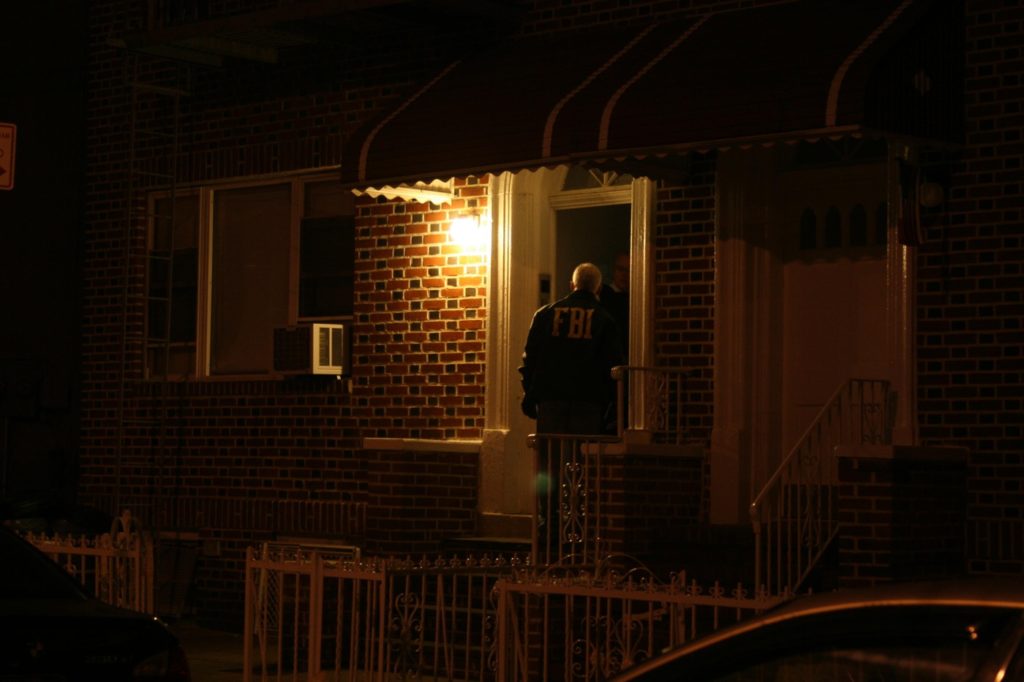
FBI agents move in on a Mafia suspect in Brooklyn in the predawn hours of January 20, 2011. Courtesy of FBI
According to the FBI, 34 of those arrested were made members of the Mafia; the others were associates. High-ranking members who were arrested included Luigi “Baby Shacks” Manocchio, the one-time boss of the Patriarca family; Andy “Mushy” Russo, acting boss of the Colombo family; and Benjamin “The Claw” Catellazzo, acting underboss of the Colombo family.
As with many Mob indictments, the news media played up the colorful nicknames of some of the wiseguys, including Tony Bagels, Frankie Steel, Lumpy, Anthony Firehawk, Marbles, Johnny Pizza, Vinny Carwash, Hootie, Johnny Bandana and Jello. Other observers noted the advanced ages of the suspects, all of whom were at least 60 years old.
The next two years saw a flurry of legal activity as prosecutors geared up for trials. Some of the indictments contained crimes that spanned decades. In one indictment, U.S. v. Corozzo et al, more than 25 members and associates of the Gambino family were engaged in a “pattern of racketeering activity“ that lasted “from at least in or about the late 1980s, up to and including in or about 2010.”
Another indictment out of New Jersey charged members of the Genovese family with racketeering and extortion related to Local 1235 of the International Longshoremen’s Association (ILA). The fact that the New Jersey waterfront was still dealing with infiltration by organized crime decades after federal watchdogs took over some of the unions illustrated the Mob’s resilience at the waterfront. Stephen Depiro, one of the Genovese mobsters charged with extorting tribute payments from ILA members, was sentenced to three years in prison. He was released in 2018. Nunzio Lagrasos, another of the Genovese mobsters convicted of waterfront-related crimes, was released in 2017.
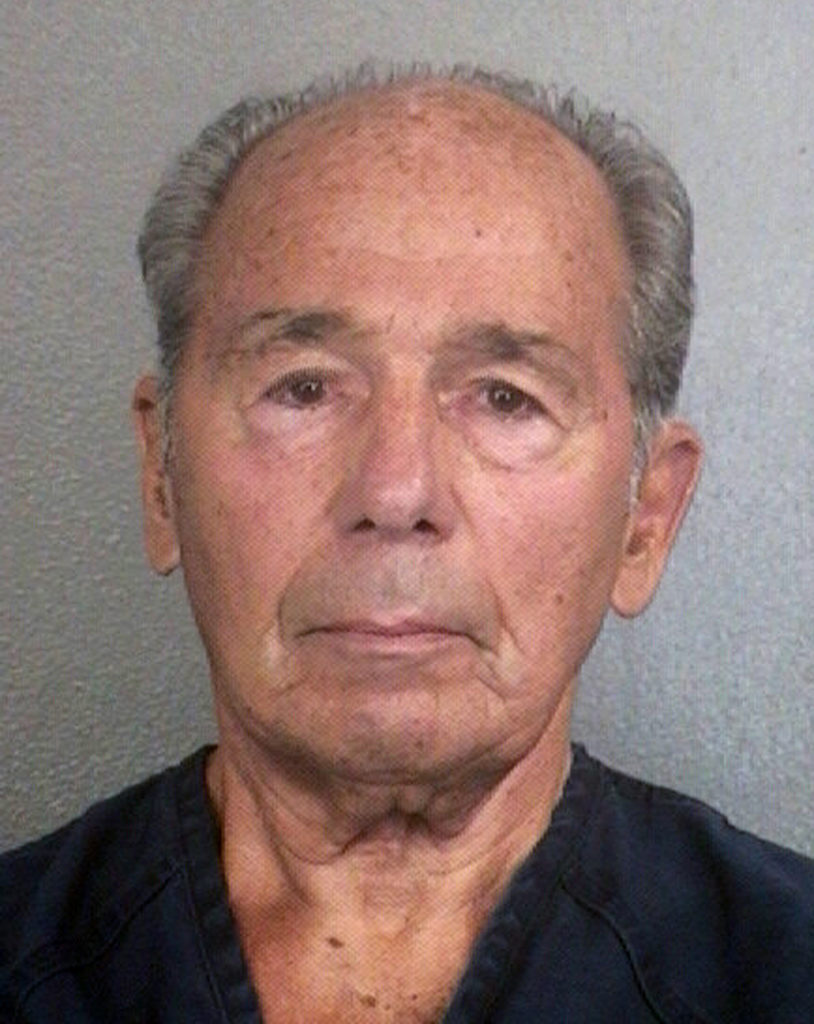
One of the top organized crime figures arrested during Mafia Takedown Day was Luigi Manocchio, former boss of the Patriarca crime family.
There also were a couple of indictments centered on murders and murder conspiracies. Longtime Gambino mobster Bartolomeo “Bobby Glasses” Vernace was convicted of the 1981 murder of two bar owners, Richard Godkin and John D’Agnese, over a spilled drink. He was sentenced to life in prison in 2014. He died in 2017.
With the overwhelming amount of evidence investigators were able to obtain, a large number of the Mob figures ended up taking plea deals rather than taking their chances at trial. Many managed to walk away with (relatively) light sentences and were back out on the streets within a few years.
Joseph Corozzo, another high-ranking Gambino mobster, whose brother Nicky was once the family’s acting boss, was sent away for five years on drug charges. He was released in 2016. Gambino capo Alphonse Trucchio, son of imprisoned mobster Ronnie “One Arm” Trucchio, pleaded guilty to a variety of charges, including extortion and loansharking. He was sentenced to 121 months and released in early 2020.
The Colombo family, for the most part, avoided any major sentences. Andy Russo pleaded guilty to racketeering and was rewarded with a relatively short 33-month sentence. He was released in March 2013. Benjamin Castellazzo was released in the summer of 2015.
Baby Shacks Manocchio, now 92 years old, pleaded guilty to extorting strip clubs in Rhode Island and Florida. At his hearing, he told the court, “By virtue of my position, I inherited the deeds of my associates. … I don’t want my family or any of my friends to believe I personally threatened anyone.” Manocchio was sentenced to five and a half years in prison. He was released in early 2015 and was living in Florida as of December 2020.
Mafia Takedown Day was one of the most successful operations in the FBI’s decades-long operations against the Mafia and marked a significant disruption to traditional organized crime. But the Mob has always been a resilient nemesis. And law enforcement continues its efforts.
Scott M. Deitche is an author, mob historian and member of the Mob Museum’s Advisory Council. Scott has written numerous books and articles on organized crime. He has been featured as an organized crime expert for true crime shows on Nat Geo, Discovery Channel, History Channel, Fox Business and A&E, among others.
American businesses have become adept at producing alternative products during the global Covid-19 pandemic. Distilleries have been producing hand sanitizer and industrial disinfectants. Breweries, vineyards and brewpubs have found ways to repackage and sell their wares through drive-up queues and online marketplaces. But 2020 was not the first time the liquor industry needed to pivot.
Many businesses faced a similar challenge on January 17, 1920, when Prohibition went into effect, and the manufacture, sale and transport of alcohol was banned across the United States. For 13 years, a number of industries were forced to change direction in order to remain in business. Restaurants explored ways to entice patrons without wine and beer. Truck drivers who previously delivered kegs found new routes. Wineries, distilleries and breweries were arguably in the toughest position of all. Although many simply shuttered, some brainstormed new ventures that sustained them during Prohibition.
In honor of the 101st anniversary of Prohibition, here is a look back at 10 alternative products made by breweries during Prohibition.
10. Barley malt syrup
Malt syrup ranked high on the list of obvious products for struggling breweries. Although the 18th Amendment went into effect a full year after it was ratified, most breweries knew their best chance at success was to pivot quickly to a product that used similar ingredients, machinery and industrial processes. Malt syrup fit the bill. Many breweries produced malt syrup, including Anheuser-Busch, Schlitz and Miller.
So what exactly is barley malt syrup? It is a thick, unrefined sweetener produced from malted barley, which happens to be one of the primary ingredients in beer making. Malt syrup is used to make malted milk, and it had a market before Prohibition from confectioners, bakeries and soda shops. But during the dry decade, malt syrup took on a subversive quality. A lot of it was not destined for malted milkshakes or candy bars. It was sold with a wink to consumers who intended to use it for home brewing.
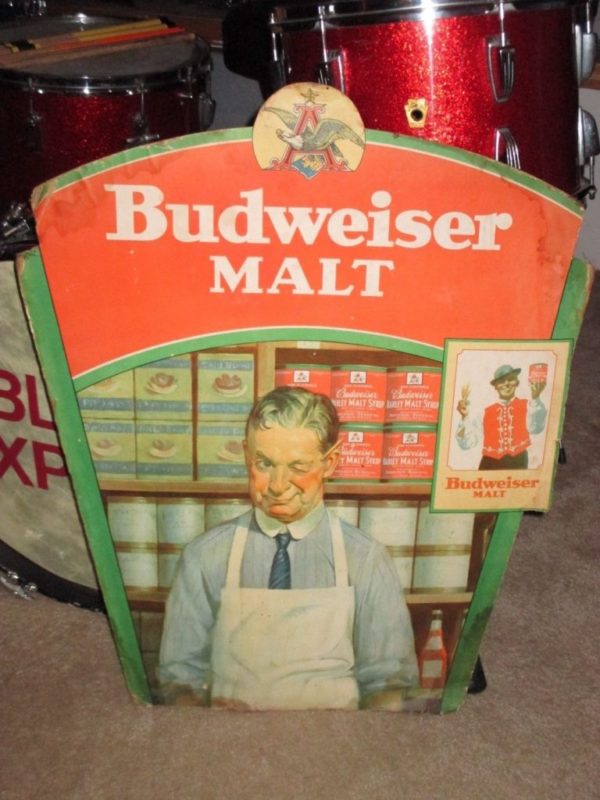
Both malt syrup and brewer’s yeast were sold in Prohibition-era grocery stores. This advertisement illustrates the literal wink to customers who knew its true purpose in home brewing.
9. Brewer’s yeast
Malt syrup alone does not make beer. To corner the market on home brewing, breweries also sold brewer’s yeast. Anheuser-Busch packaged its yeast, which it has famously kept alive since the 1880s, in five-pound cakes. Wrapped in wax paper and available in groceries, the brewer’s yeast was specifically formulated to allow home brewers to make great-tasting beer.
Brewer’s yeast is different from the active dry baker’s yeast used to make cakes and bread. Although both are made from strains of Saccharomyces cerevisiae fungus, brewer’s yeast contains chromium. Both yeasts create carbon dioxide, but brewer’s yeast also assists in increasing alcohol content as it feeds off the sugar present in malted barley.
8. Near beer and soft drinks
“Near beer” was another no brainer for breweries during Prohibition. For those unfamiliar with the term, near beer refers to what is legally called non-alcoholic beer, a fermented beverage containing less than 0.5 percent alcohol by volume. Under the Volstead Act, the companion law that defined intoxicating beverages and established enforcement parameters for Prohibition, near beer was legal.
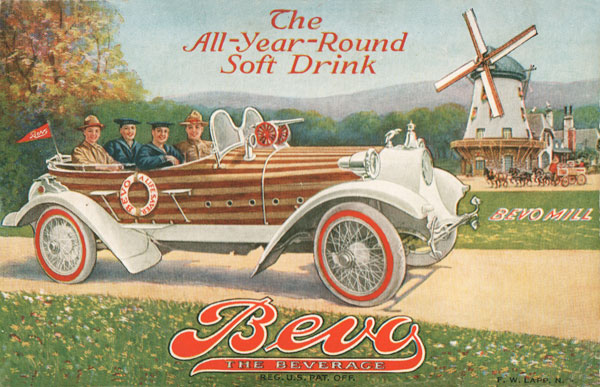
Anheuser-Busch has always been adept at marketing its brand. The Bevo Victory Boat was no exception, this time advertising Bevo near beer instead of its signature Budweiser American-style lager.
Many breweries already produced near beer before the passage of the 18th Amendment. Statewide prohibitions existed in three dozen states before the official start of Prohibition in January 1920. Near beer was promoted as a hearty, healthy drink. Advertisements aimed at pregnant and nursing mothers touted the benefits of malt in a baby’s diet as well as in supporting a mother’s milk supply.
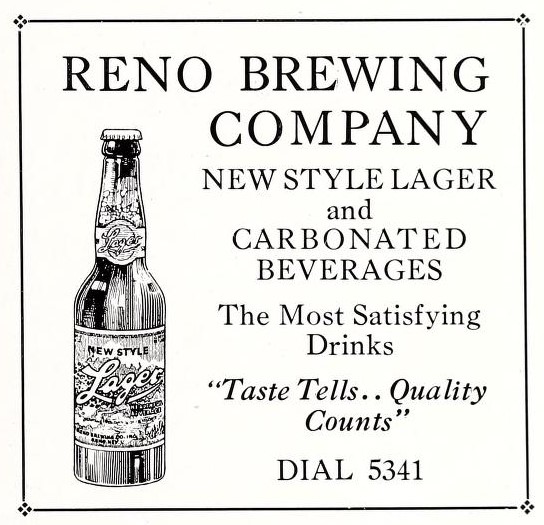
This Reno Brewing Company advertisement, featured in the University of Nevada, Reno yearbook in 1932, advertises both near beer and soft drinks. Courtesy of University of Nevada, Reno’s Special Collections and University Archives.
Near beer production increased during Prohibition, and most breweries that remained open produced their own version. Budweiser made Bevo. Pabst Blue Ribbon made Pablo. Schlitz made Famo. The Reno Brewing Company in Nevada made New Style Lager, an optimistically named near beer advertised as “the most satisfying drink.” Ultimately, consumers were not satisfied, and although near beers persist today for niche audiences, most Americans were not impressed by Bevo, Pablo or Reno’s New Style Lager.
Breweries also made soft drinks such as ginger ale, sarsaparilla and fruit-flavored sodas. Some breweries were able to develop local followings for their specific soft drinks, but most abandoned these products after Prohibition.
7. Candy
Candy was a popular idea for breweries, and quite a few produced some sort of sweet treat or confectioner’s ingredient. Milwaukee’s Blatz made grape- and mint-flavored chewing gums. Schell’s Brewery in New Ulm, Minnesota, began wholesaling candy made by other companies. Coors became the main supplier for malted milk at the Mars Candy Company and continued to produce malted milk until 1957.
One failed product worth mentioning was Schlitz’s Eline chocolate bars. Although the chocolate itself seemed to be well made, it was packaged on a machine that used fish oil as a lubricant, which in turn gave the chocolate a fishy taste.
6. Ceramics
In 1913, Adolph Coors, founder of the Golden Brewery now known as Coors, became president of Herold China and Pottery Company in Golden, Colorado. When Herold’s founder left the community in 1915, Coors fully absorbed operations and renamed the company Coors Porcelain.
Statewide prohibition in Colorado began in 1916. Between the decreased demand for beer and the increased need for domestic porcelain labware during World War I, Coors Porcelain was poised to become a large part of the Coors empire. During Prohibition it created labware, dinnerware and hotelware as well as promotional products such as ashtrays. It became the global leader in the production of porcelain labware in the 1920s.
Today the company lives on as CoorsTek, and it continues to produce technical ceramics for a range of industries.
5. Ice cream
Dairy products were another popular category of alternative products because breweries already had equipment for refrigeration, freezing and pasteurization. Detroit’s Stroh Brewery Company, Anheuser-Busch and Pennsylvania favorite Yuengling were among the many breweries that began churning out frozen dairy treats.
Yuengling in particular was successful in the production of ice cream, which began in 1920. By 1931, the ice cream plant had expanded a few times. First, Yuengling purchased additional property in Pottsville, the city of its founding, to enlarge its footprint. Then it established additional branches in Allentown and York, Pennsylvania. These expansions also allowed the company to begin processing and distributing milk. The end of Prohibition in 1933 did not affect Yuengling’s commitment to ice cream, and the company continued operations until 1985.
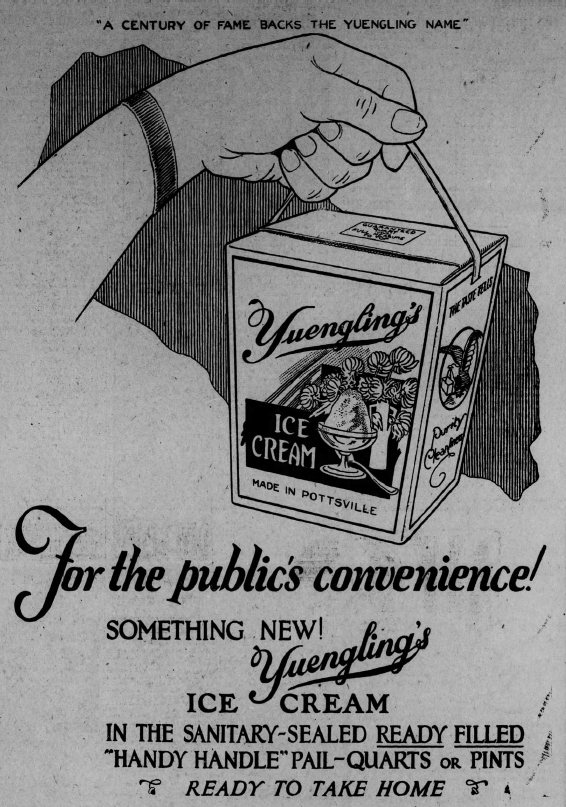
Pennsylvania-based Yuengling successfully banked on its name’s “century of fame” as a well-respected brewery when it began selling ice cream in 1920.
4. Truck bodies
With new products came even greater need for innovation. Anheuser-Busch was notable for producing more than 25 alternative products during Prohibition. Some of those new products — particularly its ice cream — demanded new transportation methods. Anheuser-Busch developed a vehicle department and began making refrigerated truck bodies and ice cream cabinets. Its technology, called Automatic Brine Circulation, became popular with dairymen, butchers and green grocers, but it was later supplanted by dry ice and electric refrigeration.
In additional to commercial vehicles, the company also produced a recreational vehicle called the Lampsteed Kampkar, as well as a series of promotional vehicles, including the Bevo Victory Boat, an automobile named after its non-alcoholic beer.
3. Artificial ice
Ice cream was not the only frozen product that helped breweries keep the lights on. Rhode Island’s Narragansett Brewing Company was the largest brewery in New England on the eve of Prohibition. Its success rested partially on the pleasant-tasting water derived from the Scituate Reservoir. And it used this water to make more than just beer. Beginning in the 1910s, Narragansett’s holdings included an artificial ice plant and cold storage. It delivered 25 tons of ice to more than 1,500 customers. Artificial ice was still a relatively new phenomenon in the 1910s and ’20s, when most Americans still relied on naturally harvested ice or simply went without.
Once Prohibition began, Narragansett began making medicinal tonics and soft drinks, but its ice production provided a steady capital and customer base to endure Prohibition.
2. Frozen eggs
On display at The Mob Museum, this canister of Bud Frozen Eggs once held 30 pounds of frozen eggs.
Possibly the most surprising alternative product of the Prohibition era is Bud Frozen Eggs. Anheuser-Busch began producing 30-pound canisters of frozen egg products in “golden select” and “special whites” varieties. The processes for breaking, separating and freezing eggs was only 30 years old when Anheuser-Busch added this product to its arsenal.
As with many of the alternative products produced during Prohibition, such as malt syrup and Coors ceramics, frozen eggs were marketed for commercial consumers. Frozen eggs are used to this day in the baking industry and within large-scale restaurant operations. Anheuser-Busch’s version showed up in advertisements and company product lines until the 1950s.
1. Processed cheese
Although a handful of breweries experimented with ice cream and Budweiser made a mark with frozen eggs, one of the most innovative dairy products was Pabst-ett cheese. Pabst Brewing Company, of Pabst Blue Ribbon fame, purchased a local dairy at the beginning of Prohibition and began developing a processed cheese that could be marketed as easily digestible, healthful and delicious. What it created was a whey-based product available in cheddar, Swiss and pimento and sold as both blocks and spreads. Pabst Brewing sold more than eight million pounds of Pabst-ett during Prohibition.
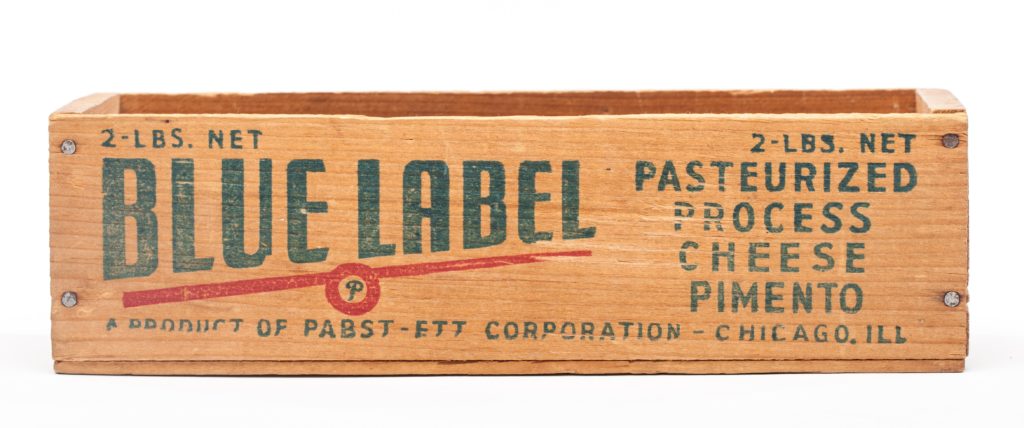
Pabst-ett cheese bricks came in wooden boxes like this one. They were available in two- and five-pound bricks as well as smaller spreadable sizes.
At the time, processed cheese was touted as a healthy alternative to natural cheeses. Velveeta created the market standard in 1918. Kraft Foods later acquired Velveeta, and Kraft felt so threatened by the Velveeta-esque Pabst-ett product that it sued Pabst for infringement in 1924 and won. Instead of forcing Pabst to completely fold its cheese operations, Kraft allowed Pabst to continue making the product, and the brewery paid a 25-cent royalty per 100 pounds of cheese produced. After Prohibition ended, Pabst sold its cheese operations to Kraft and returned to making PBR. Although Pabst-ett was short-lived, it has lived on as one of the most iconic examples of Prohibition ingenuity.
Although most of these alternative products are long forgotten, they are a great reminder of the innovation and creativity that can be tapped into in even the most unprecedented of times. And it would be shortsighted to believe that any of these products are merely a part of the past. Yuengling satisfied its loyal fan base’s nostalgia when it reintroduced ice cream in 2014 after a nearly 29-year hiatus. With interest in home brewing increasing in the United States since the start of the coronavirus pandemic in March 2020, as well as increased awareness and interest in sobriety over the last few years, who can say whether malt syrup or near beer might become the next big product for your favorite micro — or macro — brewery.
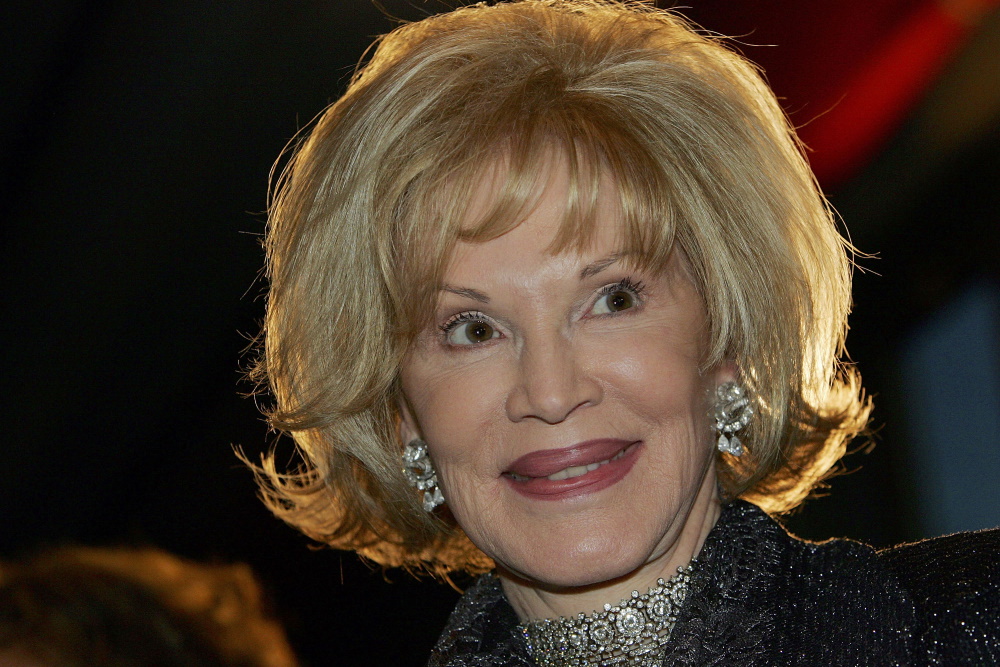
Phyllis McGuire, the last of the popular McGuire Sisters singing trio and onetime girlfriend of Chicago Outfit boss Sam Giancana, died December 29 at her Las Vegas home. She was 89.
The McGuire Sisters, whose sweet harmonies made them big stars in the 1950s, had chart-topping hits such as “Sincerely” and “Goodnight, Sweetheart, Goodnight,” which recalled an era, as the New York Times put it, of “car fins, charm bracelets and duck-tail haircuts.”
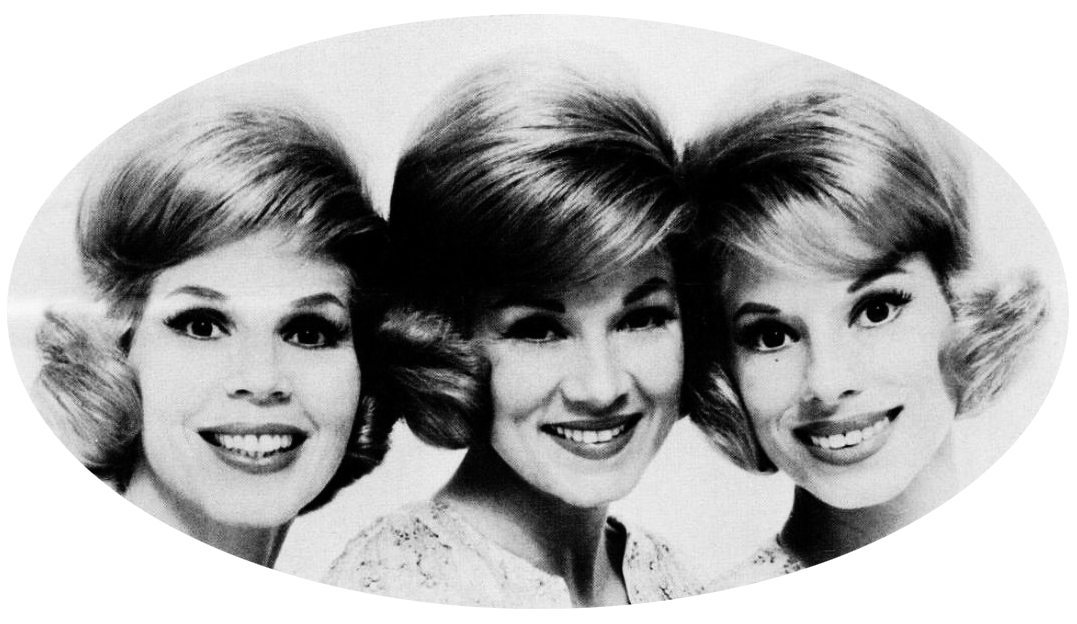
The McGuire Sisters — Christine, Phyllis and Dorothy — were a popular trio in the 1950s and 1960s. They had two No. 1 songs, “Sincerely” in 1955 and “Sugartime” in 1957, as well as many other Top 40 hits. Image from Billboard magazine, 1964. Courtesy of Wikimedia Commons.
In 1952, barely into her 20s, McGuire married broadcaster Neal Van Ells. This was the same year she and her sisters began their musical ascent after winning the Arthur Godfrey Talent Scouts competition. By 1956, McGuire and Van Ells ended their marriage without children.
The daughters of an Ohio steelworker father and minister mother, Phyllis, Dorothy and Christine McGuire ranked with the top stars of the ’50s and early ’60s. Phyllis was the youngest of the trio and the lead singer.
For some fans, however, Phyllis McGuire’s wholesome image seemed less glossy after reports surfaced about her relationship with Chicago Outfit boss Sam Giancana.
By the time McGuire met Giancana in Las Vegas in 1959, he’d had a long history in Chicago’s underworld and as a force on the national criminal scene. In the early ’60s, Giancana was part of an unsuccessful alliance between the Mafia and the CIA to assassinate Cuban leader Fidel Castro.
Around the time Giancana met Phyllis McGuire, he and President John F. Kennedy were involved with the same woman, Judith Campbell Exner. At some point, Campbell Exner also was in a romantic relationship with stage and screen star Frank Sinatra.
Cal-Neva Lodge
During this time, federal agents were tracking Giancana’s movements, including when he traveled to different cities to meet up with McGuire where she was performing. In 1963, this led to a scandal that cost Frank Sinatra his ownership of the Cal-Neva Lodge on the north shore of Lake Tahoe.
That summer, Giancana stayed with McGuire in one of the lodge’s chalets while she and her sisters were there to perform in the Celebrity Room. Giancana is believed to have had a hidden ownership in the now-shuttered Cal-Neva Lodge.
Giancana wasn’t supposed to be there at all. His name was in the Nevada Gaming Control Board’s Black Book, prohibiting him from entering any casino statewide. When a Nevada gaming regulator confronted Sinatra about this, Sinatra lit into the state official, calling him a “crippled S.O.B.” Because of childhood polio, this state official used a cane.
Within months, Sinatra forfeited his ownership in the Cal-Neva, as well as a 9 percent interest in the Sands Hotel in Las Vegas. Sinatra and Giancana blamed each other for the incident.
McGuire once said she had known about Giancana’s underworld reputation but not what those activities entailed, according to the New York Times. The relationship caused some heartache in her family, she said.
“It makes me look terrible,” McGuire said of the relationship. “It would be different if I were on my own, but I’m not a single — I’m part of a trio. My sisters and my parents — they’re brokenhearted about this.”
McGuire and her older sisters performed together until 1968, when the other two took time off to focus on their families. Phyllis continued performing from her base in Las Vegas.
In 1975, Giancana, age 67, was shot to death in his home in Oak Park, Illinois, a Chicago suburb. No one was ever arrested in the killing.
His death had a permanent impact on McGuire. “The two great losses of my life were my father and Sam,” she said.
The McGuire Sisters got back together in 1985 and toured for about 20 more years, performing in casinos and nightclubs. Phyllis McGuire added impersonations of other singers to the show.
Phyllis McGuire’s sisters preceded her in death, Dorothy in 2012 and Christine in 2018.
Bugging Dan Rowan
While Giancana had multiple affairs while he was with McGuire, he was not enthused about her doing the same. Giancana’s accomplices in the plot to assassinate Castro were fellow mobster Johnny Rosselli and private investigator Bob Maheu, who served as the liaison between the Mob and CIA. In his memoir, Maheu recalls that while the three men were meeting in Miami to discuss how to kill Castro, Giancana wanted to take off for Las Vegas immediately but the CIA vetoed the idea.
“It seemed that Giancana was upset about Phyllis,” Maheu wrote. “He had heard that she had been dating the comedian Dan Rowan while he and partner Dick Martin were appearing at the Desert Inn. Since Sam couldn’t go in person, I agreed to at least arrange a tail to be put on Rowan.”
Maheu hired a private eye to check on the situation in Las Vegas. The private eye placed an illegal tap on Rowan’s phone and got caught. He had left his monitoring equipment unattended in a nearby hotel room where a maid discovered it and reported it. “Just why he thought tapping Rowan’s phone would help determine details about his love life, I’ll never understand,” Maheu wrote.
Bob Stupak
In the 1990s, McGuire and Las Vegas casino owner Bob Stupak became a couple. In an interview with Las Vegas journalist John L. Smith, Stupak said: “I guess Phyllis is my one big love affair since I’ve been in town. It’s unexplainable. Things happen. I don’t know how they happen. It was completely unexpected. I’d never been with someone who was an entity in themselves, and Phyllis definitely was an entity in herself.”
The relationship with McGuire had a side benefit for Stupak: It enhanced his credibility in the community at a time when he was trying to raise funds to build the Stratosphere Tower.
In 1995, Stupak was involved in a serious motorcycle accident that left him in critical condition at a Las Vegas hospital. His face did not fare well in the crash, with many cuts, broken bones and missing teeth. His skull was fractured, and both his arms and a leg were broken. He was bleeding profusely.
Phyllis McGuire soon was at his side. According to John L. Smith, “Phyllis McGuire took up a vigil at the trauma center and later followed Stupak to the hospital’s Intensive Care Unit, where she read to him daily. She remained by his side for weeks.”
After five weeks, Stupak finally opened his eyes, although he still was out of touch. “Bob was slinging and flinging his arms trying to break out of the restraints,” Phyllis told Smith. “I call him the warrior of warriors. I’ve never seen anyone fight so hard to stay alive.”
Stupak, who achieved his dream of opening the Stratosphere Tower, died of leukemia in 2009.
In later years, McGuire’s companion was a petroleum company owner, Edward Mike Davis, known as Tiger Mike. According to the Las Vegas Sun, Davis was a high school dropout regarded in one media account as “pugnacious and profane.” He died in 2016.
Barbara Walters interview
In 1989, ABC News reporter Barbara Walters conducted an interview with McGuire at her Las Vegas home in the exclusive Rancho Circle gated neighborhood on Rancho Drive. While Walters marveled at the 28,000-square-foot mansion, with its 45-foot replica of the Eiffel Tower, lavish furnishings and pricey dress, shoe and jewelry collections, she also asked McGuire about her relationship with Giancana.
McGuire said when she met Giancana in 1959, she was not aware of his prominent role in organized crime. “When I met him, I did not know who he was,” she said. “And he was not married, and I was an unmarried woman. And according to the way I was brought up, there was nothing wrong with that. I didn’t find out until some time later really who he was. And I was already in love.”
Phyllis McGuire lived in a mansion in the exclusive Rancho Circle neighborhood in Las Vegas for more than 50 years. She died at home last week at age 89.
McGuire acknowledged her relationship with Giancana damaged the singing trio’s career, and she considered breaking it off with him as a result. “I tried twice but it didn’t work,” she said, because of her love for the widowed crime boss.
Adding to the difficulties for Phyllis and her sisters, the FBI was keeping its eye on her. She was called before a grand jury to testify in 1965, but she says she didn’t have a lot to say because Giancana didn’t talk with her about his activities. “He was very protective of my not being involved with any of whatever he was doing,” she told Walters.
McGuire explained that wise investments in oil and gas, not the proceeds of her singing career, were the reason she owned a mansion and wore rings and earrings worth millions.
In a 1989 Vanity Fair interview with the writer Dominick Dunne, McGuire said Giancana was the “greatest teacher I ever could have had.”
“He was so wise about so many things,” she said.
McGuire’s relationship with Giancana was the subject of the 1995 HBO movie Sugartime. This is also the title of one of the McGuire Sisters’ biggest hits. McGuire panned the biopic as wildly inaccurate.
Christmas parties
Oscar Goodman, former Mob defense attorney and three-term mayor of Las Vegas, has fond memories of the Christmas parties McGuire threw at her palatial home.
“Carolyn and myself were always invited to her beautiful home in Rancho Circle for a Christmas event,” Goodman said. “She always had an eclectic group of friends. Kirk Kerkorian was there. Paul Fisher, who makes the space pens, was there. Robert Goulet and his wife, Vera, were there. Robert Maheu was there. It was a very joyous occasion when we saw her socially.”
Goodman never served as an attorney for McGuire. “I never saw her out of her home, other than when she was performing,” he said. “I think she was very, very private.”
For Goodman, McGuire embodied the golden age of Las Vegas, before megaresorts towered over the Strip and suburbs sprawled into the foothills.
“It was a different town then than it is today. I loved it back then. You felt very close to these people and were part of the history of the town.”
Organized crime’s influence in New Orleans is at the center of a legal drama airing on Showtime through January.
Titled Your Honor, the limited series stars Breaking Bad’s Bryan Cranston as a respected judge and single father whose teenage son (Hunter Doohan) kills a boy in a hit-and-run accident. The boy turns out to be the son of an organized crime boss, a vengeful underworld figure named Jimmy Baxter (Michael Stuhlbarg).
Veteran character actor Michael Stuhlbarg plays the crime boss in Your Honor. He also played Arnold Rothstein in Boardwalk Empire. Image courtesy of Showtime
As the series begins, Baxter’s evil reputation casts a cloud of fear over those in his path. He seems untouchable, even by people in power. This forces the judge into a series of extreme cover-ups to try to keep himself and his son out of Baxter’s crosshairs.
Against this dramatic backdrop is a New Orleans netherworld of racism, police brutality and corruption. The show’s gloomy setting — empty streets, neglected neighborhoods, above-ground tombs — adds to a sense of decay and doom.
The series is set in contemporary New Orleans, but, because of the city’s Mob history, the show calls to mind earlier mobsters who ruled The Big Easy with an iron fist and with little constraint from public officials.
The city’s organized crime history is extensive, especially regarding the Sicilian Mafia. New Orleans is considered the first place in the United States where the traditional Mafia formed into an organized criminal element. Mafia violence in the city dates back to the late 1800s. In 1890, a young police chief caught in a conflict between Mafia factions was shot to death. Those thought to be responsible were lynched.
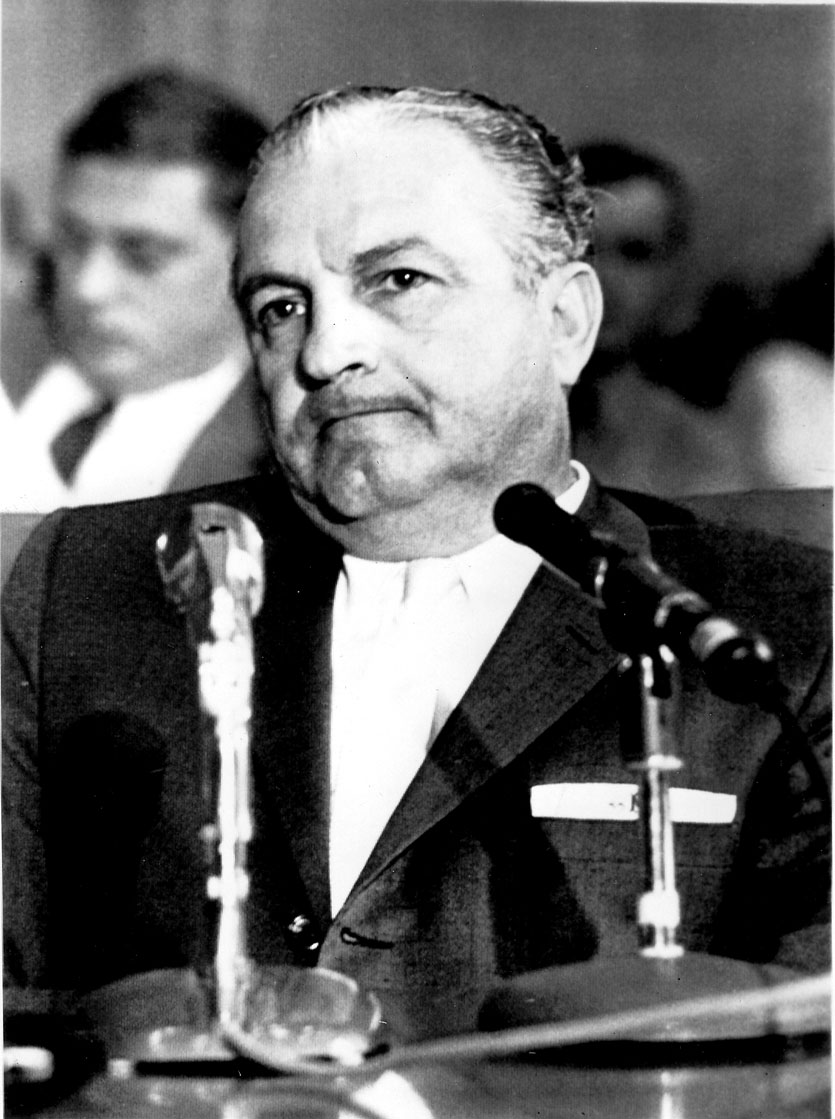
Much later, Carlos “Little Man” Marcello, once a French Quarter petty thief, emerged as the city’s crime boss. He was born in Tunisia in 1910 but moved to Louisiana as an infant named Calogero Minacore. His parents later changed his name to Carlos Marcello.
Beginning in the late 1940s, Marcello ruled an unlawful empire in Louisiana and other states along the Gulf Coast, including Texas. He took in millions of dollars from vice rackets. Partnering with high-ranking Frank Costello of New York, he controlled slot machines throughout the region. The self-described tomato salesman’s reach extended into Las Vegas. According to a 2008 story in the Las Vegas Sun, the Tropicana hotel-casino’s hidden ownership on the Strip “included Carlos Marcello, the don of the New Orleans mob.”
Like many in the underworld who achieve power, Marcello used payoffs to keep public officials under control. According to the Washington Post, the Senate’s Kefauver Committee investigating nationwide organized crime reported that Marcello dominated in Louisiana at the “personal enrichment of sheriffs, marshals and other law enforcement officials,” who received money for “their failure to enforce gambling laws and other statutes related to vice.”
Carlos Marcello was the longtime Mafia boss in New Orleans, where he was involved in vice rackets that spread well beyond the city’s borders. Courtesy of John Binder
While Marcello controlled public officials in his own backyard, the federal government under President John F. Kennedy and his brother Robert, the U.S. attorney general, proved more challenging.
In 1961, Robert Kennedy had Marcello deported to Guatemala, the mobster’s fictitious place of birth. Marcello made his way back to New Orleans, but the incident further may have fueled animosity toward the Kennedys. This led to suspicion that Marcello and others in the Mafia orchestrated President Kennedy’s assassination in 1963. Those who disagree with this theory contend there has never been any evidence pointing to Mafia involvement in the shooting, that the act in Dallas was carried out by a deranged gunman, Lee Harvey Oswald, acting on his own.
During these years, Marcello’s criminal peers held him in high regard. The Washington Post noted that the U.S. House Assassinations Committee considered Marcello “one of the 10 most powerful Mafia leaders in the United States . . . a La Cosa Nostra boss whose businesslike approach, political influence and power were particularly respected in the underworld.”
The roster of influential New Orleans crime figures includes more than Marcello, who died in 1993 at age 83 after a prison term.
Others associated with the New Orleans underworld have had histories as colorful as their nicknames — Silvestro “Silver Dollar Sam” Carollo, Phillip “Dandy Phil” Kastel, “Diamond Jim” Moran.
Now added to this list is a fictional crime boss, Jimmy Baxter, with as much menace as any who ruled New Orleans in real life. Through Baxter, the Showtime series conveys the destructive power of New Orleans criminal leaders and the grave consequences awaiting those in their line of fire.
Larry Henry is a veteran print and broadcast journalist. He served as press secretary for Nevada Governor Bob Miller, and was political editor at the Las Vegas Sun and managing editor at KFSM-TV, the CBS affiliate in Northwest Arkansas. The Mob in Pop Culture blog appears monthly.
Francis Ford Coppola’s re-edit of The Godfather: Part III is receiving praise from critics who say the changes have streamlined the original’s meandering plot and sharpened the movie’s focus.
Some critics say it is a better movie now but still not as good as the first two in the Godfather trilogy.
The re-edited movie, titled Mario Puzo’s The Godfather, Coda: The Death of Michael Corleone, was released in early December.
In a brief introduction to the new version, the 81-year-old Coppola explains that “coda” is a musical term meaning “a summing up,” which is what he and Puzo intended this movie to be. Puzo died in 1999 at age 78. He wrote the 1969 novel that the films are based on. Puzo also co-wrote the movie trilogy with Coppola.
In addition to a new beginning and ending, Coppola says many scenes were “repositioned.”
“The picture has been given, I think, a new life,” Coppola says.
The film now starts with the financial arrangement between the Vatican Bank and Michael Corleone (Al Pacino). Critics say this gives viewers a better understanding of how the Vatican angle ties into Michael’s middle-aged effort to part ways with his criminal past.
In the re-edited movie, the desire of Michael Corleone (Al Pacino) to move on from his criminal past is made clearer. Courtesy of Paramount
The other major change is that Michael is alive when the movie ends. In the 1990 version, the aging Michael is in a chair outside in the sunlight, alone except for a couple of dogs in the yard, when he slumps over and dies.
In the new version, he is in the same chair outdoors, but this time he remains upright, the camera tightly focused on his face, his untrimmed gray hair emerging from beneath a hat. The implication is that Michael is isolated in his advanced years, left alone to contemplate the missteps and losses in a long life filled with melancholy and regret. The death implied in the new title seems to be an internal death.
The original version has been widely panned over the decades as inferior in comparison to the first two Godfather movies, winners of multiple awards in the early 1970s.
Over time, the re-edited movie will be subjected to additional analysis, but some veteran film critics taking a first look at it have been generous.
In the Chicago Sun-Times, Richard Roeper wrote: “I found the new cut to be more cohesive and more impactful, including a final shot that proves less is often more when one is telling such an epic tale.”
Roeper wrote that the new ending is the most important change, “which Coppola has sculpted in a way that closes the curtain with more dignity and resonance.”
As for the beginning, Part III in its original theatrical release took “a long wind-up before getting into a major storyline about Michael investing $600 million with the Vatican,” according to Roeper. In the older version, this crucial information doesn’t come up until 40 minutes into the movie. Putting it at the beginning clarifies the plot.
“This immediately establishes that Coda will be in large part about Michael’s desire to leave the crime world behind him once and for all,” Roeper wrote, “leading to the movie’s most quoted line: ‘Just when I thought I was out, they pull me back in!’”
Roeper wrote that Coppola intended the original film “to be an epilogue that serves to sum up and bring closure to the original saga.” Coppola also wanted “to breathe new life into the picture,” Roeper noted.
“He has achieved just that,” the film critic wrote.
Roeper asserted that the third Godfather movie will always be the third best of the trilogy, but Coda does “slightly narrow what remains a fairly large gap.”
“A Godfather film that’s a distant third is still a Godfather film worth treasuring,” he wrote.
One point of contention with Roeper is the performance by George Hamilton, who replaced Robert Duval as the family’s consigliere. Duval declined to appear in Part III 30 years ago over a pay dispute.
“Every time George Hamilton appears onscreen,” Roeper wrote, “we can’t help but miss the great Robert Duvall.”
Sofia Coppola’s portrayal of Michael Corleone’s daughter, Mary, which was harshly criticized after release of the original movie, has been improved in the re-edited version. Courtesy of Paramount
When the original movie was released, many critics said Sofia Coppola’s performance was subpar at best. Sofia Coppola, who is Francis Ford Coppola’s daughter, now is a respected film director.
Richard Brody, a New Yorker magazine film critic, recently wrote that she was unfairly criticized during the first go-round. “Sofia Coppola’s performance was wrongly, absurdly, frenetically reviled by many critics at the time of the film’s release,” Brody wrote.
He noted that former New Yorker film critic Pauline Kael was not among those who heaped “critical hostility” on Sofia Coppola when Part III came out.
As Brody noted, Kael stated in the New Yorker years ago that Sofia Coppola “has a lovely and unusual presence; she gives the film a breath of life,” adding, “I grew to like her.”
In the re-edited version, her performance has a “contemporary” feel, according to Brody.
“Her tremulously expressive performance, which seemed so idiosyncratically low-key and indeed unusual, comes off now as utterly contemporary, in the same vein as the younger generation of actors who have populated Sofia Coppola’s own films and many low-budget independent films of the past decade,” Brody wrote.
Brian Tallerico, editor of RogerEbert.com, said viewers who were “turned off by Sofia Coppola’s performance” in Part III won’t be swayed now. However, “if you’re someone who defended it or found yourself wondering if it was better than you remembered,” he wrote, “well, it’s definitely better now.”
Owen Gleiberman, chief film critic for Variety, conceded he was one of the few who, while recognizing the first version’s flaws, liked Part III in its initial run. The re-edit brings the movie to a higher level and is worth seeing, he wrote.
“With The Godfather, Coda, let the tinkering be done,” he wrote on Variety’s website. “But I urge you to seek the movie out, because it truly does touch the grandeur of the first two films. Even if it can’t match it.”
Larry Henry is a veteran print and broadcast journalist. He served as press secretary for Nevada Governor Bob Miller, and was political editor at the Las Vegas Sun and managing editor at KFSM-TV, the CBS affiliate in Northwest Arkansas.
In the fourth quarter of a 2002 NBA conference playoff game, Los Angeles Lakers star Kobe Bryant elbowed the Sacramento Kings’ Mike Bibby in the face with only seconds to go. Bryant was seeking an open lane to the baseline to receive an inbound pass in a tight game. Bibby stood in his way. After the elbow, the smaller Sacramento player fell to the court on his back.
The refs did not call a foul.
This incident is mentioned in a recent podcast series, Whistleblower, calling into question the National Basketball Association’s credibility during this era. Lurking in the league’s shadows, according to the podcast, were Mafia figures, corrupt referees, and a money-hungry front office that used its muscle to stifle controversy.
The podcast series, by sports journalist Tim Livingston, focuses on an NBA referee who went to prison in a betting scandal during these years. The former referee, Tim Donaghy, says in the podcast that he bet on games he officiated.
Donaghy cooperated with federal prosecutors in the case and was sentenced to 15 months in prison, according to news stories. In his book, published in 2009, Donaghy said his “involvement with illegal betting was more than a crime; it was a betrayal of the profession to which I had devoted my entire adult life.”
The book, published in 2009, is titled Personal Foul: A First-Person Account of the Scandal That Rocked the NBA. Donaghy spoke at The Mob Museum in 2013.
“During this dark period, I associated with sleazy bookies and reputed Mob figures, slowly becoming someone my family and friends no longer recognized,” he wrote. “I passed inside information to wiseguys who were making millions of dollars on my picks and lining the pockets of Mafia heavyweights.”
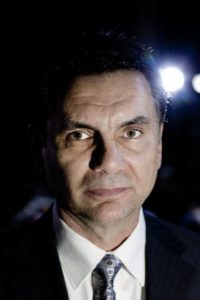
Michael Franzese, one-time made member of the Colombo crime family in New York, says the Mafia earned millions fixing games in a variety of sports. Photograph by Jens Astrup.
The podcast series includes an interview with Michael Franzese, once a made member of the Colombo crime family in New York. Franzese said that in the 1990s he had two NBA officials on his payroll. Neither was Donaghy. Franzese declined to name the referees.
Franzese said the Mafia fixed games in all sports: basketball, baseball, football, tennis. The best way to control a game is to have a referee “working with you,” he said. Officials can sway the outcome in ways that are hard to detect. Nearly every play in every game has something that can be called — or not — to produce a desired final result.
The Mob made millions on illegal sports betting back then, according to Franzese.
Donaghy, who grew up in the Philadelphia area, refereed in the NBA from 1994 until he resigned on July 9, 2007. His downfall began a month before he resigned when the FBI, in an investigation into betting in the NBA, informed the league about Donaghy.
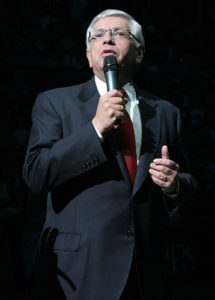
On July 20, 2007, the New York Post, based on information from unnamed sources, broke the story about Donaghy, linking him to the Mob. Some believe one source was then-NBA Commissioner David Stern. It was thought that Stern leaked the story to protect the NBA’s brand by painting Donaghy as a lone operator.
According to one of the newspaper’s sources, Donaghy got into trouble by “wagering with Mob-connected bookies.” Within days, Stern would refer to Donaghy as a “rogue, isolated criminal.”
On January 1, 2020, Stern died at age 77. Current Commissioner Adam Silver has held the post since 2014.
Silver’s recent challenges have included restarting the NBA season last summer after league play was halted in March at the onset of the coronavirus pandemic. The NBA’s solution was to finish the season and conduct the playoffs in an isolated “bubble” at Walt Disney World in Florida. Fans were not allowed at games, but the games were televised. The league used this platform to promote social justice. A shortened season was completed, with the Los Angeles Lakers, featuring LeBron James, winning the NBA championship.
Donaghy, 53, lives in Sarasota, Florida, not far from where these games were played.
Sports Illustrated has reported that Donaghy is lined up to referee for Major League Wrestling. He also operates an online handicapping service, providing betting advice. The website for this service,” Ref Picks: Tim Donaghy’s Handicappers,” states that Donaghy has a “leg up on most handicappers” because of his “insider experience in officiating games.”
The Ref Picks site says Donaghy “knows all too well how and what can affect a score.”
In a telephone interview, Donaghy said that when he was a referee in the league, he picked up valuable inside information at meetings with other referees. He funneled this information to bookies, giving them a three- to five-point advantage when placing bets, he said.
David Stern, NBA commissioner at the time of the Donaghy scandal, may have leaked the story to the press to focus attention on Donaghy as a lone operator rather than as part of a more widespread problem. Photograph by Cody Mulcahy.
Also during this time, the league’s critics called the NBA’s credibility into question by claiming the top brass wanted certain teams to win. These were the teams with marquee athletes, playing in major TV markets that appeal to advertisers. The theory is that more viewers will watch these games than ones featuring teams from smaller cities or teams without star players. The NBA assigned these games to officials who understood the expectations, according to Donaghy.
The league has denied any sanctioned wrongdoing.
Donaghy was not officiating the controversial 2002 playoff game between the Los Angeles Lakers and Sacramento Kings, but it often is brought up as an example of suspicious refereeing. The small-market Sacramento Kings had the league’s best record that season, with 61 wins, but their roster was filled with players few casual fans knew much about. The Lakers’ roster included Bryant and Shaquille O’Neal, two superstars playing for a team based in a huge metropolitan area.
In the fourth quarter of Game 6 in Los Angeles, the Lakers shot 27 free throws, the Kings just nine. The Lakers won that game and the next one to eliminate the Kings in the conference playoffs. The Lakers went on to defeat the New Jersey Nets to win the league title.
In the Washington Post, sportswriter Michael Wilbon said some of the calls against Sacramento in that Lakers-Kings game “were just plain wrong.” Consumer advocate and former presidential candidate Ralph Nader called for an investigation. “Something stinks in La La Land,” he said.
Bill Walton, a former UCLA and NBA player working during that game as a television analyst, questioned some calls on the air. He later softened his tone. “You can look at any play or any game and say the referees did a good job here or a bad job there,” Walton told The New York Times. “Referees have bad games. They’re human.”
Since that game, almost two decades have gone by. Legal sports betting during these years has exploded in popularity. Nearly half the states in the country allow legal sports wagering either at sportsbooks in casinos or on smartphones and other online platforms. A public vote on the November 2020 Louisiana ballot demonstrates sports betting’s growing mainstream acceptance. Across the state, 55 of 64 parishes voted to allow sports betting within parish boundaries. In Louisiana, counties are called parishes.
Even with this popularity, some people wonder whether the bets they place are on the up-and-up. Years of game-fixing scandals throughout the sporting world have left a cloud of suspicion.
“I question every game and almost every call, just by nature,” Franzese said in the podcast series, “because I know the way it goes.”
Donaghy said he’s skeptical about some calls in games he watches even to this day. His role now, however, is to help guide bettors on which picks to make. Though Donaghy’s handicapping service gives advice on sports wagering, he doesn’t place bets himself anymore, he said.
“It got me in a lot of trouble,” he said. “I need to stay in my lane.”
Larry Henry is a veteran print and broadcast journalist. He served as press secretary for Nevada Governor Bob Miller, and was political editor at the Las Vegas Sun and managing editor at KFSM-TV, the CBS affiliate in Northwest Arkansas.
The U.S. Senate’s Special Committee to Investigate Organized Crime in Interstate Commerce, chaired by Tennessee Democrat Estes Kefauver, focused attention as never before on gambling-related crime as a national problem. Popularly known as the Kefauver Committee after its telegenic chairman, the committee captivated the nation in 1950-1951 with its televised hearings. It retains its relevance today, particularly in Las Vegas, where The Mob Museum occupies the building in which the committee met during its sole trip to Las Vegas.
The committee members held, as an article of faith proven through witness testimony (and artfully interpreted silences), that there existed a national syndicate of criminal organizations, and that this syndicate was forcing its way into legitimate businesses. It wasn’t surprising, then, that on November 9 the committee announced it would visit Las Vegas as part of a West Coast tour to learn about legalized gambling and its impact on neighboring states.
On November 14, the senators making the Western jaunt — Kefauver, Charles Tobey of New Hampshire and Alexander Wiley of Wisconsin — joined their investigators in Los Angeles. The senators and a small staff, including chief counsel Rudolph Halley, flew to Las Vegas the following morning, arriving at 9:30. The official record reflects that they convened the committee in the courtroom on the second floor of the federal building at 300 Stewart Avenue as scheduled at 10 a.m. The unofficial record is a bit messier. According to the Las Vegas Review-Journal’s A.E. Cahlan, Kefauver kept the rest of the committee — and witnesses — waiting until 11, then held a press conference before starting the hearings a half-hour later.
William J. Moore
William J. Moore was up first. An architect by trade, he came to Las Vegas in 1941 to design the Hotel Last Frontier for his uncle, R.E. Griffith, and operated the casino, which opened as the second major property on the Strip in 1942, after his uncle’s death. In addition to his duties at the Last Frontier, Moore served as a member of the Nevada Tax Commission, the administrative body that oversaw the collection of taxes from Nevada businesses, including casinos.
Chief counsel Halley probed Moore’s knowledge of the race wire situation. Next, Senator Tobey grilled Moore on the moral characteristics of his fellow gambling entrepreneurs. Moore admitted there were “a few more shady characters” than in other lines of business, and that, while it would be a “desirable” thing to purge some individuals from the industry, he had never given any thought to how it could be done, despite his license-issuing role on the Tax Commission.
Moore revealed that since the Tax Commission had begun issuing licenses, it had refused “hundreds” of applications and revoked as many as 100 for reasons of “character.” Halley asked why William Graham and James McKay, notorious Reno racketeers, had been granted licenses despite their convictions for altering government bonds in the southern district of New York. They remained qualified, Moore insisted, because of a “granddaddy clause” that allowed those who were operating before the more stringent regulatory regime was adopted to continue to do so. Mert Wertheimer of Detroit was licensed after a testimonial from “the former head of the FBI from Detroit.” Moore knew of Wertheimer’s gambling activities in other states, but insisted that shouldn’t disqualify him. “The man gambles,” he explained. “That is no sign he shouldn’t have a license in a state where it is legal.” This was “a basic policy” of the Tax Commission. After Moore explained that the Commission had just denied a license to Joseph “Doc” Stacher because of his “associates in New Jersey,” Kefauver thanked and excused Moore.
Clifford Jones
Clifford Jones took the stand next. Jones was the lieutenant governor of Nevada, a partner in the law firm of Jones, Wiener, Jones, and Zenoff, and a part owner of the Thunderbird Hotel, Golden Nugget and Pioneer Club. Halley queried him about how much he paid for each interest and the ownership structure of the Thunderbird. Halley questioned Jones on his partner Louis Wiener’s role as attorney for Dr. Maurice Siegel, executor of his brother Ben Siegel’s estate. Jones denied any detailed knowledge, deferring to Wiener, though he volunteered that Morris Rosen had “assumed a position of authority of some” of Siegel’s interests. He was aware, though, that Siegel had had an interest in the Golden Nugget’s race book. Halley then asked if Jones could ask Weiner to testify, to which Jones agreed. The committee briefly recessed.
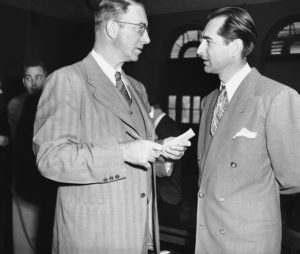
Senator Estes Kefauver, left, talks with Nevada Lieutenant Governor Cliff Jones, who was interviewed by the committee on November 15, 1950. Associated Press
When the committee returned, Halley asked one final question: Was it good policy to let people “whose previous records had been bad” to continue in the gambling business simply because they’d started before 1949? Jones replied that as long as the individuals conducted themselves properly, “probably no harm comes of it.” But what constituted proper conduct, Halley wanted to know. As Jones tried to answer, Kefauver interrupted him mid-sentence.
“I think we had better put the press off no longer,” the senator said. “We have put the press off here for a long while, and Mr. Jones is going to bring his partner back.” With that the committee adjourned, Kefauver held a press conference and went to lunch before returning.
When the committee reconvened, Henry Phillips, proprietor of the Last Frontier “commission room,” was sworn in. Phillips, likely sensitive to the difficulties that accepting bets across state lines might bring him, said he hadn’t been doing much of anything since taking over the commission room. “I did try to go into business,” he remarked, “but there is nobody to do business with.” He refused to admit that he accepted lay-off bets from out-of-state bookies. Moore broke in to blame the committee itself for killing the interstate race betting business.
“To be perfectly frank,” he said, “you are all running around the country investigating the race horse book and the wire and closed down all those offices.”
Phillips was excused and Jones returned with details about the Thunderbird’s race wire service.
Halley asked Jones if he knew Meyer Lansky. Jones claimed to have never met him, nor had Lansky spent time at the Thunderbird. “As far as I know,” Jones contended, “he has never been in the city of Las Vegas.” When confronted by Halley with rumors that Lansky was “reputed to live at the Thunderbird Hotel a great deal of the time,” Jones admitted that a man named Jack Lansky had been a guest at the hotel. When pressed, Jones “assumed” that this was Meyer’s brother, and that Jack had stayed at the hotel “a couple of weeks” on at least two occasions. Halley aggressively quizzed Jones on the Thunderbird’s early financial problems. Jones was certain that neither Jack nor Meyer Lansky had ever directly or indirectly loaned any money to the Thunderbird. He admitted to knowing George Sadlo, an El Paso gambler who frequently visited the Thunderbird and was an intimate of Jack Lansky’s but insisted that both men just liked to gamble at the casino. Similarly, he denied that Frank Costello had any interest in the Thunderbird, again claiming that to his knowledge Costello had never set foot in Las Vegas. Nor had he ever heard the name of Costello associate Phil Kastel.
“Is he a local fellow?” he asked Halley.
“That is all,” Halley responded, dismissing Jones and turning to Wiener.
Wiener confirmed that he was attorney for the Siegel estate’s executor, and that Siegel’s interest in the Golden Nugget race book had a value of zero. His interest in the Flamingo and a small share of the Frontier Club turf book were his only Nevada assets. Wiener admitted that Lansky might have owned some stock in the original Nevada Projects Corporation, but that “it wasn’t a large percentage.” Siegel was the largest shareholder. About two weeks after Siegel’s June 20, 1947, death, Sanford Adler and his associates formed Flamingo Hotel Inc., and bought the property from Nevada Projects. Lansky was “washed out” in this transaction. After a dispute with Rosen, Adler sold his 49 percent share of Flamingo Hotel (in a transaction brokered by Wiener and Jones) and departed for Northern Nevada. With that explanation, Kefauver thanked and excused Jones and Wiener.
Up next was Reno Police chief Lawrence Russell Greeson, who had investigated New Jersey gambling figure Joseph “Doc” Stacher. Stacher had applied for a license to become a partner in Bill Graham and Jim McKay’s Bank Club. Greeson admitted he had passed on to investigator Robinson when they met at a police chiefs’ convention in Colorado Springs the rumor that Stacher was willing to spend $250,000 to elect a group in Reno that would permit him to buy a one-third share in the Bank Club. It was “common knowledge” in town. Greeson had no opinion on the ramifications of Reno’s wide-open gambling on surrounding states and did not know of any operators currently in Reno with outside interests. Kefauver excused Greeson and moved on to the next witness, Wilbur Clark.
Wilbur Clark
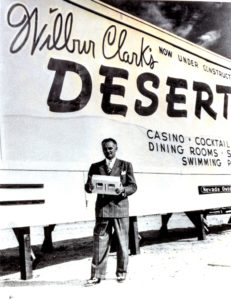
Wilbur Clark poses in front of a sign on the Desert Inn construction site. Clark started building the Desert Inn in 1947 but ran out of funds. The resort was completed in 1950 after he brought in Mob-connected investors from Cleveland led by Moe Dalitz. Courtesy of The Mob Museum Archive
Clark started by sharing that he was a member of the corporation that owned Wilbur Clark’s Desert Inn and an employee of the casino. He and his brother also had shares in the Barbara Worth Hotel and an unconnected cocktail lounge in San Diego. Then Clark’s powers of recollection began to falter. He was unable to recall exactly how much he had invested in the Desert Inn, possibly a quarter-million dollars? He professed not to know the hotel’s final construction cost, or the current book value of the property. Clark was not, he told the committee, in charge of the hotel’s construction or finances; that was “a boy by the name of Allard Roen.”
As Clark began explaining how the “fellows from Cleveland” had come into his project, Halley interrupted him, demanding that he “try to be a bit more businesslike in explaining these series of transactions.” Clark did his best, describing how he had approached the group — which included Sam Tucker, Moe Dalitz, Morris Kleinman and Thomas McGinty — for their help in finishing the Desert Inn. Clark first “put the proposition” to the group in Las Vegas; they rebuffed him. He approached them again in Reno three months later, and they accepted. Under terms of the agreement, the Cleveland group would fund the project to completion and provide its bankroll, receiving 74 percent of the casino’s stock. Clark retained 25 percent, and 1 percent went to newsman Herman “Hank” Greenspun. Greenspun owned a piece of property that was included in the Desert Inn’s grounds, and owned 30 percent of a motel adjacent to the hotel.
In the casino’s six and half months of operation, Clark had not yet been paid. He knew that Sam Tucker, Allard Roen and Cornelius Jones were overseeing the Cleveland group’s interest at the Desert Inn but was unsure about his own role in the operation, despite the fact that his name was on the marquee out front. Nor was Clark certain exactly who was overseeing the department heads; he thought that Kleinman and Dalitz might be in charge.
Clark said he did not know the total cost to build the Desert Inn, but was 100 percent certain he had never approached any of a list of alleged underworld kingpins whom Halley mentioned: Frank Costello, Phil Kastel, Meyer Lansky, Jack Lansky, Jack Dragna, Mike Accone and Ben Siegel. Clark testified that he was aware of but did not “have knowledge” of his partners’ various scrapes with the law, which included bootlegging convictions and illegal gambling indictments. He had heard that Dalitz was in the laundry business, but that was all.
Moe Sedway
Next up was Moe Sedway, who, unprompted, poured out a list of his physical ailments: three major coronary thrombosis, an ulcer, an upper intestinal abscess, and a six-week bout of diarrhea. “I just got out of bed and am loaded with drugs,” he told Kefauver. He shared his story: born in Poland, naturalized as a citizen in 1914, a resident of New York City until 1938, Los Angeles from 1938 to 1940, and Las Vegas from 1941 onward. He had been arrested on numerous charges, including assault and robbery, but had no felony convictions. Sedway had attended but not graduated from high school and, after a few years in the garment industry, had become a full-time gambler, dabbled in trucking, and owned a Chinese restaurant in New York.
Unlike other witnesses, Sedway admitted to having known Ben Siegel, Meyer Lansky, Jack Lansky, Little Augie Casanno, Frank Costello, Joe Adonis, Nate Rutkin, Frank Erickson, Longie Zwillman, Charles “Lucky” Luciano, Charlie Fischetti, Rocco Fischetti, Jack Dragna, Gene Normile, Jake Guzik, and the principals in the Cleveland group. He knew Hank Greenspun, but not under his birth name of Herman. He denied having ever had a business relationship with any of them or knowing any specifics of their business. Nor did he know whether Siegel had the race wire in Los Angeles or not.
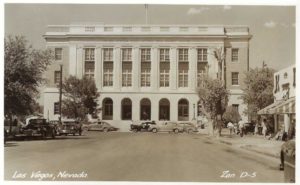
The U.S. Post Office and Courthouse is featured in this postcard from the late 1940s, not long before the Kefauver Committee held a hearing on the second floor. Courtesy of Robert Stoldal
Sedway then talked about his partnerships with Siegel in the Golden Nugget and Frontier Club race books, but, when pressed about Siegel’s outside interests, objected that “Siegel wasn’t the talkative type. If I wasn’t interested in a business, he didn’t discuss that business with me.” After Tobey went on an extended diatribe that culminated with him calling Sedway and his partners “a cancer spot on the body politic,” the senator returned the floor to Halley, who continued questioning Sedway — in less judgmental terms — about his current businesses and his knowledge of the business of Lansky, Sadlo, Costello, Dragna and Hymie Levin, about which he claimed to know nothing. He was similarly uninformed about the reasons for Siegel’s murder. After estimating that the Flamingo produced $400,000 after taxes per year, Sedway was excused.
That led to the day’s final witness, builder and automobile parts store owner Robert J. Kaltenborn, who had pled no contest to tax evasion and served four months in federal prison. Kaltenborn testified that an Internal Revenue Board employee had attempted to shake him down, but couldn’t offer proof. He was afraid of retaliation for testifying, but Kefauver cut him off with a bland reassurance that they probably wouldn’t leave him twisting in the wind (“we will do our best anyway”) before adjourning the committee and convening the final press conference of the day. Kefauver had a plane to catch.
In the end, Kefauver was unable to rouse Congress to action against Nevada’s regime of legal commercial gambling, but in the aftermath of his committee’s investigations public opinion turned against illegal gambling, inspiring crackdowns against illegal gambling operations around the country. Other states considering legalized gambling (including California) demurred, and states with some tolerance of various legal gambling schemes closed those loopholes. Kefauver’s Las Vegas hearings, then, helped provide a cocoon of monopoly for the Nevada casino industry to grow unchallenged for the next 25 years, which likely benefited the state as a whole.
David G. Schwartz is the author of several works of history about Las Vegas, including At the Sands: The Casino That Shaped Classic Las Vegas, Brought the Rat Pack Together, and Went Out with a Bang; Grandissimo: The First Emperor of Las Vegas; Suburban Xanadu: The Casino Resort on the Las Vegas Strip and Beyond; and Roll the Bones: The History of Gambling. He is the associate vice provost for faculty affairs at the University of Nevada, Las Vegas.
Watch the latest from The History Guy on the Kefauver Committee and Organized Crime
With a thunderstorm raging outside the kitchen window, Michael Corleone in The Godfather: Part III expresses anger at the Mafia treachery keeping him connected to the underworld.
The thunderstorm outside can be said to reflect, at least symbolically, the inner turmoil that Corleone (Al Pacino) is going through.
“Just when I when I thought I was out, they pull me back in,” Michael says before collapsing in a diabetic stroke.
Now director Francis Ford Coppola is pulling movie fans back into The Godfather trilogy. The 81-year-old director has re-edited the third film for release in December.
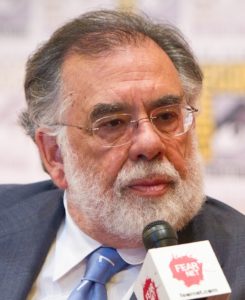
Francis Ford Coppola, director of the Godfather movies, has done a new edit on the third installment, which, when it was first released in 1990, did not garner the same critical acclaim as the first two. He is shown here at the 2011 ComicCon in San Diego. Photo by Gerald Geronimo
Most movie fans won’t mind being pulled back in. While there are questions about any artist redoing an established work, Coppola’s new version is being met with curiosity and anticipation.
“Maybe we should be glad we’re getting to see another good Godfather,” film historian Jeanine Basinger told the Mob Museum in a telephone interview. She is the author of A Woman’s View: How Hollywood Spoke to Women, 1930-1960 and other books on film history.
The first two Godfather movies came out in 1972 and 1974, winning Oscars and widespread acclaim. Both are considered classics. The Godfather: Part III debuted in 1990. It is celebrating its 30th anniversary in December.
The third Godfather was released just months after Martin Scorsese’s now-classic Mob movie, Goodfellas. That film is centered on a real-life gangster, Henry Hill (Ray Liotta). Unlike the Godfather movies, it does not give much attention to those who rule Mafia empires. Any Mob movie coming out right after Goodfellas might have had trouble looking good in comparison.
The Godfather: Part III had a hard time being compared even to its own predecessors. Many critics viewed it as less successful than the first two. Some said the third movie’s convoluted subplots made the main story hard to follow.
The movie’s main focus is on the graying Michael Corleone’s effort to become a legitimate businessman and to make amends for the worst parts of his past, including responsibility for his brother’s murder.
But the third movie has a lot more going on than Michael’s late path in life and internal turmoil. There is a complicated Vatican banking scheme involving a shadowy, chain-smoking religious figure. Also, several characters are dispensed with in unusual ways. Among these are a helicopter assault on a meeting of Mafia leaders and, later, a lengthy death-by-cannoli sequence in an opera house. At the end, an elderly Michael, seated outside in a chair with no one around, slumps as if asleep and falls to the ground.
According to critics, The Godfather: Part III seems like a jigsaw puzzle without all the pieces — and with other pieces that don’t fit.
Coppola said the revised movie is closer to what he and author Mario Puzo had in mind. Puzo wrote the 1969 novel The Godfather and co-wrote the movie trilogy with Coppola. The third film’s new title is Mario Puzo’s The Godfather, Coda: The Death of Michael Corleone.
Puzo died in 1999 at age 78.
In a statement published in Vanity Fair magazine, Coppola said the new version “is an acknowledgment of Mario’s and my preferred title and our original intentions for what became The Godfather: Part III.”
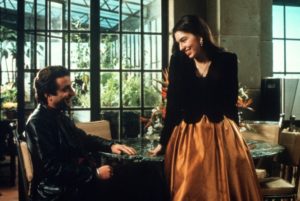
A teenage Sofia Coppola played Mary Corleone in The Godfather: Part III. Her character was in love with her cousin, Vincent Mancini, played by Andy Garcia. Sofia Coppola’s lack of acting experience is evident in the film.
“For this version of the finale, I created a new beginning and ending, and rearranged some scenes, shots, and music cues,” Coppola said. “With these changes and the restored footage and sound, to me, it is a more appropriate conclusion to The Godfather and The Godfather: Part II.”
Critics also took issue with Coppola’s then-18-year-old daughter, Sophia, in the third movie, saying her performance is unconvincing. Winona Ryder, originally selected for the role, stepped aside to star in Edward Scissorhands, according to The Ultimate Book of Gangster Movies. That movie, which stars Johnny Depp, came out the same month as The Godfather: Part III.
In the new version of the third Godfather movie, Coppola has recut some of his daughter’s scenes.
“I want to show Sofia a new version, because she is so beautiful in it and so touching,” Coppola told the Hollywood news website Deadline. “She wasn’t an actress. But she was the real thing, playing that 19-year-old Italian girl in love with her own cousin. Godfather III as The Death of Michael Corleone is doubly painful because at the end he doesn’t die, but he does worse than die. He loses everything he loves — and he lives. There are certain things in life that are worse than death.”
During a 2011 interview in the online interview magazine The Talks, Sophia Coppola, now a respected film director, said that at age 18, the last thing a person wants to do “is listen to what your parents say.”
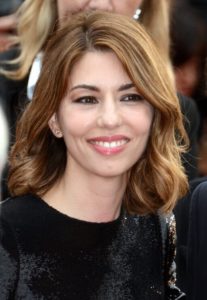
Sofia Coppola, shown here at the Cannes Film Festival in 2013, went on to become an accomplished director. Photo by Georges Biard
“My dad was directing me, so it was awkward because I am not naturally an actress,” she said. “But I just wanted to try everything, and wasn’t expecting that so many people would look at it. I grew up with The Godfather as a familiar thing, but to me, it wasn’t this iconic masterpiece. It was a learning experience. But since I never wanted to be an actress it wasn’t devastating for me that people generally weren’t too fond of me being in it. After all, it was good because these kinds of experiences make you stronger.”
Coppola said his daughter’s portrayal was “one of the things that can be so improved” in a re-edited movie. “I believe that in a new version of The Death of Michael Corleone, Sofia’s performance will vindicate her,” he said.
Basinger said it is a “rare occurrence” for a movie to be redone like this. “There are very few films where we need filmmakers to go back and fix them,” Basinger said.
She said movies are a group effort, involving actors and many others, and become a part of film lore as presented when released. “They are made to go out to see if they stand the test of time,” she said.
Basinger said that while The Godfather: Part III has problems, she likes the movie, especially Pacino’s performance. As a viewer, she doesn’t need to see a new version. “I’m highly motivated to see films I love,” she said. “I’m not as motivated to see films changed.”
A complete redo raises the question about what becomes of the original. Movies have special meaning for audiences, she said. “We own them in our hearts and in our heads the way they are,” she said.
However, Basinger said she has enormous respect for Coppola and will watch the new version, happy to be pulled back in.
“Perhaps we need to allow him to show us what he really meant for it to be,” she said.
Larry Henry is a veteran print and broadcast journalist. He served as press secretary for Nevada Governor Bob Miller, and was political editor at the Las Vegas Sun and managing editor at KFSM-TV, the CBS affiliate in Northwest Arkansas.
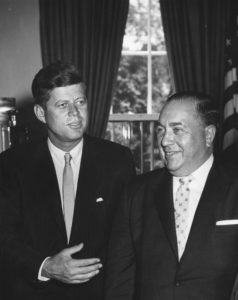
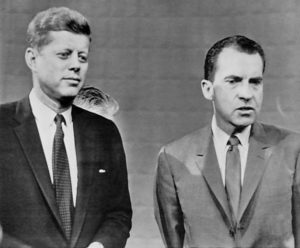
A number of authors assert, based on claims by individuals who were linked in one way or another to organized crime in Chicago, that the Chicago Mob — usually referred to as the “Outfit” — was responsible for John F. Kennedy’s election as president in 1960. It is alleged that John Kennedy’s father, Joseph, met with Outfit boss Sam Giancana before the election and struck a deal. If Giancana made sure that Kennedy was elected, Kennedy in return would “lay off” organized crime when he was president. Supposedly the Outfit kept its end of the bargain, but it was double crossed by the Kennedys, who increased federal pressure on the Outfit locally and the Cosa Nostra generally. In several versions of the story, the Outfit retaliated by assassinating John and Robert Kennedy.
These books, and associated television programs and media coverage, have received a great deal of attention. So much that many people now treat it as an established fact that the Outfit elected Kennedy. More recently, these claims are prominent in the blockbuster movie The Irishman directed by Martin Scorsese.
But did this really happen? As I point out initially in my book The Chicago Outfit and analyze in detail in an article titled “Organized Crime and the 1960 Presidential Election” that appeared in the academic journal Public Choice in 2007, there is no convincing evidence to support these claims about the 1960 presidential election.
The Kennedys and the 1960 election
Several authors discuss the role of the Outfit in the 1960 presidential election. The earliest statement, by William Brashler in The Don, is quite mild. He argues that Frank Sinatra, who knew Sam Giancana and John F. Kennedy, approached Giancana and asked for his help in electing Kennedy. However, the Outfit’s efforts were secondary to those of the Chicago Democratic Party political machine, which went all out for an Irish-Catholic strongly supported by Mayor Richard Daley. According to Brashler, “an order from the mob to work for Kennedy only insured a total Chicago effort of the kind that historically had been known to work miracles in the early-morning hours of vote counting.” In other words, the Chicago Democratic Machine delivered on Election Day for John Kennedy, essentially as it always did for its candidates, with the Outfit-controlled wards doing little (if anything) extra. In his autobiography Man Against the Mob, former FBI agent William Roemer provides a similar account of the events surrounding the 1960 election. Roemer, it should be noted, had developed two high-placed informants in the Outfit. He was, therefore, uniquely informed about what happened in that world.
A greatly amplified version of the story appears in the book Double Cross by Sam and Chuck Giancana, the half-nephew and half-brother, respectively, of the Outfit boss, Sam Giancana. According to the Giancanas, Joseph Kennedy, the father of John Kennedy, struck a deal with Sam Giancana before the 1960 election. “I help get Jack elected and, in return, he calls off the heat,” Sam Giancana is reputed to have said. The Giancanas claim the Outfit did everything possible for Kennedy in the wards they controlled. Allegedly, there was massive fraudulent voting, and hoods inside polling places made sure all ballots were cast for Kennedy by breaking the arms and legs of those who did not comply. The Kennedys, however, double crossed Giancana and the Outfit, despite Giancana supposedly meeting with John Kennedy at the White House to remonstrate with him. According to these authors, this caused the Outfit to assassinate both John and Robert Kennedy.
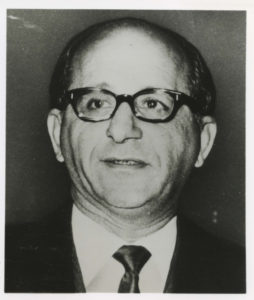
It has become conventional wisdom that Chicago Outfit boss Sam Giancana put his criminal resources to work to get John Kennedy elected president in 1960, but a close examination of the election results does not support the claim. Courtesy of Las Vegas Review-Journal Archive.
Seymour Hersh, in a chapter of his book The Dark Side of Camelot titled “The Stolen Election,” also maintains the Kennedys struck a deal with the Outfit. Former Chicago lawyer Robert McDonnell claims he helped arrange the meeting between Joseph Kennedy and Sam Giancana in Chicago, which curiously McDonnell saw take place but did not attend. McDonnell asserts the Outfit got out the vote at the ward level in Chicago for Kennedy. Gus Russo, in The Outfit, repeats the stories told by the Giancanas and Hersh, claiming that “scores of Giancana’s ‘vote sluggers’ or ‘vote floaters’ hit the streets to ‘coerce’ the voters.” Russo, summarizing the election events overall, states quite strongly that Outfit chieftain Tony Accardo, the Mob’s political point man Murray Humphreys, and other top Chicago hoodlums met in June 1960 to “decide who would become the next president of the United States.” A recent book by Antoinette Giancana, John Hughes and Thomas Jobe repeats the extreme claims that the Outfit elected Kennedy in 1960.
On the other hand, Len O’Connor, the dean of Chicago’s political commentators, remarks in his book Clout:
“The power of the Daley Machine was evident throughout the city, only the two crime syndicate wards, the First and the Twenty-eighth, delivering a low count, fewer votes for Kennedy in 1960, in fact, than they had delivered for Daley in 1955. The Machine interpreted this disappointing performance as a mild rebuke by the syndicate people who had been mercilessly pounded by the presidential candidate’s brother, Robert [at the McClellan Committee hearings].”
O’Connor discusses how Charlie Weber, the Democratic alderman of the 45th ward, openly opposed the Kennedys, having been influenced by his friend Murray Humphreys to take a dim view of Kennedy’s candidacy. O’Connor was certainly well informed about Chicago politics, counting aldermen such as Weber among his sources, and was a contemporary observer of the 1960 election.
Several of these accounts also discuss voting by labor union members, locally or nationally. For example, in Hersh’s book Robert McDonnell alleges the Outfit pressured various unions (although it is unclear whether he means locally or nationally) to support Kennedy. Murray Humphreys’ second wife, Jeanne, is more specific. She claims the Outfit delivered Teamsters Union votes at the national level. She professes to not only have witnessed Humphreys coordinating this effort, but to have worked alongside him as he directed Teamsters leaders from around the country Russo also alleges that the Outfit, through Murray Humphreys, made sure that union members nationally voted Democratic. Although he quotes Mrs. Humphreys’ Teamsters-focused account, Russo asserts that non-Teamsters union members nationally were influenced to vote for Kennedy and places particular emphasis on four states: Illinois, Michigan, Missouri and Nevada. On the other side of the ledger, O’Connor argues that unions tied to the Outfit were very displeased with Robert Kennedy and the McClellan Committee hearings and therefore John Kennedy.
A closer look at the sources
When closely examined, the claims that appear in the books by the Giancanas, Hersh and Russo are implausible and are based on sources who lack credibility. For example, there is not one word in any of Chicago’s four major daily newspapers about any violence directed at voters in November 1960, much less of a 1920s-style wave of terror around Chicagoland. In fact, legendary crime reporter Ray Brennan, writing the day after the election, described it as “sissified” and “bland” in comparison to the violent primary election of April 6, 1928.
More generally, the Outfit simply did not have the ability to deliver for Kennedy in Chicago in a meaningful way. According to a federal government report, in 1960 the Outfit controlled the (Democratic Party) political machinery in five of the 50 Chicago wards: the 1st, 24th, 25th, 28th and 29th. There were 279 precincts/polling places in those wards. To effectively intimidate voters at a polling place, it would have taken at least four or five hoods. A smaller number would have allowed irate voters to pummel the “intimidators.” With about 300 full members in 1960, and many of these of advanced age, the Outfit would have been able (if the police did not intervene) to coerce voters in essentially only one of these five wards because each ward had between 46 and 63 precincts. On this point, note that when Al Capone’s goons helped elect the Republican slate of candidates in Cicero in 1924, he needed to bring in additional men from Dean O’Banion’s North Side Gang and others. Capone’s Prohibition-era gang, with 500 gunmen at its height, was larger than the Outfit in 1960, while Cicero was quite a bit smaller (about 70,000 inhabitants in 1924) than the five Outfit-controlled Chicago wards (whose total population was more than 300,000 in 1960).
Allegations that the Outfit manipulated the Teamsters or other unions nationally are equally implausible. Individual Cosa Nostra crime families generally controlled local chapters of unions rather than the national union. Therefore, the Outfit was in no position to command Teamsters — or other union officials — from around the entire country to do their bidding. More importantly, Teamsters boss Jimmy Hoffa hated the Kennedys and publicly endorsed Richard Nixon, which eliminates the possibility this union influenced its members nationally to vote for Kennedy. This probably leads Russo to modify Mrs. Humphreys’ story to one where the Outfit influenced non-Teamsters unions to vote for Kennedy.
It is also hard to believe that Joseph Kennedy met with a notorious mobster who was investigated by a Senate committee his two sons were associated with. If John Kennedy had been linked publicly to Giancana, the damage to his campaign would have been immeasurable. Even a hint of this, leaked to the press by someone involved, would have been damaging. Also, it is hard to imagine how the Outfit, after being attacked by the McClellan Committee, would trust the Kennedys or believe they would not continue on the same course. In fact, Ray Brennan reported in a newspaper article just two days after the election that John Kennedy intended to crack down even harder on organized crime, including the Outfit, as an outgrowth of his activities on the McClellan Committee. And Bobby Kennedy had already labeled organized crime as the greatest danger facing the country in his book The Enemy Within.
The details of McDonnell’s story about the meeting between Joseph Kennedy and Sam Giancana are also not plausible. First, Joseph Kennedy supposedly solicited Chicago Judge William Tuohy, who in turn contacted Bob McDonnell, for help in contacting Sam Giancana. Yet McDonnell admits he did not know Giancana. Tuohy could easily have contacted First Ward Democratic politicians, such as John D’Arco or Pat Marcy, who were close to Giancana, to more effectively arrange a meeting. Second, McDonnell claims Tuohy wanted him present at the actual meeting. Yet as soon as the parties were introduced, Tuohy and McDonnell left the building. If McDonnell’s presence was not required at the meeting itself, why was it necessary that he be there at all?
The credibility of several individuals who make these claims is also questionable. In reality, organized crime operates with a degree of secrecy identical to that used by major intelligence agencies such as the CIA or KGB. Only those who absolutely “need to know” are informed at the time about particular operations. The average soldier (lowest rung, full member) of the Outfit would not have known the information the Giancanas claim to have known, much less Chuck Giancana, who was at best a lowly Mob associate. Moreover, the Giancanas’ book is not taken seriously by well-informed students of the Chicago Outfit. In it the authors claim Sam Giancana was involved in every major event related to organized crime in Chicago that occurred from his adolescent years onward, even though many of their assertions are contrary to the known facts or are unsupported by other evidence.
The same point applies as strongly, if not more strongly, to Jeanne Humphreys. In the completely male world of traditional American organized crime, members do not share information with females, including wives. This is a standard in the Cosa Nostra. Female relatives of gangsters have, in fact, made remarks to this author such as, “I’m a girl. They never told me anything.” Certainly, union leaders would have refused to conduct business with Humphreys if a woman or non-Outfit member were present. In fact, if Humphreys had even suggested to his superiors that his wife attend such meetings — much less that she work with him — they would have concluded he was insane and almost certainly killed him and her as well.
Robert McDonnell is similarly lacking in credibility. A disbarred attorney who was a compulsive drinker and gambler, McDonnell borrowed heavily from loan shark Sam DeStefano, a Mob associate, to support his gambling habit. When he was unable to pay his debts, DeStefano put McDonnell to work for him, including allegedly (see the account in Captive City by Ovid Demaris) having him carry two dead bodies from his basement. It is extremely unlikely that someone as unstable and unreliable as McDonnell would have been involved by the Outfit in a supposed undertaking of this magnitude and with information this secretive and sensitive. Furthermore, it is difficult to find informed, unbiased individuals who place any faith in statements by Robert McDonnell.
More generally, retired police officers who specialized in organize crime, including former members of the Chicago Police Department’s elite Intelligence Unit, scoff at the notion that non-mobster relatives or peripheral associates of gangsters would have any information about the Outfit that is not publicly available, such as in newspaper articles. Additionally, it must be noted that sensationalism sells books, and that Jeanne Humphreys and Robert McDonnell were each writing a book on the heels of their public claims about the Kennedys, the Mob and the 1960 presidential election — books that would have received considerable attention because of those claims.
It is also worth noting that in the years after 1968, when both John F. Kennedy and his brother Robert were still revered by the public as martyrs, it has become “open season” on the Kennedy family. Nothing sells books faster in recent years than juicy allegations, whether they are supported by convincing evidence or not, concerning members of the Kennedy clan, the Mob, the Rat Pack, and Marilyn Monroe. Such is the world we live in — in which readers need to examine the latest (or the most frequently repeated) sensational claims before giving them any credibility.
Evidence from voting in the election
Obviously, there is considerable disagreement about the Outfit’s role in the 1960 election. While analyzing the sources’ credibility and the plausibility of their claims provides insight into the issue, direct evidence comes from data on voting in the election itself. If the Outfit elected John Kennedy, then Outfit-controlled political districts around Chicago or labor union members influenced by the Outfit must have voted unusually heavily Democratic in 1960.
In statistical tests, I have examined voting by four groups of wards and suburbs where the Outfit would have been most able to deliver votes for Kennedy if it so desired: the five Outfit-controlled wards mentioned above, those five wards and the 45th ward (mentioned by O’Connor), the five Outfit wards and the two premier Outfit-controlled suburbs, Chicago Heights and Cicero, and all six of these Chicago wards and the two suburbs. In each case the percentage of voters casting a Democratic ballot in 1960 is compared not only to the percentage voting Democratic in the previous (1956) or the next (1964) presidential election, but also to how the other wards in Chicago voted in 1960 versus the comparison election. That is, eight separate tests were done with the local voting data to determine if Outfit-influenced political districts voted (everything else being equal) unusually heavily Democratic in 1960.
In only one of eight cases is there evidence of unusually strong Democratic voting that might be due to organized crime. This weak result may be due to chance — that is, it is caused by other random factors that affected voting from one election to the next. Or at most it indicates that the Outfit had a negligible effect on voting in these districts, as Brashler and Roemer argue. It certainly is not consistent with an all-out effort by the Outfit to elect Kennedy, because in that case increased Democratic voting should be evident in more than just 12.5 percent (one of eight) of the tests.
While the statistical tests are by their very nature complicated, the flavor of the results can be obtained by looking at changes in the percentage of the vote cast for the Democratic candidate across presidential elections. The table that follows reports the Democratic percentages in the 1956 and 1960 presidential elections for three groups of political districts: the five Outfit-controlled wards in Chicago, the other 45 wards in the city, and the two premier Outfit-controlled suburbs.
Percentage of votes cast for the Democratic presidential candidate:
1956
1960
Outfit Wards (1, 24, 25, 28 and 29)
70%
83%
Other 45 Chicago Wards
47%
62%
Chicago Heights and Cicero
34%
50%
Certainly, the five Outfit wards and these two suburbs voted more heavily Democratic in 1960 than in 1956. But so did Chicago, as well as the rest of the country in general, as evidenced by the other 45 wards in the city. The increases elsewhere in Chicago are fairly similar, although the percentage voting Democratic increased more (by 15 percent, from 47 percent to 62 percent) in the other parts of the city than it did in the Outfit-controlled wards (where it changed by 13 percent). This simply indicates that JFK was a more popular candidate in 1960 relative to his Republican opponent than Adlai Stevenson was in 1956, when he ran against President Dwight Eisenhower, and/or that county wide the Daley Democratic Machine worked harder for the party’s candidate in 1960 than in 1956. There is nothing in the raw percentages that shows that anything happened in the Outfit-controlled political districts in 1960 beyond what was going on elsewhere around Chicago, given that these five wards voted heavily Democratic in every election (including 1956) for several decades. Similar results are obtained when 1960 is compared to 1964.
President Kennedy meets with Chicago Mayor Richard Daley in the White House in 1962. Daley’s efforts, more so than those of the Mob, boosted the turnout for Kennedy in Chicago in 1960. Courtesy of Abbie Rowe, White House Photographs, John F. Kennedy Presidential Library and Museum.
However, analysis of the 1960 presidential voting in isolation ignores important local political issues that may cause the preceding results, as weak as they are, to be biased in favor of assertions the Outfit worked for Kennedy. The regular election for Cook County State’s Attorney also took place in November 1960. During the previous four years the Republican incumbent, Benjamin Adamowski, was a thorn in the side of the Outfit, raiding gambling joints in Cicero and strip clubs in Calumet City, and City Hall. It was widely believed that Adamowski, if re-elected as the State’s Attorney, would expose further crime and corruption, especially on the heels of a major scandal in the Chicago Police Department in 1959, and then run for mayor against Richard Daley in 1963.
The Outfit worked extremely hard against Adamowski and, therefore, in support of his Democratic opponent, Dan Ward, in November 1960. Defeated by only 25,000 votes, Adamowski charged that there was widespread vote fraud, and he named 10 wards in Chicago as the worst offenders. Four of these wards were Outfit controlled. If some of this effort involved straight ticket voting, legal or fraudulent, as the Cook County Republican Party chairman claimed occurred with Democratic precincts captains pulling the voting machine levers for illegal voters, then the efforts against Adamowski contributed votes to Kennedy as a side effect.
A recount of about 490,000 paper ballots, in which Adamowski gained 6,186 votes but Nixon gained only 943 votes, showed that the vote fraud was principally directed at Adamowski. While these figures (covering 863 paper ballot precincts), along with the claims about voting machine irregularities, support the contention the Outfit focus on defeating Adamowski resulted in some votes for Kennedy, more direct evidence can be obtained by further examination of the election results. Statistical analysis of voting by the Outfit-influenced wards/suburbs in the State’s Attorney election versus the presidential election finds evidence in all four tests that these political districts voted much more strongly for Dan Ward than they did for John Kennedy when general voting patterns are controlled for. Because of straight ticket voting, some of this effort spilled over to Kennedy, causing the weak pro-Kennedy results in the tests that analyze presidential election results.
The first debate between Kennedy and Republican Party nominee Richard Nixon debated occurred on September 26, 1960, in Chicago. It was the first televised presidential debate in American history.
The Outfit’s efforts for Kennedy were nothing like what they were capable of, as demonstrated by the unusually heavy pluralities for Dan Ward than for John Kennedy. Similar statistical tests show that the Outfit wards strongly delivered votes for Richard Daley, because the Mob greatly feared his Republican opponent Robert Merriam in the 1955 mayoral election because Merriam campaigned vigorously against crime and corruption. Therefore, the Outfit was quite capable of producing votes in certain areas when it wanted to. It simply was not interested in doing that for Kennedy.
If the Outfit did not get out the vote for Kennedy in its own backyard, where it had control of the political apparatus, it is hard to believe it did so elsewhere. Nonetheless, further statistical tests examine voting by union members nationally. There is no evidence that union members around the country or in states where the Outfit at least partially controlled organized crime activities, such as labor racketeering, voted unusually heavily Democratic in the 1960 presidential election. In fact, there is evidence that union members in states where the Outfit operated voted less heavily Democratic than usual and therefore against JFK, as Len O’Connor suggests.
Before closing this article, one important distinction must be made because there is often confusion on this point. The fact that the Outfit did not deliver on Election Day for Kennedy does not mean that the Cook County Democratic Party Machine led by Richard J. Daley did not pull out all the stops for JFK. The Machine may well have gotten living and dead humans and a variety of fictitious individuals (by making up identities for fraudulent voters) to vote for JFK. Illegal as some of this might be, that is what political machines do — come hell or high water they deliver votes for their party’s candidates. In fact, the Cook County Democratic Machine was famous for its ability to deliver votes. As a show of gratitude Mayor Daley and his family were the first people invited by the new president to stay at the White House.
This also does not mean that Joseph Kennedy, the father of John Kennedy, did not spend lavishly to get out the vote for his son in various parts of the country — that is what backers of political candidates do. However, the Outfit is not Joseph Kennedy. Nor is it identical to the Democratic Party in Cook County. At the time the Outfit controlled the Democratic Party apparatus in only five of Chicago’s 50 wards and in a few, if any, of the suburbs. Therefore, the analysis in this article in no way negates the separate claims that the Daley Machine or Joseph Kennedy did everything possible to elect JFK president.
Conclusion
A famous story from the world of horse racing concerns a supposedly fixed race. Various people “knew” which horse would win and they all bet accordingly. Unfortunately, that horse did not win, prompting one unhappy bettor to remark, “Someone forgot to tell the horse.”
Several extreme claims have been made about the role of the Chicago Outfit in the 1960 presidential election. Like many conspiracy theories, these stories are tantalizing to many people because they suggest a world in which the rich and powerful are pulling strings behind the scenes to make things happen. But these claims lack plausibility when carefully examined, and the sources are far from credible. Even more important, someone apparently “forgot to tell the voters.” Seasoned politicians such as the Kennedys would have recognized that, if anything, Outfit-influenced labor unions voted against John Kennedy, and that the Mob’s behavior locally (in defeating Adamowski) was self-serving. Therefore, they would have owed the Outfit nothing, even if there had been a pre-election agreement.
Clearly, there was no “double cross” when the Kennedy administration intensified the fight against organized crime. In fact, the evidence is inconsistent with the claim that there was a pre-election deal, because the Outfit had nothing to gain by making an agreement and then breaking it. Or, if there was such an agreement, the Outfit double crossed the Kennedys by not delivering the votes on Election Day. Either way, the Outfit certainly had no reason to later retaliate against either John or Robert Kennedy, a claim that is at the heart of several conspiracy theories about both of their assassinations.
Therefore, much of what has been written about the Outfit, the 1960 presidential election, and other events involving the Kennedy family appears to be historical myth.
John J. Binder is the author of The Chicago Outfit (2003) and Al Capone’s Beer Wars (2017) as well as various articles on the history of organized crime. He is also a member of The Mob Museum’s Advisory Council and a consultant to the Chicago History Museum. Various individuals, especially Art Bilek, Bill Brashler, Mars Eghigian, Mickey Lombardo, Matt and Christine Luzi, Tim Perri, Vince Sacco, and Jeff Thurston, provided comments and suggestions that improved this article. To contact Binder, email him atjbinder@uic.edu.
While most of us are focused on the pandemic and the final weeks of the presidential campaign, federal law enforcement agencies have been busy executing a series of huge busts related to international drug trafficking and tax fraud.
On Thursday, October 15, at the direction of the U.S. Drug Enforcement Administration, retired Mexican secretary of defense Salvador Cienfuegos was taken into custody at Los Angeles International Airport. The following day, prosecutors in New York unveiled an indictment charging him with multiple counts of drug trafficking and money laundering.
Cienfuegos, 72, is accused of using his power to help a drug cartel known as H-2 to smuggle cocaine, heroin and methamphetamine into the United States from 2015-2017. He allegedly helped H-2 find ships to transport drugs and prevented the Mexican army from going after the cartel’s operations.
The general was known as “El Padrino,” or The Godfather, to his cartel accomplices. According to the indictment, his activities were detailed in thousands of cell phone messages.
H-2 is one of several cartels that evolved out of the once-powerful Beltran-Leyva Cartel. The original “H” was Hector Beltran-Leyva. He died of a heart attack while in prison in 2018. “H-2” is a reference to his successor, Juan Francisco Patron Sanchez. Patron Sanchez died in 2017 when Mexican marines assaulted his home on the Pacific coast with a helicopter gunship. The Mexican marines are part of the navy, which was not under Cienfuegos’s control.
News of the indictment came as a surprise to many people in Mexico, because Cienfuegos was widely regarded as honest. Roderic Camp, a professor at Claremont McKenna College in Southern California, told the Washington Post that the arrest “really does come as a shock for those who knew and worked with him.”
Further, the military had been considered the most honest organization in Mexico, where government corruption has been rampant for decades. The indictment of Cienfuegos raises the disturbing prospect that the last line of defense against the cartels can’t be trusted either.
This case also could have implications for the relationship between the United States and Mexico in regard to their collaboration to fight the drug cartels.
In this video, journalist Ioan Grillo, a member of the Mob Museum’s Advisory Council, interviews retired DEA agent Mike Vigil about the arrest of Mexico secretary of defense Salvador Cienfuegos.
Record meth bust in L.A.
The Drug Enforcement Administration busted a stash house in the small town of Perris, California, last week and seized more than 2,200 pounds of methamphetamine. Courtesy of DEA.
Also last week, the DEA announced that its agents had seized more than 2,200 pounds of methamphetamine from a stash house in Perris, California, in Riverside County east of Los Angeles. In addition, the agents grabbed 893 pounds of cocaine. The drugs were packed into duffel bags prepared for distribution.
It was the DEA’s largest domestic meth seizure in history. Timothy Shea, DEA acting administrator, said the seizure represents “a significant blow to the cartels, but more importantly, it is a gigantic victory for communities throughout Southern California and the United States who have had to deal with the torrent of methamphetamine coming into their neighborhoods.”
Bill Bodner, DEA special agent in charge of the Los Angeles field division, speculated that the suspects involved with the stash house were trusted cartel associates. “Someone who’s responsible for this quantity of drugs is someone who is very, very trusted by the cartels,” Bodner said. “A low-level operative would not be trusted with $18 million of drugs in a house.”
The seizure in Perris, California, followed another huge seizure of illegal drugs at the Otay Mesa port of entry in San Diego. The drugs, which included meth, heroin and fentanyl powder, were hidden inside a truck delivering medical supplies.
“These two seizures are more than enough to provide a dose of meth for every man, woman and child in the United States and Mexico,” Shea said.
$2 billion tax evasion case
A federal grand jury in San Francisco last week indicted a Texas billionaire in what prosecutors called the largest tax fraud case against an individual in U.S. history.
Robert Brockman faces 39 charges of tax fraud, wire fraud, money laundering and evidence tampering. Brockman allegedly hid his income in entities in Bermuda and Nevis, a small Caribbean island. He used encrypted email systems to communicate with his offshore accomplices.
Robert Brockman, a Texas billionaire, was indicted last week in what officials called the largest tax fraud case against an individual in U.S. history.
Brockman, 79, is the chairman and chief executive officer of Reynolds and Reynolds, a software company based in Ohio.
Jim Lee, chief of the Internal Revenue Service’s Criminal Investigation Division, said Brockman’s tax evasion over many years amounted to $2 billion. “IRS Criminal Investigation aggressively pursues tax cheats domestically and abroad,” he said. “No scheme is too complex or sophisticated for our investigators.”
In a related case, Robert F. Smith, another Texas billionaire, admitted to his participation in Brockman’s tax scheme. As part of a non-prosecution agreement, Smith will pay $139 million and cooperate with investigators.
Smith, chief executive of Vista Equity Partners, is best known as the nation’s wealthiest African-American. In 2019, he announced he would pay the student debt for the entire class at Morehouse College in Georgia. Time magazine this year listed him among its 100 Most Influential People.
IRS Criminal Investigation is often overshadowed by larger federal law enforcement agencies, but it has a long history of taking down tax cheats. In 1931, the agency, then known as the Intelligence Unit, built the case that resulted in the tax evasion conviction of Chicago Mob boss Al Capone.