




Omertà: More than a ‘code of silence’
The scope of the Mafia’s ‘virtue that includes all others’ is wide but inconsistent
No English word entirely captures the Mafia concept of “omertà.” The code associated with Italian organized crime is sometimes so opaque that even those who broke it left more doubt than clarity.
“We know what vendetta is. We think we know what mafia is,” a New York Press reporter wrote in 1909. “But we have never heard of omertà, which is the foundation of both.”
American media began using the foreign term in the late 1800s with occasional newspaper stories addressing an unfamiliar and largely misunderstood criminal threat.
“Mafia,” “Camorra,” and “Black Hand (La Mano Nera)” were among the descriptors found in turn-of-the-century reporting on criminal elements living among or hiding within urban enclaves of Italian immigrants. Omertà, at the time, essentially stood as a broadly encompassing term for the “code” practiced by these entities.
Defining an elusive code
Omertà has no literal English translation. It originally existed inside a closed geographical and cultural world that outsiders could only glimpse from a distance. Most reporters and readers never really grasped what it meant beyond the convenient shorthand of a “code of silence.”
Omertà was—and remains—a more elusive philosophy than the press could comprehend, but it carried real meaning and consequences for anyone who broke it.
While omertà is regularly minimized to one of its mandates, a “code of silence,” it is not so limited in scope. In addition to silence, omertà includes ideology, vengeance, loyalty, and taking one for the team.
“To a member of the alliance, ‘omertà’ is the virtue that includes all others,” Edwin H. Woodruff, Stanford University’s first librarian, wrote in the San Francisco Chronicle in 1891.
Woodruff attempted to define it with a combination of English sayings: “The word can best be translated into English by our adage ‘There is honor among thieves’ and the colloquialism ‘Mum’s the word.’”
The word’s etymology shows that it resists reduction to a narrow meaning. Much like the word “mafia,” its precise root is not entirely clear. Although historical accounts share common elements when applying the term, each tends to present variations or add-ons.
“It comes from the Sicilian word ‘omu,’ which is the Italian ‘uomo,’ and the Latin ‘homo,’ ‘man,’” a 1909 New York Press article reported. “Omertà is manliness; and it is a significant thing that in the Sicilian language ‘manliness’ has come to mean not telling anything to the police.”
Meanwhile, the 2005 Oxford Dictionary of Phrase and Fable offers an alternative definition with some similarities: “The word is Italian and is either a regional variation of the Italian umilta [for] ‘humility’ … or Old Spanish hombredad [for] ‘manliness.’”
The etymological uncertainty confirms what the New York Press intuited back in 1909: Omertà has no single English equivalent. Just as its etymology resists a single fixed meaning, omertà’s origins reveal a code older and broader than any one criminal organization.
Origins and proverbs
Before the 1861 unification with mainland Italy, Sicily was a culturally and politically distinct entity for centuries. Many of the folk tales and proverbs later associated with omertà circulated more broadly within Sicily’s distinct culture long before Mafia groups co-opted them.
Many non-Italian criminal groups employ or profess dogma like the principles contained within omertà. But despite its perpetual association with the “Mafia,” it remains unconfirmed whether the word owes its infamy solely to Italian organized crime.
The principles of omertà are often best explained through proverbs. Some sources in the 1890s included Sicilian sayings to illustrate the term’s meaning. In his 1891 article, Woodruff uses one of them: “Take the life of whoever makes you lose the means of living.” That same year, a letter to the editor by Oliver T. Morton in The Indianapolis Journal mentioned another: “If I die, they will bury me. If I escape, I will strike you dead.”
The early 20th century saw more extensive discussion on the subject, drawing heavily from the research of Sicilian-born police officer Antonino Cutrera. His 1900 book, La Mafia e i Mafiosi: Origini e Manifestazioni, presented an investigative look into the themes and edicts held sacred by the Mafia—even as the loosely organized criminal group was still evolving. Many of these lessons were passed down through storytelling or preserved in Sicilian song lyrics and quotes from both known and anonymous sources.
Cutrera’s book also illustrated the principles of omertà through maxims. For instance, “Si campu, t’ allampu, Si moru ti pirdugnu” translates to “If I live, I’ll kill you. If I die, I forgive you.” Another philosophy pointed out in Cutrera’s research is “La forca e per il povero, La giustizia per il babbeo,” which loosely translates to “The gallows is for the poor, Justice is for the fool.” Translations of Cutrera’s book were given their own interpretive spin in American newspapers yet still maintained the general gist of omertà’s principles.
Silence broken
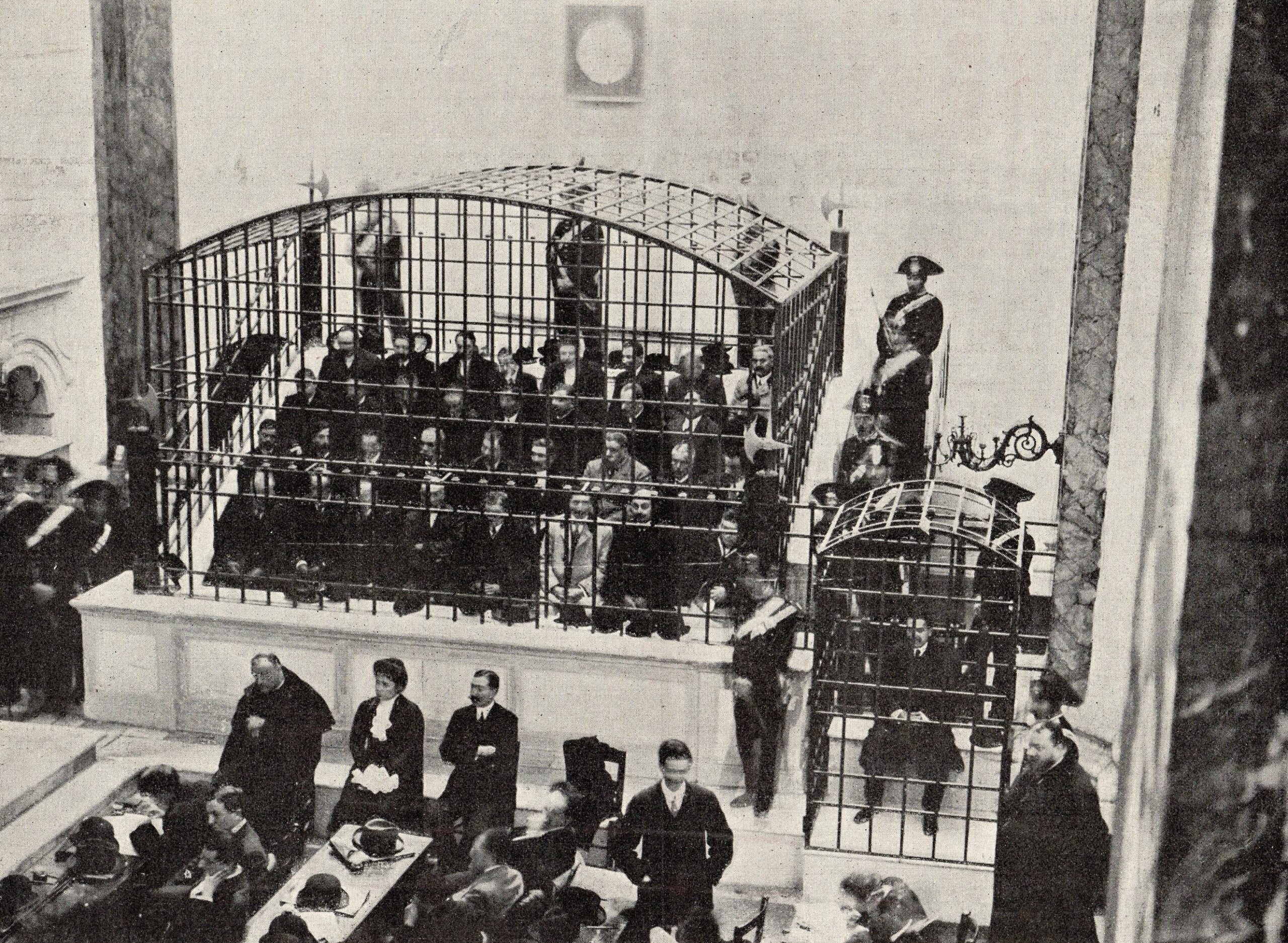
In Italy, the Viterbo Trial of 1911–1912 was one of the first widely publicized tests of omertà’s code of silence. When informant Gennaro Abbatemaggio stepped into the courtroom’s iron cage reserved for mafiosi, he was met with fury. Curses and epithets rained down from the accused Camorristi held in a larger barred enclosure. The scene was a small demonstration of the consequences for violating the “virtue that includes all others.”
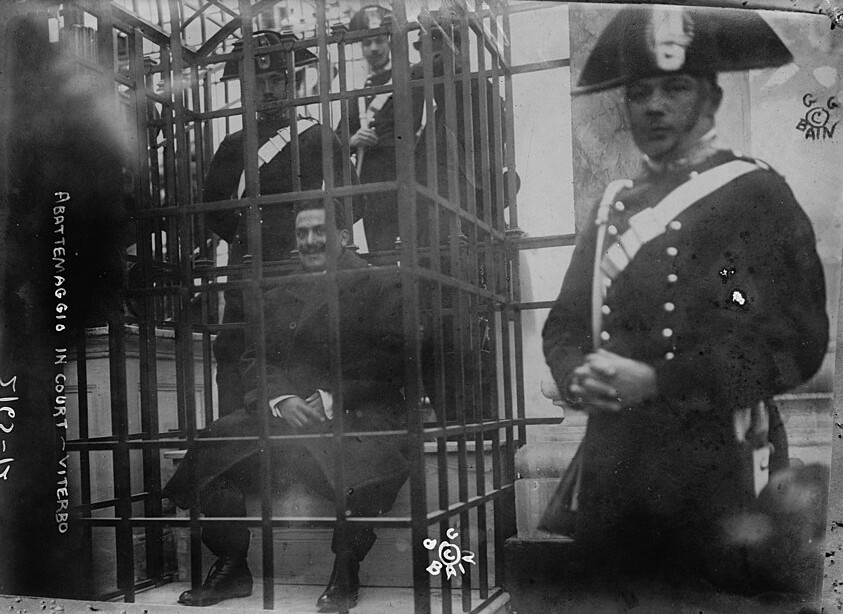
But Abbatemaggio’s testimony, an act that supposedly cracked the silence wide open, has never settled into certainty. Historians have questioned portions of his account, and more than a century later, the extent of any possible embellishments remains uncertain. Unresolved doubts like these have trailed omertà from the sensational newspaper columns of the 1890s to the present.
Mob informants in both the United States and Europe—Joseph Valachi, Sammy “The Bull” Gravano, and Tommaso Buscetta among them—only deepened that ambiguity. All broke the code under different circumstances and proved that omertà was never absolute even among insiders. Over the years, the code came to be obeyed less as an inviolable law than as a subjective and situational loyalty, honored unevenly and abandoned when self-interest demanded.
In popular culture, omertà has largely transcended its Sicilian origins to become shorthand for any code of silence or uncompromising loyalty. Metal bands such as Lamb of God and Katatonia have used the term to explore themes of betrayal, vengeance, and emotional isolation. Hip-hop artists, including Drake with his 2019 song “Omertà,” have adopted it as a metaphor for discretion, solidarity, and the protection of one’s inner circle. In these contexts, the word functions less as a reference to the Mafia than as a broader symbol of secrecy and allegiance.
The term’s wider applications reflect its resistance to a single definition. Even for the men sworn to omertà, adherence depended on circumstance and self-interest. The code was never the fixed, unbreakable law of legend—only a loyalty each man measured for himself and broke on his own terms.
Christian Cipollini is an organized crime historian and the award-winning author and creator of the comic book series LUCKY, based on the true story of Charles “Lucky” Luciano.
Feedback or questions? Email blog@themobmuseum.org