

‘The Green Felt Jungle,’ published 60 years ago, rattled Las Vegas

When The Green Felt Jungle was published 60 years ago, the book created a stir by detailing Mob influence and public corruption in Las Vegas.

Some hailed the 1963 addition to organized crime history as a much-needed exposé, while critics regarded it as inflammatory and unfair.

Written by two crime reporters, Ed Reid and Ovid Demaris, The Green Felt Jungle was not the public’s first exposure to the Las Vegas underworld, but community boosters were put off by what they regarded as its harsh portrayal and insulting tone. The local business community viewed it as sensationalistic and harmful to economic development.

In the book, much of the focus is on shady casino operators, prostitution and corrupt public officials. The town itself is not spared. Las Vegas is described as a “grotesque” desert Disneyland “devoted to fleecing tourists.”

The appendix even created problems for some influential locals, with its list of casino owners and the percentages of their holdings as of April 1, 1962, including their mailing addresses. Some of those listed were mobsters or their associates. This faction was concerned the book would attract additional government scrutiny, jeopardizing the syndicate’s lucrative casino ventures in Las Vegas.
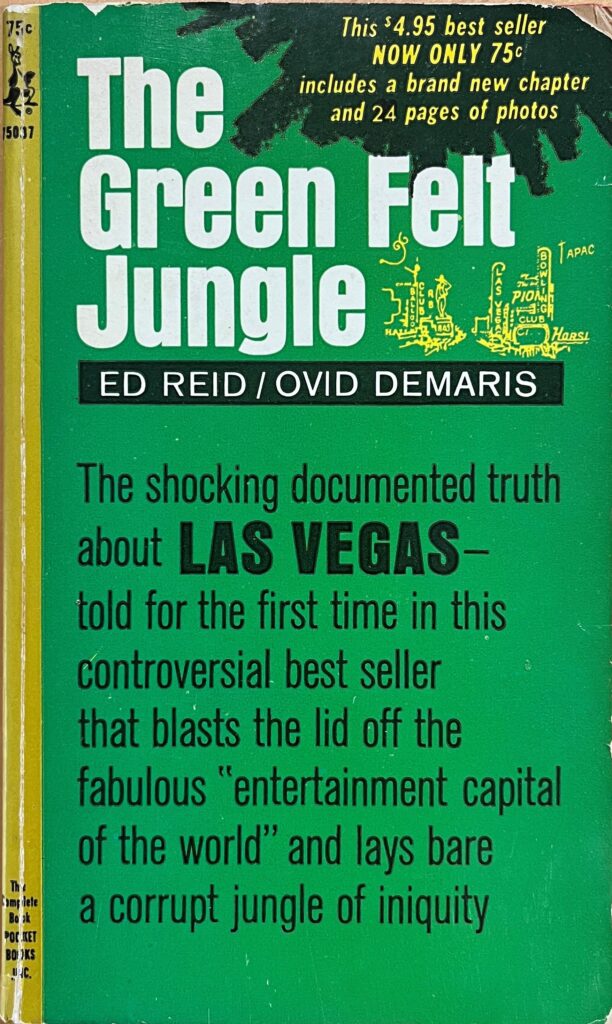
The Green Felt Jungle exposed the seedy side of Las Vegas to the public, which outraged the local business community.

Mob attack at Desert Inn

Throughout the years, co-authors Reid and Demaris built respected careers writing newspaper articles and books about organized crime across the country. During this pre-internet era, their work relied upon source development and document research — and a journalist’s ability to hook readers with interesting details.

Earlier in his career, Reid had been a reporter at the Brooklyn Eagle, leading the newspaper to a 1951 Pulitzer Prize for Public Service by exposing an illegal gambling ring protected by corrupt police officers. His later article in True magazine, “I Broke the Brooklyn Graft Scandal,” resulted in the 1958 movie The Case Against Brooklyn.

After leaving the Eagle, Reid went to work for the Las Vegas Sun. While there, he was beaten during an encounter with mobsters at the Desert Inn, a now-demolished resort that stood on the east side of the resort corridor where Wynn Las Vegas is located today.

In a first-person account of the March 1954 incident for his former paper, the Brooklyn Eagle, the 39-year-old Reid said he’d gone to Las Vegas with the idea that it was the place to find “the most hoodlums concentrated in the smallest space.” 

Las Vegas Sun Publisher Hank Greenspan had wanted Reid to produce a newspaper series about “syndicate hoodlums” in the city that had grown from a population of 8,000 to 50,000 in only a decade, the reporter noted. “I found so many hoodlums I could not begin to write about them all,” Reid wrote.

One article in the series especially seemed to strike a nerve. It mentioned Jack Dragna, a West Coast syndicate operative who, according to Reid, “dabbled in every form of crime for many years.”

As Reid put it, on a Saturday at 2 a.m. inside the Desert Inn, he saw about 10 “of the nation’s most notorious hoodlums” seated at tables flanking the craps tables and slot machines. At a nearby table was Clark County Sheriff Glen Jones. Dragna also was there.

As Reid stepped out of the resort’s glass entrance doors to leave, two men, including one who’d been seated with Dragna, beat him with their fists and a blackjack, Reid wrote. The attackers knocked off his glasses and left him bloodied.
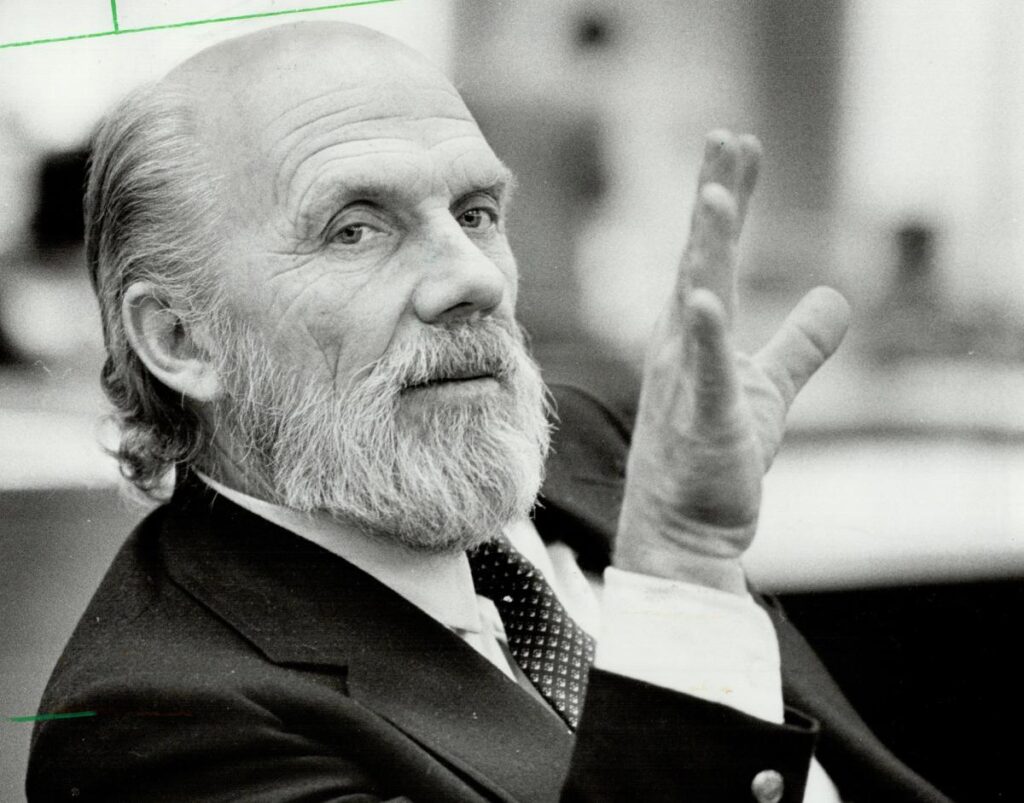
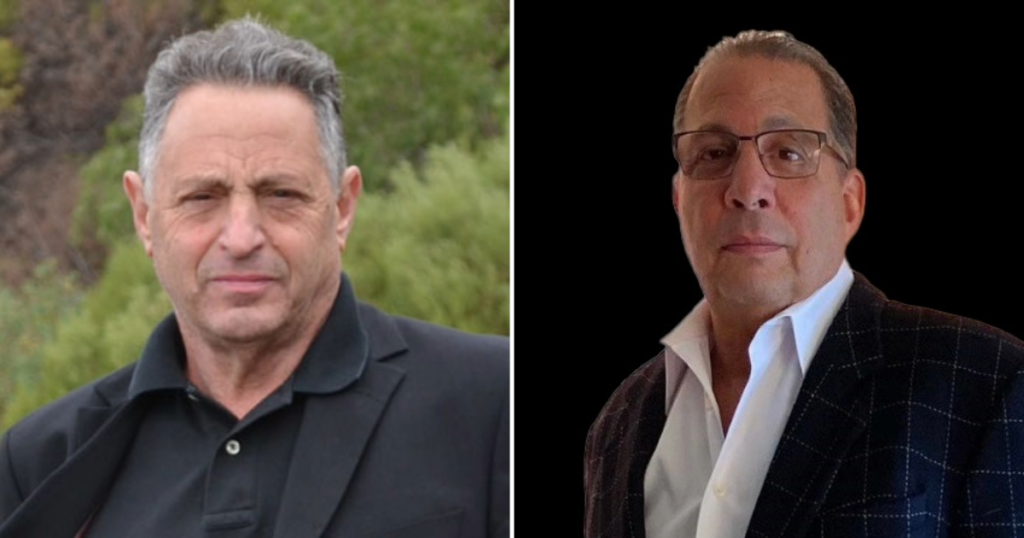
Ovid Demaris, co-author of The Green Felt Jungle, published dozens of books over his career, with many focused on organized crime.

Afterward, accounts of the incident varied, and a Clark County grand jury voted to take no action, according to a published report.

To Reid, however, the assault showed what the town was really like. “Maybe people will believe me now when I tell them Las Vegas is swarming with unsavory characters from all over the United States,” he said.

Top reporter fired

Though Reid had been the Las Vegas Sun’s ace reporter, publisher Hank Greenspun fired him after The Green Felt Jungle was released.

Years later, Greenspun’s son, Brian, now the Sun’s editor and owner, wrote in a column that The Green Felt Jungle zoomed to the top of the best-seller list as a nonfiction book but would have been “better nestled” in the fiction section.

Before the book went to print, Reid encouraged Hank Greenspun, his editor, to read the galleys.

“When my dad read what Ed Reid had written, he told him it was full of half-truths, innuendoes and lies and that Ed had to correct that which was wrong and misleading,” Brian Greenspun wrote. “Ed refused, and my father let him go.”

Hank Greenspun, who founded the Las Vegas Sun in 1950, had been employed a few years earlier by gangster Benjamin “Bugsy” Siegel as a publicist at the Flamingo. A growth spurt in gaming during the following years attracted more tourists to the area, with a potential for even greater numbers. After The Green Felt Jungle came out, Greenspun looked for television and radio interview opportunities to explain what he regarded as the truth about Las Vegas.
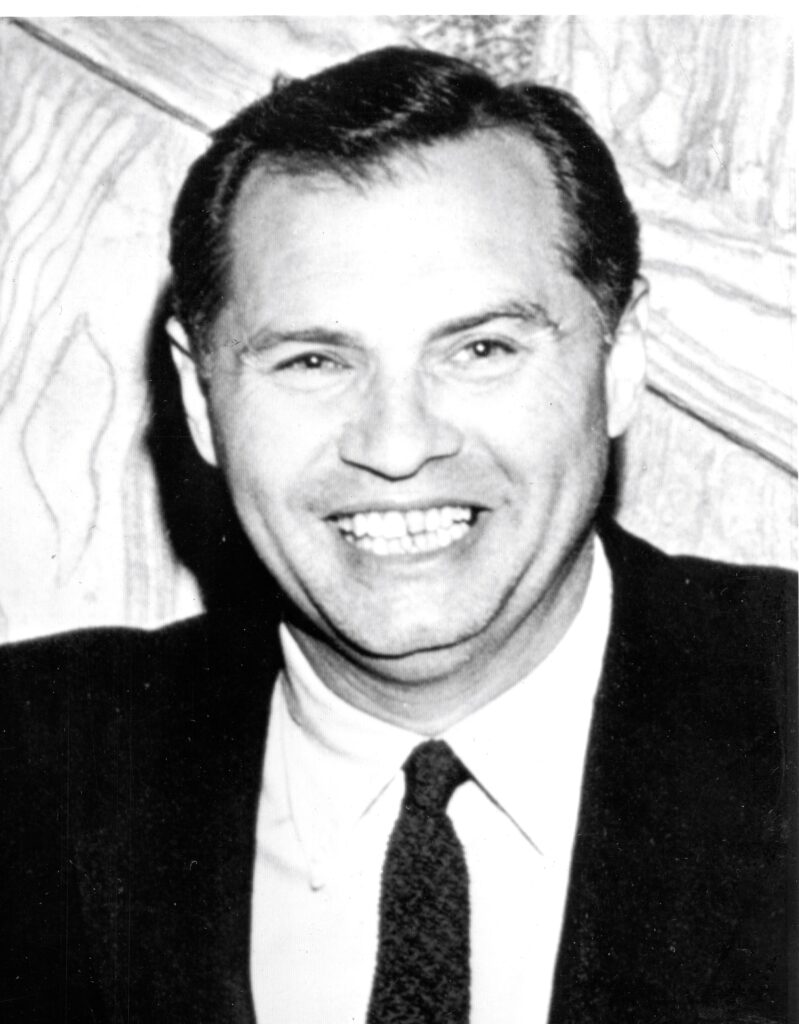
Hank Greenspun, founder and publisher of the Las Vegas Sun, fired Reid after the reporter published the controversial book. Associated Press

Greenspun told his son Brian he did this because he wanted to do what he could to make sure “you are never ashamed of where you were born.”

Reid, who had written books before and after working at the Sun, including Las Vegas: City Without Clocks and The Grim Reapers, died in 1977.

For his part, Demaris also wrote other books, ranging from The Last Mafioso: The Treacherous World of Jimmy Fratianno to crime novels such as The Hoods Take Over and Candyleg. These two novels were made into movies  — Gang War (1958), based on The Hoods Take Over, and Machine Gun McCain (1969), based on Candyleg.

In his novels, Demaris sometimes employed the themes and language found in the hard-boiled fiction of that era. One of his novels, The Lusting Drive, is included in a large volume for fans of gritty writing: Vintage Sleaze Super Pack: 24 Forbidden Novels from the 1950s and 1960s.

A former United Press International wire service reporter and author of more than 30 books, Demaris died in 1998.

Mob driven out of Las Vegas

Today’s Las Vegas Valley is different from the mobbed-up gambling outpost described 60 years ago in The Green Felt Jungle.

Since then, the area’s population has continued to grow and is expected to top 2.48 million in 2024, according to UNLV’s population forecast.

With this growth, mobsters like those that Reid and Demaris encountered have been pushed out. One important factor was the arrival in November 1966 of reclusive billionaire Howard Hughes, who bought six casinos, most of them from the Mob. He lived in seclusion for a few years at the Desert Inn.

Also, the Nevada Legislature in 1967 authorized corporations to own and operate casinos, meaning each shareholder didn’t have to be investigated for suitability and licensed. According to the Nevada Resort Association, this “paved the way for the casino industry to become what it is today.”

Into the 1980s, aggressive local reporters such as Ned Day, Jeff German and Jane Ann Morrison focused attention on the mobsters still active in the valley. This focus, coupled with pressure from state regulators and law enforcement, put the Mob into a final tailspin by the mid-1980s.

In 1989, casino developer Steve Wynn opened the Mirage hotel-casino on the west side of the Las Vegas Strip, leading to a boom in megaresort construction. As a result, several formerly Mob-linked casinos were imploded. These included the Desert Inn, Sands, Riviera, Stardust, Dunes and Hacienda. In most instances, corporate megaresorts have replaced the demolished properties. The Flamingo, where Hank Greenspun once worked, is at the same location as when it first opened in December 1946, though none of the original buildings remains.

The region continues to evolve and now is positioning itself as the nation’s sports capital, with professional teams making their home on or near the Strip and major events such as the Formula One Las Vegas Grand Prix and the NFL’s 2024 Super Bowl occurring there.

One of the last Las Vegas Strip resorts with original construction from The Green Felt Jungle era, the Tropicana, is slated to be demolished so that a Major League Baseball stadium can be built at that site. The Oakland Athletics plan to relocate to Southern Nevada and begin playing home games at the stadium in 2028.

Larry Henry is a veteran print and broadcast journalist. He served as press secretary for Nevada Governor Bob Miller, and was political editor at the Las Vegas Sun and managing editor at KFSM-TV, the CBS affiliate in Northwest Arkansas. Today, he is a senior reporter for Gambling.com.
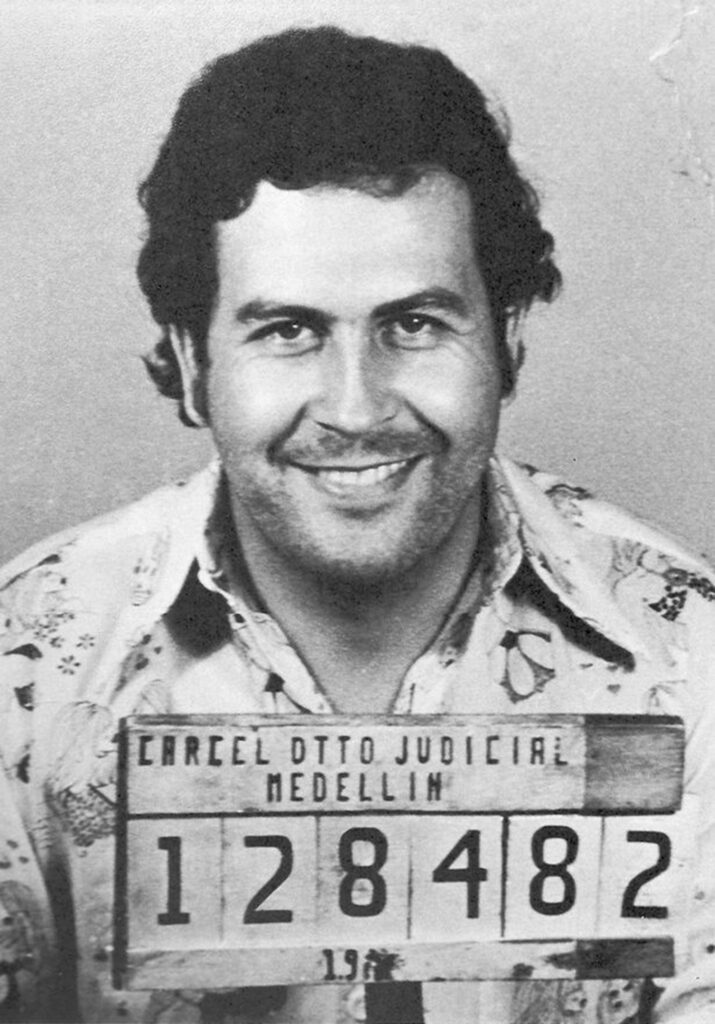
Colombian drug lord Pablo Escobar killed 30 years ago this month

Warning: This blog contains graphic images that some readers may find disturbing.

Thirty years ago this month, the bloody reign of the world’s most wanted narco kingpin came to a violent end. As Colombian forces closed in on drug lord Pablo Emilio Escobar Gaviria, the old cliché rang true: “Live by the gun, die by the gun.” On December 2, 1993, Escobar was shot and killed atop a terracotta roof in a Medellín suburb.

The epic tale of Pablo Escobar involves an eclectic cast of characters whose stories garnered fame for some and infamy for others. From books to movies to TV series, supporting players in the larger drama have included Griselda Blanco, George Jung, Barry Seal, Jack Carlton Reed, Carlos Lehder, Manuel Noriega and the Drug Enforcement Administration’s Steve Murphy and Javier Peña.

Escobar amassed so many enemies that neither his vast wealth nor fear tactics could provide him with any solace or protection, especially in the waning years. Few remained loyal and those that did were picked off by the law, military or vigilante posse. With his days numbered, the ever-defiant Escobar tried to evade the multipronged front hunting him down, literally to his final moments.

However, the chapter did not fully close there, as is often the case with legendary figures and dramatic downfalls. Conspiracies and conjectures circulated regarding the circumstances of his death. Among them are legitimate questions that remain intriguing.

The high life

Most of what we know regarding Escobar’s early forays into crime comes from hearsay, folklore and a handful of accounts shared by surviving friends and family. Almost all versions share a few common denominators: Escobar started with small-time theft, smuggling and marijuana dealing before graduating to international drug trafficking. Other tales speak of kidnappings and murder. His first major arrest occurred in 1974, an auto theft charge for which he served several months. He graduated to the big leagues with remarkable speed, entering a business where an old narcotic substance had gained a renewed, glamorous popularity in the United States and Europe.

Escobar’s smiling mugshot from 1976 hindered his political ambitions. Courtesy of Steve Murphy and Javier Peña

Capitalizing on the demand for cocaine made many independent traffickers wealthy. Some combined forces into “cartels,” but that is probably a misnomer. With respect to its strict definition as a coalition of colluding price-fixers, oversight committees and academics have noted that many people call the group by a more fitting name: the “Medellín Mafia.”

Still in his 20s, Escobar was already enjoying the spoils of money, power and an increasingly dangerous reputation. On June 9, 1976, a drug raid conducted by the Colombian intelligence agency (also known as DAS) netted about 40 pounds of cocaine base (crack) hidden in a car tire. The bust resulted in the arrest of six co-conspirators, including Pablo Escobar and his cousin/right-hand man Gustavo Gaviria. Escobar manipulated the system and swiftly got the whole crew out of the mess, but another judge had him rearrested. That also ended in Escobar’s favor, and he would later exact revenge on the judge and two police officers. That drug charge, however, would come back to haunt him.

Primed for violence

Buzzwords like “cartel” and “narcoterrorism” entered the world’s collective lexicon at the height of cocaine’s violent era in the 1980s. A series of crucial turning points gave rise to this new reality.

First, the once-independent barons pooled their respective talents and supply chain controls into a loose alliance. Soon after, they faced an imminent threat from paramilitary groups who used kidnappings to extort the wealthy kingpins. In solidarity, narco bosses from various factions and regions delivered a vicious response to the militias: “Death to kidnappers.”

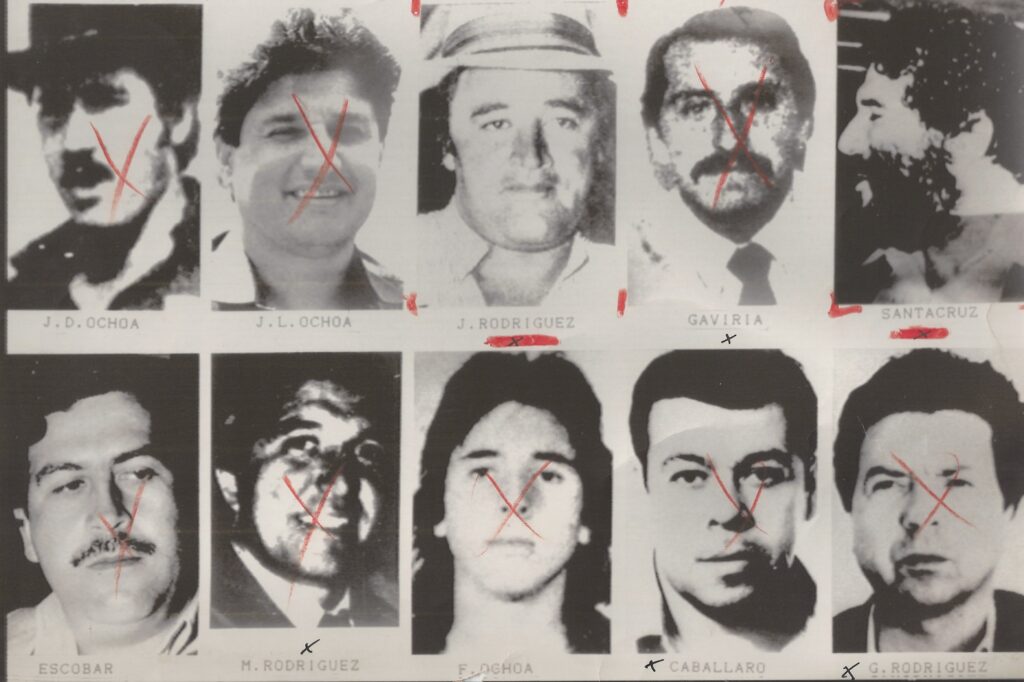
The DEA’s 10 most wanted Colombians in 1989 included members of both the Medellín and Cali Cartels. Courtesy of Cipollini Collection

Another issue facing the traffickers, the ultimate flashpoint, was a 1979 extradition treaty between Colombia and the United States. Although it was initially seldom used, by 1981 the threat of its use grew as the U.S. began indicting people like Escobar and fellow cartel members Carlos Lehder and Jorge Ochoa.

Always ambitious for greater power, Escobar campaigned for a seat in Colombia’s parliament (and the diplomatic immunity that came with it). In November 1982, he was elected as a substitute for Jairo Ortega. To his surprise, perhaps, some politicians publicly questioned his business dealings, insinuating narco-affiliation. This, at first, led to a war of attrition. Escobar and his allies cast accusations back at their accusers, but by August 1983, the ghost of the gangster’s past returned.

Compounding the accusations of his rivals in congress, ABC News premiered a special, “Cocaine Cartel,” which featured an interview with Escobar. In the segment, Escobar, like the others who agreed to be interviewed, denied narco involvement, postulating rather matter-of-factly: “If there had not been an influx of hot money or dollars into the country, then the country would be suffering a grave economic crisis similar to that of other countries of Latin America.”

Detractors were quick to use the “hot money” statement against him. Just days later, the Colombian newspaper El Espectador resurrected its 1976 article covering Escobar’s drug bust. First stripped of his immunity, Escobar eventually bowed to the pressure and resigned in January 1984. But he would get his revenge.

The Medellín faction pivoted to a public relations campaign, creating “Los Extraditables.” The shadowy group distributed literature and sent out letters condemning Colombia’s extradition treaty, attempting to win over the masses. “But the group called ‘The Extraditables’ was a nickname that Pablo gave himself,” said Ochoa in a 2000 interview with Frontline, “so that he could direct all his violence and his terrorist actions towards the extradition.” 

Escobar unleashed a retribution that shook Colombia to its core, including murders, bombings and a literal declaration of war against his own country. From 1984 to 1991, Escobar was directly blamed for the assassinations of political adversaries, police officers and the editor of El Espectador. Among the most reprehensible acts linked to him were the two-day siege of the Palace of Justice (98 dead and his extradition documents conveniently destroyed), the bombing of Avianca flight 203 (107 dead), and the DAS building bombing (60 dead and more than 600 wounded).

Conditional surrender

On September 5, 1990, Colombia hoped to bring the bloodshed under control by instituting a program of partial amnesty and promising no extradition. Traffickers began to trickle in, including two of the Ochoa brothers, by the following January. Escobar, however, held out until June 1991, when the extradition ban formally entered the constitution. Escobar publicly stated that he agreed to surrender “because I could not remain indifferent before the longings for peace of the vast majority of the Colombian people.”

Accompanied by Catholic priest Rafael Garcia Herreros, Pablo Escobar turned himself in to Colombian authorities on June 19.  He handed over his personal effects, including a Sig Sauer 9mm pistol. Per the agreement, authorities took him to a special prison facility southeast of Medellín. La Catedral, unofficially called “Hotel Escobar,” was designed and built to his specifications and included amenities such as a disco and a jacuzzi. This so-called incarceration seemed a mockery, so the United States continued to pressure Colombia.

For Escobar, everything remained business as usual. Rumors of lavish parties and general debauchery going on inside La Catedral circulated among the public. There were even allegations of murder on the premises. Colombia’s government had to do something.

La Catedral, Escobar’s self-designed prison, was more posh than punitive. RAUL ARBOLEDA / AFP via Getty Images

In July 1992, Escobar got word of the government’s plan to move him to another facility. On July 22, Escobar and nine others fled into the surrounding woods as forces approached the prison. A day later, his lawyers delivered a list of conditions for their client to re-surrender. This time, Colombian authorities had no interest in negotiations.

End of days

Escobar remained on the run and ordered more attacks, while the price on his head grew larger. Colombia’s elite Search Bloc, formed specifically to hunt Escobar, had the support of the DEA, Delta Force and Navy Seals. Over the previous years, Escobar’s violence even made some of his own members turn against him. Los Pepes – an acronym meaning “the Persecuted by Pablo Escobar” – was a group made up of former allies, paramilitary and angered citizens (and purportedly funded by the Cali Cartel) who worked outside the law to flush the fugitive out. They killed anyone associated with Escobar.

On December 2, 1993, one day after his 44th birthday, Pablo Escobar and his chauffeur/bodyguard, Álvaro de Jesús Agudelo, also known as “El Limón,” were virtually hiding in plain sight. They might have thought the police would never expect them to lay low in Escobar’s own hometown area.

Search Bloc was closing in on Escobar, thanks to successfully triangulating an uncharacteristically long phone call. A member of the team spotted a man in the second-floor window of a row house. The long-haired, full-bearded man in the window looked different than the Pablo Escobar from their photos. But it had to be the guy they were looking for.

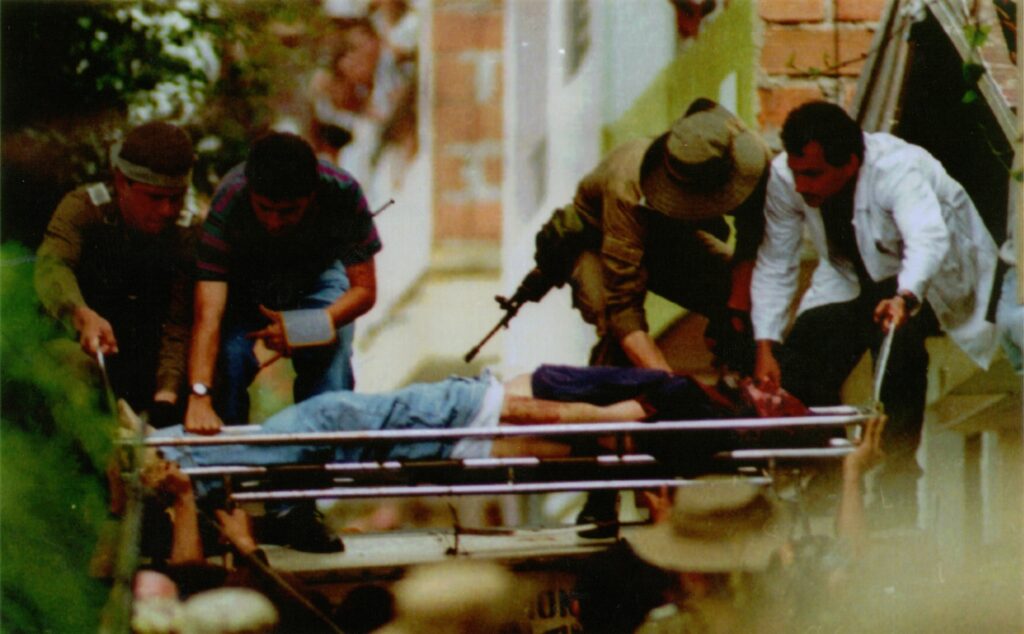
Escobar’s body is lowered from the rooftop where his bloody reign ended on December 2, 1993. Courtesy of Cipollini Collection

As Search Bloc surrounded and entered the house, Limón fled out a window. He dropped to the lower roof but was hit multiple times while running and plunged to the ground below. Escobar – armed with two pistols, including the Sig Sauer he had turned over in 1991 – attempted the same escape route via the roof but was struck three times in the left leg, upper right back and right ear.  Both men lay dead.

Who fired the killing shot? Plenty of people wanted to take credit. Search Bloc’s Hugo Aguilar was the most notable to claim responsibility. Diego Murillo Bejerano of Los Pepes, also known as “Don Berna,” claimed his brother did it. Conspiracy theorists insist it was U.S. agents. It was a mystery right out of the gate because the takedown happened very quickly without many onlookers. Would-be witnesses were taking cover in their homes when the gunfire erupted. The first photos taken of the scene were snapped by DEA agent Steve Murphy, who didn’t arrive until after Escobar was dead. Then, the scene itself – and subsequent medical examination – was a chaotic mess of people shuffling through, a crime scene gone wild.

Exploration into the controversy has continued over the years. In 2006, Escobar’s body was exhumed to settle a paternity test but provided little to no updated forensic information.

More recently, a 2020 episode of the television series The Curious Life and Death of… examined the original autopsy. They conducted their own tests to determine the caliber of the fatal bullet and who may have fired the shot that felled the kingpin. They used ballistic gel dummies for their analysis, which concurred with previous findings: neither the bullet through Escobar’s leg nor the shot to the back, which lodged in the neck region, were fatal. The head shot was indeed the cause of death, but they ruled out previous claims that the round came from a rifle. Their tests echoed a theory that has circulated since Mark Bowden’s 2001 book Killing Pablo: a 9mm gun delivered the fatal bullet, possibly at close range.

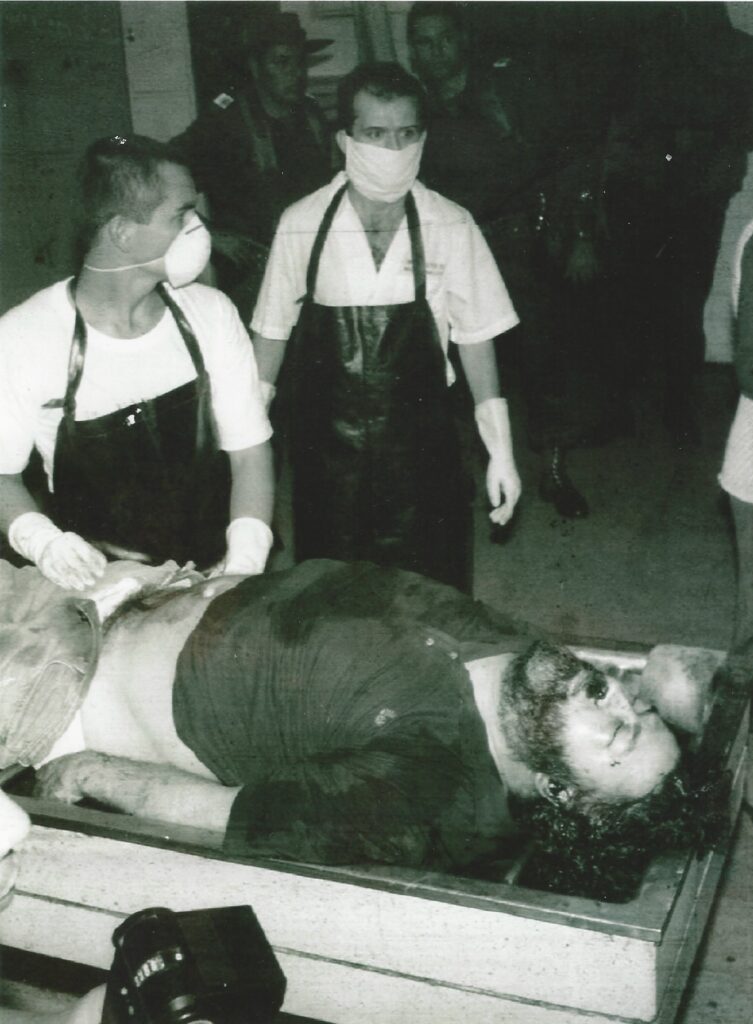
The autopsy performed on Escobar is still the subject of some controversy. Courtesy of Cipollini Collection

The lack of gunshot residue, or “tattooing,” on the entry wound cannot be conclusively explained, except for the possibility that Escobar put the barrel directly to his own ear, or someone else did, as Bowden suggests. Bowden points out that Limón’s forehead also bore an unusually accurate gunshot wound. Whether self-inflicted or coup de grâce, it is possible that little or no gunshot residue would be found on the entrance wound. The show found that at that close range the residue would blast right through along with the round. Some of Escobar’s surviving family are convinced he took his own life.

The official autopsy, one of the sole sources of evidence, also had its peculiarities. Most coroner’s reports don’t come with a press release attached, as one of the show’s investigators pointed out. Also odd, they explained further, is that the press release apparently went above and beyond to specifically discount suicide.

With plenty of questions and not many concrete answers, a few additional developments over the years simultaneously shed some light and left us hanging. Regarding Los Pepes, they reportedly had contact or relations with Search Bloc and U.S. agencies. Yet some of their own commanders denied any involvement or presence that fateful day, contradicting Don Berna’s account. Years after Escobar’s death, Aguilar, whose claims have largely been discredited, found himself in hot water on corruption charges in the political realm. In an interview that surfaced in 2017 (from a defunct documentary film), he admitted to secretly exchanging his own gun for Escobar’s Sig Sauer at the crime scene.

Christian Cipollini is the author of Murder Inc.: Mysteries of the Mob’s Most Deadly Hit Squad and LUCKY, a gangster graphic novel.

Listen to retired DEA agent Javier Pena’s episode on The Mob Museum’s podcast Inside the Life to hear Pena’s role in taking down Pablo Escobar.

Ninety Years Ago Today, Prohibition Ended at 2:32 p.m. Pacific Time

On Tuesday, December 5, 1933, the unprecedented repeal of a constitutional amendment went into effect, officially relegalizing intoxicating liquors in the United States. Americans could buy a legal drink for the first time in more than 13 years.

Across the nation, people celebrated, eager to exercise their legal right to booze. Some threw repeal parties to mark the occasion. Although repeal parties were more celebratory than the pre-Prohibition “last call” parties of 13 years earlier, they certainly were not as wet or as numerous. When last-call parties mourned the loss of legal liquor on January 16, 1920, hotels, restaurants and saloons were eager to sell the last of their supply. Booze flowed freely, and many people staggered home bleary-eyed in the early morning of January 17.

The landscape after repeal was more complicated. Nineteen states had the necessary laws in place to legalize liquor as soon as the final state ratified the 21st Amendment. For other states, access to liquor, and even wine and beer, would take days, weeks, months or years. A combination of remaining state Prohibition laws and regulatory issues, as well as limited liquor stock in the United States, did not make it easy for would-be revelers to drink to excess.

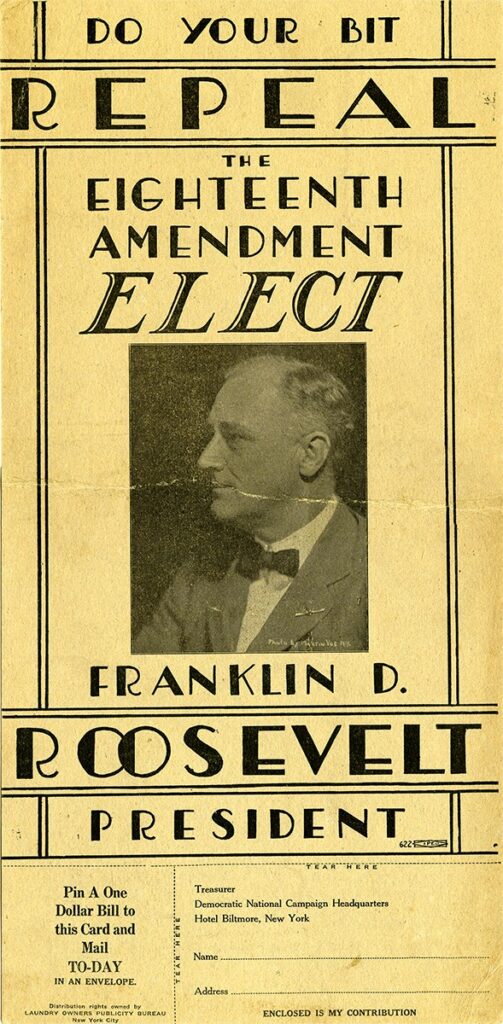
President Franklin D. Roosevelt heartily supported repeal both as a common-sense approach to end the increase in crime during Prohibition and as a companion to other measures meant to ease suffering during the Great Depression.

December 5, 1933, broke the seal on a situation that had been bubbling for almost half a decade. In 1929, violence related to liquor trafficking increased — as evidenced by the St. Valentine’s Day Massacre in Chicago — and the Great Depression caused massive upheaval in American society. People began expressing greater frustration with Prohibition, and they were ready for a change.

From start to finish, the repeal process took less than 10 months. The House of Representatives passed the Prohibition repeal act on February 20, 1933. Yet lightning-quick ratification was hardly a foregone conclusion. On the day the act passed, congressional forecasters pegged ratification at about two years, but the sweeping tide of “wet” advocates who pushed for repeal made haste. At the time, this was the second quickest ratification process in U.S. history. It was beat only by the wild no-brainer of the 12th Amendment, which created the combined presidential-vice presidential ticket, replacing the ineffective system in which the presidential runner-up became vice president. 

By November 2, 1933, 30 states had ratified the amendment. Experts began projecting a clear path to ratification before the end of the year. On December 5, Pennsylvania, Ohio and Utah all approved the amendment in state conventions selected specifically to vote on the law. Utah became the final state necessary to ratify the amendment at 3:32 p.m. mountain time.

The following day, both Maine and Montana also ratified the amendment, although unnecessary for the law to pass. Ultimately, 38 states ratified the Amendment, but only 36 were required. South Carolina unanimously rejected the amendment, North Carolina rejected a measure to hold the required state convention, and the other eight states never moved to hold a state convention at all (Alaska and Hawaii were not yet states). 

President Franklin D. Roosevelt, a vocal advocate for repeal, immediately issued a proclamation announcing the ratification of the amendment. Legend has it that he then celebrated with a happy hour martini; it was, after all, already five o’clock in Washington, D.C.

But the phrasing of the proclamation is important. Even for wet politicians such as Roosevelt, repeal did not necessarily mean a desire to return to the pre-Prohibition status quo. In his proclamation, Roosevelt expressed, “I trust in the good sense of the American people that they will not bring upon themselves the curse of excessive use of intoxicating liquors, to the detriment of health, morals and social integrity.” He also asked for “the wholehearted cooperation of all our citizens to the end that this return of individual freedom shall not be accompanied by the repugnant conditions that obtained prior to the adoption of the 18th Amendment and those that have existed since its adoption.”

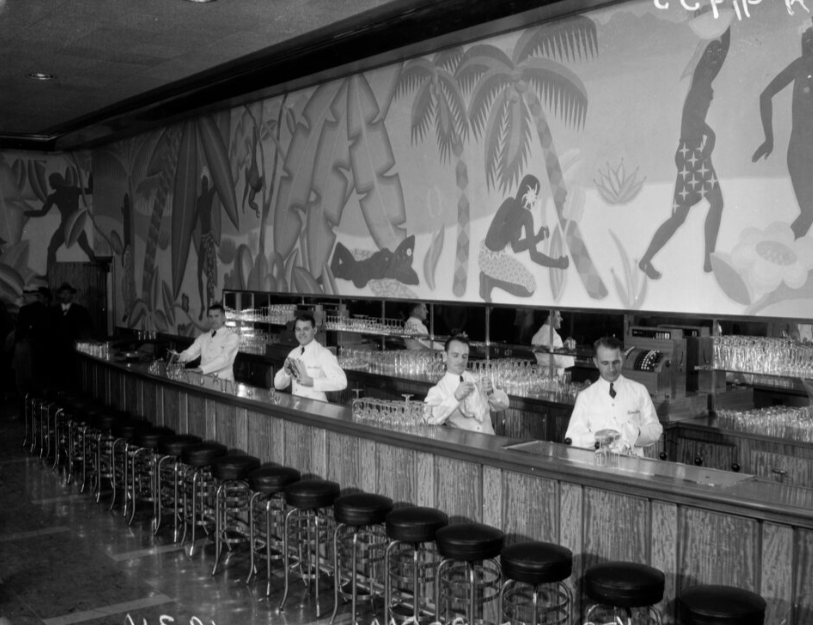
Bartenders at Chicago’s Palmer House eagerly prepared the bar and awaited news that Prohibition had been ratified on December 5, 1933. Chicago History Museum via Getty Images

Roosevelt echoed sentiments heard from many who once supported Prohibition before switching to the repeal cause in the late 1920s. Urging Americans to follow both the letter and the intent of this new law, Roosevelt expressed a desire for citizens to practice moderation and denounced the saloons that had existed before Prohibition. His proclamation focused not only on temperance and a request for Americans to abide by the law, but on the idea that a return to legal liquor also meant a return — and in many ways an increase — in regulation of both drinking establishments and alcohol itself.

Political proclamations aside, what did the night of repeal actually look like? How great were the parties?

Although some states expedited licensing in the lead-up to repeal, many jurisdictions still had very few establishments with liquor licenses. In Las Vegas, just nine tavern licenses, five drugstore package permits and one cabaret license were issued ahead of repeal.

In Brooklyn, New York, only two hotels had full liquor licenses in place by the evening of December 5, according to the Brooklyn Times Union. In an article from the following day, repeal night was described as restrained, with no reported arrests for drunk or disorderly conduct as of 11 p.m. on the 5th. The reporter did note that “many young people…seemed in awe of the wine list.” And although many establishments did serve liquor without full licensure in place, what they had on hand was limited.

One notable exception to the lackluster celebrations was Chicago. Even before the final state ratified repeal, large crowds filled Chicago Loop bars and stayed until closing time. At the Hotel Sherman, bartender Danny Monahan, who also tended bar on the last day before Prohibition began, led a team of assistants on the afternoon and evening of repeal. At 4:35 p.m. central time, just three minutes after Utah ratified repeal, a bellboy entered and rang a handbell that signaled liquor could be sold again.

Four blocks away at the Palmer House, officials stated that by midnight, guests had consumed 50 cases of bourbon and rye, 25 of Scotch, 50 of gin, 75 of wine and champagne, 10 of cordials and 20 barrels of beer. Chicago had been wet during Prohibition, and repeal showed no signs of dampening the fun.

A Chicago Tribune article from December 6 noted that to expedite drink service, many hotels and bars eschewed the former custom of serving patrons with a glass and decanter and simply poured drinks straight from the jigger to a waiting glass. Although this was reported as a time-saving measure meant to aid in the fulfillment of nonstop drink orders, it was also likely a result of rusty or novice bartenders. America’s best bartenders fled to Europe during the 13 years of Prohibition. While many skilled barkeeps still served in the nation’s speakeasies, by 1933, a whole generation of young adults had no experience at all with legal liquor.

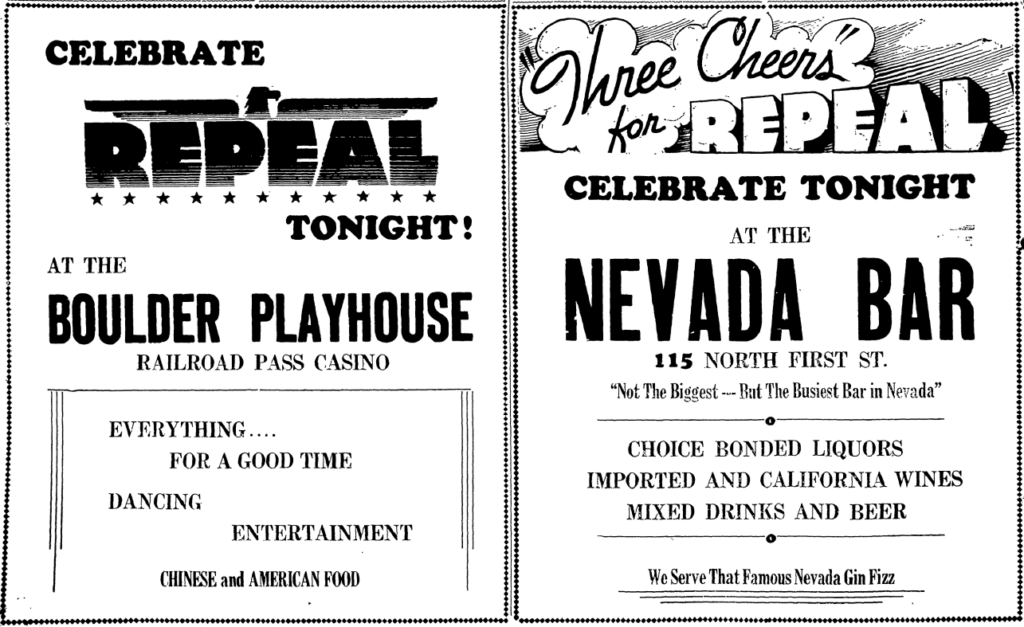
These ads for repeal parties ran in the December 5, 1933, edition of the Las Vegas Evening Review-Journal.

In Las Vegas, where Prohibition had not been strictly enforced since the repeal of a state companion law in 1923, the night of repeal was largely business as usual. In the December 5 edition of the Las Vegas Evening Review-Journal, three area bars, the Apache Hotel bar, the Nevada Bar and the Boulder Playhouse, took out quarter-page ads promoting repeal parties to be held that evening. Three drugstores also celebrated the return of legal package liquor in quarter-page ads.

Based on these advertisements, one might think that December 5, 1933, was quite raucous, but an editorial the following day painted a different picture:

“In many states there was a big hurrah and plenty of liquor being gurgled down parched throats. That, however, was in sections where prohibition had placed some restraint on the sale of liquor, or where wealthy play-boys and play-girls took advantage of the opportunity for one of their celebrations which come at the least excuse. Nevada has worried little about prohibition these later years, and has reached a stage of real temperance as a result. There will be little change in the actual drinking habits of the people of this state as a result of repeal.”

It is certainly an understatement that the city had reached any demonstrable state of temperance, but the parties were reportedly low-key affairs.

If muted Repeal Day parties are evidence of limited liquor supply, legal red tape and regulations, they are also evidence of the realities of Prohibition. Prohibition never outlawed the right to drink. It outlawed the manufacture, transport and sale of intoxicating beverages. And for the 13 years, 10 months and 19 days that Prohibition was in effect, mobsters, moonshiners and rumrunners supplied thirsty Americans with liquor regardless of its legal status.

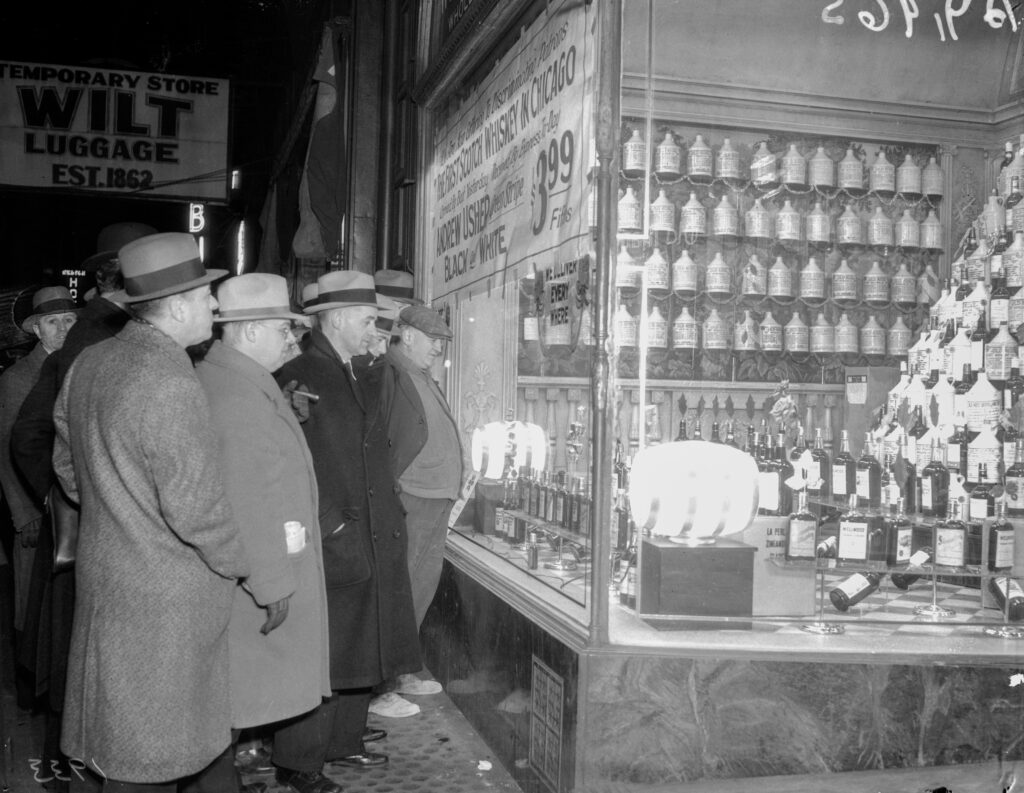
Not all repeal day revelers chose to go out. Many Americans purchased bottles of liquor and lifted a glass at home. Establishments such as this Chicago liquor store had to wait until ratification to legally sell their supply. Chicago History Museum via Getty Images

Speakeasies existed everywhere. In New York alone, experts estimate more than 30,000 speakeasies operated during Prohibition. In Las Vegas, a community with fewer than 9,000 people in 1930, there were more than a dozen speakeasies raided and closed — temporarily — in the first two months of 1928 alone.

The majority of Americans heaved a sigh of relief on Repeal Day, and many also raised a glass. Although contemporary press coverage painted a picture of quiet, refined parties, many a photo reveals exuberant crowds pressed elbow to elbow, ready to sidle up to the first legal bar in sight since 1920. Nevertheless, Americans continue to celebrate Repeal Day as a return to personal liberty in the form of a pint glass, highball or champagne flute.

Artifact Spotlight: Frank Gusenberg’s Colt .38 Special Revolver

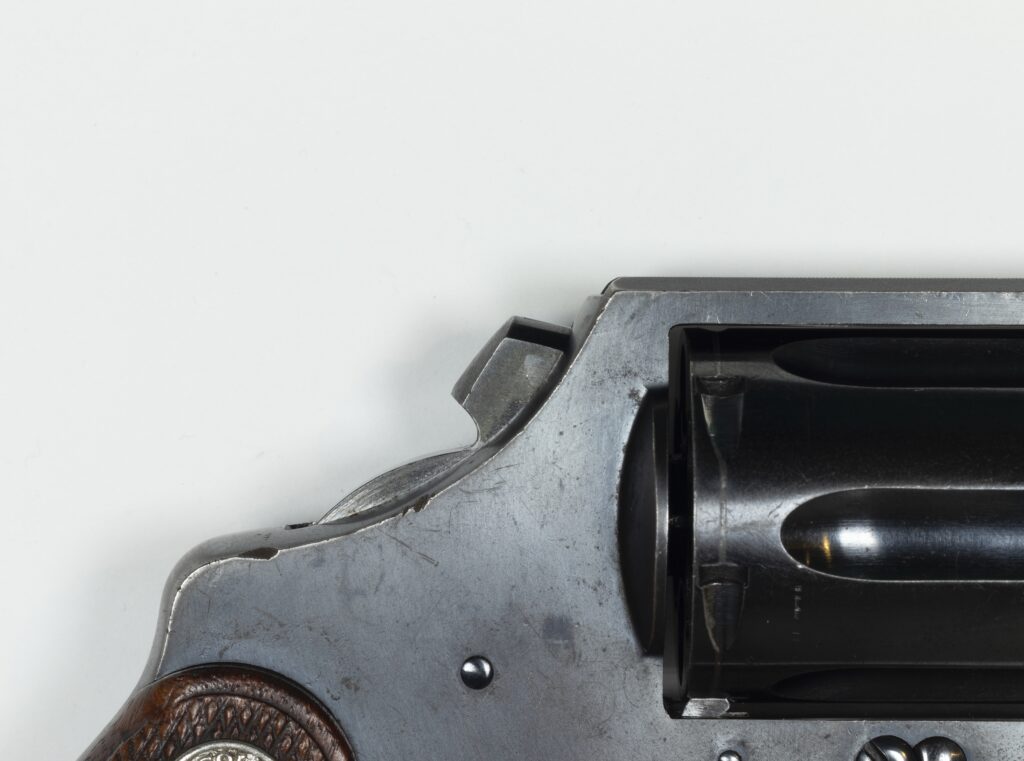
Police found only one firearm at the St. Valentine’s Day Massacre crime scene: a .38 Special revolver. The fully loaded gun was a smaller caliber than the spent casings scattered at the crime scene, so it wasn’t fired during the carnage. The revolver’s owner, North Side Gang enforcer Frank Gusenberg, had been rushed to the hospital in a futile effort to save him from 14 bullet wounds.

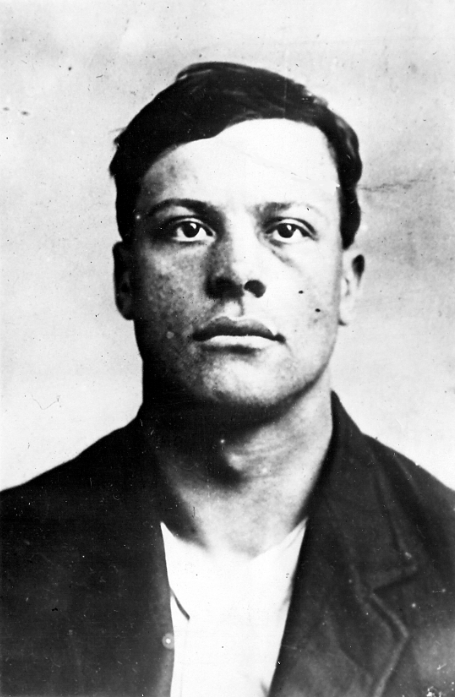
Frank Gusenberg, owner of the revolver, was one of the seven victims of the St. Valentine’s Day Massacre. Courtesy of the John Binder Collection

Frank, his brother Pete and five other members and associates of the North Side Gang were waiting in a North Clark Street garage in Chicago for their boss, George “Bugs” Moran, to show up. Four men, two dressed in police uniforms, entered the garage. It appears the seven men were told to line up against a brick wall, and then the assailants delivered a barrage of bullets from two Thompson submachine guns and a shotgun. Police arrived at the scene after a neighbor was alerted by the traumatized wailings of Highball, a German Shepherd chained to the axle of a truck inside the garage.

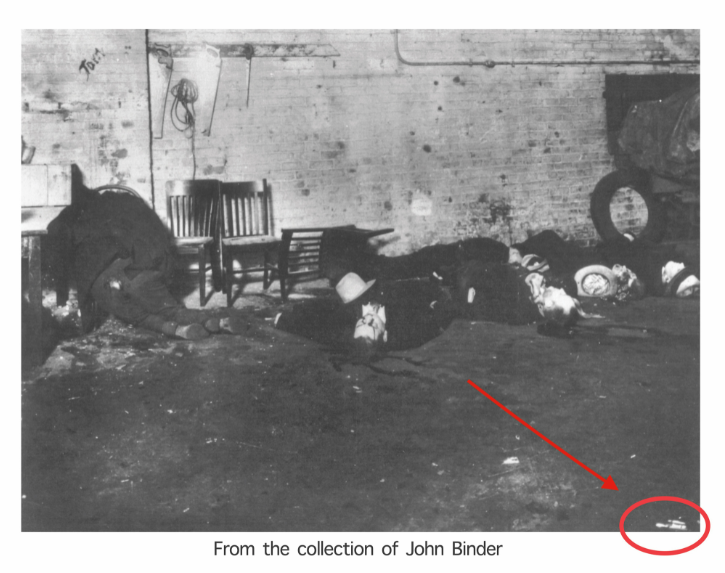
Gusenberg’s revolver is just barely visible in the lower right corner of this crime scene photo from the St. Valentine’s Day Massacre. Courtesy of the John Binder Collection

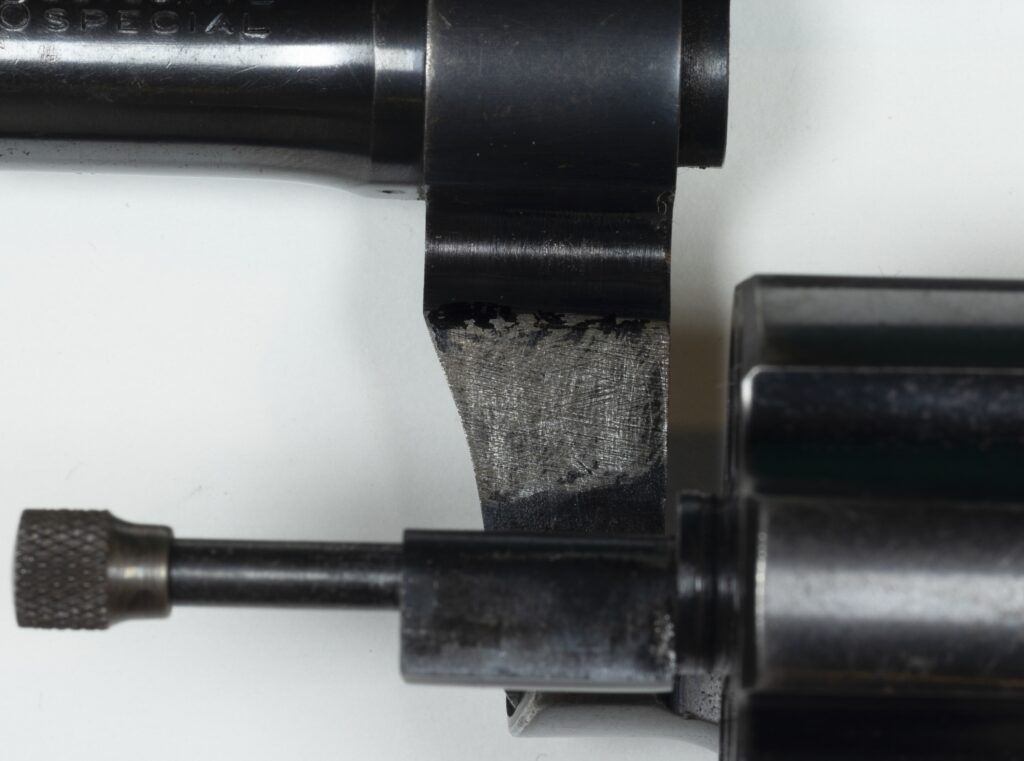
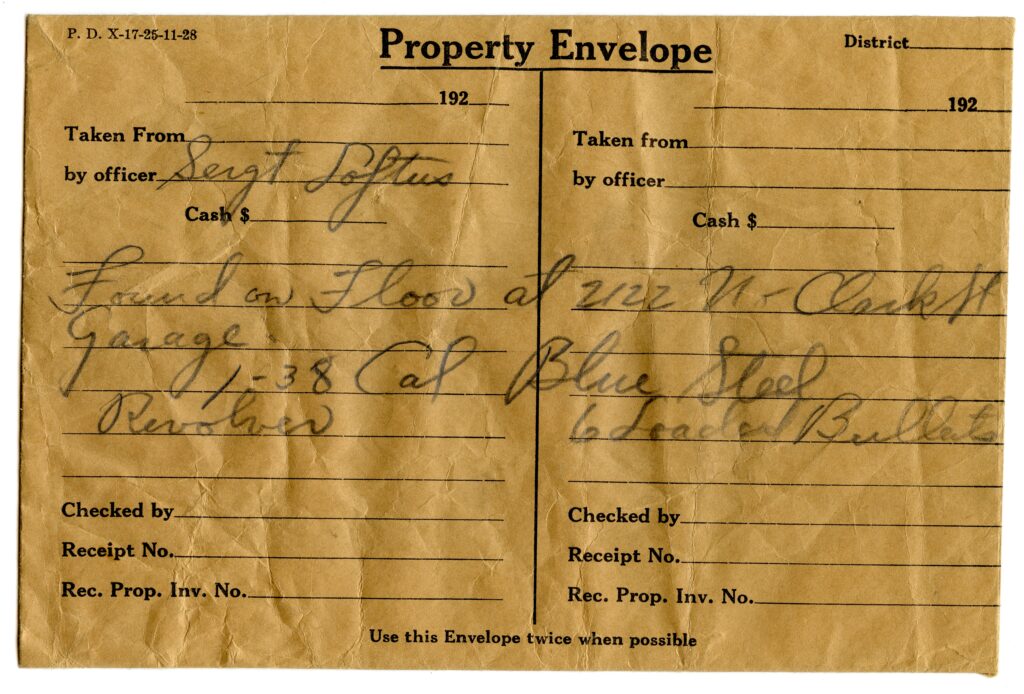
The revolver was collected as evidence by Sergeant Thomas J. Loftus, one of the first officers at the scene. Loftus was also the one who called an ambulance for the wounded Frank. After restoring the obliterated serial number with a special acid solution, investigators linked the gun to Frank Gusenberg as well as firearm dealer Peter Von Frantzius, known as the “Armorer of Gangland.” Von Frantzius also supplied one of the Thompson submachine guns used in the Massacre.

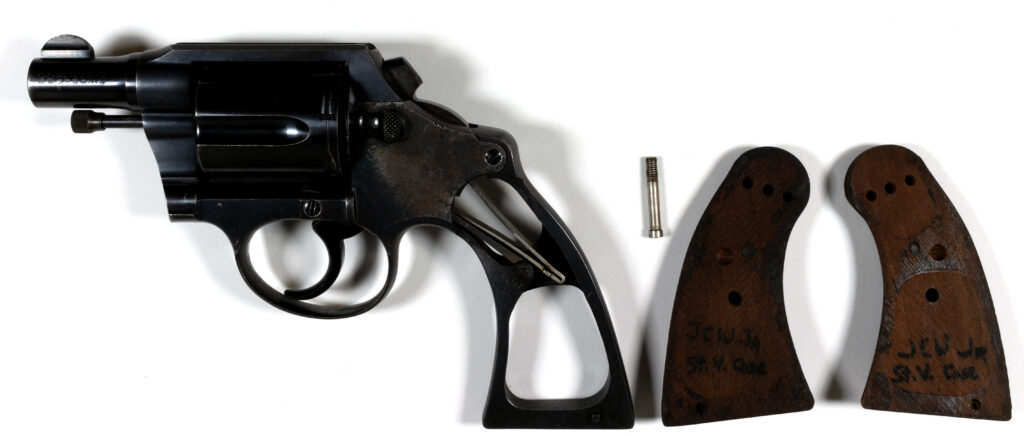
On the reverse side of the grip are the initials of Joseph C. Wilimovsky Jr., assistant to Dr. Calvin Goddard. The gun remained in his family’s possession for decades.

Because of the possibility that police were involved, Cook County Coroner Herman Bundesen decided the initial investigation would be conducted by a coroner’s jury, rather than the police. The jury brought in Dr. Calvin Goddard, father of forensic ballistics and firearms examination, who opened a crime lab at Northwestern University. Goddard ruled out police involvement by testing firearms used by Chicago’s police officers, none of which matched the bullets and casings from the crime scene.

The hammer has been “bobbed,” or shortened, to facilitate the quick draw. Some underworld suppliers offered to sell handguns “pre-bobbed.”

The Thompson submachine guns used in the Massacre were found 10 months later in Berrien County, Michigan, in the home of suspect Fred “Killer” Burke. Goddard’s ballistics analysis concluded they were the same guns used in the Massacre.

The serial number has been filed away, a commonly seen modification in outlaws’ firearms. Investigators were able to restore it through a process called chemical etching.
 

After the investigation concluded and Goddard moved back to New York, Goddard’s assistant and criminologist Joseph Wilimovsky kept all the evidence, except for the Tommy guns, and took it with him to Madison, Wisconsin. The evidence remained with his family for decades until collector Neal Trickel acquired it in the 1980s. The Museum acquired the evidence from Trickel.

Sergeant Thomas J. Loftus discovered the .38 Special revolver at the crime scene and collected it as evidence in this envelope.

Visit stvalentinemassacre.org to learn more about the St. Valentine’s Day Massacre.

John Gotti’s takedown detailed in new Netflix series

A three-part docuseries now available on Netflix examines the dramatic rise and fall of Gambino crime family boss John Gotti in New York City.

Titled Get Gotti, it explains how authorities finally brought Gotti to justice, despite a lack of cooperation among the law enforcement agencies tasked with ending his reign. The show also focuses on Gotti’s high-profile status as a New York media sensation.

The Get Gotti series was produced by the makers of Fear City: New York vs. the Mafia, the 2020 Netflix series that documents the investigation that culminated in the Mafia Commission trial.

Gotti rose to power by orchestrating the shooting death of then-Gambino boss Paul Castellano in December 1985. With Gotti and Salvatore “Sammy the Bull” Gravano in a car nearby, gunmen ambushed Castellano and his driver, Thomas Bilotti, outside Sparks Steak House on East 46th Street in Manhattan.

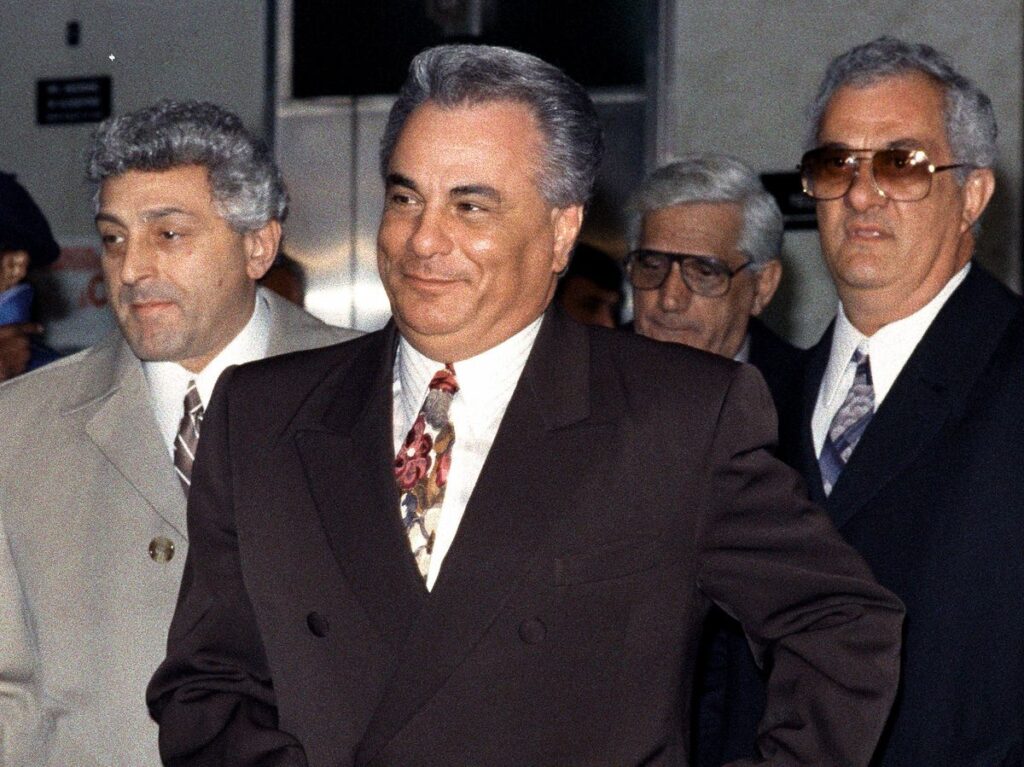
John Gotti was a flamboyant public figure in New York. He relished media attention rather than staying in the shadows like other Mob bosses.

Soon after, Gotti took over the Gambino family, with mobsters pouring into the Ravenite social club at 247 Mulberry Street in Little Italy to greet the new boss. These days, a clothing store called Descendant of Thieves occupies that space.

‘True gangster’

During the 1980s, Gotti was acquitted in three criminal trials. Because the charges didn’t stick, New York tabloids labeled him the Teflon Don.

During those years, Gotti was a celebrity crime boss who, in 1986, even appeared on the cover of Time magazine, with his likeness illustrated by famed artist Andy Warhol.

Gotti’s flamboyant personality was not typical of most previous Mob leaders, who preferred operating in the shadows. He was front-page news in the nation’s media capital, a visible Mafia figure whose flashy lifestyle partially defined the era.

Andrea Giovino, featured in the docuseries as a Gotti associate, told The Mob Museum the docuseries does a good job of getting at what New York City was like in the 1980s. Giovino is the author of Divorced from the Mob: My Journey from Organized Crime to Independent Woman. She plans to launch a podcast soon.

Andrea Giovino was interviewed for the docuseries, reflecting on Gotti and Mob culture in 1980s New York.

During those years, the Gambino crime family was involved in many money-making schemes, including in construction, public sanitation and the garment industry, Giovino said. The Gambino crew under Gotti also was skilled at bribing jurors and killing rivals, as the docuseries makes clear.

“The Gambino crime family ran New York,” Giovino said in a telephone interview. “You’d have to go through them to get something.”

Giovino benefited from this. She said one of the Gambino mobsters gave her a mink coat that had been “hijacked.” Giovino still has the coat, which, 35 years ago, was valued at $20,000.

She also recalled a lesson she learned from Gotti about how to handle someone who presents a problem. Once at New York City’s Club A, Giovino, a self-described “hotheaded” person during those days, got into a dispute with another woman. As tensions spiked, Giovino told the woman she was going to hit her. Then Giovino did as promised — she hit her. 

According to Gotti, though, that wasn’t the way Giovino should have handled the situation. Gotti said she shouldn’t have let the woman know what was coming. That advance knowledge gives the target an edge.

“You take action and do it,” she recalled Gotti telling her. “You don’t let the other person know what you’re thinking.”

Giovino, now living in Pennsylvania, later schooled her sons on that life lesson from Gotti. “He was your true gangster,” Giovino said.

Arrest and conviction

After the 1985 coup, Gotti’s “true gangster” persona opened doors for him across the city. He also attracted favorable attention from Hollywood celebrities such as Mickey Rourke, Anthony Quinn and John Amos, who, in the case of those three, were seen at the courthouse when Gotti was on trial.

There were others who wanted to be near him, too. Once at Club A, Brooke Shields, who’d starred in movies such as The Blue Lagoon, slipped her phone number into Gotti’s pocket, according to former mobster Anthony Ruggiano Jr. in the Netflix docuseries. Gotti tore up the number, noting that Shields was his daughter’s age, Ruggiano said.

Former mobsters Sal Polisi and Anthony Ruggiano Jr. were interviewed for the Get Gotti docuseries.

By the late 1980s, Gotti’s high-flying lifestyle would catch up to him. Authorities attempting to bring him down intensified their efforts.

In one key development, federal agents planted an eavesdropping device in an apartment above the Ravenite where Gotti met with top advisers. That second-floor unit, Apartment 10, had one resident, Nettie Cirelli, 74, the widow of Gambino soldier Mike Cirelli. When she was gone for one reason or another, it was a secluded place for Gotti and his lieutenants to meet in private. One Thanksgiving, when Cirelli apparently was visiting a son in California, authorities picked the lock and went inside, planting the bug.

For months, the device recorded incriminating conversations, including discussions about the Castellano shooting and Gotti’s take on the killing of Mob porn king Robert “DiB” DiBernardo.

With these tapes in their possession, federal officials raided the Ravenite in December 1990, arresting Gotti, Gravano and another ranking member, Frank Locascio.

The tapes were not the only bombshell that doomed Gotti. In a surprise development, Gravano cooperated with the government after hearing Gotti on tape bad-mouthing him. Gravano, who confessed to 19 killings, thought the boss was going to come after him.

According to federal prosecutor John Gleeson during a recent presentation at The Mob Museum, Gravano told authorities, “I want to go from my government to your government.”

Presented with the tapes and Gravano’s testimony, the jury in a federal racketeering case convicted Gotti on April 2, 1992. He was sentenced to life in prison for murder and other crimes. Battling cancer, Gotti died on June 10, 2002, at the federal prison hospital in Springfield, Missouri. He was 61.

Locascio also died in prison. Gravano served a shorter term after cooperating, but he later went back to prison on a separate drug-related conviction. Gravano now is out and hosts a podcast, Our Thing, available on his website, which also has T-shirts and other items for sale.

Larry Henry is a veteran print and broadcast journalist. He served as press secretary for Nevada Governor Bob Miller, and was political editor at the Las Vegas Sun and managing editor at KFSM-TV, the CBS affiliate in Northwest Arkansas. Today, he is a senior reporter for Gambling.com.

Eighty-two years ago this month, Murder Inc.’s Abe Reles took a mysterious fall

Abraham “Kid Twist” Reles’ damning testimony assisted in taking down some of the most vicious Mob enforcers during the sensational Murder Inc. trials. After sending many of his colleagues to the electric chair, the prosecution’s singing star was set for his biggest performance yet – testifying against New York Mafia boss Albert “The Mad Hatter” Anastasia.

A funny thing happened on the way to that big day, though: The canary found out the hard way that he couldn’t fly.

Witness protection

The Murder Inc. investigation was wrought with paranoia from the outset. The district attorney’s office and every other law enforcement entity involved were keenly aware that the singing canaries were also walking targets for Mob reprisal.

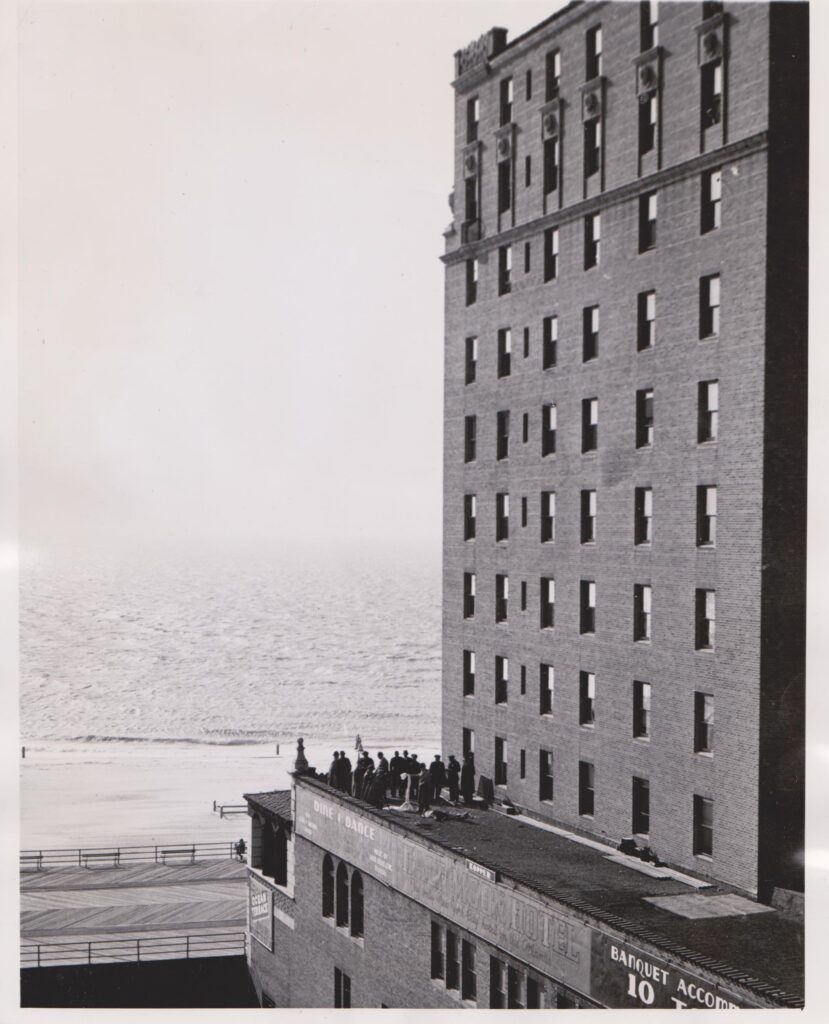
In an effort to minimize opportunistic marksmen and to keep the “choir” protected behind official security details, DA William O’Dwyer’s office rented a suite on the sixth floor of Coney Island’s Half Moon Hotel. Lodged on the floor with Reles were fellow witnesses Albert “Tick Tock” Tannenbaum, Mickey Sycoff and Sholem Bernstein. Each had his own room. Guards on duty – officers specifically reporting to the DA’s office – maintained positions throughout the 10-room section within Suite 620. Two guards were assigned to the hotel’s main floor, but their instructions were vaguely listed as “keeping an eye out for suspicious people.”

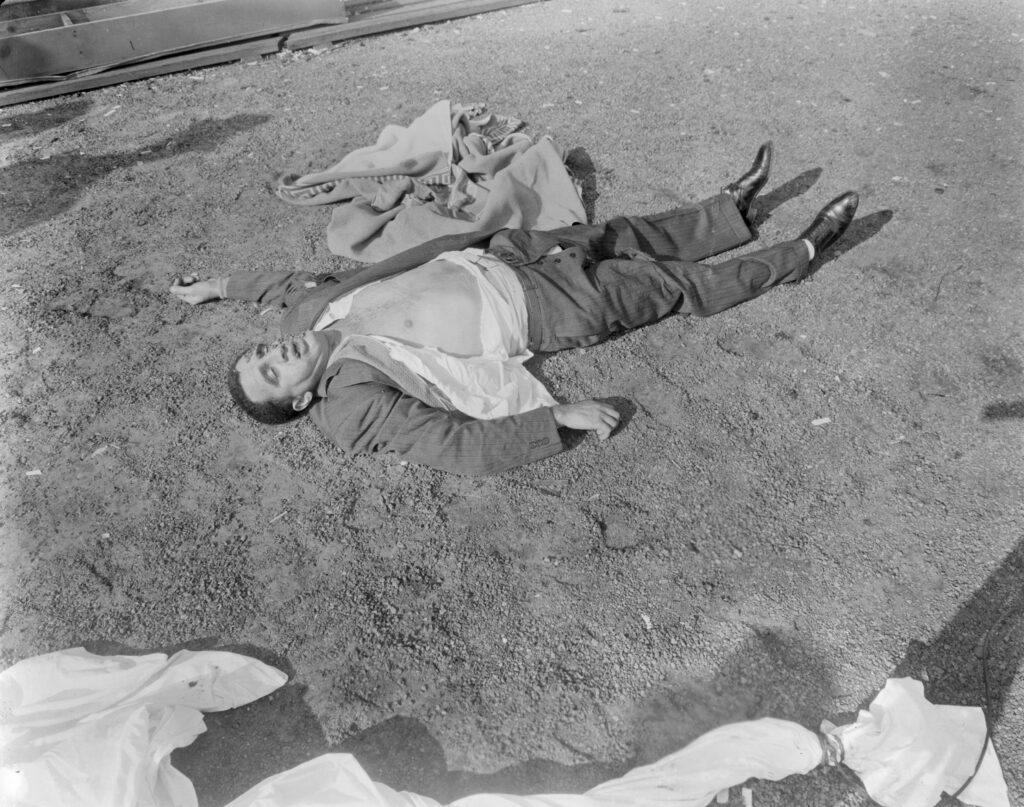
Investigators surround the body of Abe Reles, where it lay on an overhang of the Half Moon Hotel. Courtesy of Cipollini Collection

The witnesses were housed on the sixth floor of the hotel for the better part of a year. During that time, they were permitted visits from wives and other family, and transported to and from various courtrooms in and outside New York.

By November 1941, Reles had already testified in three Murder Inc. cases. Two of those trials sent four of his former gang pals to the electric chair. A third trial – that of Irving Nitzberg for the murder of Albert “Plug” Shuman – almost gave Old Sparky another notch. Nitzberg avoided execution several times and eventually got out of prison altogether.

Reles had also traveled to Los Angeles to testify against a syndicate big shot – Benjamin “Bugsy” Siegel. Interestingly, the more valuable (though ultimately futile) testimony was offered by Tannenbaum in that case. Reles was not quite as important. That said, Reles was expected to be brought back to California to again offer testimony against Siegel. That day never came.

Flight of the songbird

Sometime between 3 a.m. and 6.30 a.m. on the chilly morning of November 12, 1941, Reles jumped, slipped or was forced out of the window of Room 623 of the Half Moon Hotel. He had been scheduled to testify that morning against Anastasia, the alleged Murder Inc. boss.

The news of Reles’ death spread quickly, followed by rapidly multiplying conspiracy theories. In the aftermath, five members of O’Dwyer’s witness protection force were demoted. Captain Frank Bals, overseer of the security squad, came under heavy scrutiny and offered contradicting information, yet was defended throughout by O’Dwyer himself.

According to a grand jury, Reles fell to his death while attempting to climb out of the window with a makeshift rope that could not hold his weight. Courtesy of NY Municipal Archives

Many questions were raised regarding how secure the witnesses really were, who was in charge that night and, of course, was the Mob behind Reles’ demise? Besides his scheduled appearance against Anastasia, Reles was also expected to again take the stand against Siegel and Louis “Lepke” Buchalter, who was arguably the top prize for eager law enforcement entities. Among other things, it was evident that Lepke, along with Anastasia and Jacob “Gurrah” Shapiro, was a direct overseer of Murder Inc. and possibly the most accountable.

But did Reles’ mysterious free fall ruin the plan to get Lepke? No. Buchalter, Mendy Weiss and Louis Capone were all put to death after convictions for their roles in the murder of Joseph Rosen in 1936. Reles’ testimony would have been good for the prosecution but, as it turned out, the incriminating testimony came from Tannenbaum’s mouth.

Who did it?

Nobody really knows what really took place. However, a grand jury investigation concluded in 1951 that Reles’ death was an accident. The grand jury further condemned many aspects of the investigation. Among the points of criticism: no specific guard was ever in charge; some evidence was simply disposed of or not examined; the extremely long amount of time it took to identify and then examine Reles’ body; and the unaccountable hours between the last moment Reles was seen alive and the moment when he was found dead.

Despite the bad taste left in their collective mouths, the grand jurors determined from all the evidence they studied that Reles had tried to lower himself to the partially open window of Room 523 (which showed evidence of scrapings they believed were caused by Reles trying to grab the window sill), was too heavy for the wire and bedspread rope he had fashioned for this purpose.  

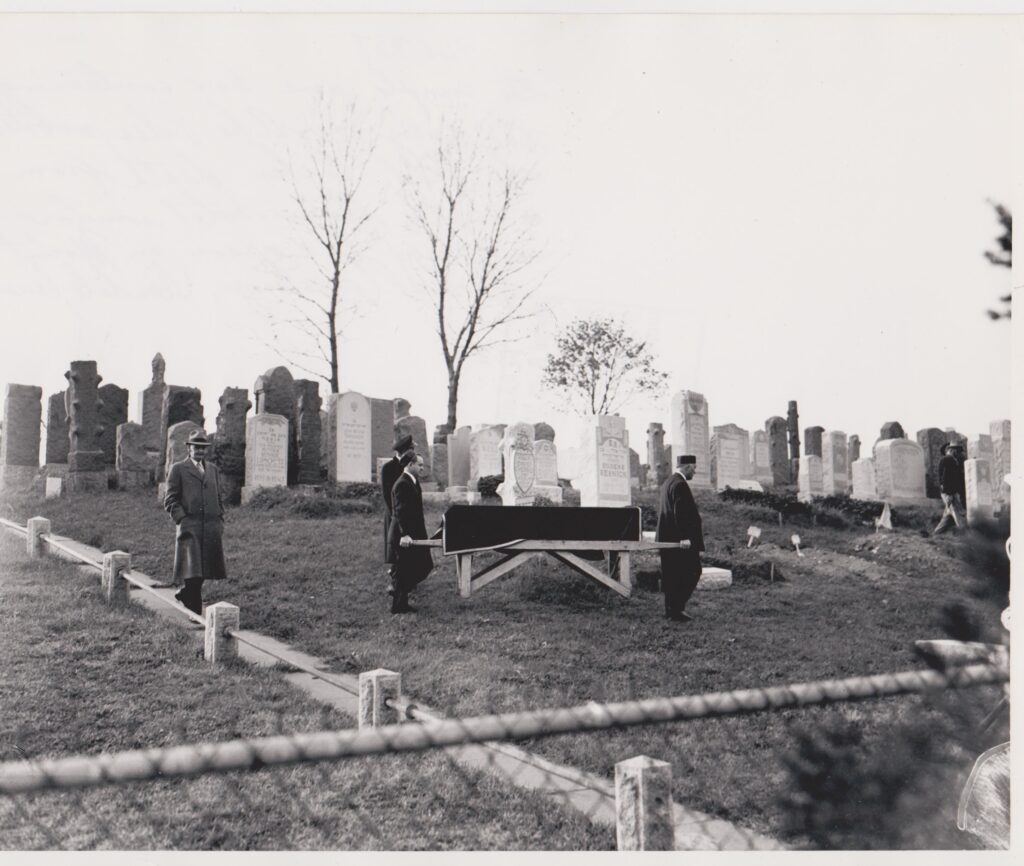
Abe Reles’ casket is carried to his final resting place in Mount Carmel Cemetery in New York. Courtesy of Cipollini Collection

Plus, if anyone had really wanted to kill Reles, it likely would have been done already, as there had been ample opportunities for more than a year because the witnesses were accessible from time to time. The stories or theories of Reles suffering from the symptoms of syphilis, or having been drunk at the time, were also dismissed by the investigation.

“Reles died of a fractured dislocation of the fourth and fifth lumbar vertebras, ruptured liver and spleen and hemoperitoneum (hemorrhage in the abdomen),” according to the grand jury statement on his cause of death.

In the early 1950s O’Dwyer – then ambassador to Mexico – was called before the Kefauver Committee to answer questions regarding his purported friendship with mobster Frank Costello and how it came to pass that Anastasia never once entered a courtroom during the Murder Inc. trials. O’Dwyer offered few concrete replies to the probing questions, and when grilled on the Reles/Anastasia situation, he replied: “When Reles went out the window … [the case went] out the window with him.”

Christian Cipollini is the author of Murder Inc.: Mysteries of the Mob’s Most Deadly Hit Squad and LUCKY, a gangster graphic novel.

Mobsters blamed for Election Day violence in New York City 90 years ago

Before a hotly contested battle for the New York mayor’s office culminated in a big win for a “law and order” candidate in November 1933, the typical vitriol and mudslinging on the campaign trail devolved into violence. This was not politics as usual. The Mob’s political influence was on the line, so out came the brass knuckles and blackjacks.

Political intrigues

Nationally, neither the Republicans nor the Democrats were in exceptionally good standing with American voters. This was the Great Depression, and there was plenty of blame to go around.  Voters in New York’s five boroughs were presented with a rare opportunity to seriously challenge both dominant forces. This was especially intriguing for constituents fed up with the corruption and scandals inside the powerful Democratic machine of Tammany Hall.

Weeks before people headed to the polling stations, the press predicted that disruption and clashes would haunt the New York election.

The stage was set for major change. Investigations into New York City corruption began in 1930, spearheaded by Judge Samuel Seabury, and the allegations led straight to the mayor’s office. 

Under mounting pressure, Mayor Jimmy Walker resigned in September 1932 and fled the country. In his place stepped Joseph McKee, but that was short-lived, and John O’Brien filled the position. Challenging the old system, with a special focus on reducing the Tammany influence, two third-party ticket options emerged: the Fusion and Recovery parties.

To the surprise of many, the maverick movements gained an almost unprecedented following as more than 50,000 voters registered with these new parties. The Fusionists essentially tried to harness the best of both major parties and “fuse” them into one incorruptible and righteous entity.

Meanwhile, Republicans tussled over who should be their candidate. Enter Fiorello LaGuardia. The staunch tough-on-crime Republican wasn’t anybody’s first choice, but according to the book Others: Third Parties During the Great Depression, strong endorsements turned the tide in his favor. “As it turned out,” author Darcy G. Richardson writes, “the GOP acquiesced to the highly regarded Seabury and the City Fusion leadership at almost every step in the candidate-selection process.”

Drama unfolded on the Democratic side as well. McKee, viewed as a viable candidate for any party, entered the race late and ran on the Recovery party ticket. Both new parties were granted approval just weeks before the election.

The O’Brien campaign tried to distance itself from former Tammany Mayor Walker. O’Brien, however, was not viewed as a particularly strong contender, and spent much of the campaign defending his record and principles.

Blood in the streets

The two-pronged threat against Tammany gained momentum as Election Day approached. Efforts by concerned factions commenced to “dissuade” voters from making the “wrong” decision, and bloodshed soon followed.

“Fist fights, slugging and violence splotched the nation’s largest city today as more than 2 million voters determined whether Tammany Hall would control municipal government for four more years,” according to an Associated Press report on November 7, 1933.

News reports described groups of people attacking opposing groups at rallies and speeches leading up to November 7. On Election Day, the bloodletting was blamed almost entirely on roving bands of men who accosted voters, poll workers and campaign staff throughout Manhattan. A handful of daily newspapers spiced up the copy with colorful, sometimes gratuitous prose. One of New York’s papers went a step further, calling out and laying blame on two specific Lower East Side mobsters, neither of whom were household names, at least not yet. 

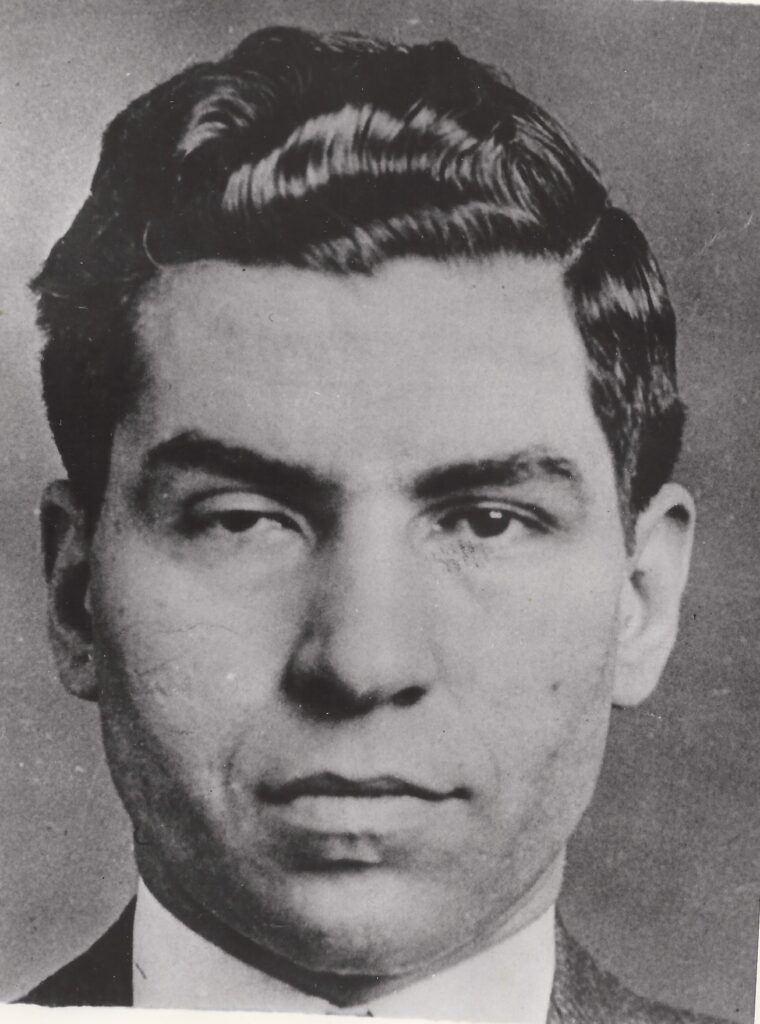
According to the New York Daily News, coordinated transgressions were carried out by underlings of August Del Gracio and Charles “Lucky” Luciano. “Gangster Del Grazzio, who has inherited the name Little Augie because of his prominence as a hoodlum, was in charge of the Tammany strong-arm squad at the Baxter and Hester corner,” said one Daily News report.

Charles “Lucky” Luciano’s mugshot in 1931, arrested on felony assault charges. Courtesy of Cipollini Collection
 

Luciano’s minions, the paper alleged, mobilized around Public School 21 at the intersection of Elizabeth and Spring streets. “During the morning Lucky’s gangsters slugged Fusion, Socialist, Recovery and Communist voters without discrimination. … Policemen on duty turned their backs on the beatings.”

Winners and losers

Luciano and Del Gracio both grew up in Lower East Manhattan and were associates in the underworld. Although Luciano was a familiar figure to local law enforcement and newspapers (the Daily News had covered him quite a bit since 1928), he was not yet well known outside the city.

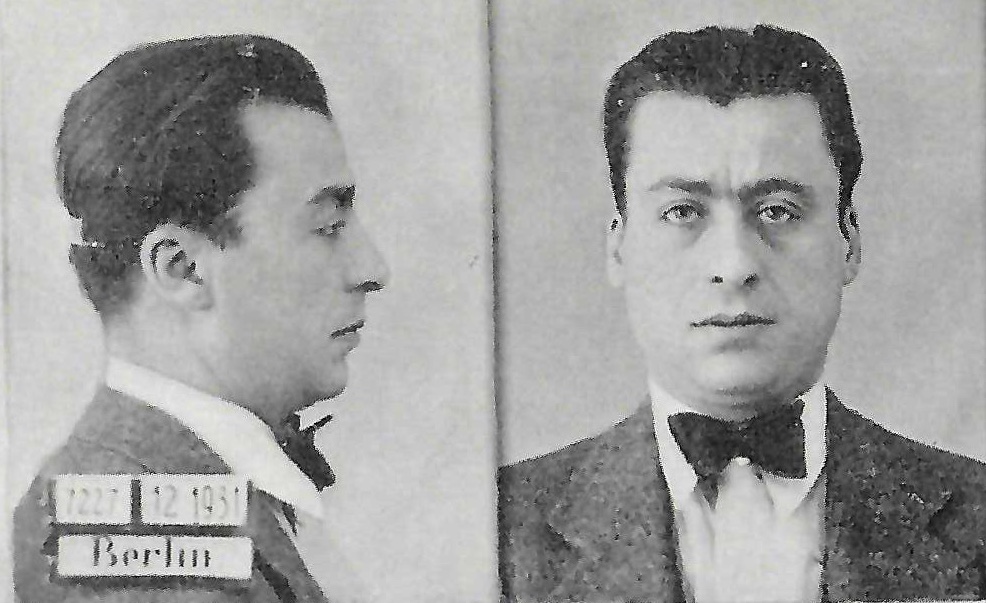
Conversely, Del Gracio had already earned international media notoriety as a world-traveling drug trafficker. Earlier that year he was named to the Top 10 list of traffickers by Egypt’s Narcotics Bureau and the League of Nations. Augie’s full story and role in the Mob has never gotten much traction in the broader annals of organized crime history, but back in 1933 he was probably as good a choice as any when putting a name or a face to a crime.

Arguably, both men were plausible culprits. Thomas Hunt, publisher of Informer Journal, says LaGuardia’s well-known anti-organized crime stance certainly would have been strongly opposed by Luciano and his associates, but where the allegations of direct involvement in the day’s chaos originated is anybody’s guess. “Possibly, Fusion spokespeople fed that information to the press,” Hunt theorizes. “If the press was going to invent a story about the person in charge of muscling voters, I’m not sure they would have decided on Lucania.” (Lucania is the actual spelling of Luciano’s name.)

August Del Gracio’s mugshot from his 1931 arrest in Berlin on drug charges. Courtesy of United Nations Library & Archives

Despite the barbarity of its efforts, and regardless of who ordered it, the Mob didn’t chalk up much in the win column that day. Richardson summed up the rather unusual voter turnout: “Astonishingly, more than 1,119,000 New Yorkers voted for mayoral candidates, including La Guardia, on independent or minor party tickets that year, while barely a million voters pulled the Democratic and Republican levers.”

All the coercion and head-busting tactics apparently couldn’t stop the fast-moving winds of change. In the end, the Fusion-backed candidates did well across the board. LaGuardia won the race with 858,551 votes. McKee came in second with 604,045 votes. Tammany fell to a hard third: O’Brien was unable to carry even one of the five boroughs.

Christian Cipollini is the author of Murder Inc.: Mysteries of the Mob’s Most Deadly Hit Squad and LUCKY, a gangster graphic novel.

Classic Mob movie ‘Mean Streets’ celebrates 50th anniversary

Martin Scorsese’s Mean Streets, released in October 1973, is regarded as a classic crime drama, depicting a New York City neighborhood teeming with dead-end types and some wiseguys.

The movie was the first collaboration between Scorsese and actor Robert De Niro. Their later work would range from character studies such as Taxi Driver and Raging Bull to Mob movies such as GoodFellas, Casino and The Irishman. More recently, Scorsese and De Niro collaborated on Killers of the Flower Moon, set in 1920s Oklahoma during the Osage Nation murders.

On his own Instagram page, director Francis Ford Coppola, whose blockbuster movie The Godfather was released one year before Mean Streets, called the 80-year-old Scorsese “a wonderful person and the world’s greatest living filmmaker.” 

Complicated relationships

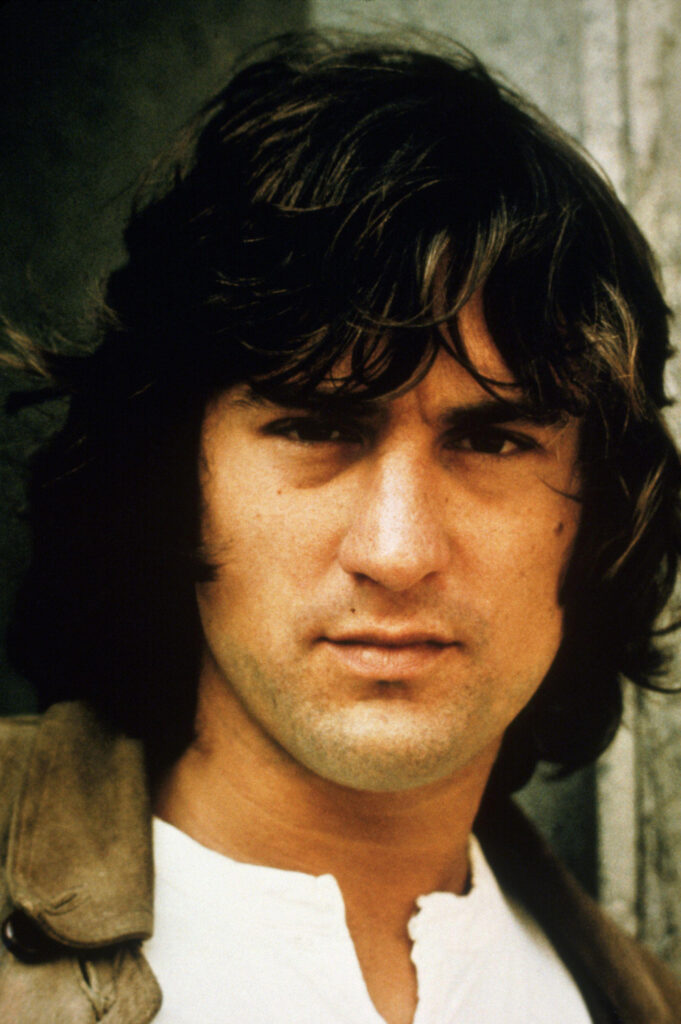
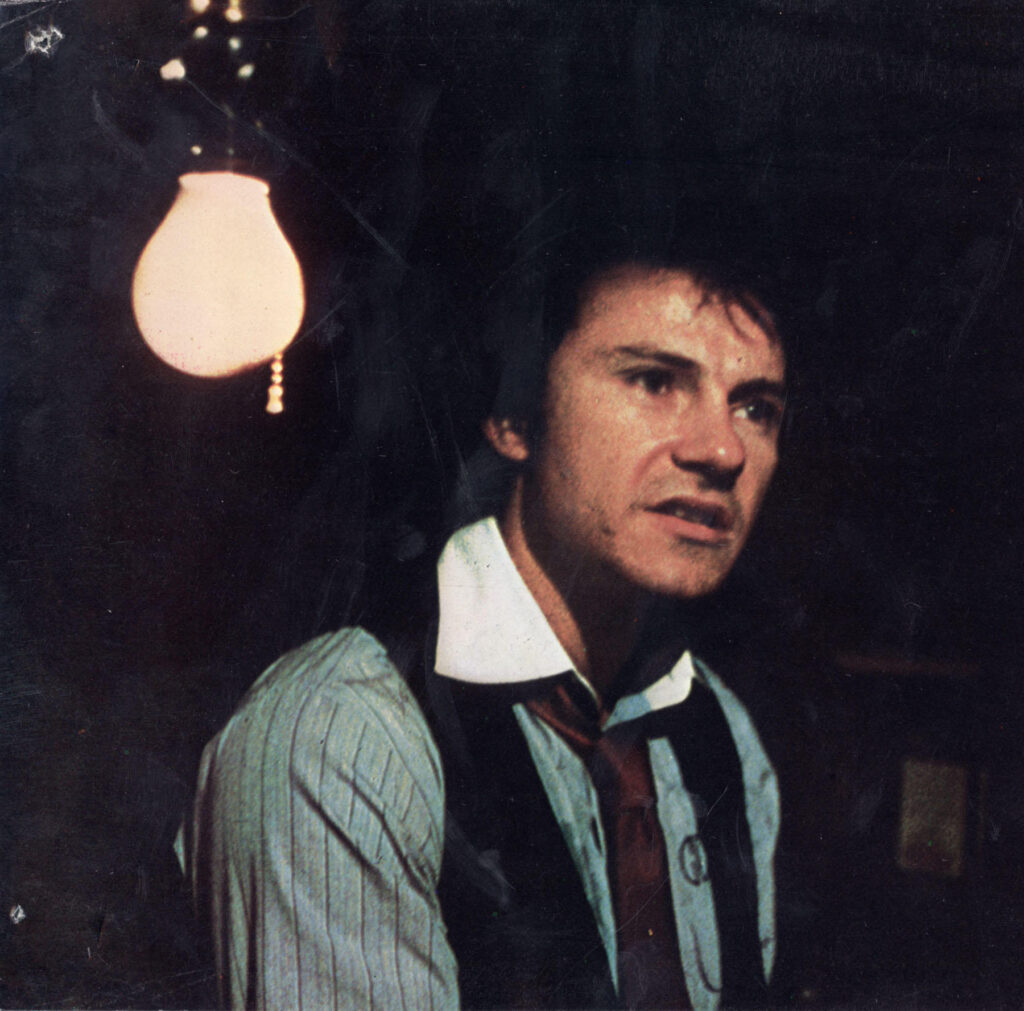
In Mean Streets, filmed on a tight budget, De Niro plays Johnny Boy, a foolish hothead in debt to a badgering loan shark. Harvey Keitel portrays a mobster’s nephew named Charlie who battles religious guilt as he seeks redemption by watching over Johnny Boy.

Robert De Niro plays Johnny Boy, the irresponsible and annoying sidekick to Harvey Keitel’s lead character. Entertainment Pictures / Alamy Stock Photo

“You don’t make up for your sins in church,” according to a voice-over at the beginning of the movie. “You do it in the streets. You do it at home.” The narration is provided by Scorsese to distinguish between Charlie’s thoughts and actions.

Charlie is dating Johnny Boy’s cousin Teresa (Amy Robinson), complicating the family connections that add conflict to the story, which was co-written by Scorsese and Mardik Martin.

Part of the Scorsese legend is that he grew up around people like these in New York City. According to America: The Jesuit Review, Scorsese was “a Catholic schoolboy educated by the Sisters of Charity on the Lower East Side of New York.” Scorsese told the publication that Mean Streets “has a very, very strong religious content.”

Scorsese’s neighborhood roots run deep in real life and on the screen. His mother, Catherine, appears toward the end of the movie, helping Teresa as the young woman struggles with epilepsy.

The Oscar-winning director has cast his mother in other movies, including Casino, released in 1995, two years before she died at age 84. Casino, a Mob movie set mostly in Las Vegas, was her final role.

Mobsters impressed

In film critic Glenn Kenny’s book Made Men: The Story of Goodfellas, Scorsese discusses his upbringing in Manhattan’s Little Italy during the 1940s and ’50s. Scorsese said he grew up in a “closed community” of Sicilians and Neapolitans.

“It took me me years to work out what was happening among the organized crime characters,” Scorsese said.

Several figures from those formative years would show up, at least as representative characters, in a string of Scorsese Mob movies, including Mean Streets.

When that movie first came out, it scored points with critics and even hit home with low-level gangsters such as Henry Hill, who, according to Kenny, was impressed by its accurate portrayal of “life among the Little Italy mooks.”

Many years later, actor Ray Liotta would portray Hill in Goodfellas, with Paul Sorvino cast as a character based on Mob underboss Paulie Vario.

Long before Goodfellas thrust Hill into the spotlight, he took the real Mob underboss, Vario, to see Mean Streets. “Vario was reportedly similarly impressed,” Kenny wrote.

‘Something extraordinary’

The New York City on display in Mean Streets is dark and forbidding, an ominous setting populated by hustlers, crooked cops, strippers and even an unhinged Vietnam combat veteran. The dive bar that serves as a hangout for the characters in Mean Streets is filmed in an eerie red glow that evokes the hellish world these people inhabit.

Harvey Keitel plays Charlie, a young Mob enforcer and nephew of a feared Mafioso in Manhattan’s Little Italy neighborhood. RGR Collection / Alamy Stock Photo

In addition to using lighting as a mood-setter, Scorsese employed other signature techniques in Mean Streets that would become familiar as his reputation grew, including pop music to propel the story and violence as a character trait.

Over time, Scorsese would make “slicker, better-crafted movies,” according to authors George Anastasia and Glen Macnow in The Ultimate Book of Gangster Movies, “but the nuts and bolts of who he is and what he’s about are here.”

The authors rank Mean Streets No. 14 of the Top 100 gangster movies, just behind Léon: The Professional and ahead of Reservoir Dogs.

On one level, watching Mean Streets is like finding some old film of Joe DiMaggio and Mickey Mantle and Willie Mays during their first seasons in the big leagues,” the authors wrote. “The raw talent is there. There are sparks and smoldering potential.”

With Mean Streets, Scorsese was among a handful of filmmakers breaking new ground for Mob movies. While The Godfather highlighted Mafia royalty, movies such as Mean Streets and director Peter Yates’ The Friends of Eddie Coyle, both released in 1973, drew attention to those on the underworld’s bottom rungs.

According to Anastasia and Macnow, Mean Streets “was one of the first to tell the story from street level.” This echos what Henry Hill noticed years earlier — that Mean Streets, as Anastasia and Macnow put it, “is not about a Mafia don or the capo of a crew.”

“It’s about a bunch of guys from the neighborhood who are ‘connected,’ some directly and some, as is more often the case in real life, through a series of vague relationships,” the authors wrote.

Looking back on its significance, Anastasia and Macnow said Mean Streets “helped define a genre.”

“More important,” the authors noted, “it marked the start of something extraordinary in the American cinema.”

Larry Henry is a veteran print and broadcast journalist. He served as press secretary for Nevada Governor Bob Miller, and was political editor at the Las Vegas Sun and managing editor at KFSM-TV, the CBS affiliate in Northwest Arkansas. Today, he is a senior reporter for Gambling.com. The Mob in Pop Culture blog appears monthly.
Defiance of Kefauver Committee put Frank Costello behind bars for 14 months

When New York underworld boss Frank Costello famously walked out while being questioned by the Kefauver Committee in 1951, he may not have fully understood the implications of his actions. Or maybe he did. Either way, he was charged with contempt of court and sentenced to 18 months in prison.

On October 29, 1953 – 70 years ago this month – Costello, once dubbed by Treasury agents as the “Prime Minister of the Underworld,” exited a federal prison in Michigan after serving about 14 months of his 18-month sentence.

Frank Costello is pictured in October 1939 following an arrest on tax evasion charges. Courtesy of Cipollini Collection

Costello’s record reflected a few stints in jail as a younger man but he managed to avoid any lengthy prison for decades (the closest call was a tax evasion charge in October 1939 that was dismissed). That winning streak began to fizzle out on March 15, 1951, when, as a witness before Tennessee Senator Estes Kefauver’s Special Committee on Organized Crime in Interstate Commerce, he refused to answer any more questions.

The responses he had previously provided were evasive at best, arguably hostile at worst. Costello’s refusal to answer questions regarding his net worth or about his relationship with William O’Dwyer (the former district attorney in charge of the Murder Inc. prosecutions) particularly drew the ire of the presiding senators.

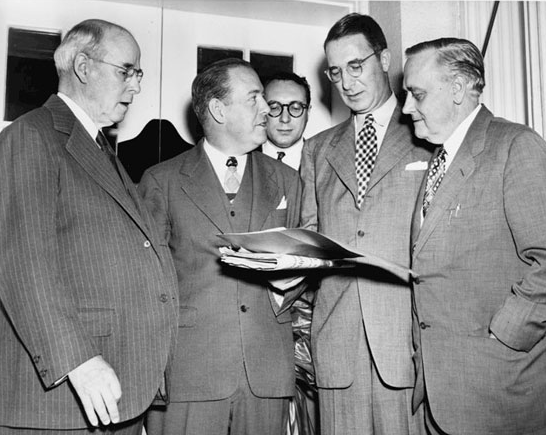
Members of the Senate Crime Investigating Committee. From left: Senator Charles Tobey, Senator Herbert O’Conor, chief counsel Rudolph Halley, Senator Estes Kefauver and Senator Alexander Wiley. Courtesy of Library of Congress

Eventually Costello made it clear he wanted no more part in the proceedings.

“Am I under arrest?” he asked.

“No,” replied Rudolph Halley, the committee’s chief counsel.

“Then I am walking out,” Costello fired back.

Costello defiantly stood up, but stopped short of fully exiting the hearing room while a brief period of exchanges ensued, culminating with Costello’s attorney stating that his client had “acute laryngotracheitis” and producing a doctor’s note recommending bed rest. The committee wasn’t satisfied with the excuse and reminded Costello that he was under subpoena to appear and that leaving would be in violation. Despite the warning, Costello, with his lawyer in tow, left the room.

The incident left the senators in dismay, while producing deliciously scandalous fodder for the press to exploit. In contrast to the closed preliminary hearings held a month before, the committee hearings on New York organized crime were opened to photographers, reporters and TV cameras, thus making it quite a public affair. At that time, roughly half of American households had a television set. The live televised hearings placed subpoenaed mobsters in the visual spotlight as well as the committee itself.

Costello wasn’t the only big name scheduled to appear before the committee in New York. Others called to testify included Frank Erickson, Joe Adonis, William O’Dwyer and Virginia Hill. Costello requested that only his hands would appear on camera, and it was approved. Of course, there are many photos of him that appeared in newspapers and newsreels, but for TV viewers, they only got to see his fidgeting hands and hear his raspy voice.

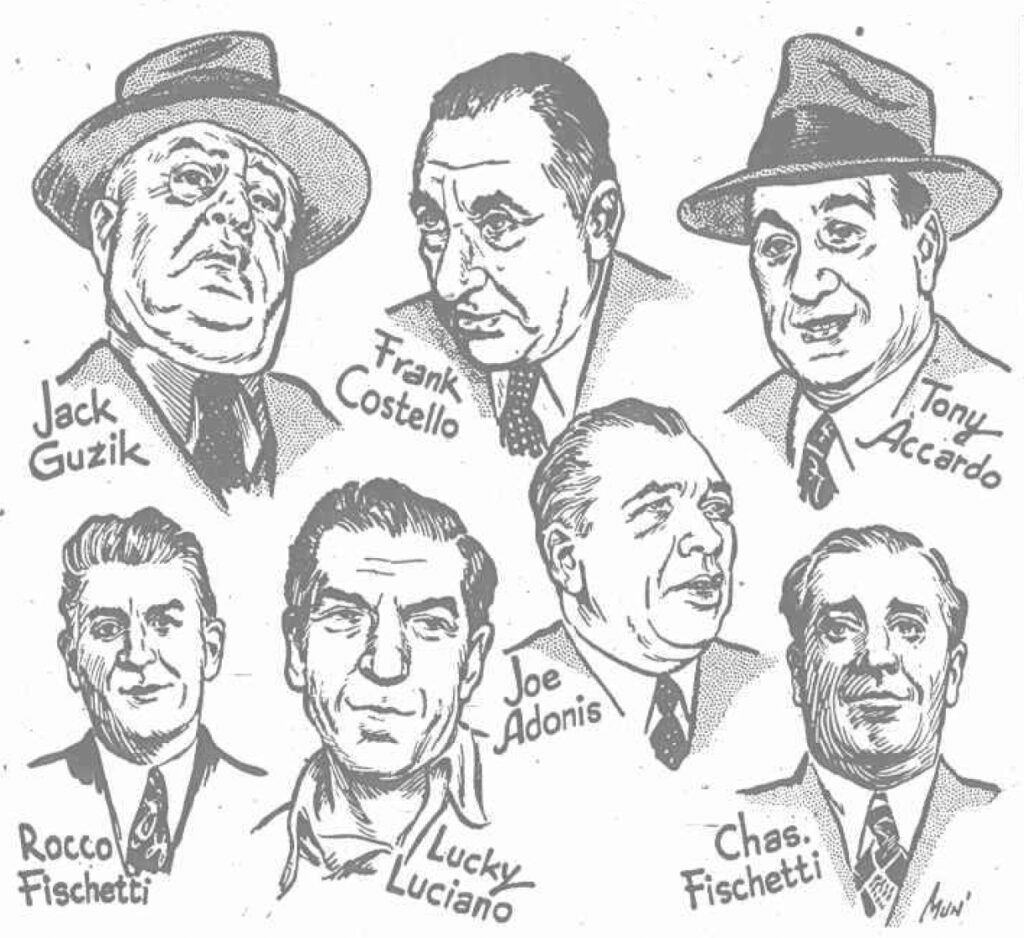
During the Kefauver hearings, newspapers named Frank Costello one of the Mob’s “Big Six” underworld figures. Oddly, seven mobsters are depicted in the sketch. AP sketch by H. E. Munhall

To Costello’s dismay, the committee’s threats were not idle. It filed 11 contempt charges with the U.S. attorney, and Costello was brought to trial in January 1952. The jurors were deadlocked but a second jury convicted Costello on 10 counts. He was sentenced to 18 months in federal prison, plus a $5,000 fine (later reduced to $2,000 on appeal). Costello went to the U.S. Courthouse in New York and surrendered to U.S. Marshal Tom Farley at 10:10 a.m. Friday, August 15, 1952.

“Tell the boys I have come in to do my bit,” Costello announced to surrounding reporters. “I don’t want no favors from nobody. I wanted to be treated like everybody else.”

Costello was moved around several prisons before winding up in the federal institution at Milan, Michigan, on December 27, 1952, where he served out the rest of his sentence. Milan was a minimum-security penitentiary. Previously, Costello had been held in maximum-security facilities, including Atlanta’s federal pen, but the grounds for his conviction were deemed suitable to be served in what the press called a “common jail” facility.

Upon his release from the Michigan prison on October 29, 1953, Costello was greeted by his wife and whisked away by car, doing his best to lose pursuing reporters. They boarded a train in Detroit and arrived in New York the next day, but not without a dose of token Costello cleverness. The couple didn’t arrive at the predicted destination – Grand Central Station – where reporters eagerly awaited. Instead, they disembarked at a junction in Westchester County and took a car back to Manhattan.

Costello was out of prison, but his legal troubles weren’t over. The government had already been actively looking to challenge Costello’s U.S. citizenship, and another tax evasion case was looming.

Christian Cipollini is the author of Murder Inc.: Mysteries of the Mob’s Most Deadly Hit Squad and LUCKY, a gangster graphic novel.

Tod Goldberg’s Mob trilogy concludes with ‘Gangsters Don’t Die’

The third novel in a Mob trilogy by author Tod Goldberg was released in September, completing the tale of a Chicago hit man on the run after killing three federal agents and a confidential informant.

With the killings behind him, and being hunted, mobster Sal Cupertine leaves Chicago, making his way to Las Vegas and assuming a new identity as Rabbi David Cohen. His wife and son remain back home, not knowing what happened to him or where he is.

The three novels — Gangsterland, Gangster Nation and Gangsters Don’t Die — can be read as standalone thrillers, but when read in order, they guide readers chronologically through a period from the late 1990s into the 2000s, with flashbacks.

Each novel moves through a series of plot twists and, in several cases, deadly encounters. In the first novel, Cupertine states his belief in three things: family, duty and retribution. That theme plays out, sometimes violently, throughout the trilogy.

‘Grist for a crime writer’

Goldberg’s knowledge of the Las Vegas area beyond its casino culture gives his novels an authenticity that challenges stereotypes. Among his 16 published books are 14 works of fiction and two travel guides to Las Vegas.

Tod Goldberg, a former Las Vegas resident, takes care in his Gangsterland trilogy to get Las Vegas right, from the geography to the public figures who find their way into the narrative.

In the trilogy, the Las Vegas references include names such as Mob defense attorney Oscar Goodman, now a former mayor; local residential areas such as Summerlin; and the state’s largest daily newspaper, the Las Vegas Review-Journal.

Goldberg’s understanding of the territory is evident in concrete details (down to unique plant names) and through his characters’ observations. Many of these observations are humorous, while others are scathing — Las Vegas, to one character, is “a fetid sunburnt bowl of dust in the middle of nothing. Just another Pleasure Island, filled with liars and thieves.”

A native Californian, the 52-year-old Goldberg grew up in Walnut Creek and Palm Springs. Since the 1980s, he has visited Las Vegas often and was a resident from 1998-2000. Currently, he is professor of creative writing and director of the low-residency MFA in Creative Writing & Writing for the Performing Arts program at the University of California, Riverside.

Goldberg’s many trips to Southern Nevada helped spark his creative instincts.

“When you live in the Coachella Valley, skipping across the desert to Las Vegas is an easy jaunt,” he said in an email, “particularly if you go the secret back way, through the nameless desert mining towns where, if you have a good imagination, you start to think about hiding bodies.”

The author’s mother, Jan Curran, was a society columnist for the Desert Sun newspaper in Palm Springs, east of Los Angeles, popular throughout the years among entertainers such as Frank Sinatra and Dean Martin — and with mobsters.

As a newspaper columnist, Curran attended social events in the 1980s and ’90s, putting her in contact with some of the underworld figures in Palm Springs. Goldberg grew up around his mother’s stories and was exposed to even more in Las Vegas, where the Mob was covered extensively in the news media.

“It was all fascinating grist for a crime writer,” said Goldberg, whose brother, Lee Goldberg, also is a best-selling writer, with a new novel, Malibu Burning, now available in bookstores and online.

In Tod Goldberg’s recent trilogy, his knowledge of Chicago adds additional credibility and depth to the novels.

“Chicago is a town I’ve come to love over the last 25 years,” Goldberg said. “I’ve visited many times, and a small press based out of Chicago published two of my early story collections, so I’ve spent a fair amount of time there.”

A recognizable world

With his Mob books, Goldberg said he is attempting to reinvigorate a subject that “waxes and wanes” in public popularity.

“When Gangsterland came out in 2014, I was told beforehand that the Mob novel was dead, that it had been done to death and there was no way to make it more original than The Sopranos managed to do over its incredible run on HBO,” he said.

Goldberg said there was a long period when Mob stories essentially were a rip-off of two classic films, The Godfather, scripted by novelist Mario Puzo and director Francis Ford Coppola, and Goodfellas, which journalist Nicholas Pileggi and director Martin Scorsese co-wrote.

“I absolutely felt pressure writing the first novel in the series,” Goldberg said. “But I decided, ‘Well, I’m going to admit what we all know in the book itself: that Mario Puzo had both created and ruined the modern story of organized crime, that modern gangsters were influenced more by the books and movies than they were about some ancient notion of omertà.’ And once I did that, I think I landed on a recipe for success, which is that you admit the failure of the genre while trying to reinvigorate it.”

For Goldberg, crime stories can go deeper than just action and mystery, though he is highly effective with those components. He said crime fiction “hangs a mirror up to society and forces us to take a hard look.”

“During the pandemic, I found myself settling in for the night by watching some gruesome true crime show, only falling asleep once the killer was behind bars,” he said. “And I realized that I really needed to see chaos reordered in those days when everything felt so unsure. It’s very fulfilling to see justice and the end of chaos, the world reset to some sense of normal. Or at least if not normal, the world is recognizable again.”

In that regard, Goldberg’s books can appeal to readers who prefer literary fiction with complex characters, but also to those who really only want a great story. Goldberg’s list of favorite crime writers shows the influences that shape his work.

“My favorite crime novelists would be Elmore Leonard, who taught me how to create empathy in even the most woebegone characters; Daniel Woodrell, who showed me that to be truly great means to write the novels only you can write; Donald Westlake, who taught me how to end a story; Dennis Lehane, who showed me that emotional and literary complexity has a place in modern crime fiction; and my brother Lee, who paved the road for me,” he said.

He also has learned from authors not thought of as crime writers.

“My favorite novelists in general would include Susan Straight, who taught me that the desert and the Inland Empire can be as vivid as any big city; Richard Ford, whose early stories showed me how to write men with guns who still felt like humans on the inside; Richard Russo, whose novels of small-town conflict remind me, always, that it’s not about the size of the place, it’s about the size of the problem; Margaret Atwood, who has mixed genres for her entire career and done so masterfully; and lastly Robertson Davies, who taught me the nature of fate in fiction.”

Goldberg has other literary influences as well. “About 50,000 others,” he said.

Path toward redemption

The concept of creating mobsters as fully developed characters hits home with other authors. One is Eric Dezenhall, whose novels include The Devil Himself, which explores the U.S. government’s collaboration with mobsters such as Meyer Lansky decades ago in confronting the Nazis.

Dezenhall said the public responds well to an unexpected humanity in these kind of stories, and to “something we never saw coming.”

“I’m thinking about Tony Soprano and the ducks and Donnie Brasco’s Lefty sobbing in the hospital at his son’s drug addiction,” Dezenhall said in an email. “When I wrote The Devil Himself, the angle that interested me was Meyer Lansky’s desire to work with the Navy in the Second World War because he wanted to be an American, to fight Nazis and be a positive part of American history. The thing that got to me most in reviewing Lansky’s private records were the notations he made in books such as ‘remember to look up Thucydides.’”

Mob stories continue to generate interest, Dezenhall said, because they area perversion of the superhero fantasy — the idea that there is someone who doesn’t have to play by the rules, do whatever he wants and that everyone fears.”

“At a lizard level, wouldn’t we all like that even though on a moral level we know it’s wrong?” he said. “It’s telling that the angriest anybody got over anything I said about the Mob [in a radio interview] is that Meyer Lansky didn’t have a $300 million fortune, the Mob didn’t compromise J. Edgar Hoover, and Tony Accardo wasn’t more powerful than the president.”

Giving readers fully developed characters, including mobsters like those in Goldberg’s recent trilogy, keeps the story from becoming hackneyed and can uncover truths about human nature.

In Goldberg’s fictional world, a ruthless criminal like hit man-turned-rabbi Sal Cupertine, though deeply flawed and violent, might somehow find himself on a path toward redemption in a religious context.

“Because as much as the books are about an exploration of violence and the culture which abets it, it’s also a journey of the soul, watching how a bad man becomes a better man when he’s exposed to some notion of faith,” Goldberg said.

Larry Henry is a veteran print and broadcast journalist. He served as press secretary for Nevada Governor Bob Miller, and was political editor at the Las Vegas Sun and managing editor at KFSM-TV, the CBS affiliate in Northwest Arkansas. Today, he is a senior reporter for Gambling.com. The Mob in Pop Culture blog appears monthly.