

Latest search for Jimmy Hoffa’s remains joins long list of fruitless attempts

The FBI announced in July that it did not find any sign of the body of former Teamsters Union leader James Hoffa after surveying and digging for weeks near a former New Jersey landfill. The news came only days before the 47th anniversary of Hoffa’s disappearance outside Detroit.

“Nothing of evidentiary value was discovered during that search,” Special Agent Mara Schneider, public affairs officer for the bureau’s Detroit field office, said in a prepared statement. “While we do not anticipate any additional activity at the site, the FBI will continue to pursue any viable lead in our efforts to locate Mr. Hoffa.”

Thus, the agency concluded yet another attempt to locate Hoffa’s final resting place, a search that began after he vanished from where he was last seen, a restaurant parking lot in suburban Detroit on July 30, 1975. In November of that year, the FBI, based on a mobster’s tip, looked around the same Jersey City dump site but found nothing.

Since 2000, subsequent explorations had agents digging at a former card casino in Gardena, California; under a suburban swimming pool in Hampton, Michigan; at a farm in Milford, Michigan; a backyard in Roseville, Michigan; the site of a demolished building at a football stadium in New Jersey (on the say-so of a Mob informant); and looking inside a home in Bloomfield, Michigan.

Other less-credible reports, including that Hoffa was stuffed in a barrel and dumped into the Florida everglades (via another Mob squealer) and that his body was melted into steel shipped to Japan, also are part of the Hoffa legend.

Origins of New Jersey search

It was the work of Dan Moldea, investigative journalist and Hoffa expert, that persuaded the FBI to again comb the New Jersey landfill. Moldea remains convinced that Hoffa’s corpse is really there, and that the agency somehow missed it.

His question is whether the FBI examined the exact spot adjacent to the one-time PJP Landfill beneath the Pulaski Skyway overpass. This spot is where Frank Cappola insisted that his father, Paul, the landfill’s Mob-connected co-owner, once showed him where he buried Hoffa in a metal drum shortly after the labor figure went missing.
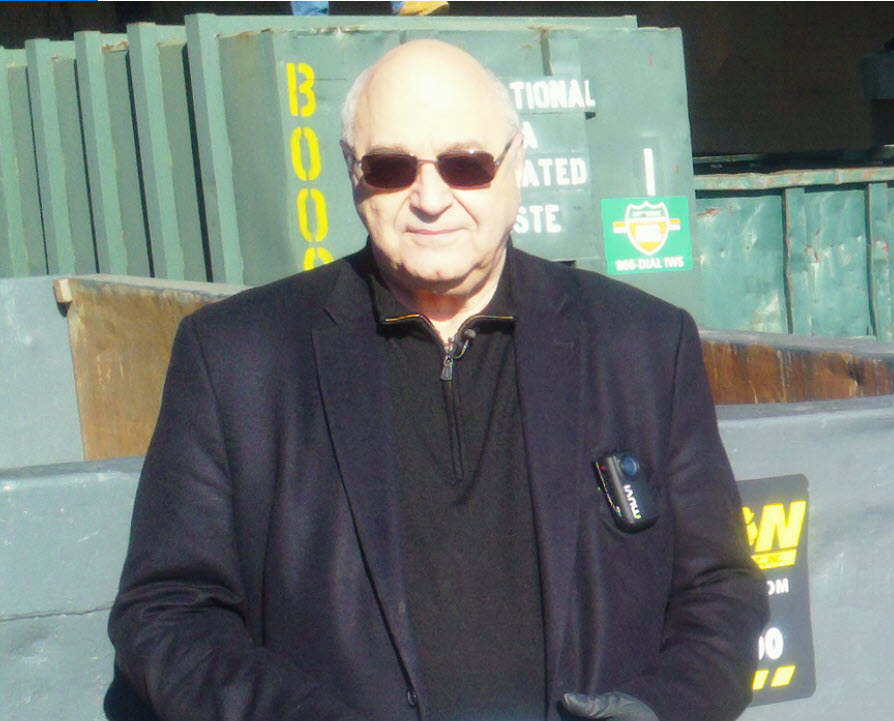
Investigative journalist Dan Moldea poses at Brother Moscato’s Dump, aka the PJP Landfill, in Jersey City in 2020 amid a clutter of dumpsters. Moldea’s research indicated that Jimmy Hoffa’s remains are located in a barrel buried on land adjacent to the dump, but an FBI search in 2022 turned up nothing. Courtesy of Dan Moldea (Copyright © 2020 by Dan E. Moldea)

“Regardless of how this plays out, I still believe that Hoffa is or was buried at or near PJP in Jersey City after his 1975 murder in Detroit . . . and we just can’t find him,” Moldea wrote after the FBI’s announcement on July 21.

Another Hoffa expert offered a different perspective.

“I want Dan to be right; there is no one more on Dan’s side than me,” said Scott Burnstein, an author, Detroit organized crime expert and member of The Mob Museum’s Advisory Council. “I have nothing but respect for Dan.”

Nevertheless, Burnstein trusts that the FBI followed the parameters of the search warrant granted for the New Jersey site. The Detroit-based agents have worked hard for many years for answers and genuinely want to find Hoffa’s remains. The agency, Burnstein said, has spent “tens of millions if not $100 million” over the decades trying to solve the Hoffa whodunit.

“It’s not some case collecting dust. It’s an active case,” he said. “They were going to take this lead at the maximum priority level. There’s pride involved. They’re doing it for the guys who came before them.” 

Author committed to landfill story

Moldea, who has written about Hoffa since the mid-1970s, defends his scenario about how and where Hoffa’s body ended up in New Jersey.

Before Frank Cappola’s death in 2020, Moldea had him stand at the precise spot of the purported Hoffa grave and pose for a photo there. Later, Moldea’s crew of civilian investigators and a separate team from Fox News hired companies using ground-penetrating radar (GPR) devices to check for anomalies deep inside the soil. Moldea said both firms found potential evidence that might confirm Frank’s story.   

However, the FBI told him that its GPR readings failed to confirm what his and Fox’s readings showed, and so the agency decided not to dig there.

Burnstein does not think the FBI will conduct another search of the New Jersey location. “It would be great for the FBI to entertain going back, but that’s not something they are even considering,” he said. “That’s what I’ve be told.

“I have a hard time believing they have all of this stuff and they would get the warrant for parts of the area and not other parts.”

If it came down to choosing between the private company’s GPRs done for the Moldea and Fox crews and the government’s, Burnstein said, “I’m going to put my money on the government GPR.”  

Different theories on Hoffa death

Moldea and Burnstein, who are friends, have different hypotheses about Hoffa’s demise. Their views are theories because the case is still unsolved, and may never be, since virtually everyone with direct knowledge about it is dead.  

Moldea recalls that his interest in Hoffa’s Teamsters Union started in December 1974 while a graduate student at age 24. He wrote a newspaper series about the union, which led to research jobs on Hoffa for NBC News and the Wall Street Journal just before the labor boss’s disappearance. Moldea has since been a leading investigative journalist about all things Hoffa. He wrote The Hoffa Wars, published in 1978.

Moldea’s theory that Hoffa was buried near the New Jersey landfill appeared to be promising. The New Jersey idea goes back almost to the start of the Hoffa investigation. In November 1975, several months after Hoffa went missing, the FBI checked out a tip from Ralph Picardo, an associate of New Jersey Mafia capo Anthony “Tony Pro” Provenzano, that Hoffa’s body was buried at the PJP landfill.

As Moldea sees it, Tony Pro contracted Genovese crime family hit man Salvatore Briguglio to kill Hoffa after luring him to a supposed meeting with Provenzano, Detroit Mafia street boss Anthony “Tony Jack” Giacalone and Mob associate Leonard “Little Lenny” Schultz at the Machus Red Fox restaurant in suburban Detroit on the afternoon of July 30, 1975.

Based on Moldea’s many interviews and research, he posits that after Hoffa was murdered, Tony Pro ordered a barrel containing Hoffa’s body transported hundreds of miles from Detroit by truck and delivered to PJP for disposal.

Moldea believes Picardo told the FBI the truth about Hoffa’s burial in the Jersey City site.

While in business, the landfill was nicknamed “Brother Moscato’s Dump,” after the late Phillip “Brother” Moscato, a soldier for New York’s Genovese family who operated it with Paul Cappola.

Moldea reported that Frank Cappola, who submitted to 30 hours of interviews from 2019 to 2020, told him that Moscato ordered Paul Cappola to bury the barrel containing Hoffa’s remains. Cappola said he was 17 years old when a limousine pulled up at PJP with a drum presumably containing Hoffa’s body. He watched as handlers removed the body from the barrel and inserted the corpse head first into a different one.

Frank recounted that his father argued with the people who brought Hoffa’s body. They directed Paul to bury Hoffa in a specific spot at the landfill. But Paul told Frank that, fearing the place was under surveillance by police, he went back at night to a different location just outside the landfill. He used a backhoe to dig a large hole and plunged the Hoffa barrel to the bottom. He dropped a group of up to 15 other barrels over it and covered the whole thing with dirt and debris while leaving a marker somewhere underground.

The area where Paul claims he buried Hoffa is government property, now used as a park and nature preserve.

Burnstein paints a different picture of the murder and disposal of Hoffa’s body. To him, Tony Pro, of New Jersey’s band of the Genovese family, played only a minor role in the conspiracy to eliminate Hoffa. The murder scheme, he said, centered on the Giacalone brothers, Anthony “Tony Jack” and Vito “Billy Jack,” both higher-ups in the Detroit Mafia.

They were happy with the union money kicked back to them by corrupt Teamsters president Frank Fitzsimmons and did not like hearing that Hoffa wanted to run for union president again in 1976, he said. Hoffa had also made certain threats to them, and there were rumors he’d been an FBI informant. Hoffa saw that the only way to return to lead the union was with government backing, and so he might have to run on an anti-corruption platform. To the Giacalones, that jeopardized further payoffs to the Detroit family.
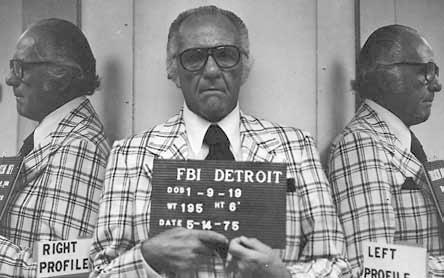
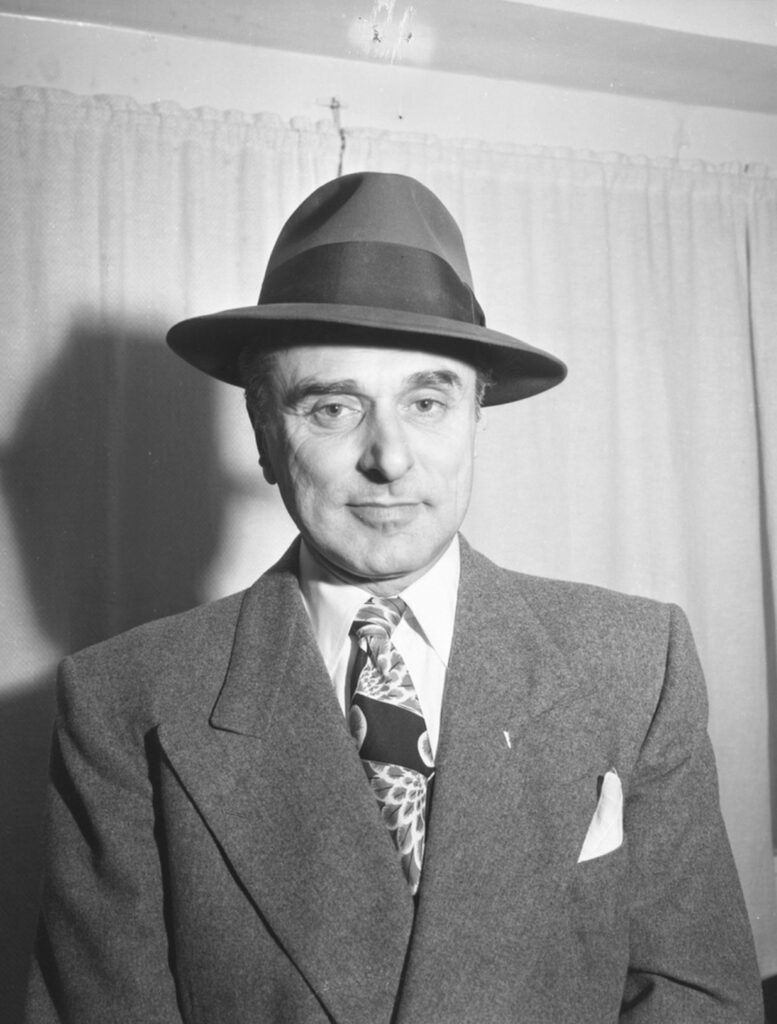
Journalist Scott Burnstein believes Hoffa was killed by a hit man assigned by Detroit Mafia bosses Anthony “Tony Jack” Giacalone (pictured) and his brother, Vito “Billy Jack” Giacalone. Burnstein believes the union leader’s body was incinerated or cremated in the Detroit area.

Even though Hoffa and Tony Pro were on bad terms then, Hoffa needed the voting block the mobster held among union members to win election as president. Hoffa, Burnstein said, “was blinded by his obsession to take over the Teamsters” and agreed to a risky meeting with Provenzano, Anthony Giacalone and Schultz.  

The theory Burnstein currently favors about Hoffa’s death is that after he entered a car owned by Anthony Giacalone’s son, Hoffa was driven a few miles to a home owned by Carlo Licata, a Detroit Mafia soldier and brother-in-law of Detroit’s acting boss, Giacomo “Black Jack” Tocco. Hoffa had met with the Giacalone brothers there multiple times, so he may not have suspected anything. He was killed in Licata’s home, according to this viewpoint.

The consensus among FBI agents in Detroit, based on wiretaps and informants, is that Hoffa’s killer was local Mafia soldier Anthony “Tony Pal” Palazzolo, Burnstein said.

Hoffa then likely ended up “incinerated, cremated” in one of the nearby sanitation businesses or funeral homes controlled by the Detroit family, he said. The Giacalone brothers, he added, engaged in a “disinformation campaign” from the 1970s to the 2000s to confuse authorities and cover their tracks about Hoffa’s murder.

Burnstein said that to show the lengths the FBI went to find out what happened to Hoffa, they bugged the nursing home in which the 88-year-old Vito Giacalone lived from 2011 to his death in 2012. But they picked up nothing to resolve the ongoing mystery of what happened to Hoffa, and his body.
Latest from popular crime novelist Don Winslow delves into 1980s Mafia drama

Don Winslow, an author known to many in recent years for stories about cartel violence along the U.S.-Mexico border, has released a novel set in Rhode Island, a small New England state that once had a large Mafia presence.

The first in a trilogy, City on Fire centers on a war during the 1980s between Irish and Italian mobsters in the state’s capital, Providence.

At first, the two factions remain on respectful terms, but then a member of the Irish crime family inappropriately touches a woman dating one of the Italian mobsters. This drives a wedge between the groups that escalates when the woman marries this same Irishman.

Against this backdrop is a fast-paced series of shootings, betrayals and tragedies.

Ready to turn his back on the destructive environment in his hometown, Irish mobster Danny Ryan dumps millions of dollars’ worth of heroin into the ocean and shoots a corrupt federal agent to death.

Apparently headed to California with his son to start over, Ryan concludes, “If you want to build a new life, a clean life, you can’t do it on top of sin.”

Packed with action, violence and sex, this tale, inspired by Homer’s Iliad, appears ready-made for a television miniseries. Readers familiar with Winslow’s border novel Savages, made into a movie by director Oliver Stone, have an appreciation for how effectively his plot-driven thrillers translate to the screen.

Las Vegas connection

A portion of City on Fire is set in Las Vegas, where a showgirl originally from a poor family in Barstow, California, marries a wealthy Southern Nevada lingerie manufacturer, the “Undergarment King of the World,” and, in time, begins engaging in extramarital affairs. One brief relationship, with a man she meets in a bar at the Flamingo hotel-casino on the Las Vegas Strip, results in the birth of Danny Ryan.

Deciding she’s “not cut out” to be a mother, the former showgirl travels to Rhode Island to drop the child off with his gangster dad, then ultimately makes her way back to Las Vegas.

After her husband’s death, with wealth of her own, she reappears in Danny Ryan’s life to help his family financially during their later difficulties. However, Danny’s smoldering resentment toward her for leaving him motherless won’t subside, and she is driven away.

Mafia stronghold

The use of Providence as the primary setting gives City on Fire a ring of geographic authenticity. While the novel doesn’t touch on the area’s historical mobsters, Providence earned a reputation decades ago as a Mafia stronghold, ruled by crime boss Raymond Patriarca, whose empire extended across the region.

In the book Black Mass, by former Boston Globe journalists Dick Lehr and Gerard O’Neill, the iron-fisted Patriarca is described as “the New England godfather.” The 2015 movie Black Mass, starring Johnny Depp as Boston gangster James “Whitey” Bulger, is based on the book.

Providence also is featured in the first season of the documentary podcast Crimetown, which follows the plight of former Mayor Buddy Cianci, a convicted felon, and shines a light on the city’s underworld.

In addition, Providence is where crime novelist George V. Higgins got his start in journalism as a newspaper reporter, learning about the Mafia’s involvement in the city.

Leaving the Providence Journal behind, Higgins returned to Boston, where he’d gone to college, and worked as a reporter for the Associated Press, then as a prosecuting attorney sometimes handling organized crime cases.

With this background, Higgins was critical of fiction writers who lack real-world work experience. His most celebrated New England-based crime novel, 1972’s The Friends of Eddie Coyle, was made into a movie starring Robert Mitchum.

”The disability of much American literature is that it’s written by college professors sitting on their big fat rusty-dusties who don’t know anything about law, politics or any subject in which real people make real livings,’’ Higgins said.

Winslow retiring from fiction writing

Like Higgins before him, Winslow is a novelist whose work life has included employment in different fields. A Rhode Island native, the 68-year-old Winslow has held down several jobs, including movie theater manager, private investigator in Times Square and safari guide in Kenya.

As an investigator mainly in California, Winslow lived with his family in hotels for almost three years while working on cases and consulting at trials.

The author of 22 books, Winslow now is active on social media sites, speaking out on gun violence and other issues. His Twitter account, identifying him as “#1 International bestselling author + troublemaker,” has almost 900,000 followers.

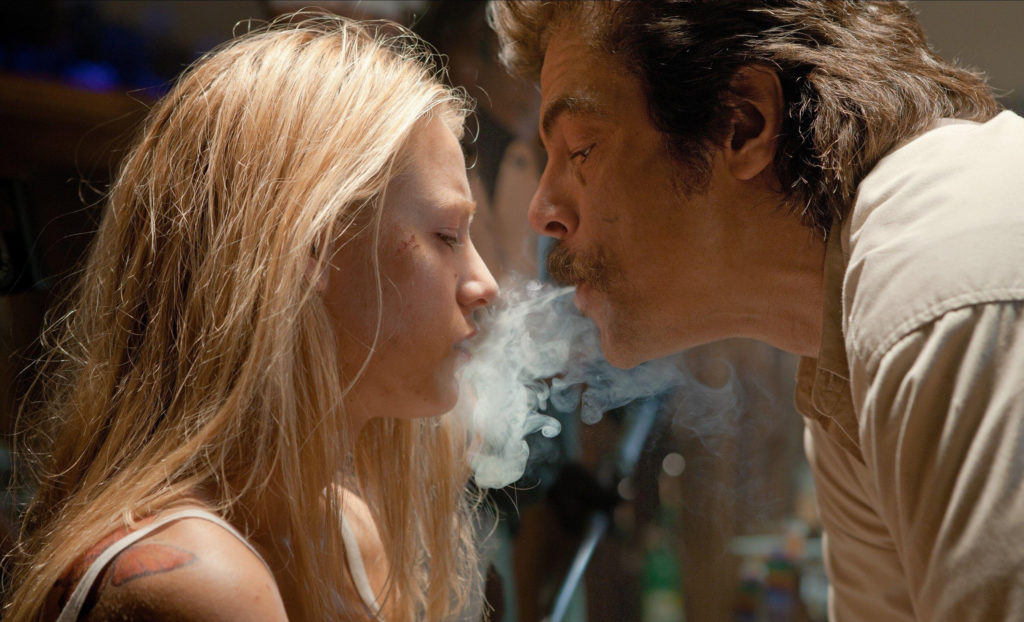
Blake Lively and Benicio Del Toro in Savages, the 2012 movie based on a Don Winslow novel. Maximum Film/Alamy Stock Photo

On his YouTube channel, “Don Winslow Films,” the author has created a video series, with help from celebrities such as Bruce Springsteen and Jeff Daniels, criticizing political figures such as former President Donald Trump.

Winslow’s activism shows no signs of slowing down. On a recent episode of PBS NewsHour, Winslow, responding to why he is retiring from fiction writing after completing this Mafia trilogy, said it is time for him to step off that stage to focus more on public policy.

“We’re in an existential crisis for democracy around the world but particularly here at home,” he said. “I think this is going to be a fight. It’s a fight we have to win, and I wanted to devote more time and energy to that fight.”

Larry Henry is a veteran print and broadcast journalist. He served as press secretary for Nevada Governor Bob Miller, and was political editor at the Las Vegas Sun and managing editor at KFSM-TV, the CBS affiliate in Northwest Arkansas. Today, he is a senior reporter for Gambling.com. The Mob in Pop Culture blog appears monthly.

‘Godfather’ castmates remember James Caan

James Caan, the versatile actor who achieved lasting fame as hot-headed Sonny Corleone in the 1972 Mafia movie The Godfather, died July 6 at age 82.

After the recent death of Goodfellas star Ray Liotta, the news that Caan and Sopranos actor Tony Sirico also have died added to the grief felt by fans who consider the three of them among the best at depicting Mafia characters.

Liotta, who was 67 when he died May 26, portrayed gangster Henry Hill in Goodfellas and recently appeared in another Mob movie, The Many Saints of Newark.

Sirico, a convicted felon who turned to acting, played the malaprop-prone mobster Paul “Paulie Walnuts” Gualtieri in HBO’s The Sopranos TV series. Sirico died July 8 at age 79.

Lasting legacy

The cause of Caan’s death was not immediately disclosed, but when the news broke, many recalled his several popular roles, including in the TV series Las Vegas and movies such as Misery and Elf

In his pre-Godfather acting career, Caan was remembered for his portrayal of cancer-stricken NFL football player Brian Piccolo in the television movie Brian’s Song, a moving portrait of the Chicago Bears running back and his friendship with teammate Gale Sayers. Piccolo, 26, died in 1970.

But Caan’s performance as the temperamental son of Don Vito Corleone (Marlon Brando) solidified a reputation for memorable acting that endures 50 years after The Godfather premiered. The role earned him an Oscar nomination.

‘Fiery portrayal’

The Bronx-born son of Jewish immigrants, Caan modeled his Godfather character in part on wiseguys he knew in New York, such as Andrew “Mush” Russo, a cousin of the Colombo crime family’s Carmine “The Snake” Persico.

Caan’s performance was so convincing that some people later would try to provoke Sonny-like responses from him, author Mark Seal said in an email.

Seal’s 2021 book Leave the Gun, Take the Cannoli examines how director Francis Ford Coppola’s movie came together despite obstacles and now is regarded as a masterpiece. Among the unforgettable scenes involving Caan is one in which Sonny is gunned down at a parkway tollbooth, still considered shocking and gruesome.

“James Caan’s fiery portrayal of Sonny will surely be remembered as one of the greats, as evidenced by what Caan told me about how people would test him in public to see if he would react like Sonny Corleone,” Seal said.

“I won Italian of the Year twice in New York,” Caan said, according to the author, “and I’m not Italian.”

Master of the improv

During filming, Caan’s character really jelled when he began to channel Don Rickles, the insult comedian. As Seal notes in the book, it was this “rapid-fire, Don-Rickles-meets-the-Mob bravado that elevated his character to a whole new level.”

Seal recalled conversations with Caan about the actor’s interpretation of the bold Corleone son depicted in Mario Puzo’s novel The Godfather. Another son, Michael (Al Pacino), is level-headed and responsible. A third, Fredo (John Cazale), shows signs of weakness. But Sonny is brash and action-oriented.

“I first met him in person in 2008, in his home in Beverly Hills, and I remember seeing an artist’s depiction of the three Corleone brothers and the Don on his wall,” Seal said. “We spoke for hours that day and thereafter, but (the Rickles story) was critical to how he brought Sonny Corleone to life so vividly — and fiercely — on the screen.”

Caan became so wrapped up in the character that he improvised scenes that Coppola, a classmate at Hofstra University, left in the movie. Among these is Caan’s ad lib of the phrase “bada bing.”

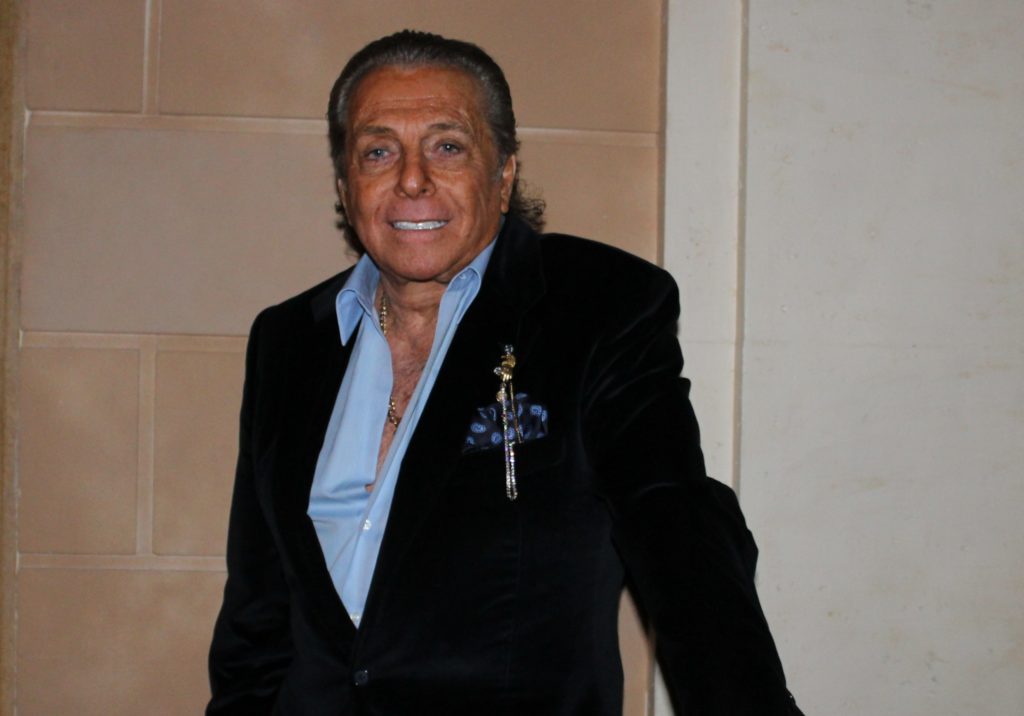
Gianni Russo, who played Carlo Rizzi in The Godfather, says he was injured during a fight scene with James Caan. Russo is pictured at The Mob Museum in 2019.

The expression comes up when Sonny is explaining to his brother Michael, a former combat Marine, that he can’t shoot two targeted Corleone enemies from a mile away, like in the military.

“You gotta get up close, like this — bada bing,” Sonny says.

In the book, Seal notes that this term was “sent straight from improv heaven and would quickly become a mantra for mobsters and aspiring mobsters.” Years later, a fictional strip club that the central characters in The Sopranos use as a Mob hangout is called the Bada Bing.

At least one Godfather cast member, Gianni Russo, was not impressed with Caan’s improvisational skills. Russo played Carlo Rizzi, the abusive husband of Sonny’s sister, Connie.

During a phone call after Caan’s death, Russo recalled how Caan veered from the script in throwing a sawed-off broom handle at him in a fight scene and beat him so badly during filming that he was left with a chipped elbow and a couple of cracked ribs.

Russo, author of the 2019 memoir Hollywood Gangster: My Life in the Movies and the Mob, said Caan earlier had set him up to be embarrassed in the presence of mobsters at Jilly’s, a Manhattan nightclub during that period.

Throughout the years, the two of them never got along, Russo said.

Fond memories

Johnny Martino, a Brooklyn-born actor who played Paulie Gatto in the movie, said he saw the news about Caan’s death online.

“I wasn’t sure I was reading it right,” he said over the phone.

It was reported that Caan struggled at one time with drug abuse and had run-ins with the law regarding alleged violent behavior. Martino said he knew Caan had been using a wheelchair because of leg problems, but he had no idea the actor was nearing the end of his life.

Martino remembered Caan as a “tough guy from Queens” who also was a practical joker. “He and Brando would kid sometimes,” Martino said.

Once on the set, with Caan nearby, Brando let his unfastened pants drop, Martino said. Caan earlier had mooned Brando from a moving car.

Johnny Martino, who played Paulie Gatto in The Godfather, fondly recalls Caan from the filming of the classic movie. He said Caan and Marlon Brando exchanged practical jokes on the set. Martino is pictured at The Mob Museum in 2022.

On the phone two days after Caan’s death, Martino was waiting in line to enter a minor league ballpark in Florida where New York Mets star Jacob deGrom was pitching for single-A St. Lucie. The Mets ace was rehabbing in the minors while recovering from an upper-body injury.

The 85-year-old Martino said he is a fan of both New York big league teams, the Mets and Yankees. Incidentally, Caan spent much of his youth in Queens, where the Mets play their home games. The Yankees are from the Bronx, where Caan was born.

Though Martino was going in to see the baseball game, he took a minute to talk about his friend James Caan. In their younger years, they had been fellow actors enjoying the experience of being on the set of a movie that no one knew would turn out to be a hit, he said.

“It was truly exciting,” Martino said.

Martino said he wishes he’d had a chance to connect with Caan again. “I wanted to see him one more time,” he said.

Although Caan is best known for his Godfather role, he starred in a number of other films, including the well-reviwed 1981 crime thriller Thief, which has a Mob plot line. Thief marked the directorial debut of Michael Mann. He also co-starred with Hugh Grant in the 1999 Mob comedy Mickey Blue Eyes.

Seventy-five years later, debate over Bugsy Siegel murder still rages

As Americans opened their newspapers on June 21, 1947, they saw large headlines about the murder of Benjamin “Bugsy” Siegel, who, according to a United Press story, was the “nation’s No. 1 gangster.” As Time magazine noted, “for a managing editor who likes a good, splashy crime story, the murder of Benjamin “Bugsy” Siegel in a Beverly Hills mansion had everything.”  For several days, “the tabloids of Manhattan, the sensational papers of Los Angeles and, to a lesser degree, papers all over the U.S. played it high, wide & handsome.” Because this crime has never been solved, it still captures our attention. While we know what happened to Siegel, there is much speculation about who killed him and why.

Siegel was hit two times in the face and two in the chest. There were five other shots that missed him.

Siegel had arrived in Los Angeles early in the morning of June 20. He had been successful in completing the construction of the Flamingo casino with a fabulous opening on December 26, 1946, and of the hotel, which had opened on March 1. The property had begun to make a profit, but Siegel still faced substantial unpaid construction costs. Those around him in May and early June saw a man worried about how to pay off those debts, a man who needed to take a few days off from the stress. 

Siegel had leased a house at 810 North Linden Drive in Beverly Hills for his mistress, Virginia Hill. She had run off to Paris after another of their many spats. Since the lease was about to end, Siegel needed to collect some clothes. He also had scheduled a meeting with publicist Paul Price and his lawyer, Joe Ross, to discuss a promotion campaign for the Flamingo. Most importantly, his daughters, Millicent and Barbara, were going to join him in Los Angeles for a vacation. He had divorced his wife, Esta, the previous August, and this would be the first time since October to see the girls, who were traveling by train from New York.  

That evening Siegel went to dinner with his friend Allen Smiley, Hill’s brother Chick and Hill’s secretary Jerry Mason, who was going to marry Chick. Smiley drove everyone back to the home on North Linden Drive, where he and Siegel relaxed on a sofa, as Smiley later explained, “chinning and skimming” newspapers. Mason and Hill went upstairs.

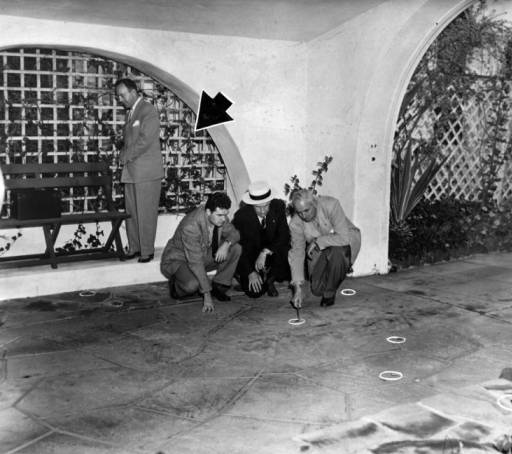
Siegel and Smiley chatted, blissfully unaware that someone was standing outside a window to their right. He rested a .30-caliber military carbine on the trellis just outside the window. The muzzle of the shooter’s gun was less than 14 feet from Siegel. A little before 11 p.m., he fired nine rounds. One hit the bridge of Siegel’s nose and knocked out his left eye, another round hit him in the right cheek, and two hit him in the chest. The other rounds hit the wall behind Siegel.  

One of the rounds had gone through Smiley’s jacket, but he was not wounded. He told the police, “I heard the glass shattering, and I ducked. I don’t know how many shots were fired, but when I looked at Siegel, I could see he had taken most of them.” Some neighbors rushed into the street after hearing the shots and saw a car that raced away. Hill called the police, who arrived on the scene within minutes.

In the early days of the investigation, Los Angeles County deputy district attorney Ernest Roll told reporters, “There might have been a hundred different people who wanted him out of the way.” This led journalists to raise all kinds of questions about the motive for killing Siegel. Had he crossed the wrong person in narcotics trafficking, or in the struggle to control the horse race wire service? Had he spent too much of the Mob’s money in completing the Flamingo, or had he skimmed their money? Had someone killed him for his ill treatment of Virginia Hill? Fairly quickly, Roll reluctantly concluded that Siegel’s shooter may “never be identified.” But over the past seven decades, gangster enthusiasts, journalists, historians and biographers have offered a variety of solutions to the crime.

One of the most enduring explanations for the hit on Siegel concerns a summit of Mob leaders that convened in Havana, Cuba. There is disagreement over whether it took place in December 1946 or February 1947, but most authors argue that notable underworld leaders Charles “Lucky” Luciano, Frank Costello and Meyer Lansky were in attendance. Those who support this theory argue that the leaders of the New York Mob decided that Siegel had to be eliminated, either because he had wasted or stolen their money. 

Detectives identify nine shells scattered across the driveway of the home next to where Siegel was shot. Los Angeles Herald Examiner Collection / Los Angeles Public Library

Those who subscribe to this theory usually add that the Mob leaders designated Southern California Mafia boss Jack Dragna to carry out the hit. Depending on the author, Dragna ordered one of three men to kill Siegel: mobster Frankie Carbo, mobster Eddie Cannizzaro or World War II veteran Robert McDonald, who, according to author Warren Hull, had a significant gambling debt he owed to the Mob.

In his co-authored 2013 book, Beverly Hills Confidential, Clark Fogg, who for many years was the senior forensic specialist in the Beverly Hills Police Department Lab, argued that there had actually been two shooters. Fogg concluded that “it would have been nearly impossible for just one gunman” to make such precise shots to Siegel’s face because “the mobster’s head would have turned upon impact from the first bullet.” He further believes mobster Joe Adonis hired the “Two Tonys,” Tony Brancato and Tony Trombino, to kill Siegel because he was stealing from the New York Mob.

Siegel’s girlfriend, Virginia Hill, was in Paris at the time of the shooting. She had left Las Vegas a couple of weeks earlier.

In July 1947, an FBI informant reported another intriguing claim about the identity of Siegel’s shooter, one that has also endured well into the 21st century. The informant said Meyer Lansky had suggested that Virginia Hill’s brother “may have killed Siegel because of Siegel mistreating Hill.” Siegel had been with Hill frequently for about five years, and, despite their having a passionate affair, they often fought. Bernie Sindler, who worked at the Flamingo in 1946 and 1947, made the same claim in his 2015 memoir, The Bernie Sindler Story.

Gus Russo, who wrote Supermob, a book about lawyer Sidney Korshak, who represented actors, corporate executives and mobsters, offered a variation on that theory. Russo said that Korshak was persuaded that Moe Dalitz, an underworld figure from Cleveland, had authorized the hit on Siegel because of his abuse of Hill, who had, for a time, been Dalitz’s lover. Screenwriter Edward Anhalt, who lived next to Hill for a time at the Chateau Marmont in West Hollywood, agreed. Anhalt described having dinner with Siegel in the spring of 1947 and having their meal interrupted by the maitre d’ handing Siegel an envelope. After reading the message inside, Siegel “really looked worried.” Anhalt contended that a friend told him the letter was from Detroit (Dalitz was also associated with the Detroit Mob) warning Siegel to leave Hill alone. 

In 2014, Amy Wallace, in Los Angeles Magazine, published a story that placed Moe Sedway, a longtime associate of Siegel’s, at the center of this murder. She drew upon an unpublished book proposal written by Moe’s widow, Beatrice. In her account, Bee claimed that Siegel planned to have her husband killed when he learned that Sedway was keeping a precise account of the business of the Flamingo and reporting the worsening debt situation to Meyer Lansky. Bee further claimed that Moe learned of Siegel’s plan and responded swiftly, getting Lansky’s approval to have Siegel murdered instead. The shooter, according to Bee, was Mathew “Moose” Pandza, a man with whom she was having an affair. 

Wallace wrote that Pandza followed Siegel’s movements on June 20 and drove behind Smiley to the house on North Linden Drive. After shooting Siegel, Pandza jumped into his car and “didn’t stop driving until he pulled into an alley in Santa Monica, where he broke down the rifle. He tossed the barrel into the ocean, the butt on a rooftop.”

Amid these conflicting claims, some things about the Siegel murder are clear. Most notably, it was a well-planned hit. On the evening of the shooting, during the 8:30 show at the Flamingo, eight men left their table in the showroom and moved quickly to the security desk, front door, casino cage and hotel registration desk, obviously to secure the property for what was to come.  Immediately after the shooting, Allen Smiley called a man who answered in a telephone booth just outside the Flamingo. The man had become an informant for Las Vegas FBI agent Curtis Lynum. Smiley told the informant that “Siegel had been shot in the face and chest, and he knew he was dead.” Only moments after Smiley’s phone call, Moe Sedway, along with Gus Greenbaum and Morris Rosen, walked into the Flamingo and announced that Siegel was dead, and that they were in control of the property.

Some researchers believe Moe Sedway, Siegel’s partner in the race wire in Las Vegas as well as the Flamingo Hotel, had something to do with his murder. The Mob Museum Collection

Although agent Lynum did not name his “super informant,” he did describe him. Lynum explained that before his arrival in Las Vegas in April 1947, a man came into “the Las Vegas resident agency and said he wanted to ‘help the FBI.’” Local agents had been able to verify the informant’s claims about the “underworld.” Moreover, as was true with Sedway, this informant “had a wife and children living in Los Angeles” while “he kept a mistress in Las Vegas.” He also “was thought to be a legitimate businessman” in town. Lynum explained that the informant’s “first information of importance . . . was keeping me advised of Siegel’s activities.” All of this evidence points to Sedway as the “super informant.” Indeed, FBI reports in both 1948 and 1951 identify Sedway as a “confidential informant” in Las Vegas. Knowing he most certainly was the informant Allen Smiley called after the shooting makes it easier to understand how Sedway, along with Greenbaum and Rosen, were in a position to enter the Flamingo so soon after Siegel died.

There is some circumstantial evidence from 1947 that confirms this conclusion. In August, an FBI agent in Las Vegas reported that someone (name redacted in FBI report) in the local police department told FBI agents that he had concluded that Sedway had “engineered the killing” because Sedway had “acted peculiarly just before Siegel was killed, and that since the killing he has been ‘nervous as a cat.’” In addition, Clinton Anderson, the chief of police in Beverly Hills, told Siegel biographer Dean Jennings, “I was convinced, and still am,” that Sedway “had a hand in the Siegel killing. He knew who did it.”

Moe Sedway did not pull the trigger, but he clearly played a role in the Siegel murder. He had to have been in close communication with the shooter or with someone who knew immediately that there had been a successful hit on Siegel. Otherwise, he would not have known when to march in and take over the Flamingo.

There is more to learn about the Siegel murder in Crime Case #46176 in the Beverly Hills Police Department. Unfortunately, because the Siegel case is an open one, researchers cannot view the file.

Larry Gragg is curators’ teaching professor emeritus of history at Missouri University of Science and Technology in Rolla, Missouri. He has published 10 books, including Bright Light City: Las Vegas in Popular Culture (2013), Benjamin “Bugsy” Siegel: The Gangster, the Flamingo, and the Making of Modern Las Vegas (2015) and Becoming America’s Playground: Las Vegas in the 1950s. His biography of Moe Sedway, titled Escaping Bugsy’s Shadow: Moe Sedway and Bugsy Siegel in Las Vegas, will be published in 2023 by the University of New Mexico Press.

HBO Max series ‘Tokyo Vice’ explores Japan’s criminal underworld

A new television drama series, available in its entirety on HBO Max, focuses on organized crime in Japan, featuring a Tokyo-based American journalist with sources on both sides of the law.

In Tokyo Vice, actor Ansel Elgort portrays Jake Adelstein, a Missourian working as a crime reporter in Tokyo, the first American ever in that role on the Japanese-language newspaper Yomiuri Shimbun.

In 1994, when Adelstein worked at the paper, the print edition had a circulation of 10 million, making it the largest in the world, according to its website. The newspaper’s daily circulation is still more than seven million. By comparison, The Wall Street Journal, among the most widely circulated U.S. newspapers, averaged 3.7 million combined digital and print subscriptions in the first quarter of this year. About 700,000 of those are print subscriptions.

Adelstein was a reporter at the Japanese newspaper from 1993 through 2005. The HBO Max limited series is inspired by his 2009 book Tokyo Vice: An American Reporter on the Police Beat in Japan. Adelstein had first gone to the country in 1988 as an exchange student and remained in Tokyo after being hired at the paper. His job was to cover crime. 

Rachel Keller plays Samantha Porter, an American expatriate who works as a hostess at a nightclub, in Tokyo Vice.

“As a Japanese police reporter for 12 years,” he said in an email, “I covered serial killers, robbery, loan sharks, sex work and the 20-plus organized crime families collectively referred to as the ‘yakuza.’”

The book and television series explore the inner workings of the yakuza, which Publishers Weekly calls the “top-most villains of Japan’s organized criminal underworld.”

‘The ultimate path’

In a profile of Adelstein 10 years ago, The New Yorker noted that, according to police, tens of thousands of yakuza members were active in Japan in 2012, “whereas in America the Mafia had only five thousand in its heyday.”

New Yorker writer Peter Hessler, who knew Adelstein during their younger years in Missouri and profiled him for the magazine, wrote that the yakuza name “refers to an unlucky hand at cards — yakuza means ‘eight-nine-three’ — and bluffing has always been part of the image.”

Adelstein writes in his book that many members of this “Japanese mafia” refer to themselves not as yakuza, but as gokudo, meaning “the ultimate path.”

While reporting on the Japanese underworld, Adelstein, a father now in his early 50s, encountered threatening and violent gangsters, and later was under police protection.

His book opens with yakuza enforcers demanding the reporter not write an unflattering story about their boss, who, Adelstein discovered, had gotten special access, which seemed “fishy,” for a liver transplant at a UCLA cancer center. Some of this information came from unnamed sources.

In a note at the end of the book, and on the website japansubculture.com, Adelstein explains that he went to great lengths to protect the identity of his sources in general, concerned they might otherwise be endangered.

“I have changed names, used nicknames, altered nationalities and identifying details, and more,” he writes in the book. “I’ve tried to keep a good balance between obscuring and misleading, and I hope that has worked.”

Gangster life

Asked to describe the yakuza, Adelstein said in an email that there is not a “monolithic ‘the yakuza’, but it’s a blanket term for many groups.”

“The yakuza have been around for centuries but only really came into power after the Second World War,” he said. “They are legal entities with office buildings, business cards and, up until 2017, several monthly magazines devoted to their exploits.”

Adelstein said the groups “claim to be humanitarian organizations.” They step in to assist during national emergencies, he said, including the 2011 Fukushima nuclear meltdown. Adelstein wrote about that incident for the Daily Beast news website. He continues to write for news organizations and has been involved in anti-human trafficking efforts.

“After major disasters, they often bring relief and supplies to devastated areas,” he said.

Traditionally, the yakuza have made money from activities such as racketeering, gambling, kickbacks, bid rigging and protection rackets.

“Most groups have a code of ethics which forbids certain practices,” he said. “Technically, yakuza aren’t allowed to commit street crimes. Rape is not allowed either.”

He added that the yakuza “frown on stealing purses, robberies, break-ins, muggings: all the crimes that make the general populace uneasy.”

“However, blackmail and extortion are generally acceptable,” he said. “I once asked an Inagawa-kai boss to tell me, ‘Why aren’t blackmail and extortion banned?’ The reply was, “If you have something to be blackmailed about by us, you deserve to be punished. That’s social justice.’”

Yakuza members “are brutal peacekeepers on their own turf,” Adelstein said.

“That’s in their self-interest, too,” he said. “If people are reluctant to visit the areas where sex shops, illegal gambling parlors, strip clubs, and hostess clubs are located, they lose money. It pays to keep the peace.”

The yakuza’s well-publicized rituals and practices, including extensive tattooing, have a specific meaning, Adelstein said. “The full-body tattoos, which older yakuza have, show a commitment to the gangster life and an ability to deal with pain,” he said, adding that their tattoos “are very painful and costly.”

Chopping off a member’s pinkie finger has two purposes — “to atone for your screw-up or to save an underling from being kicked out or other punishment,” Adelstein said.

TV series borrows from book

The television series focuses on the Adelstein character’s personal relationships, in and out of the newsroom, as he tracks down sensitive information about crimes and fights to get this material into print.

Jake Adelstein was a crime reporter for Japan’s largest newspaper, Yomiuri Shinbun, from 1993-2005. His book Tokyo Vice inspired the HBO Max series of the same name.

In his round-the-clock hunt for scoops, which TV viewers witness, Adelstein develops sources among plainclothes police officers, including a corrupt cop feeding information to a yakuza leader. Adelstein also builds trust with gangsters and befriends nightclub workers struggling to survive amid the underworld figures controlling Tokyo’s bar scene.

Adelstein said the television series is “true to the spirt of the book, but the book and the series are very different things.”

“The show borrows elements from the book, and it is true to the time period,” he said. “I covered the 4th district (Kabukicho), the red-light district where Shinjuku PD was located from 1999 to 2000. And much of the action occurs in that area.”

On social media sites, the show’s fans, wanting a resolution to loose ends from the first eight episodes, have urged HBO to renew the series. Adelstein said he is hopeful the series is picked up for a second season.

Dwindling Yakuza presence

In 1999, there were nearly 90,000 yakuza in Japan operating openly, Adelstein said, but by 2022, the numbers are down to 12,000.

“I think all over the world the Mafia are fading away,” he said. “In Japan, they have maybe another decade left.” 

Even as these numbers decline, audiences continue to be interested in stories about organized crime. The attraction has to do in part with “escapism and fascination for the fearless,” Adelstein said.

“It’s a reminder of a world where things were less orderly, where a small group of people could get away with breaking the rules and wield great power,” he said.

Larry Henry is a veteran print and broadcast journalist. He served as press secretary for Nevada Governor Bob Miller, and was political editor at the Las Vegas Sun and managing editor at KFSM-TV, the CBS affiliate in Northwest Arkansas. The Mob in Pop Culture blog appears monthly.

Three charged in Hells Angels shooting of rival Vagos riders during Memorial Day weekend

It was supposed to be a peaceful motorcycle ride near Hoover Dam in honor of America’s war dead, followed by a trip to a veterans cemetery in Boulder City, Nevada.

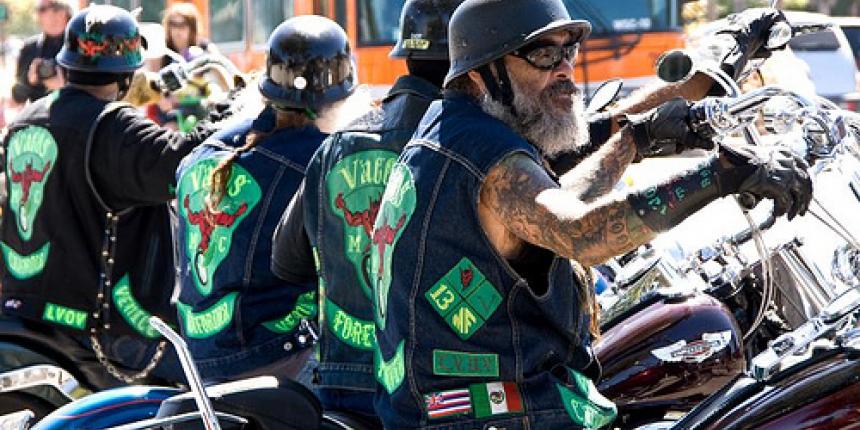
Members of the Vagos, an outlaw motorcycle gang with a history of violence, were clustered together driving on U.S. 95 in the Las Vegas suburb of Henderson on Sunday, May 29, when three men affiliated with the rival, equally violent Hells Angels gang followed them on their bikes and then fired shots, injuring six Vagos.

The attack happened after three men, a mix of current and prospective Hells Angels, trailed the Vagos who were riding as part of the Flags Over Dam motorcycle event that morning outside Hoover Dam and on to the Veterans Memorial Cemetery, where people gathered in tribute to fallen members of the U.S. military during the Memorial Day weekend.

Authorities have not yet released, or determined, what triggered the one-sided shooting. The Vagos apparently did not fire any shots before or during the assault.

Three suspects, Richard Devries, 66, Stephen Alo, 46, and Russell Smith, 26, were arrested and charged with attempted murder, murder conspiracy, battery with a deadly weapon and discharging a firearm into a vehicle.

Devries is president of the Las Vegas chapter of the Hells Angels.

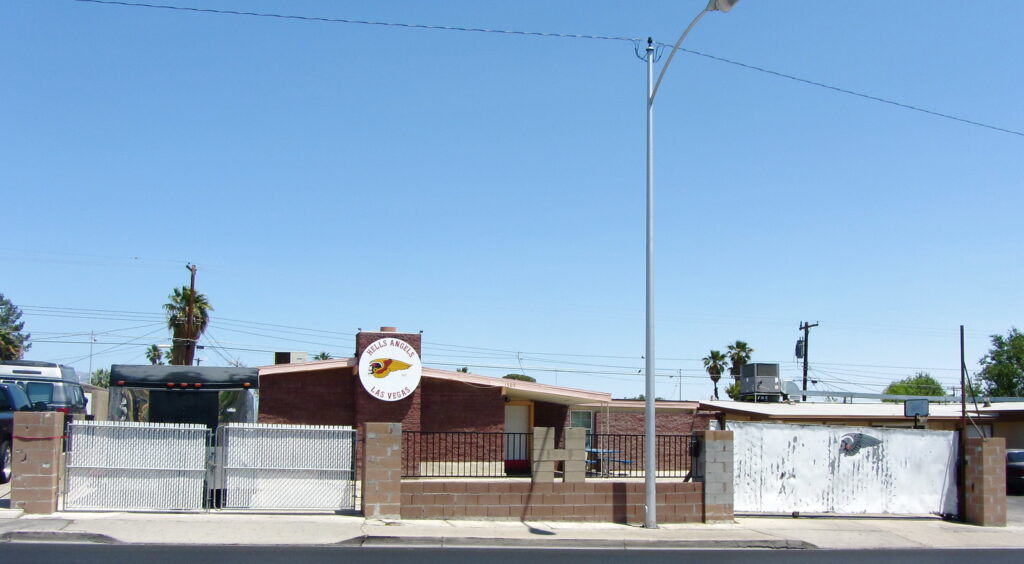
The exterior of the Hells Angels clubhouse in Las Vegas, near Bonanza Road and 15th Street. Courtesy of Flickr.

HELLS ANGELS MAY HAVE TAKEN THE OPPORTUNITY TO STRIKE

Steve Cook, a motorcycle gang expert and executive director of the Midwest Outlaw Motorcycle Gang Investigators Association, based in Kansas City, Missouri, said the Hells Angels and Vagos have had a longstanding violent feud and the Angels in this case may have decided, “we have an opportunity here, let’s take it.”

Steve Cook, an expert on outlaw motorcycle gangs, suspects the Vagos will retaliate for the shooting of six of its members outside Las Vegas.

“The Angels are the Rolls-Royce of outlaw motorcycle gangs,” Cook said. “Everyone wants to be them, but everyone hates them. They’re wealthy, they have legend status with the public.”

Lately, Cook said, the well-known biker gang has had to battle not only the Vagos, but other top motorcycle gangs such as the Mongols and Pagans “on both coasts” and the Outlaws, who “are a big problem for them.” 

“The Angels are getting pushed around a lot, especially out in Nevada,” he said. “They are basically fighting on a number of fronts. They are fighting a majority of the biker gangs in the country. The other gangs look at them, and say, ‘Yeah, let’s go after them.’”

In this case, Cook said the group of Angels may have not expected to see the Vagos on Memorial Day weekend, but “they operate in [a] thought process that can be violent. …You’ve also got to be in an offensive position, especially in a competitive place like Las Vegas.”

The casual use of methamphetamine, a common drug among biker gangs, may also have affected their judgment, Cook said.

A possible rationalization in their minds to go through with the violent altercation is the belief that witnesses might be too squeamish to testify and “the prosecution’s case will collapse anyway,” he said.

PROSPECTIVE MEMBERS RODE WITH HELLS ANGELS    

According to Henderson Police, the morning of the shooting, five prospects seeking admission as members to the Hells Angels pursued the group of Vagos to the veterans cemetery in Boulder City. The gang candidates began to cause problems, unspecified by police, for the Vagos inside the confines of the cemetery. 

The prospects then motored out of the cemetery 15 to 20 minutes before the Vagos left to drive toward Henderson. The Vagos cruised side by side northbound in the first lane of U.S. 95 near Wagon Wheel Drive. After the Vagos passed Wagon Wheel, a number of Hells Angels members and prospects were seen approaching in lanes three and two as the Vagos riders remained in lane one.

The Hells Angels members and prospects drove up to the Vagos and started to kick them, attempting to knock them down onto the freeway. Then one of the Hells Angels allegedly stood up on his cycle, pulled a gun and opened fire on one of the Vagos riders, later identified as Alejandro Castillo. After firing, the Hells Angels gunman drove off northbound on U.S. 95. Nevada State Police received a call about the shooting at 11:50 a.m.

Other Vagos injured in the gunplay included Ricardo Velasquez, Carie Chapin, Michael Stasiewicz, Michael Lempart and Chad Merrill. All were transported to Sunrise Hospital and Medical Center in Las Vegas. In their condition, the victims were only able to provide limited information to detectives. 

Police officers picked up a number of empty shell casings from the northbound roadway, between the College Drive and Horizon Drive exit ramps.

Just before the gunfire, an anonymous witness heading north on U.S. 95 phoned 911 to report seeing a number of Hells Angels parked on the side of the freeway looking as if they were waiting.

The witness took a video showing a fully patched Hells Angels member and three gang prospects riding alongside the Vagos members. One of the prospects, on a black motorcycle, wore only the bottom half of a gang logo patch, with red lining at the bottom of the vest, and tan pants and red shoes. The rider’s arms were covered in tattoos and he was holding his left arm down with an “item” in his hand, police reported. The rider passed the witness, rode toward an additional motorcyclist and then the witness heard the gunshots.

Boulder City Police soon learned that several Hells Angels had been inside the Coffee Cup café in Boulder City before the shooting. A Las Vegas Metropolitan Police intelligence detective and a sergeant arrived at the café and viewed surveillance footage showing four Hells Angels associates there about 9 a.m.

Metro intelligence officers recognized one of them as Richard “Rizzo” Devries, Las Vegas chapter president. With Devries was Stephen Alo, a prospective member who was wearing a black vest with a red lining on the bottom and no sleeves, plus tan pants and red shoes and his arms fully tattooed. Also present were two other prospects, Aaron Chun, wearing a black vest and dark pants, and Russell Smith, who had on a black vest with black sleeves, black pants and white Nike shoes.

From the surveillance video at the café and the witness’s video from the freeway, police identified Smith as the male with the tattoos on both arms, wearing a black vest, tan pants, red shoes and a white helmet who held something in his left arm. Metro intelligence detectives recognized the Hells Angels man with the fully patched vest, riding a black motorcycle, as Devries.

The detectives viewing Boulder City Police dashboard video saw some suspected Hells Angels riding westbound on U.S. 93 leaving Boulder City before the call about the shooting. A detective identified Devries, Alo and Smith on the video. Devries rode first, followed by Smith and Alo riding together.

Later that evening, Metro detectives wrote search warrants for Devries, Alo and Smith and confirmed their home addresses. Henderson and Las Vegas police watched Alo leave his home.

Las Vegas intelligence detectives traced Alo’s mobile phone to a cell signal site in the area of U.S. 95 and College Drive near the time of the gunshots. Cell sites also placed Smith’s mobile phone in the area of U.S. 95 and the I-215 freeway north of the shooting location, just after the shots were fired, and earlier at the Coffee Cup café.

Henderson Police arrested and booked the three men early Monday on six counts each of alleged attempted murder, conspiracy to commit murder, battery with a deadly weapon and discharge of a firearm into a vehicle. On Tuesday, they were formally charged. Police added gang enhancements against Devries, which could mean more years in prison if he is found guilty.

The prospects riding with Devries likely were those asked to join the Angels gang and served a preliminary “hang around” designation – fulfilling mundane chores such as guarding bikes outside a bar – for about six months, and then might receive a rectangular bottom partial “rocker” Angels patch to wear on their riding vest, Cook said.

After the prospect serves about a year with the gang, the Angels chapter decides if the person has the qualities to become a member, and takes a vote on him joining. If the person wins, the gang awards him the top rocket vest patch, reading “Hells Angels,” the gang’s signature death’s head symbol in the center and the name of their state on the bottom, and perhaps a rocket patch of the side naming their city of membership.   

Cook said he believes “there will be retaliation by the Vagos” against the Hells Angels over the Henderson shooting.

HUNDREDS OF OUTLAW MOTORCYCLE GANGS

The U.S. Justice Department as of 2021 logged more than 300 outlaw motorcycle gangs (OMG) across the county, “ranging in size from single chapters with five or six members to hundreds of chapters with thousands of members worldwide,” according to the agency’s website.

The leading gangs mentioned by the department include the Hells Angels, Vagos, Mongols, Bandidos, Outlaws, Sons of Silence, Black Pistons and Pagans.

Most of the criminal acts committed by OMGs include drug smuggling, in particular across the U.S.-Mexico border, in conspiracies with major international drug trafficking organizations.

The Hells Angels, formed in San Bernardino California, in 1948, have at least 800 members in 92 chapters in 27 states, according to the Justice Department. The gang’s illegal activities include trafficking marijuana, methamphetamine, cocaine, hashish, heroin, LSD and ecstasy, and committing assaults, extortion, murders, money laundering and motorcycle theft. 

Justice did not mention Hells Angels chapters located outside the United States. The gang’s own website claims to have 467 chapters in 59 countries on five continents.  

The Vagos outlaw motorcycle gang was founded in San Bernardino, California, in 1965.

The Vagos, started in 1965 in San Bernardino, maintains about 300 members in California, Hawaii, Nevada, Oregon and Mexico, the Justice Department estimated. The gang is known to produce and distribute methamphetamine, sell illegal marijuana and engage in assaults, extortion, insurance fraud, money laundering, vehicle theft, witness intimidation and weapons violations.

Several decades ago, the American Motorcyclist Association asserted that less than one percent of motorcyclists belong to outlaw motorcycle gangs. The outlaw clubs subsequently embraced this phrase, describing themselves as “one percenters.”

The Hells Angels and Vagos have participated in many shootings with opposing gangs over the years.

In September 2011, Vagos member Ernesto Gonzalez shot Jeffrey Pettigrew, president of the Hells Angels chapter in San Jose, California, four times in the back during a brawl on a dance floor at John Ascuaga’s Nugget hotel-casino in Sparks, Nevada. The next day in Sparks, two Vagos members were shot and wounded.

In a major legal case against the Vagos, including the 2011 Nugget casino killing, federal prosecutors in Las Vegas charged eight members with violations under the Racketeer Influenced and Corrupt Organizations (RICO) Act, including murder, drug dealing, robbery, extortion and kidnapping. The crimes were allegedly committed in California, Nevada and four other states going back to 2005. However, the case foundered and a judge dismissed the charges in 2020.

In 2002, Laughlin, Nevada, was the setting for a biker gang shootout involving the Hells Angels and Mongols. Two Hells Angels were shot to death, and one Mongol was stabbed to death. Six Hells Angels and six Mongols went to prison stemming from the confrontation.

Stuffing murder victims in barrels a common practice since mid-19th century

In April 1858, workers at the Hudson Valley Railroad’s freight house smelled an awful stench coming from a wooden barrel addressed to “Dr. Jennings, New York City.” They opened it to find a woman’s disemboweled body. Detectives tracked the barrel to Chicago, where a teamster remembered receiving it from a man named Henry Jumpertz two months earlier.

The discovery and investigation into the death of Holland immigrant Sophie Werner made international news as the original “barrel murder” case. Defendant Jumpertz insisted Sophie, his mistress, hanged herself. Fearing he would be blamed for it, he cut off her limbs, used surgical tools to remove most of her organs, stuffed her remains into a pork barrel, covered them in salt and shipped the container to New York. He was convicted, faced a death sentence, then won acquittal on appeal.

Twenty years later, in 1878, another “barrel murder” defendant, Edward Reinhardt, at trial offered the same explanation — suicide — for the cause of his wife’s death. The year before, a passerby had spotted an abandoned barrel containing the woman’s dead body, with its legs sawed off, near a road in the Silver Lake section of Staten Island, New York.

In 1890, New York Police arrested Alexander Phillipsen, lately arrived via passenger ship from Denmark, after a man’s slashed dead body was found in a barrel filled with dried cement at the U.S. customs house. The sensational story made headlines all over New York. But police in Copenhagen realized the real culprit was Adolph Phillipsen, also of Denmark, who sent the barrel to New York after murdering a man there in 1889.

In November 1901, Chicago Police extracted the hacked corpse of Italian national Antonio Napalia from a flour barrel dumped into a vacant lot off Western Avenue. The next year, a trial court convicted two recent Italian immigrants, whose motive was robbery, in the slaying.     

Using barrels to dispose of murder victims is not necessarily exclusive to killers tied to organized crime. All over the globe, into modern times, everyday killers have employed barrels — from those with curved wooden staves secured by metal hoops to the 45- to 55- gallon steel or plastic varieties — as a convenient way to conceal a body for transport to a hiding place.

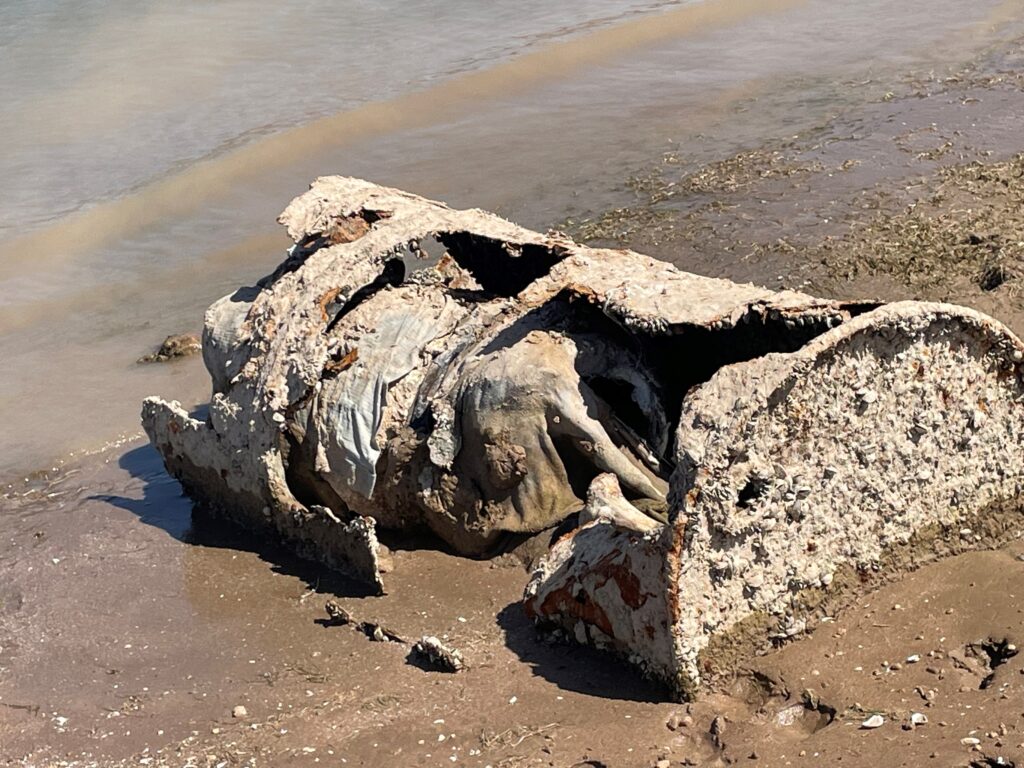
Still, the discovery on May 1 of a set of human remains inside a severely corroded steel barrel, emerging after decades from the deep mud at the drought-ravaged Lake Mead National Recreation Area, 30 miles from Las Vegas, has many speculating about whether the grisly find is a long-buried reminder of the city’s Mob past.

Las Vegas police have concluded that the Lake Mead barrel murder victim, unearthed on the shore at Hemenway Harbor, died from a gunshot wound. The badly decomposed corpse still had a shirt, belt and shoes clinging to it. Detectives surmise the Kmart-brand clothing was purchased in the mid- to late 1970s, and so the death may have occurred in the late ’70s or early 1980s.

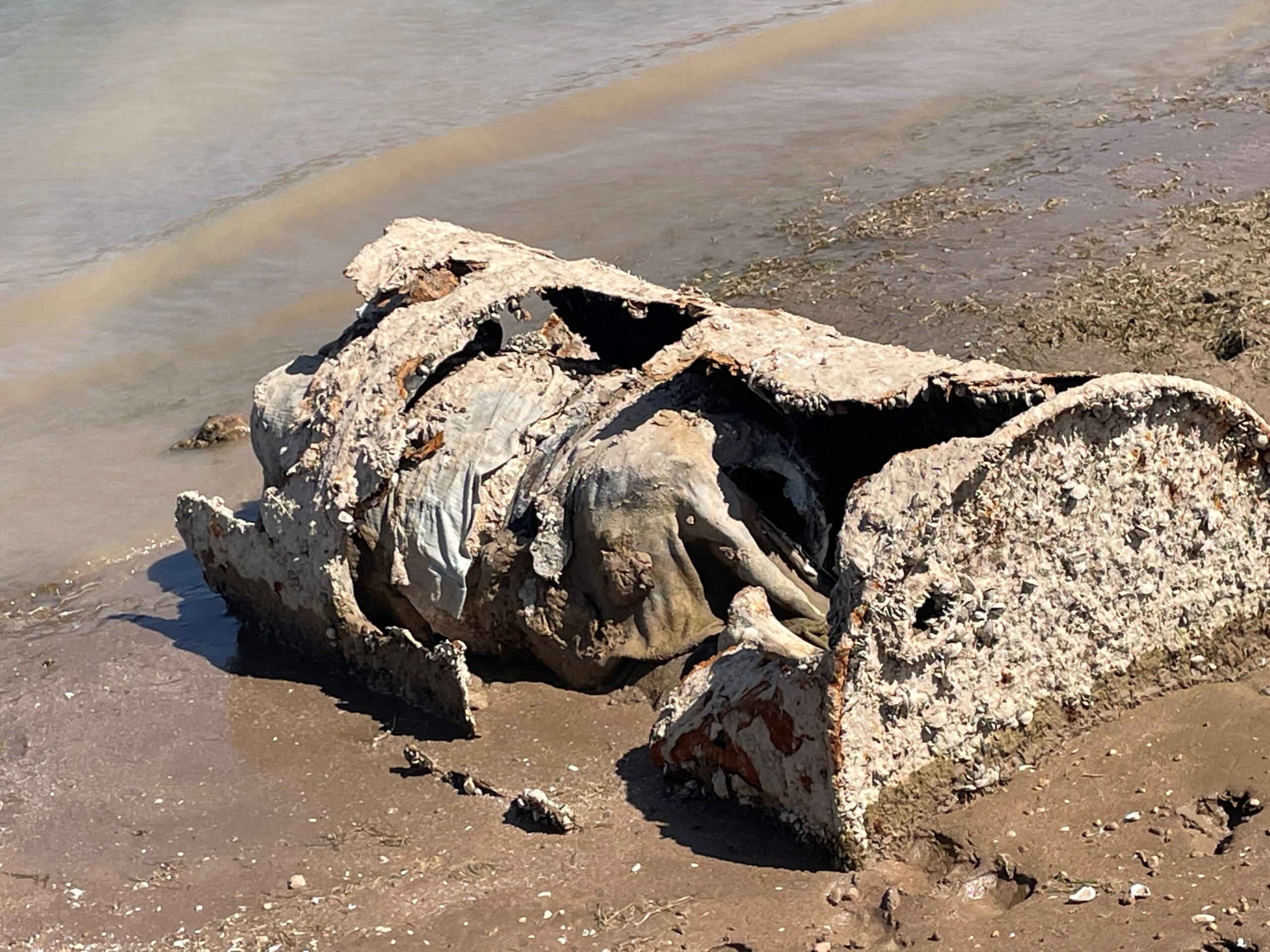
A close-up view of the corroded barrel shows the badly decomposed murder victim, shot in the head, with clothing still clinging to the remains. Las Vegas police believe the barrel was thrown into the lake in the mid-1970s to early 1980s. Gangsters used barrels to dispose of bodies going back to the late 19th Century. Credit: Shawna Elizabeth Hollister

Whoever transported the barrel containing this murder victim probably boated several hundred yards from shore and dumped it into water deep enough, or so they thought, to prevent its discovery indefinitely.

The barrel sat in the same spot for decades and only emerged when the lake receded to the current record-low water level of 1,049 feet, the lowest since the lake started filling in late 1934, amid declining snow melt from the western Rocky Mountains that drains into the Colorado River, and an exceptionally intense 22-year-long drought in the Southwest.

Lake Mead’s water supply has dropped 22 feet in the past year, and the U.S. Bureau of Reclamation projects it will drop another 26 feet by fall 2023 to about 1,023 feet. The decline in water has exposed long-submerged boats, anchors, fishing equipment and, recently, two sets of human bones.

Meanwhile, additional mortal remains are likely to appear from the reduced depths, but not necessarily murder victims. As of 1994, the lake had claimed 59 people who drowned without their bodies being recovered.

Of course, the person or persons who used a barrel in the Lake Mead barrel murder case obviously did not want the body to be found. But why did they decide to go to the trouble of encasing the victim in it, transport the heavy object by a truck or other vehicle to a water craft — risking exposure even at night — and unload it into the lake, instead of simply burying the body in the desert? For one, whoever ordered it wanted the victim to receive special treatment, perhaps over what the dead person had done to “deserve it” — such as gambling away a lot of money owed to a loanshark — or to satisfy the personal, vindictive feelings of the murderer.

Or was it the preferred “style” of corpse disposal of a Mob chief, seeking revenge against someone who crossed him in some way and willing to take it that far to achieve satisfaction? If the Lake Mead barrel murder indeed was from the late 1970s or early 1980s, it would coincide with the 1976 killing of infamous Mob figure Johnny Rosselli, whose body was discovered by fishermen inside a barrel in a bay outside Miami.

It also would be the same era when former Teamsters Union president James Hoffa disappeared, in 1975. Hoffa has long been rumored to have been killed by hitmen from a conspiracy involving Detroit mobsters Joe Zerilli, Jack Tocco and Tony Giacalone. Under one scenario, advanced by journalist Dan Moldea, his body was placed into a barrel in Michigan and transported to a waste dump in New Jersey, on the instructions of the Genovese family’s New Jersey crime boss Anthony “Tony Pro” Provenzano. The theory goes that the late Provenzano, once closely associated with Hoffa in the Teamsters Union before they had a falling out, ordered the more than 600-mile transfer of the barrel to possess Hoffa’s remains as a spiteful “trophy.” Currently, the FBI is reportedly deciding when to start digging at the New Jersey landfill to see if the alleged Hoffa death barrel is there.  


Whose body was in the Lake Mead barrel?

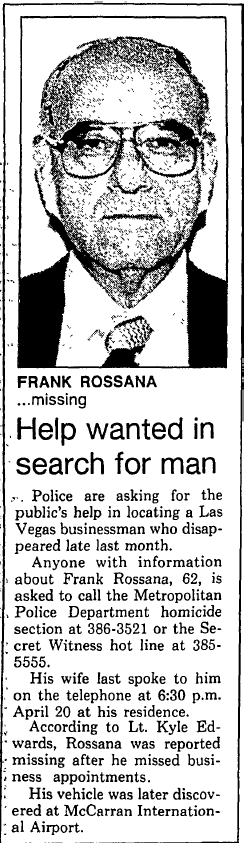
This article from the Las Vegas Review-Journal reports that Frank Rossana went missing in 1989, two months after his brokerage firm collapsed after defrauding thousands of people. Police found his car at the airport but no evidence that he had taken a flight.

Based on the police department’s estimate of the period when the murder may have occurred, we speculate that the corpse could be one of three missing persons, each having at least some association with Argent Corporation. That company owned the Stardust, Hacienda, Marina and Fremont casinos where Mob confederates secretly skimmed away cash into the pockets of crime families in Chicago, Kansas City, Milwaukee and Cleveland during the 1970s.  

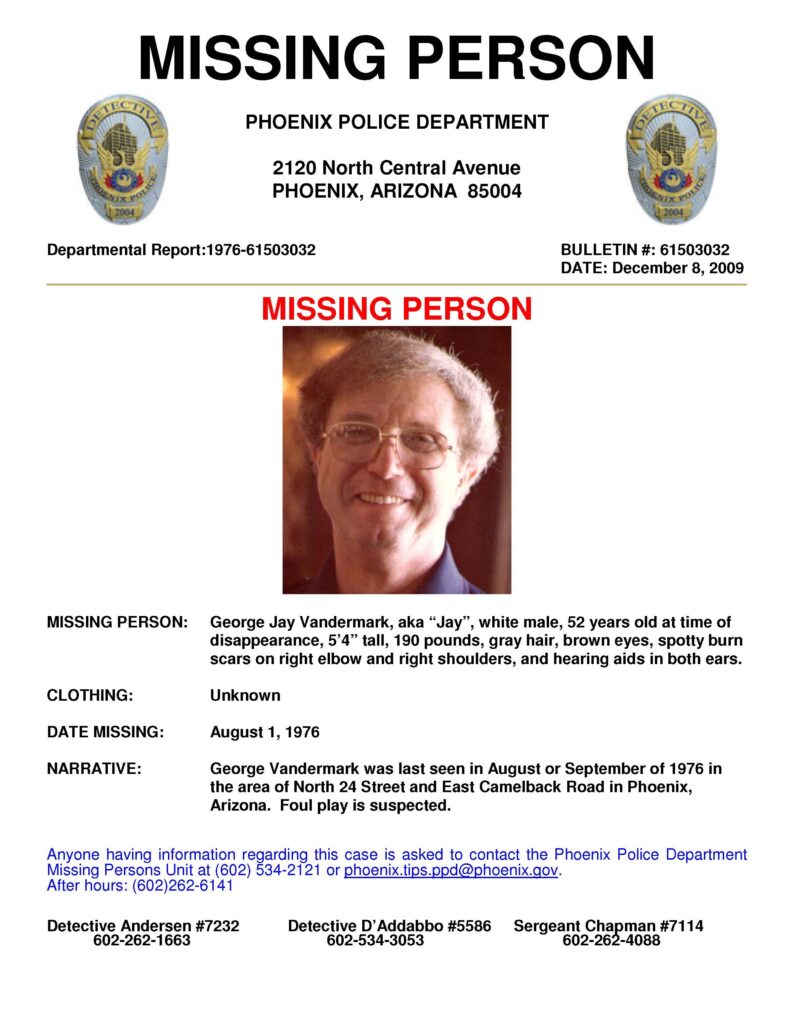
George “Jay” Vandermark skimmed between $7 million and $15 million from slot machines at the Argent casinos before vanishing in 1976 while on the run from the Chicago Outfit and Nevada gaming regulators. Court testimony in 2007 indicated that Vandermark was killed in Phoenix and buried in the desert, but a body has yet to be found.

William Crespo was a cocaine trafficker who flipped to be a witness for the U.S. government. He disappeared in 1983 before testifying against a former Argent executive and six others, who were all acquitted as a result.

Johnny Pappas, a casino employee with Mob ties and former manager of a resort at Lake Mead owned by Argent, went missing in 1976 after he told his wife he was going to meet an unknown person interested in buying the boat Pappas had docked at the lake. Of the three, Pappas seems to us to be the most likely to be the murder victim in the barrel.

Assuming it is possible the police could expand the period during which the murder occurred, we widened our research to include the late 1980s. As a result, we can add two more men reported missing in the late 1980s who also could be the barrel victim:

  • Frank Rossana, 67, vanished on April 20, 1989, two months after his Las Vegas-based brokerage firm, Power Securities Corporation, collapsed, defrauding thousands of people who had invested millions. He also had just spent $500,000, raised somewhere, on penny stocks. His estranged nephew Joe once associated with alleged gangster Philip “Fat Phil” Dioguardi, a bodyguard to Colombo crime family boss Joe Colombo in New York when Colombo was shot in 1971. Police discovered Rossana’s 1988 Cadillac parked at McCarran International Airport, but found no evidence of him taking a flight.
  • William Jay Shaw, 63, a cash-rich Las Vegas gambler whose relatives reported him missing since January 31, 1989. He was set to take a trip to New York to see family members. Shaw placed wagers in Las Vegas casinos with money provided by members of “the Kosher Boys,” a high-rolling sports betting group in New York and New Jersey who also laid bets with illegal bookmakers. Shaw would send the gamblers their winnings by express mail.            

The 1903 ‘Barrel Murder’ in New York

Giuseppe “Clutch Hand” Morello led the Mafia family that killed Madonia.

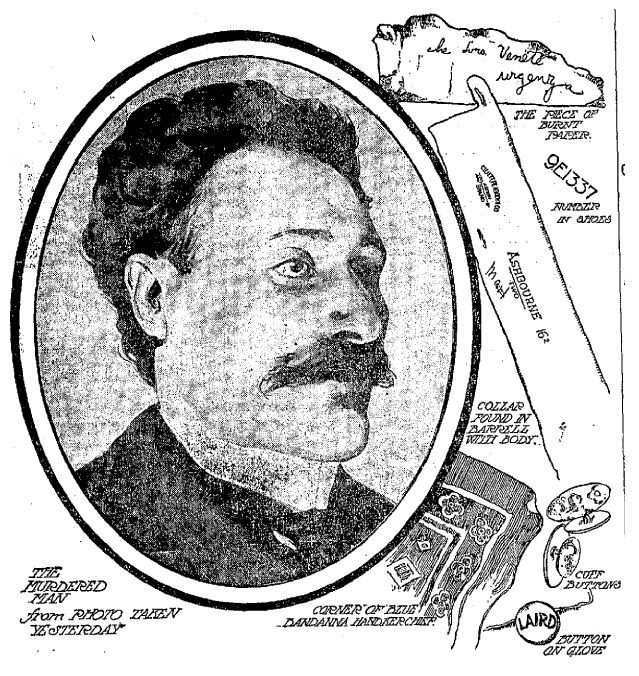
Going back more than a century to the early Sicilian Mafia gangs in New York, the most notorious murder case linked to gangsters was referred to in newspapers and crime books as “the Barrel Murder.” On or about April 11, 1903 (reports vary), a woman walking along East 11th Street in Lower Manhattan’s East Side came upon a standing wooden sugar barrel, its top covered by an expensive overcoat, next to the curb. When she picked up the coat, she screamed upon seeing a man’s blood-covered face inside.  

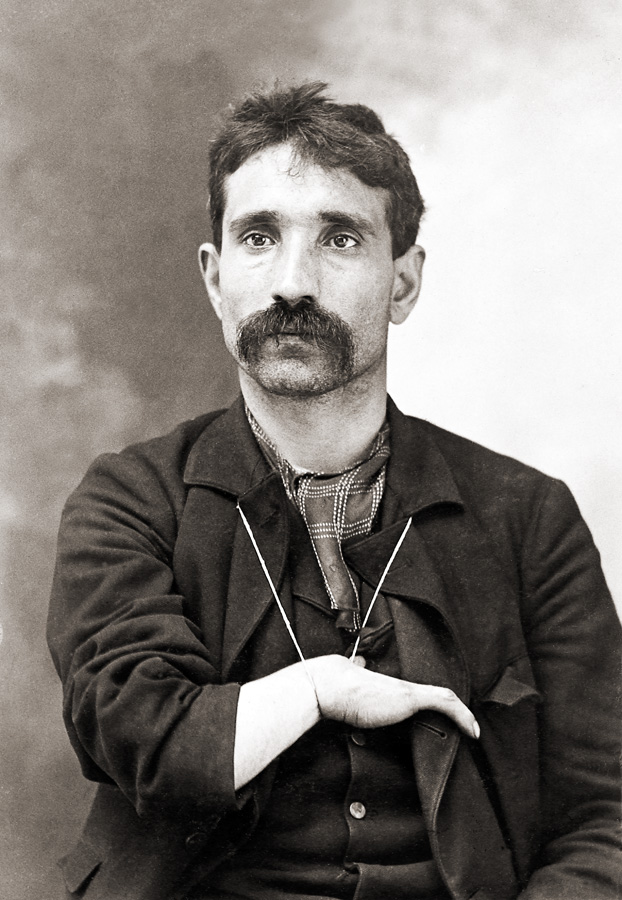
The victim, stabbed and mutilated, his head nearly severed, then crammed into the small space with his clothes on, was Benedetto Madonia, an Italian immigrant. New York detectives would learn that Madonia had been killed by the Morello gang, an American affiliate of the Mafia. Led by Giuseppe “Clutch Hand” Morello, the gang engaged in murder, extortion, kidnapping and counterfeiting in a territory from East Harlem and Manhattan to the Bronx. The condition of Madonia’s body reflected the gang’s willingness to commit atrocities. The killers slashed off his genitals and shoved them into his mouth.

Benedetto Madonia, an Italian immigrant, was killed, and his body was mutilated, stuffed in a wooden barrel and left on a sidewalk in Manhattan in 1903. Mafia members were charged with the crime.

Did the Morellos assume garbage collectors would take the barrel away, or did they want him to be found? The most accepted story goes that Madonia, himself a counterfeiter, had sent money to “Clutch Hand” Morello to pay for the criminal defense of Madonia’s imprisoned brother-in-law, a member of the Morello gang. But Morello stole the cash instead. Madonia traveled from Buffalo to confront Morello, who had him killed, and then some.

That year in New York, not long after the turn of the century, was particularly violent. A few months later, in the summer, a shooting war between the Monk Eastman and Five Points gangs erupted, with police struggling to stop it. The battling ended with three dead gangsters and seven wounded. The publicity from the shocking Madonia case may have represented a ruthless statement of the times, a high water mark of infamy among competing gangs.

“A barrel murder was the modus operandi of the Mafia, and the condition of [Madonia’s] body suggested the motive,” wrote James Lardner in his 2001 book, NYPD: A City and its Police. “Their victims were usually weighted down and dropped in the river or put in a barrel and shipped to another city. If it was an informer, though, he would likely be mutilated and left in a conspicuous place as a warning to others.”

Barrel murders through the decades

Since the Morello barrel murder and the lesser known ones before it, many other killers have opted to get rid of their victims using the method. However, based on scores of news stories over the past 150-plus years, while some reported cases are Mob-related, many appear not to be. One thing a significant number of barrel slayings has in common: angry violations of the body, which might be another reason for the murderers to choose the cover of a barrel. The following is as exhaustive a list as we can provide of such slayings.

  • 1906 — Ebervale, Pennsylvania. A hunter and his dog happened upon a partially burned sugar barrel with the body of an 18-year-old woman, throat cut ear to ear, charred beyond recognition, her head twisted to fit inside it, in eastern Pennsylvania. Hundreds of local people viewed the burnt corpse at the morgue, but no one could identify her.
  • 1911 – Rochester, New York. A farmer inspecting his skunk trap in a gulley off a main road stumbled onto a wooden barrel with the dismembered and decapitated body of Francesco Manzella, an immigrant from Italy The victim’s head and legs were sliced off with the precision of a trained surgeon. Manzella had been released a few months earlier after serving more than two years in a New York state prison for his part in a “Black Hand” Mafia extortion conspiracy. One witness reported seeing a horse-drawn wagon carrying a tall object and then driving by with the wagon empty. Others questioned reported that Manzella intended to move back to Italy and so his murderer may have robbed him of his travel money.
  • 1917 — Watervliet, New York. Near Albany, firefighters who put out a blaze came across a sugar barrel containing the folded corpse of a young man, Frank Frogola, covered in oil and sawdust. A grand jury indicted three men for arson, but no convictions resulted, and the murder remained unsolved.    
  • 1918 — Brooklyn, New York. Three boys playing with a large wine cask in a vacant lot at 45th Street and Eighth Avenue discovered it held the disfigured body of Gasparino Candello, stabbed 39 times. Prosecutors charged three men in the murder, presenting the barrel in court as evidence. A defendant convicted and sentenced to die in the electric chair for a separate murder testified against his two accomplices, saying they killed Candello when he refused to pay up front for 45 cases of Italian tomato paste.
  • 1920 — Rochester, New York. Two people who witnessed a fire found a scorched sugar barrel containing the mutilated and singed body of Filippo Ferrara. Police later arrested Christopher Mammano, who confessed to killing the man with an ax to escape making a mortgage payment.
  • 1927 — Bellaire, Ohio. A man found pressed inside a whiskey barrel had been strangled to death with a clothesline, and large nails pounded into his skull. Police could not identify him.        
  • 1930 — Pittsburgh, Pennsylvania. The headless body of William Gregory, said to have doubled-crossed the city’s liquor syndicate during Prohibition after selling a truck and its load of bootleg beer, was placed into a cabbage barrel. It was the city’s 78th gangster killing since 1926. Police arrested syndicate member Philip De Fazia.
  • 1933 — Cincinnati, Ohio. An unknown suspect killed New York jeweler Alvin Brunner, stuffed him into a barrel in Columbus, Ohio, then left it inside the rented garage of a suburban home in Cincinnati. The murderer also robbed Brunner of about $20,000 in jewelry.
  • 1937 — Queens, New York. Esther Gordon, widow of reputed underworld drug dealer Maxie “One-Eyed Maxie” Gordon, was stabbed to death with an ice pick and stuck into a flimsy barrel. Police thought underworld assassins killed her fearing she might squeal about the drug ring they shared with her husband before he died in a car crash in Texas. Maxie Gordon got his nickname from losing an eye in a fight with the Egan’s Rats gang in St. Louis in 1920.
  • 1940 — East Liverpool, Ohio. A broken potato barrel contained the body of Julia Wall, wrapped in a burlap sack. She had been strangled only about six hours before being found. The perpetrator tried to roll the barrel down a deep ravine but heavy brush stopped it.
  • 1946 — Joliet, Illinois. Arthur Blaurock was killed and crammed into a pork barrel at a slaughterhouse. A co-worker, Frank Borden, confessed in 1948 to the murder and to stealing the victim’s $200 diamond ring.   
  • 1947 — Philadelphia. Police officers could not identify the nude body of a young woman strangled to death with a length of gauze, then stuck into a heavy metal drum and rolled down an embankment.  
  • 1947 — Philadelphia. Margaret Dougherty, strangled to death, was found in a 50-gallon oil drum stuffed with sawdust and newspapers.
In 1976, fishermen discovered a barrel in a bay outside Miami. Investigators determined the body inside the barrel was that of Johnny Rosselli, a prominent mobster who had been talking to congressional committees. Courtesy of University of California, Los Angeles Special Collections
  • 1976 — Miami. The corpse of Johnny Rosselli, infamous Mob figure and one-time Las Vegas representative of the Chicago Outfit, was located inside a 55-gallon metal barrel wrapped with metal chains in a failed attempt to keep it submerged in Dumfoundling Bay. Unnamed Mob informants told the New York Times in 1977 that Cosa Nostra crime bosses decided Rosselli had to go because of testimony he provided — without permission from Mob leaders — to a grand jury about Mob infiltration at the Frontier Hotel in Las Vegas and to a U.S. Senate committee investigating the assassination of President John F. Kennedy and plots by the CIA to kill Cuban leader Fidel Castro. On July 28, 1976, a friend of his and a second man from Chicago lured Rosselli onto a boat for a cruise. As Rosselli drank some vodka, the Chicago guy put his hand over Rosselli’s mouth. Rosselli, who had emphysema, was quickly asphyxiated. They taped a washcloth over his mouth to make sure. They sawed off his legs so he would fit into the 36-inch-high barrel. They used a rope and hooks to lift his torso into the container, threw in his severed legs and threaded the chains around his remains, through holes in the barrel and the barrel lid, then threw it overboard. But eventually it wasn’t heavy enough to stay sunk — with uplift from decomposition gases being a factor — and some fishermen noticed the barrel on a sandbar beside a 28-foot-deep canal. The fishermen told police they figured the barrel contained a body.    
  • 1987 — Bowie, Texas. Donald Franklin Johnson of Lubbock was shotgunned to death, his body wrapped in cloth, then encased in cement within a padlocked 55-gallon barrel and thrown into Amon G. Carter Lake. A fisherman spotted the barrel five months later. A man was found guilty in the capital murder in 1989.   
  • 1988 — Hancock County, Indiana. Two barrels filled with concrete contained the body parts of Steve Rexcoat of Indianapolis. Prosecutors charged confessed murderer Steve “Weed” Weaver with the slaying.
  • 1992-1999 — Snowtown, South Australia. In the heinous Snowtown “bodies in the barrels” case, police recovered the cut-up human remains of eight people from six plastic barrels stored in a former bank vault. The rural serial killers murdered a total of 12 people, male and female, some of whom were tortured, starting in 1992. The lead perpetrator, John Bunting, and three other men were convicted and sentenced to from 25 years to multiple life terms in prison for the homicides.   
  • 2000 — Kansas and Missouri. John E. Robinson Sr., who surfed online for sex partners, was charged with murdering five women whose bodies were found inside barrels, three placed in Kansas and two in Missouri.   
In the 1990s, in Snowtown, near Adelaide, South Australia, the remains of eight murder victims were discovered in six plastic barrels. Four men were convicted of committing a total of 12 murders.

Body in the barrel at Lake Mead has makings of Mob hit

Editor’s note: This article first appeared at DailyMail.com

When mobsters bury their secrets, they expect them to stay hidden.

Usually, they’re right.

But as Nevada’s drought-ravaged Lake Mead recedes and sunlight shines on its muddy depths for the first time in decades, we may be getting a glimpse into the dark and sordid mob history of Las Vegas, which lies just 30 miles away.

On May 1st, the remains of a decomposed human body stuffed inside a corroded metal barrel were discovered stuck in Lake Mead’s mud.

The grisly find has all the makings of a gangland hit.

Police say the victim was shot in the head, execution-style, and crammed into the drum – historically a mob method for disposing of bodies.

The killers transported the barrel by boat several hundred yards out into the lake and dumped it in what was then 100 feet of water.

There it sat at the bottom of the lake — until now.

Already the dead man is talking – giving us clues of who he may have been, why he was killed and by whom.

Detectives confirmed that the corpse still had a shirt, belt and shoes clinging to the remains.
They determined the clothing was purchased in the mid- to late 1970s at a Kmart discount store – far from the choice attire of a high-rolling, fashion-conscious mobster.

A close-up view of the corroded barrel shows the badly decomposed murder victim, shot in the head, with clothing still clinging to the remains. Las Vegas police believe the barrel was thrown into the lake in the mid-1970s to early 1980s. Gangsters used barrels to dispose of bodies going back to the late 19th Century. Credit: Shawna Elizabeth Hollister

The timing suggests the killing occurred between the 1970s and the early 1980s, coinciding with the most violent period in Las Vegas’ past — an era of unprecedented street crime and underworld killings.

Our research has found three possible victims who may be the body in the barrel.

The three men, each with links to the mob, disappeared at that time and their bodies were never found.

Most speculation has centered on George ‘Jay’ Vandermark, a gambling machine cheater trusted by the mob to oversee its slot machine operation at the Stardust casino on the Las Vegas Strip — that is, before he double-crossed them.

The mob wanted him dead, but we doubt that it is him in Lake Mead.

There’s William Crespo, a drug-runner who turned state’s evidence after he got busted smuggling cocaine. He was set to testify against a former insider from a mob-controlled casino company but never made it to trial.

And our leading candidate for the man in the barrel is Johnny Pappas, a Chicago native and veteran Las Vegas casino host.

We can reasonably — by virtue of his owning a boat at Lake Mead — place him at the scene of the dumping grounds around the time the murder may have occurred.

The thread that strings these three men together is they were all linked to the most powerful Las Vegas mob operation of that time – Argent Corp., a front company for an organized crime operation that ran some of Las Vegas’ top gambling operations.

And if that theory holds, it may also lead us to a likely killer. One of the most notorious enforcers in mob history, Tony Spilotro.

This ruthless murderer was brought back to life as the fictional Nicky Santoro, played by Joe Pesci, in the 1995 mob movie classic, Casino.

Spilotro was considered a suspect – as perpetrator or director — in almost 20 mob-related murders and disappearances from 1975 to 1977.

His weapon of choice was a .22-caliber pistol, equipped with a suppressor, and fired into the victim’s head.

ARGENT CORP. AND THE LAS VEGAS BLOODBATH

Since the mob’s arrival in Las Vegas in the 1940s, the city was regarded by America’s crime bosses as an ‘open city,’ a place where crime families agreed not to fight over turf, as they often did in cities such as New York and Chicago.

The idea was that organized crime could share in an overflowing fountain of cash pouring from legitimate gambling operations.

By the 1970s, the Chicago Outfit, an organized crime syndicate based in Illinois that dated back to the days of Al Capone in the 1920s, established a major presence in the city after consolidating power for decades.

Argent Corp. had become a major player in Las Vegas – owning the Stardust, Hacienda and Marina hotel-casinos on the Strip, and the Fremont downtown.

Frank ‘Lefty’ Rosenthal, played by Robert De Niro in Casino, was hired to run the Stardust – the crown jewel in Argent’s criminal empire.

The mob stole (or skimmed) a percentage of those revenues and delivered them to crime bosses in Chicago, Kansas City, Milwaukee and Cleveland.

‘Skimming’ works by hiding legitimate revenue from the federal government and thereby avoiding taxes.

But the mob’s relative free rein in Las Vegas began to erode as state and federal law enforcement stepped up its scrutiny of casinos.

Corporate purchases of Strip resorts drove out many older crime figures with hidden holdings. With the mob losing its influence, petty crooks and lowlife hustlers who once feared the wrath of mobsters moved to town and even entered the casinos to operate.

The result was a wave of crime perpetrated by loan sharks, burglars, arsonists, gaming cheats, unlicensed bookmakers, shakedown artists, pimps, streetwalkers and drug dealers.

The mob, ignoring the conventional wisdom to avoid murdering people in the ‘open city,’ reacted violently and victims started disappearing without a trace.

In 1974, the Los Angeles Times report that between 1971 and 1974, Las Vegas saw more gangland slayings than in the previous 25 years combined.

GEORGE ‘JAY’ VANDERMARK – THE SLOT MACHINE CHEAT

When news about the body in the barrel at Lake Mead broke, the first name to come to mind for many longtime Las Vegans was George ‘Jay’ Vandermark, who vanished in 1976 while being pursued by the Outfit.

Vandermark was hired by ‘Lefty’ Rosenthal in 1974 to oversee the slot machines at the Stardust and the other three Argent-controlled casinos, but he was really there to run their skimming operation.

Vandermark facilitated the skimming of between $7 million and $15 million worth of coins from the slot machines. But the Nevada Gaming Control Board found out about the operation in 1976.
Nevada gaming regulators subpoenaed Vandermark as a witness to the crime and he fled to Mazatlan, Mexico. He was rumored to have ended up in Coast Rica.

It got worse for Vandermark because the Outfit suspected him of only giving them $4 million from the skimming operation and pocketing $3 million for himself.

For a while, Vandermark’s son, Jeff, who was working with the gaming board, communicated with his father, whom he said might be willing to return to testify.

George “Jay” Vandermark oversaw an operation that skimmed $7 million to $15 million worth of slot machine coins from four Las Vegas casinos to enrich several Midwestern Mob families from 1974 to 1976. After being caught, he fled town and was allegedly killed in Phoenix by two Chicago Mob hitmen in September 1976. Since his body was never found, Phoenix police still regard him as a missing person.

But Vandermark was last seen at a Phoenix hotel in September 1976. He never made it to trial.

In Casino, the character John Nance, loosely based on Vandermark, is hiding out in Coast Rica, where he is located and shot dead by a mob hitman armed with a .22-caliber pistol.

However, based on federal court testimony, Outfit hitman-turned-witness Nick Calabrese claimed to have cleared up the mystery surrounding Vandermark.

Calabrese said the Outfit learned that Vandermark was hiding out at a luxury hotel in Phoenix, the Arizona Manor, owned by Outfit associate Emil Vaci.

They sent hitmen John Fecarotta and Jimmy LaPietra to meet up and kill Vandermark. The pair buried his body in the Arizona desert, Calabrese said.

Vandermark’s body has never been found.

In April, 1977, his son Jeff was found murdered at his Las Vegas apartment. Las Vegas police investigated, arrested a suspect and concluded with certainty that the motive was robbery and not tied to his father’s activities.

WILLIAM CRESPO – THE DRUG-RUNNER TURNED RAT

William Crespo was a former resident of Puerto Rico, who was arrested by federal agents in Las Vegas in 1982 after he was caught flying in from Miami with $400,000 worth of cocaine.

Many details about this man have been lost to history, but it is possible he had some valuable knowledge about the Argent skimming case.

Given the evidence against him, Crespo accepted an offer of immunity to become a federal informant and protected witness to testify about the multimillion-dollar drug ring with which he was involved.

The U.S. government spent $13,000 for his relocation and living expenses. And his testimony before a federal grand jury helped lead to the indictment of 10 defendants, including Victor Greger, a former Argent executive.

Then Crespo, set to appear at trial, vanished in June 1983.

With Crespo a no-show, the federal judge had no choice but to drop the charges against seven defendants, who pleaded not guilty.

JOHNNY PAPPAS – THE LAKE MEAD BOAT OWNER

Johnny Pappas is the leading candidate for the barrel murder victim, due to several key factors, as reported recently by longtime Las Vegas journalist John L. Smith, who knew him as a child.

‘Johnny Pappas, born Panagiotakos if I remember correctly, found employment in the casino industry at the Castaways, Las Vegas Hilton and Caesars Palace,’ wrote Smith for The Nevada Independent. ‘By the mid-1970s, Pappas was managing Lake Mead’s Echo Bay Resort, a Teamsters Central States Pension Fund-financed project, for the Argent Corporation …’

Echo Bay Resort, now closed, was a hotel and boat launch.

Pappas also owned a boat docked at Lake Mead.

On August 18, 1976, the day he disappeared, Pappas told his wife he was going to Jojo’s restaurant at 1531 Las Vegas Blvd. South, near downtown Las Vegas, to meet someone interested in buying his boat.

Four days later, his car was spotted in the parking lot of the Circus Circus casino on the Strip.
Police, who confirmed Pappas had underworld connections, investigated his disappearance but found no trace of him.

Did the Outfit fear that Pappas might have something to reveal about the then-unfolding details about skimming at the Argent casinos? If so, they had a motive to rub him out.

It wouldn’t be much of a stretch to speculate that they may have lured him to his death by setting up the ruse of a potential buyer of his boat.

After he was theoretically killed and shoved into a barrel, it wouldn’t have taken much to dump his body, perhaps using his own vessel.

TONY SPILOTRO – THE MOB ENFORCER

If the victim in the barrel was Pappas, Crespo or even Vandermark, then the director of the Lake Mead murder might well have been Tony Spilotro.

Tony “The Ant” Spilotro, a violent hood assigned by the Chicago Outfit as its representative in Las Vegas in 1971, poses for a 1974 mug shot after a federal grand jury in Chicago charged him and others with defrauding the Teamsters Union out of $1.4 million. While in Las Vegas in the 1970s to mid-1980s, he ran a gang of burglars, jewelry fencers and hitmen before his beating death in 1986.

The Outfit sent him to Las Vegas in 1971 to watch its secret casino interests. He soon expanded into street rackets with his gang of burglars, bookmakers, jewelry fencers and hitmen.

In the mid-’70s, Spilotro worked behind the scenes to ensure that the millions in cash siphoned from Las Vegas casinos made its way to crime families in Chicago, Kansas City, Milwaukee and Cleveland.

And suspected mob hits were happening across the country at that time. In 1977, FBI agents from Las Vegas, Los Angeles, Chicago, Detroit and New York gathered in San Diego to discuss a baffling rash of nearly two dozen alleged contract murders nationwide.

Each of the victims died from a shared method — one or more nearly point-blank shots to the head from a .22 handgun, a favored implement of hitmen because the slugs enter the skull without blowing back blood and brain matter.

Arrested time after time, and sometimes brought to trial, Spilotro was never convicted of a homicide.

But his Outfit colleagues, tired of Spilotro’s high profile and constant legal troubles, beat him and his brother Michael to death in suburban Chicago in 1986.

They buried the brothers, sans barrels, in an Indiana cornfield.

The Clark County Coroner’s Office estimates it could take as long as a year to identify the body in the barrel. The investigation will include the examination of familial DNA. In the meantime, we will continue our research to solve this mystery.

U.S., European agencies target Irish crime group led by boxing promoter

To some, Daniel Kinahan is best known as a boxing promoter, with past ties to heavyweight champion Tyson Fury and legendary Las Vegas-based promoter Bob Arum.

But to law enforcement agencies, Kinahan is the boss of a family of Irish hoodlums headquartered in Dubai and tied to murder, drug and gun trafficking and money laundering.

Infamous in Ireland and the United Kingdom for more than 20 years, the Kinahan organized crime group has finally received the U.S. Treasury Department’s designation as a “significant transnational crime organization” worthy of strict sanctions, freezing all American-based bank accounts and property held by Daniel, his father Christopher Sr., brother Christopher Jr., four other Irish nationals and three family businesses.

Meanwhile, the U.S. State Department has offered a reward of up to $5 million for information leading to the arrests of Daniel, his father and brother. The Kinahans, officials allege, engaged in murder, firearms trafficking and distributing South American-sourced cocaine and heroin within Ireland, throughout the U.K. and mainland Europe, hiding the proceeds through money laundering.

Daniel Kinahan, despite his identification by the High Court of Dublin as a peddler of cocaine and firearms, as recently as 2020 served as one of the world’s preeminent boxing promoters, having organized big-money bouts fought by the likes of Fury, Michael Conlan, Deontay Wilder, Tom Schwarz and Otto Wallin.

Treasury officials in Washington announced the economic sanctions against the Kinahan clan on April 11, in collaboration with the State Department, U.S. Customs and Border Protection, Ireland’s national police An Garda Siochana, the U.K.’s National Crime Agency and the European Union’s Agency of Law Enforcement.

Brian E. Nelson, Treasury undersecretary for terrorism and financial intelligence, said the international law enforcement agencies intend to “use every available resource” to take down the Irish syndicate, which operates a web of crime stretching from Ireland and the U.K. to Spain and the United Arab Emirates.

Until recently, Kinahan had close ties to British heavyweight boxer Tyson Fury.

“The Kinahan organized crime group smuggles deadly narcotics, including cocaine, to Europe, and is a threat to the entire licit economy through its role in international money laundering,” Nelson said. “Criminal groups like the KOCG prey on the most vulnerable in society and bring drug-related crime and violence, including murder, to the countries in which they operate.”

For his part, Daniel Kinahan has denied reports of ties to organized crime.

Family patriarch Christopher “Christy” Kinahan Sr. formed his family namesake’s criminal gang in the late 1990s and early 2000s in Dublin. Christy served a combined 12 years in prisons in Ireland, the Netherlands and Belgium for raps including cocaine and heroin trafficking and money laundering.

In 2014, a Mob war erupted when Christy directed hitmen to murder Gary Hutch – of Dublin’s Hutch gang of bank robbers and narcotics smugglers – in Spain during a dispute with South American drug rings. The rival Hutch clique in 2016 sent gunmen, several disguised as police officers and one dressed as a woman, to a boxing weigh-in attended by top Kinahan guys and dozens of spectators. As the crowd looked on, the Hutch torpedoes opened fire, killing a Kinahan gang member and wounding three. Daniel, who organized the weighing event for his fighters, escaped by leaping through a window.

In retaliation days later, the Kinahans hired four hitmen to attack and kill Eddie Hutch, brother of Hutch Mob chief Gerry “The Monk” Hutch.

The gang clashes resulted in 18 deaths, mainly members, relatives or associates of the Hutches, virtually wiping out the band. When Ireland police cracked down on the Kinahans, its top members left the country but maintained operations in Ireland, the UAE, U.K. and Spain.

The State Department reported that Daniel, aka “Daniel Joseph,” “Chess,” “D,” and “Cuz,” currently oversees drug running and money laundering by the group’s members living in Dubai, where they wash criminal profits through legitimate businesses.

Kinahan associates also targeted by the Treasury for sanctions include Irish natives Sean Gerard McGovern, Ian Thomas Dixon, Bernard Patrick Clancy and John Francis Morrissey. Treasury’s sanctions also go after Kinahan family-owned businesses Nero Drinks Co. Ltd., Hoopoe Sports LLC and Ducashew General Trading LLC.

For years, Daniel Kinahan successfully represented prizefighters with the management company he co-founded, MTK Global Agency, to fulfill major boxing contests (none of them within the United States). Fury was a client of his for several years. Daniel insists he left MTK Global in 2017.

Veteran boxing promoter Bob Arum, founder and CEO of Top Rank Inc., based in Las Vegas, parted ways with Kinahan, but not before paying $4 million to one of the Irish mobster’s companies to promote four boxing matches.

It took some time, however, for Fury to part ways with Daniel, who remained the fighter’s adviser until 2020. Fury openly praised Daniel’s role in planning a proposed high-profile fight with fellow British boxer Anthony Joshua in summer 2021 that fell through when an arbitrator ruled that Fury had to fight Wilder instead (Fury defeated Wilder in October).

Fury, the World Boxing Council champion when he beat Wilder, had his promoter, Arum, reveal the split with Kinahan to the news media in 2020. Arum made it sound like a friendly separation, without mentioning allegations about Kinahan’s links to organized crime.

“Myself,” Arum told The Telegraph newspaper in 2020, “and Fury will do all fight negotiations in the future. Dan is amenable and wished us luck.”

This month, Arum confirmed to Yahoo Sports that from 2019 to 2021, his Top Rank Inc. paid Kinahan, through the firm Hoopoe Sports, $4 million to promote four fights. Kinahan family associate and sanctions target Dixon is listed as the owner of Hoopoe Sports, Treasury officials stated.

Arum told Yahoo that he remembered Kinahan “called me and we had a long conversation. He has kids and he said he wanted to get out of that other stuff. He said to me, ‘Bob, I’ve done some bad things in my life. I admit that. But I’m not involved with that anymore. I’m just trying to clean up my life and be a legitimate businessman.’ I wasn’t involved in any of the things he might have done before, and he was telling me he wasn’t doing anything.”

The 90-year-old boxing promotion icon said he severed his professional relationship with Kinahan after the man started to intimidate him in conversations and he learned that Kinahan might “still have been involved in some nefarious activities. That was enough for us.”

History Channel takes on New York Mafia’s Five Families

On March 13, 2019, Francesco “Franky Boy” Cali, a 53-year-old reputed Gambino crime family leader, was shot to death outside his home on Staten Island in New York City.

After a pickup truck hit his parked SUV, Cali went outside to investigate and was gunned down. Three days later, a suspect was arrested in New Jersey.

News stories about Cali’s high-ranking position in a New York Mafia family came as a surprise to many, according to author Selwyn Raab. Knowing that headlines can lead to problems for the organization, some Mob figures have learned to live in the shadows.

“Nobody knew he was the boss,” Raab said.

A former New York Times investigative reporter, Raab is the author of Five Families: The Rise, Decline, and Resurgence of America’s Most Powerful Mafia Empires. The book is the basis for an upcoming eight-part History Channel series on New York’s five Mafia families — Bonanno, Colombo, Gambino, Genovese and Lucchese — and their criminal involvement over time in the nation’s most-populous city and beyond.

The History Channel has not set a date for when the series will air. The executive producer is Ray Liotta, whose acting credits include a lead role in the classic Mob movie Goodfellas and in the recent Sopranos prequel, The Many Saints of Newark.

The Five Families still active

The History Channel’s series, now in the early stages of development, is focusing on the five New York crime families that Raab says were the jewel in the Mafia’s crown.

“Nobody was as widespread as them or as wealthy,” he said.

At one time, federal and local officials poured enormous resources into anti-Mafia efforts in New York City, putting more than a few underworld operatives behind bars. Much of that focus has shifted to other priorities, Raab said, but that doesn’t mean the Mob has gone away. The Five Families have been “wounded, but not mortally,” the author said. “No one has driven a spike through their heart. They’re not dead.”

One reason they’re still around is that the Mob world is a “carbon copy of capitalism,” Raab said. People in that environment figure out ways to make money.

For years, the Mafia’s bread and butter was illegal gambling and loan sharking, Raab said. “You got in trouble with a bookie, and your arm was broken.”

Though legal gambling has spread across the county, with sports betting sanctioned in more than 30 states and Washington, D.C., the Mob often adjusts to such changes and continues to exploit money-making opportunities.

“If they can’t do it with gambling, they increase the drug trafficking,” Raab said.

Spotlight shines on Mob violence

Over the years, some in the Mob have learned to avoid the spotlightpartly by steering clear of violent activity, especially high-profile murders.

Among the most well-known of these occurred on December 16, 1985, with the shooting of Gambino crime family boss Paul Castellano and his underboss, Thomas Bilotti. The double slaying took place outside Sparks Steak House in Manhattan at rush hour during the busy holiday season. It was major news in its day and is still considered one of the most brazen Mafia takedowns ever in the city.

The hit was orchestrated by John Gotti, who rose to the top of the Gambino family as a result. In his role as boss, however, he lacked the low-key personality of some that came before and after him.

Gotti died at age 61 of cancer in a federal prison hospital in Springfield, Missouri. At the time of Gotti’s death in 2002, Raab wrote in the New York Times that “traditional Mafia leaders led publicity-shy lives.”

“No so Mr. Gotti, who reveled in media attention as the boss of the nation’s largest and most influential organized crime group,” Raab wrote. “He cut a colorful figure in New York City, wining and dining in elegant restaurants and nightspots surrounded by a coterie of bodyguards.”

Gambino crime family boss Frank Cali was shot to death outside his house on Staten Island in 2019. Unlike one of his predecessors, John Gotti, Cali kept a very low profile as a Mafia boss.

By some accounts, Frank Cali’s style was a throwback to earlier leaders before mobsters like Gotti came along. In a recent story on the SIlive.com website, reporter Frank Donnelly cited an unnamed source who said Cali was “very quiet, very businesslike.” According to the story, Cali avoided violence because it could attract attention to the crime family’s illegal activities, reportedly including heroin and oxycodone trafficking.

Shooting suspect awaiting trial

Three years after the shooting, the suspect charged in Cali’s death, Anthony Comello, now 27, has not been brought to trial. Not much is known publicly about the status of the case.
New York journalist Anthony DeStefano, author of Gotti’s Boys: The Mafia Crew That Killed for John Gotti, wrote on the Mob Museum website in 2019 that the shooting allegedly had nothing to do with the Mafia.

“Rather, Comello’s defense attorney stated in court papers that Comello was under the delusional belief that Cali was involved in the ‘deep state,’ which was trying to secretly control the United States, and that on the night of March 13 he went to Cali’s house with handcuffs to arrest him,” DeStefano wrote.

The home where this took place is in a residential area familiar to those who recall the previous killing of a Gambino boss. Cali lived on a cul-de-sac near Staten Island’s Todt Hill Road, only blocks from Castellano’s house when he was shot to death in Manhattan decades earlier.

Larry Henry is a veteran print and broadcast journalist. He served as press secretary for Nevada Governor Bob Miller, and was political editor at the Las Vegas Sun and managing editor at KFSM-TV, the CBS affiliate in Northwest Arkansas. The Mob in Pop Culture blog appears monthly.