





Fortune magazine and the Mob
Forty years ago, a business magazine gave 50 mobsters a form of legitimacy
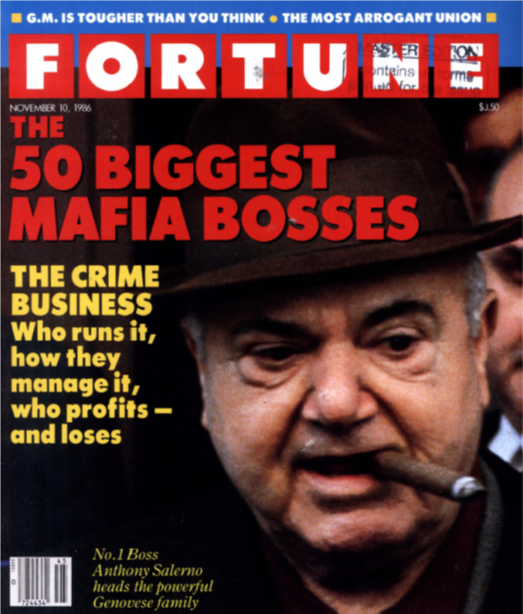
Fortune, the business magazine, changed up the formula with its November 10, 1986, cover story. Alongside a picture of cigar-chomping New York underworld kingpin Anthony “Fat Tony” Salerno, a boldface headline blared: “The 50 Biggest Mafia Bosses.”
It was a clever way to sell magazines.
Lists were nothing new to Fortune. The magazine was well known for its annual “Fortune 500,” a detailed listing of America’s biggest companies. Fortune also regularly published “Fortune 50” lists in various subcategories.
But “biggest Mafia bosses”? This was something new and provocative.
“Crime pays,” begins the article by Roy Rowan. “Annual gross income from the rackets will probably exceed $50 billion this year. That makes the mob’s business greater than all U.S. iron, steel, copper, and aluminum manufacturing combined.”
That audacious figure, an educated guess at best, came from the President’s Commission on Organized Crime. But even if the figure was off by $10 billion either way, it revealed the lucrative nature of organized crime at that moment in American history.
Rowan explains how the list of “Biggest Mafia Bosses” was compiled: “Fortune interviewed FBI agents, leaders of federal organized crime strike forces, and local law enforcement officials across the U.S.” Interestingly, Rowan apparently did not consult any current or former mobsters, who, one imagines, could have added some valuable insights.


Michael Franzese, the former New York mafioso, was listed at No. 18 on the Fortune list. Franzese earned his ranking primarily for orchestrating an elaborate and lucrative gas tax scheme. In a YouTube video earlier this year, Franzese addressed the article.
“I don’t agree with the list,” he said. “I don’t agree with much that was stated in the article. I think it’s a silly list. How do you rank guys on the street according to wealth? Most guys don’t pay their taxes, a lot of guys have cash, a lot of guys have no cash. I mean, how do you do it? They don’t ask for our tax returns.”
When the magazine published the list, Franzese was in prison in Phoenix. “I had just taken a plea not too long before that and received a 10-year prison sentence,” he said. A prison official called him into his office and showed him the article. “He says, ‘What do you got to say about this?’ And I said, ‘I’m just seeing it for the first time. I don’t know anything about it.’”
Franzese says he was placed in lockdown as a result of the article. “They put me in solitary for about two weeks while this thing played out,” he said.


In many cases, a mobster’s ranking seems to have been based on past exploits and reputation rather than actual wealth and power in 1986.
Franzese said there were people on the list that didn’t belong there at all, such as former longtime New York Mafia boss Joe Bonanno (No. 14), who in 1986 was ostracized and had retired in Arizona. “He was basically out of the life,” Franzese said. Bonanno surely would have been at or near the top of the list if it had been compiled in 1956, not 1986.
Another example was Kansas City mobster Carl “Toughy” DeLuna, who is listed at No. 33. DeLuna may have accumulated some money from his criminal pursuits in the past, but by 1986 he was serving a long prison sentence for his role in skimming from the Tropicana hotel-casino in Las Vegas.
Vincent “Jimmy Blue Eyes” Alo was another questionable choice. He was a major player in the 1950s and 1960s—closely allied with Meyer Lansky—but by 1986 he was essentially out of the rackets.
The order is also suspect in some cases. Salerno is listed No. 1. While Salerno undoubtedly was a powerful and enterprising mobster, his boss, Vincent “Chin” Gigante, is listed at No. 19—one place behind Franzese.
“How was I ahead of him?” Franzese asks.
In fact, Rowan identifies Gigante as a “capo,” or captain, revealing just how effective the Genovese crime family had been in disguising his true position. Gigante famously pretended to have mental health issues—wandering the streets in a bathrobe—to throw off law enforcement.
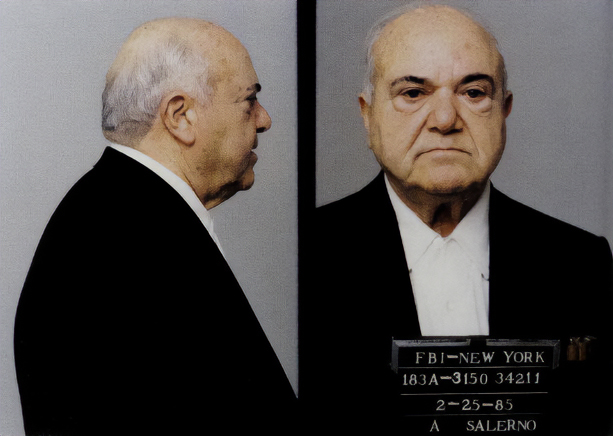
The Fortune list of 50 includes 17 people who were in jail or prison at the time. While this fact could make earning money and exerting influence more difficult, Rowan points out that incarceration didn’t necessarily hamper Mob bosses. “Bosses behind bars are not powerless,” he writes. “Their ‘access to telephones is virtually unlimited,’ assistant FBI director Oliver Revell told a Senate committee in 1983.”
Strictly from a wealth perspective, Chicago’s longtime boss Tony Accardo is properly positioned at No. 2, and New Jersey’s Jerry Catena justifiably comes in at No. 4. Both were way past their prime by 1986, but each had collected a lot of illicit money in his day.
Not surprisingly, no Las Vegas-based mobsters are on the list. Mobsters skimmed tens of millions of dollars from Las Vegas casinos, but most of that money was sent out of state. The only Las Vegas candidate for the list might have been Moe Dalitz, but he really wasn’t seen as a mobster by that time.
The Fortune list was published at a time when the Mob was in great turmoil. The FBI and federal prosecutors were engaged in a massive campaign to build RICO cases and take down organized crime groups en masse. RICO is the acronym of a 1970 law called the Racketeer Influenced and Corrupt Organizations Act. The law was not widely used in the 1970s, but federal prosecutors such as Rudy Giuliani recognized its potential and took full advantage of it in the 1980s.
Perhaps the biggest RICO case ever, the so-called Commission trial, took on the bosses of all five crime families in New York City. The trial was underway while Fortune was preparing and publishing its list. When the trial concluded, Salerno and other Mafia kingpins received 99-year prison sentences.
The prosecutorial fervor of the 1980s and ’90s crippled traditional organized crime in America. The power and wealth the Mob had built and exhibited in preceding decades were reduced to small-time scams in a handful of cities. There would be no justification for Fortune to update its list, although its competitor, Forbes magazine, did list Colombian drug kingpin Pablo Escobar on its billionaire list for seven straight years.
At the time of Franzese’s YouTube video, he noted that 46 of the 50 men on the list were dead. Franzese appears to be the only one of the surviving four who still has his health and is living a vibrant life. “I consider myself to be very fortunate, very blessed,” he said.
Feedback or questions? Email blog@themobmuseum.org