



Benny Binion’s colorful life story slated for television series
Planned drama chronicles Texas-bred Las Vegas casino operator who started World Series of Poker
Years ago in Las Vegas, a friend of professional poker player Doyle Brunson relayed an alarming message: If Brunson didn’t work with mobster Tony “The Ant” Spilotro on a poker-room cheating scheme, the card player known as “Texas Dolly” would end up with 12 ice picks in his “big fat belly.”
Doug J. Swanson tells the story of this threat in his 2014 biography Blood Aces: The Wild Ride of Benny Binion, the Texas Gangster Who Created Vegas Poker.
Spilotro, the Chicago Outfit’s street enforcer in Las Vegas during the 1970s and early 1980s, was known to demand a cut from illegal sports bookmakers and the city’s poker players. In the 1995 film Casino, Joe Pesci portrays a mobster based on Spilotro.
Facing a threat from Spilotro, Brunson turned to fellow Texan Benny Binion, who ran the Horseshoe casino on Fremont Street in Las Vegas. At 6-foot-3 and 250 pounds, Brunson, a former college basketball player, was nearly a foot taller and much heavier than Spilotro. Still, the Chicago mobster’s reputation for unchecked violence outweighed any differences in physical size.
If anybody could make Spilotro back off, it was Binion, whose fondness for Western wear and frontier justice fit his “Cowboy” nickname. A convicted killer during his bootlegging and illegal gambling days in Dallas, Binion left for Las Vegas in late 1946 when reform candidates took office in North Texas, leaving criminals like him without political protection. He arrived in Las Vegas in a Cadillac with $1 million in the trunk and two Thompson submachine guns, according to Marine Corps combat veteran R.D. Matthews, one of Binion’s associates who was along for the ride.
Even with gangsters such as Benjamin “Bugsy” Siegel in Las Vegas at the time, Binion quickly stood out as a shrewd, tough competitor. He lacked much formal education but was street smart and persuasive, and he understood the importance of political connections. Binion also had sharp elbows and knew how to use them.
“He was not a guy to be trifled with at all,” Swanson, a former Dallas Morning News reporter, told The Mob Museum.
When poker pro Brunson found himself in trouble, he knew where to turn for help in getting out of Spilotro’s cheating scheme and avoiding the mobster’s ice-pick threat.
“Brunson sought an escape route through Binion, who put the word out that he had Brunson’s back and helped negotiate his release from the scheme,” Swanson wrote in Blood Aces. “‘Without that protection,” Brunson said, ‘I have no doubt that Spilotro would have killed me.’”
‘Blood Aces’ adapted for TV
Swanson’s book now is being adapted into an MGM Television series, starring Yellowstone’s Cole Hauser as Benny Binion. Hauser’s American Outlaw Entertainment firm has partnered with veteran actor Sylvester Stallone’s Balboa Productions in developing the project. Stallone and D. Matt Geller are the executive producers.
A run date has not been set for the series, but the producers are “meeting with top-tier showrunners” to get it off the ground, according to the online entertainment site Deadline.
Stallone said Binion was an icon who connected “many worlds, some glamorous, some dangerous, some shady, but all intriguing, while helping to build the foundation for both Las Vegas as we know it and the explosive worldwide popularity of poker.”
Hauser also praised Binion, saying the former Texas outlaw, who later became a prominent casino operator in Las Vegas, is “one of the great Western American characters and success stories of the 20th century.”
“His legacy is undeniable,” Hauser said in a statement about the series.
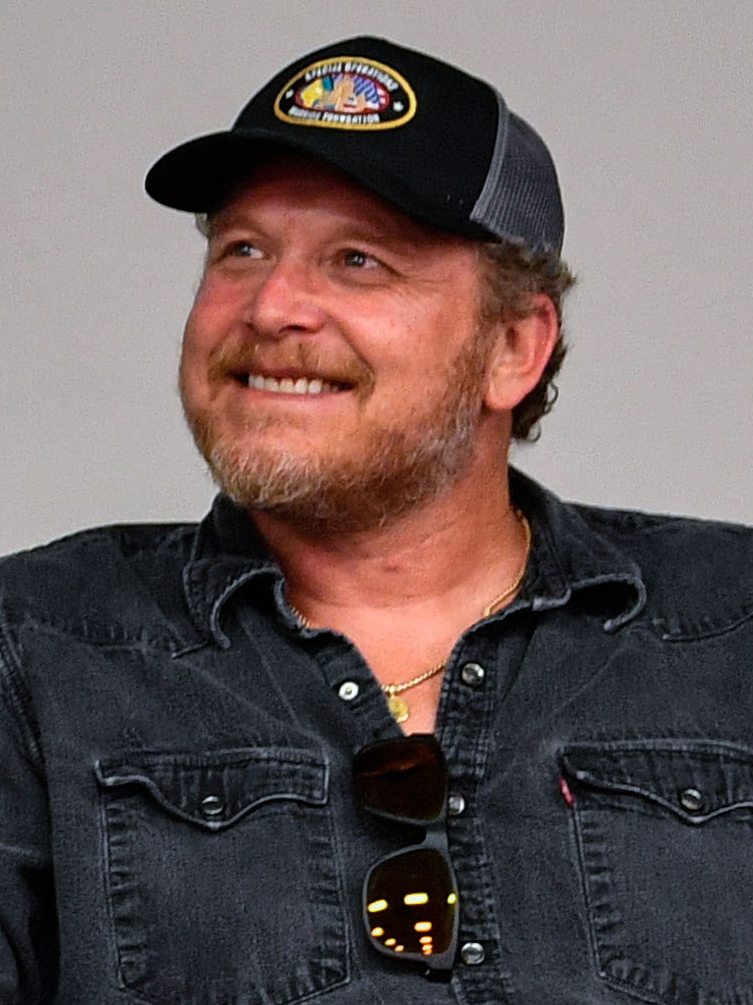
Swanson said he hopes the planned series conveys that Binion was a complex, fascinating person. “He was a man of many layers, and I hope that’s what they go for,” Swanson said. “I hope they treat him as the important historical figure he was.”
The author said Binion could be a person’s best friend or worst enemy, but he also was “a brilliant businessman.”
“If you were some down-and-out cowboy who came in and needed money, he’d be happy to just give you $100,” Swanson said. “He really had a soft spot for the downtrodden. At the same time, if you got on his wrong side, you were in a lot of trouble. So I hope they can embody all those contradictions.”
Poker legacy
On Christmas Day in 1989, Benny Binion died in Las Vegas of congestive heart failure at age 85. Although he had been involved in numerous ventures since moving to Southern Nevada, including a cattle ranch in Montana and other real estate, he made his mark at the Horseshoe casino in downtown Las Vegas.
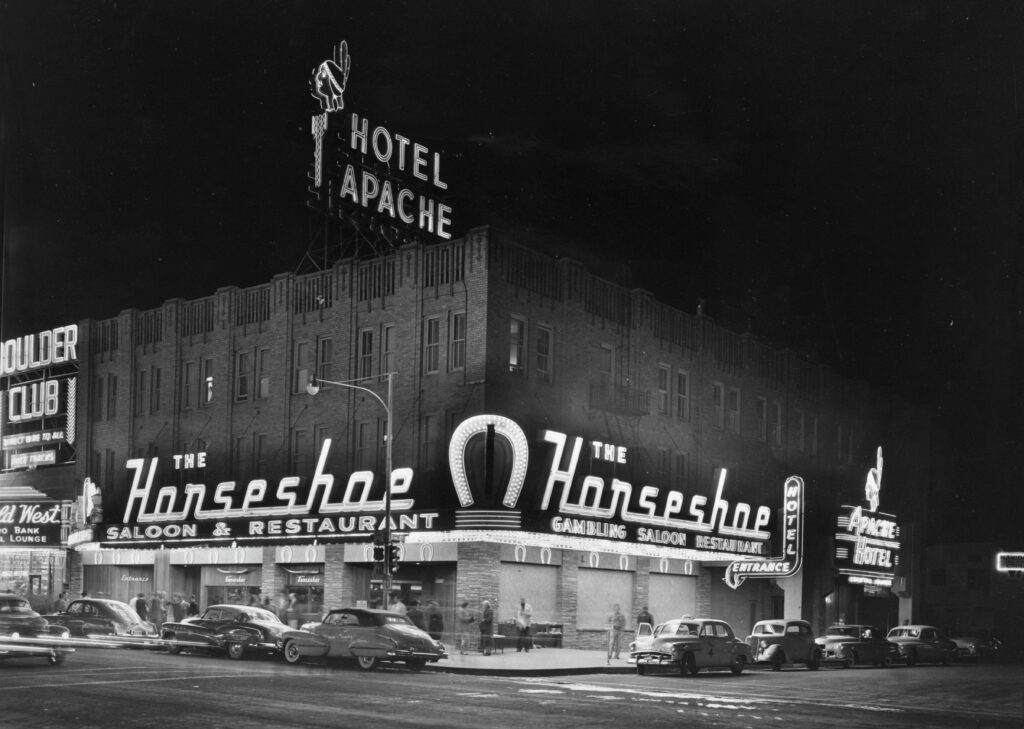
During his years at the Horseshoe, Binion turned it into a popular destination in an area known as Glitter Gulch. He welcomed high-stakes gamblers to the casino, accepting massive bets, but also packed the gaming floor by attracting locals and tourists looking for low-minimum craps and blackjack tables. All visitors were welcomed by the promise of “good food cheap, good whiskey cheap and good gamble.” People also came to have their picture taken in front of an encased display of $1 million in $10,000 bills.
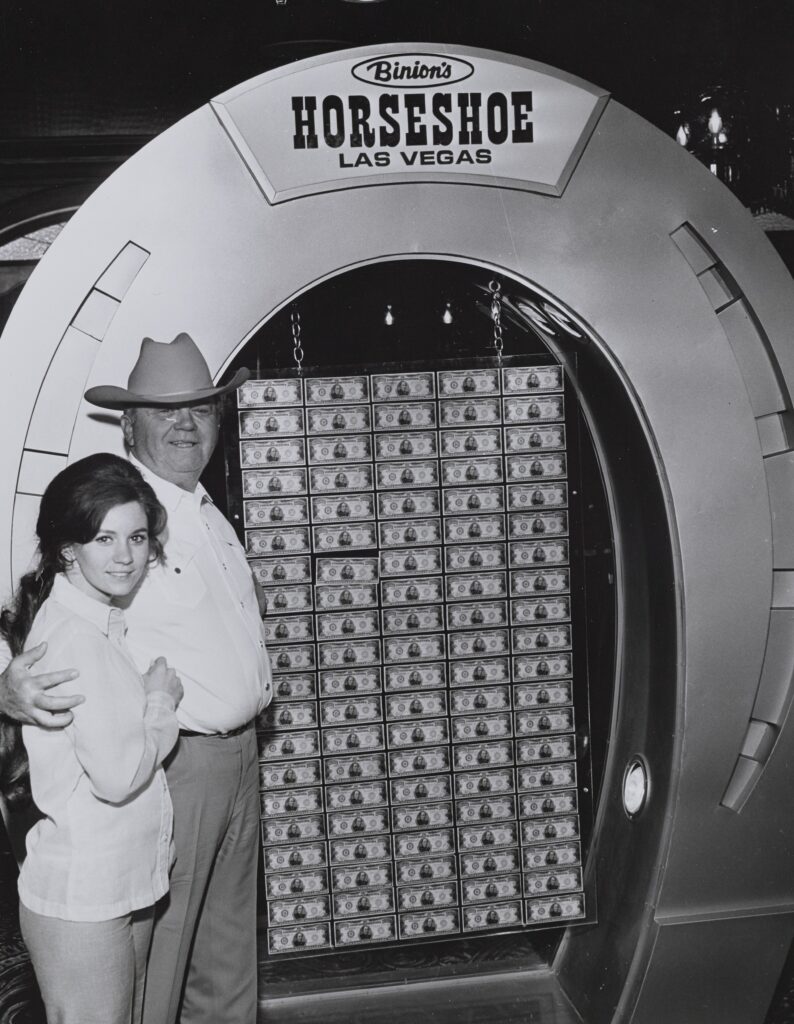
“Maybe you drove a Rolls and lived in Malibu, or maybe your suit came from Sears and the wife clipped coupons at the kitchen table,” Swanson wrote in Blood Aces. “It didn’t matter to Binion. The way to get rich, he loved to say, was to treat little people like big people.”
There also were dark moments. Binion once was imprisoned for tax evasion. His eldest daughter, struggling with drug abuse, died of an apparent suicide. And the perception that he or some who worked for him sanctioned beatings and even deathslingered partly because of things Binion said, such as the time he declared, “I ain’t never killed a man who didn’t deserve it.”
Through it all, one of his lasting legacies is the World Series of Poker, whose early participants are still regarded as among the best in tournament history. Those poker players include Stu “The Kid” Ungar, Thomas “Amarillo Slim” Preston and Doyle Brunson.
An earlier version of the tournament, the Texas Gamblers Reunion, took place in 1969 at the Holiday Hotel in Reno, 440 miles north of Las Vegas. The hotel’s owner, Tom Moore, also a Texan, invited some poker players to a competition to generate business during a slow period.
It was at this event that Brunson and Binion first met face-to-face. “I’d heard about Benny all my life,” Brunson said. “He was just a tough old cowboy.”
In Blood Aces, Swanson noted that Binion wore a western shirt with gold coins for buttons at the Reno event and “moved through the room as if he owned it.”
Binion “loved what he found at Reno,” Swanson wrote, and the next year launched the tournament now known as the World Series of Poker at the Horseshoe in Las Vegas. Since it began in 1970, the tournament has gained an international reputation for attracting the world’s best poker players. In the poker world, winning the tournament’s Main Event is regarded as a crowning achievement. Brunson won it twice in back-to-back years. In 1988 he was inducted into the Poker Hall of Fame.
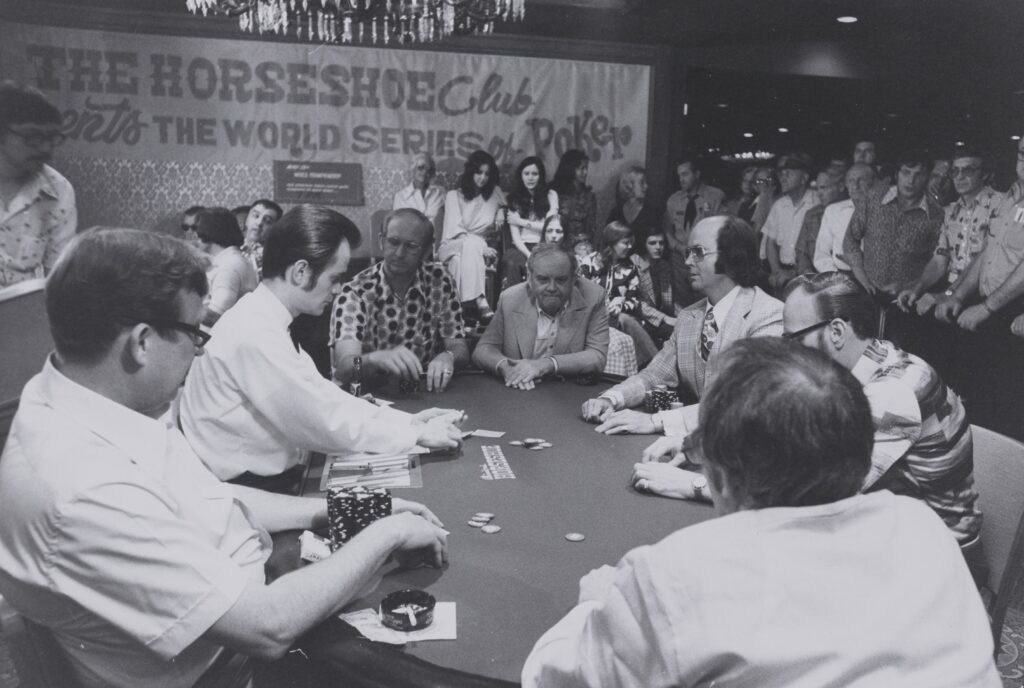
These days, the World Series of Poker is held on the Las Vegas Strip at two Caesars Entertainment resorts connected by an interior walkway. The two properties are the Paris Las Vegas and the former Bally’s hotel-casino, now rebranded as the Horseshoe.
The downtown Horseshoe casino has been renamed Binion’s Gambling Hall. Despite the name, it no longer is owned by the Binion family, following disputes among the heirs and the death of Binion’s youngest son, Ted. A heroin user, Ted Binion died at his Las Vegas home in 1998 at age 55, leaving millions in buried treasure about 60 miles west of Las Vegas in Pahrump. His death initially was ruled an overdose of heroin and Xanax, but his girlfriend, Sandy Murphy, and her lover, Rick Tabish, later were convicted of murder and burglary in the case. Murphy and Tabish ultimately were granted a second trial and acquitted on the murder charges.
Monuments to a bygone era
Doyle “Texas Dolly” Brunson died in 2023 in Las Vegas. The cause of death was undisclosed. He was 89.
Years earlier, Brunson tweeted several recollections of his run-ins with Spilotro, reflecting on a bygone era in Las Vegas characterized by Mob intimidation and violence. In one tweet, Brunson wrote that Spilotro, with “those rattlesnake eyes,” had been shaking down hotel owners and poker players.
Another tweet included a picture of Spilotro along with a statement from Brunson noting this was “the SOB that tried to kill me.” Brunson added, “Thank you, Benny Binion.”
All these years later, two bronze statues on display in Southern Nevada recall a period when Las Vegas transplants such as Binion, Spilotro and Brunson crossed paths and now are part of the city’s lore.
One statue is of Spilotro conferring with his attorney, Oscar Goodman. It is displayed inside Oscar’s Steakhouse at the Plaza hotel-casino on Main Street, only a short walk from the former Horseshoe casino that Benny Binion once operated. The steakhouse is named for Goodman, who became a Las Vegas mayor. Spilotro and his brother, Michael, were killed by mobsters in the Chicago area in 1986 and buried together in an Indiana cornfield.
Thirteen miles south of downtown Las Vegas at the South Point resort is another statue, a bronze likeness of Benny Binion on a horse, with a coiled rope gripped in the Texan’s right hand as if he is ready to lasso a stray.
Larry Henry is a veteran print and broadcast journalist. He served as press secretary for Nevada Governor Bob Miller and was political editor at the Las Vegas Sun and managing editor at KFSM-TV, the CBS affiliate in Northwest Arkansas. Today, he is a senior reporter for Gambling.com.
Feedback or questions? Email blog@themobmuseum.org