


Geraldo Rivera uncovered ‘The Mystery of Al Capone’s Vaults’ on live television 40 years ago
The hunt came up empty but launched a trend in reality TV
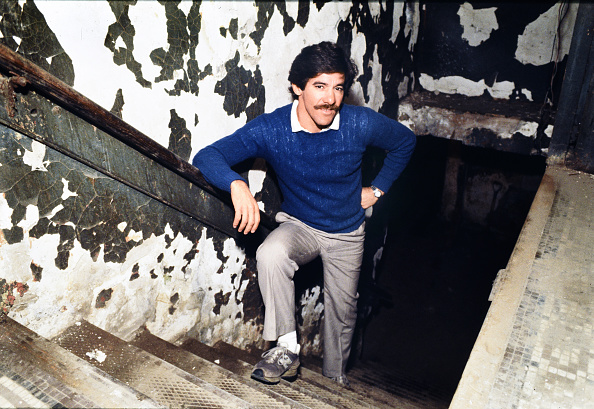
On April 21, 1986, television reporter Geraldo Rivera completed his final on-air shot in a live broadcast from the Chicago hotel where Prohibition-era Mob boss Al Capone supposedly had an underground vault.
With 30 million viewers watching, the vault contained not much more than a couple of decades-old bottles and a cloud of dust. Afterward, sensing that critics would pounce, Rivera went on a bender, convinced his career was over.
“He said he got tequila drunk across the street,” William Elliott Hazelgrove told The Mob Museum. Hazelgrove is the author of the newly released book, Capone’s Vault: The Real Story of the Biggest Disaster in Television History.

As it turned out, the show—broadcast 40 years ago this week—would launch a trend in reality television that continues to this day, Hazelgrove said. The inherent drama in an unexpected outcome has an appeal of its own. “What they realized after this night was that, guess what? It doesn’t matter if there’s a payoff. People don’t care. They just want the ride,” Hazelgrove said.
High risk, high reward
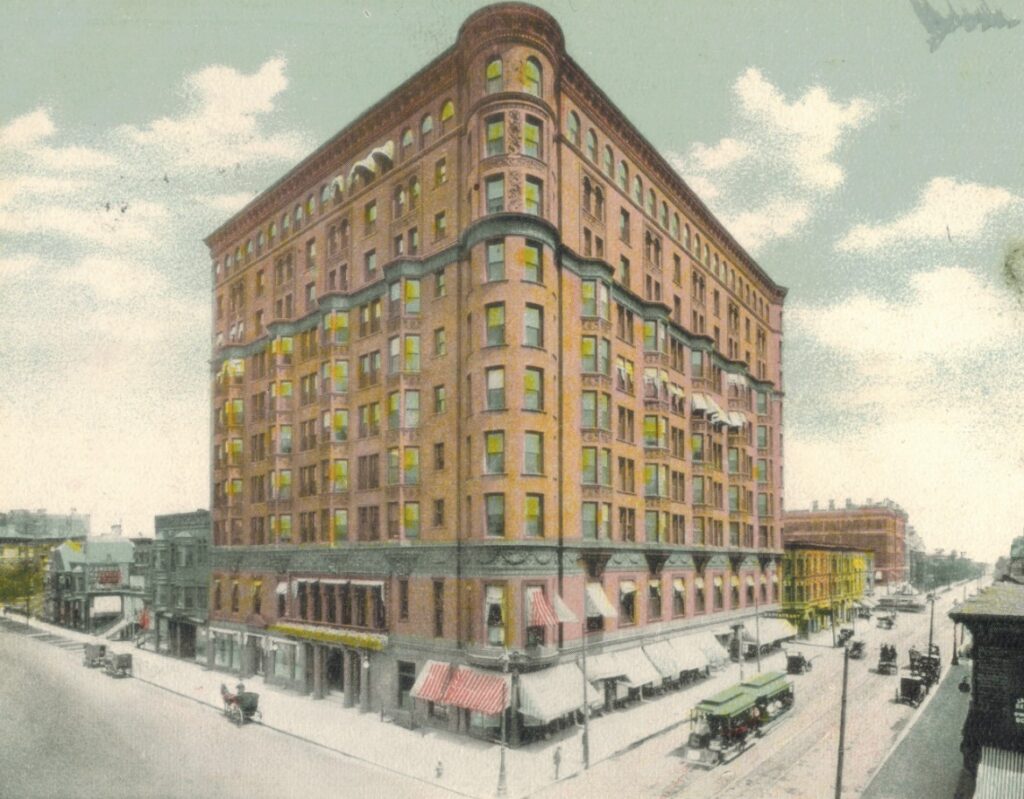
Rivera’s live broadcast, The Mystery of Al Capone’s Vaults, aired from the historic Lexington Hotel on Chicago’s South Side. From 1928 to 1932, Capone used the hotel as a brothel and well-guarded fortress, maintaining a suite on the fifth floor in Room 530. An underground space thought to be a vault beneath the hotel was protected by thick concrete. There, Capone supposedly hid his illegally obtained millions.
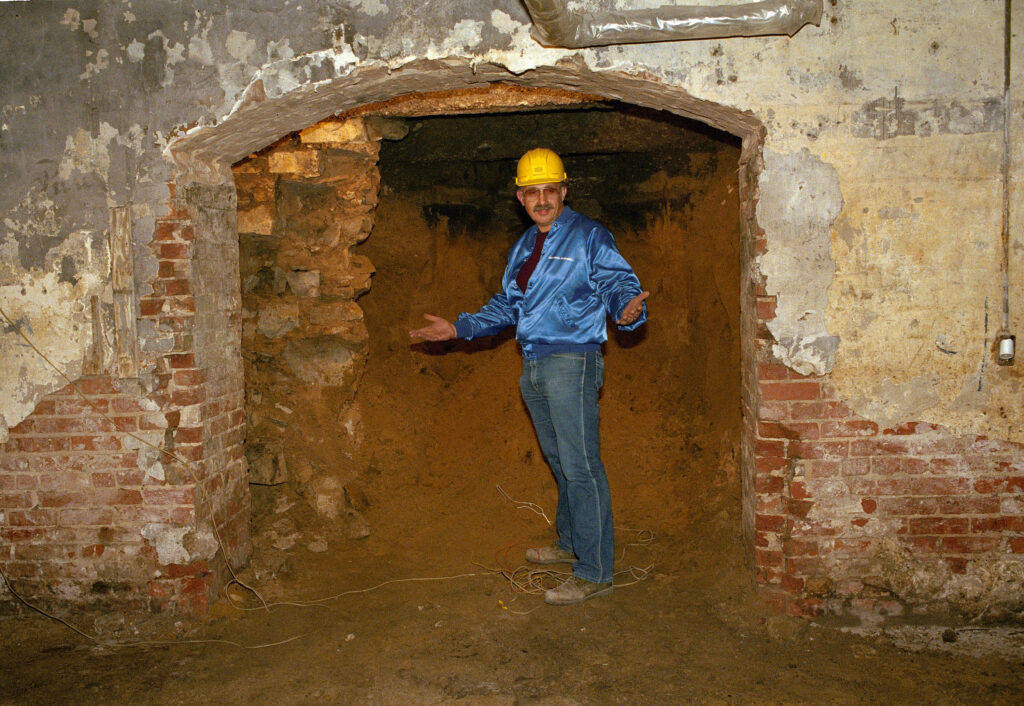
When a demolition team blasted through the concrete two hours later, Rivera, shrouded in a dusty haze, stood at what once might have been a coal chute, but not a vault.
After this disappointment, the 42-year-old attorney-turned-reporter feared he might never work in the news business again. He previously was fired from ABC News, losing a salary that soared to $1 million in the 1980s. Rivera’s ouster resulted from his complaints to a syndicated columnist that management killed a story by his friend and colleague, Sylvia Chase. Her story had focused on Marilyn Monroe’s affairs with President John F. Kennedy and, later, his brother, Attorney General Robert Kennedy. Rivera, a self-described “kick-ass reporter,” assumed ABC News President Roone Arledge spiked the story because of his friendship with Robert Kennedy’s widow, Ethel Kennedy.
“Stoked with emotional fury I charged Roone with cronyism and censorship and questioned his journalist integrity,” Rivera said.
The live show from the Lexington Hotel was Rivera’s chance to get back into broadcasting, but it did not go as hoped. During the final seconds of the show, Rivera was surrounded by a work crew from co-producer Doug Llewelyn’s Westgate Group in yellow hard hats. Holding an air horn, Rivera said he promised his critics he’d sing a song if he and the team found nothing. He then walked out of the shot to his left, singing, “Chicago, Chicago, that toddlin’ town.” Still walking, he said, “Goodnight. I’m sorry.”
From there, Rivera got “tequila drunk.” “I ordered a bottle of Cuervo and tried to forget,” Rivera later told reporters.
The next day’s newspapers were devastating. “They all blamed him,” Hazelgrove said. “They didn’t blame the producers. They blamed him.”
At one point, a room service employee showed up at the reporter’s hotel door, saying, “I got these messages for Mr. Rivera.” According to Hazelgrove, Rivera said, “Oh, just put them over there.” The hotel employee did as told. Finally, a friend showed Rivera one of the messages to “make him feel better.”
“So he looks, and it’s the ratings,” Hazelgrove said. “The overnight ratings showed 30 million people had watched.” This large viewership was out of a total U.S. population of about 240 million at the time.
Also in the stack of messages were 12 job offers, which later shot up to 22.
“He went all the way down, then all the way up,” Hazelgrove said. “High risk, high reward.”
‘I need the money’
Rivera wasn’t the first choice to host the live broadcast from the Lexington.
“They wanted to get Robert Stack first,” Hazelgrove said, referring to the actor who played Eliot Ness on the TV show The Untouchables. “But then they’re like, ‘No, he’s too boring.’”
Veteran 60 Minutes host Mike Wallace also was under consideration, but there were doubts CBS would let him front a two-hour live show regarding what might or might not be in Capone’s vault.
“So then it came down to, well, what about Rivera?” Hazelgrove said.
The former network reporter might be able to handle the task, it was thought, since he was considered to be part journalist, part showman and part carnival barker. In later years, The New York Times would describe Rivera as having prolific hair, a prodigious mustache and broadcast-perfect voice.
Recently fired from ABC and without the network contract, Rivera was ready to listen. Offered $25,000 for a one-time deal, he finally got the syndicated program’s backers to bump the pay up to $50,000. With that, he was in. “Rivera was like, ‘I need the money. You know, I really need the money.’ And so, he did it,” Hazelgrove said.
Working without a script, Rivera walked viewers through parts of the vacant hotel, checking constantly with the crew blasting and digging in search of a vault down below.
Real-time scenes of the crew at work were interspersed with live and recorded interviews. Among them was Dennis Sansone, an IRS special agent there to collect taxes in case any money was found.
Some of Capone’s contemporaries also appeared on camera. In a filmed interview, Chicago newspaper photographer Tony Berardi discussed shooting pictures of the bloody St. Valentine’s Day Massacre scene inside the SMC Cartage Company garage. On Chicago’s North Side on February 14, 1929, seven men were lined up against a brick wall inside the garage and shot to death. Capone wasn’t there but was thought to have ordered the attack against rival bootlegger George “Bugs” Moran’s North Side Gang. But Moran wasn’t inside. As he approached the garage, Moran kept walking when he saw a police car, which the killers used for their law enforcement disguises, outside the building.
Adding to the show’s spectacle, Rivera got into the act himself. During one on-camera demonstration in the hotel’s former gymnasium, he fired a Thompson submachine gun similar to those used in the Massacre.
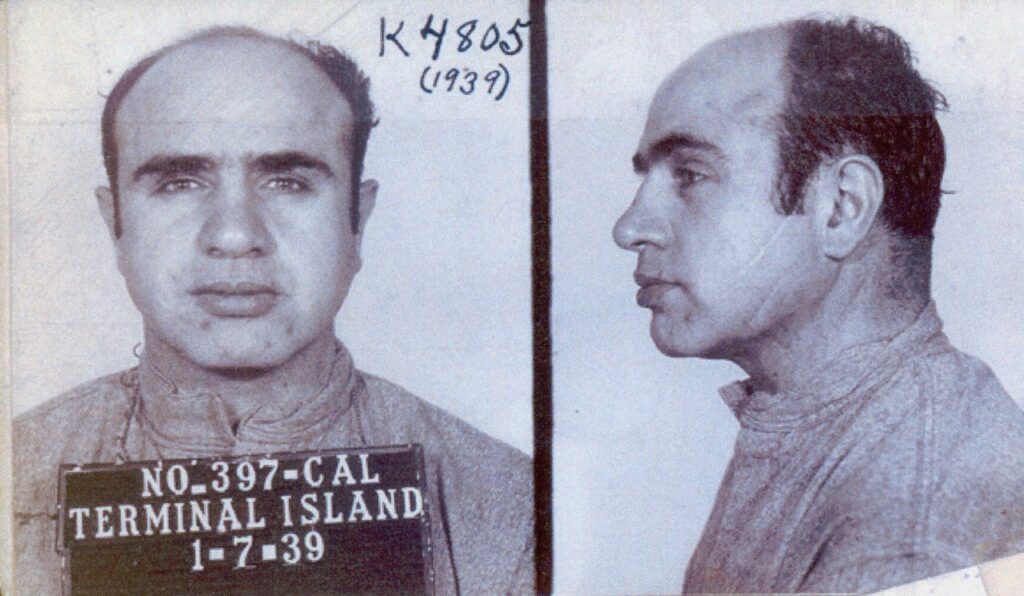
In recorded segments, Rivera also conducted on-site interviews at places such as the Alcatraz Federal Penitentiary in the San Francisco Bay, where Capone had been imprisoned for tax evasion, and at the gangster’s Palm Island estate in Miami Beach. On January 25, 1947, suffering from syphilis, Capone died at his South Florida home of a heart attack at age 48. He was buried at Mount Carmel Cemetery in Chicago.
Where is Capone’s hidden treasure?
To date, no treasure associated with Capone has been found. “It’s one of the great mysteries,” Hazelgrove said. “He had this money, and he couldn’t remember where he put it. And he had syphilis, so he lost his mind.”
After being released from Alcatraz, Capone “had no idea where the money was,” Hazelgrove said. “When he came out, he said famously that he buried it somewhere, but he couldn’t remember where,” the author said.
Chuck Goudie, a veteran Chicago television reporter, told The Mob Museum the Capone treasure hunt “has probably burned itself out.”
“Many experts agree there is no missing treasure,” the NBC Chicago reporter said.
Before the show even aired, most organized crime reporters in Chicago figured the vault would be a bust, Goudie said. “From maps, notes, news coverage in Capone’s day, and what researchers strongly warned, there was ample warning that nothing was there,” he said.
However, “people bank on hope, no matter how inconsequential or unlikely,” Goudie said.
Even today, any news about crime bosses will always generate interest, Goudie added, especially regarding the bootlegging kingpin who once ruled the Chicago underworld from the now-demolished Lexington Hotel.
“Anything Capone is still attention-grabbing,” Goudie said.
Larry Henry is a veteran print and broadcast journalist. He served as press secretary for Nevada Governor Bob Miller and was political editor at the Las Vegas Sun and managing editor at KFSM-TV, the CBS affiliate in Northwest Arkansas. Today, he is a senior reporter for Gambling.com.
Feedback or questions? Email blog@themobmuseum.org