


Los Angeles kingpin Jack Dragna was no ‘Mickey Mouse’ boss
Seventy years ago, underworld leader’s death contributed to L.A. Mob’s decline
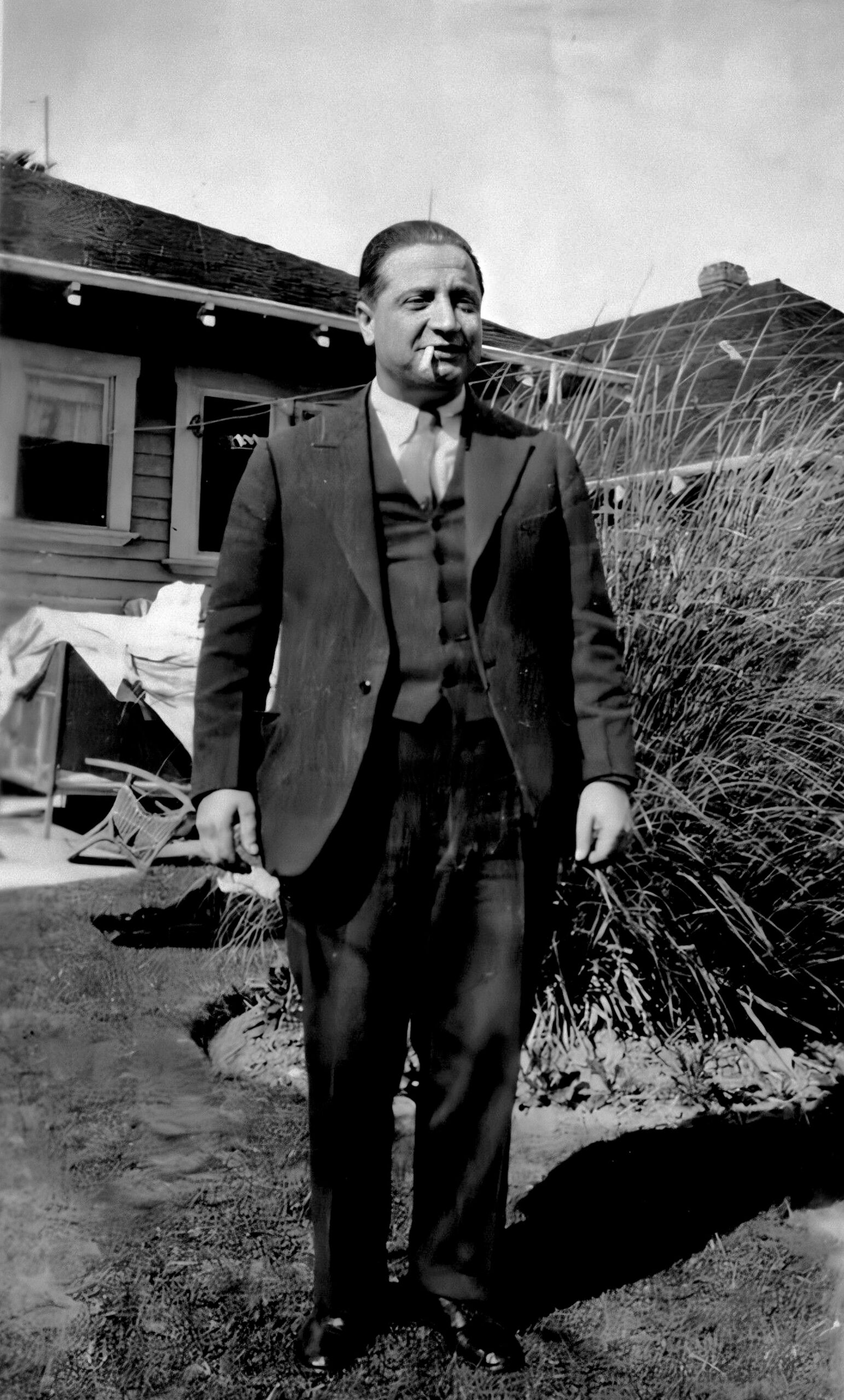
In 1984, when Los Angeles Mob boss Peter Milano was arrested along with 19 others, LAPD Chief Daryl Gates announced the organization “had become a ‘Mickey Mouse Mafia.’” This new reputation had formed a few years earlier for the L.A. Mob, which had been in decline since the death of former boss Jack Dragna in 1956.
In February 1980, the Chicago Tribune revealed that agents overheard “more than one restaurant conversation in which the [Mickey Mouse] term was laughingly used.” With Chicago boss Tony Accardo nesting in Palm Springs, the agents were all ears. More details followed that November in another article, “Californians: The Shame of the Mob,” though the Tribune again qualified “in recent years.” By then, Dragna had been dead for nearly a quarter-century.
All the laughs seemed to center on recent arrests. Mafia leaders in Los Angeles faced 20 to 60 years in prison, and their counterparts across the country were far from sympathetic—but they had their reasons. For nearly three years, “a $100,000 contract to kill” hung over L.A.’s former acting underboss, Jimmy Fratianno. Not only was Fratianno still actively testifying against his fellow mafiosi, but he helped author Ovid Demaris pen a bestseller about him, The Last Mafioso. Stirring gangster aggressions, the book was printed one month before the Chicago Tribune released its initial report.
Although journalists of the early 1980s poked fun at the L.A. Mob, critics largely left Dragna out until 1987. That year, in The Mafia Encyclopedia, author Carl Sifakis alleged that Dragna “rose to the top” as “the best of a poor lot.” By contrast, the Los Angeles Times wrote that Jack Dragna was “perhaps the only classic ‘godfather’ that the city has ever known” and explained that “the family went into decline under the leadership” that followed.
Bootlegger to boss
Jack Dragna rose to prominence on the West Coast during the 1920s through a combination of bootlegging, politics and gambling endeavors. By 1930, he could boast owning two of the earliest gambling ships to operate offshore.
Leaving East Harlem in his early 20s, Dragna began climbing the ranks of L.A.’s underworld in 1915. The following year, he faced a three-year sentence for extortion and entered San Quentin prison under an alias, Jack Rizotta. Despite a letter confirming Mafia ties in his hometown of Corleone in Sicily, he was released on a technicality after serving just six months. Although all charges were dropped later that year, more trouble followed in the next. Extradited to New York to stand trial for murder in 1917, Dragna spent 19 months in a Manhattan prison, called “the Tombs,” as a material witness under another alias, Charlie Dragna. He returned to Los Angeles in 1919.
Already steeped in the fruit trade when Prohibition set in, Dragna and his brother, Tom, were ready-made for liquor production and, thanks to an unlikely truce, quickly prospered as bootleggers. The area’s various warring Sicilian clans reconciled to form a single Mafia family by 1921. Leadership of this group shifted from Vito Di Giorgio in 1921 to Rosario DeSimone in 1922 and then to Joe Ardizzone in 1925. Plotting Ardizzone’s murder, Jack Dragna seized the throne in 1931 and served as the family’s most powerful leader for the next two and a half decades.
A crime commission declared Dragna the “Al Capone of Los Angeles” and the “Kingpin of the Southern California Bookie Syndicate.” Two years later, crime writer Ed Reid named him ninth out of the nation’s top 83 mafiosi, ranked “in order of their importance.” Charles “Lucky” Luciano sat behind Dragna in 11th place, with Frank Costello, Tony Accardo and Joe Adonis holding down the next three slots.
Early on, a 1932 flight manifest confirmed Dragna’s heightened national standing. Several bosses traveled cross-country for Dragna’s first known Mob summit, including Frank Milano of Cleveland, Vincent Mangano of New York and Angelo Caruso, the underboss of Joe Bonanno, also from New York. Milano, Mangano and Bonanno all sat on the Commission, the newly formed “United Nations for mafiosi,” which came together less than a year earlier following the American Mafia’s abandonment of the tyrannical “boss of all bosses” system. Attending high-level meetings on the East Coast from the start, Dragna represented several smaller clans out West: San Francisco, San Jose and at least one family out of Texas.
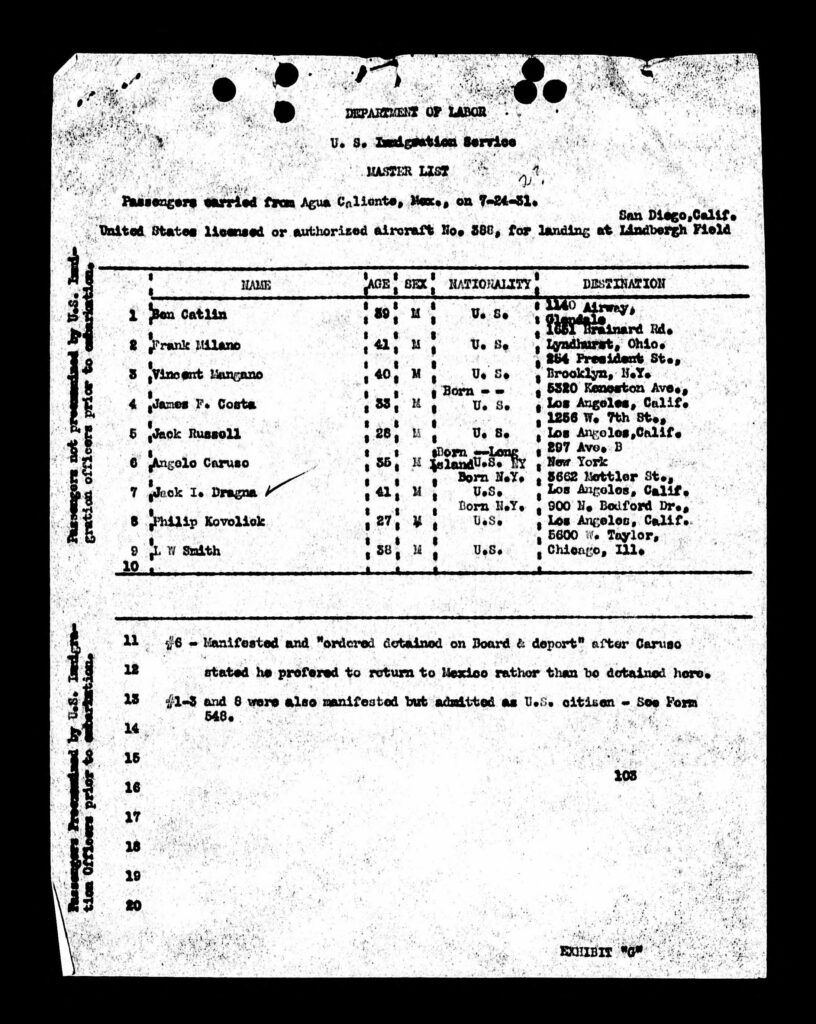
On behalf of the Jewish syndicate, Phil Kovelick, an associate of Meyer Lansky and Benjamin “Bugsy” Siegel, attended Dragna’s event. Four years later, Siegel himself would land in Los Angeles for a more permanent stay.
Allies, not rivals
Siegel’s arrival in 1936 is often portrayed as an incursion, with stories alleging that Luciano paved the way with ultimatums, forcing Dragna into a subservient role. But these unsupported theories go against the very premise of the Commission. “All families, no matter how big or how small, have separate but equal power.” And “the only purpose,” as L.A. soldier Johnny Rosselli added, “is to settle disputes that come up between different families.” Sending a Jewish mobster to take over an Italian’s territory would have stirred an opposite effect.
Commission member Joe Bonanno agreed. Rather than governing families, the Commission “served a unique purpose for this thing of ours—as a means of stabilizing relations among all the families across the country whose agendas, left unchecked, could have been mutually destructive.”
Despite pop culture depictions, Siegel’s move hinged on survival rather than expansion. New York District Attorney Thomas Dewey had just put away Luciano for 30 to 50 years, and Siegel knew his name sat high on the special prosecutor’s list for his involvement in murder. Fleeing made sense, as his alibi wasn’t exactly airtight. Hollywood made sense, too. Not only was it far from New York, but he had been a regular visitor since the start of the decade—his sister lived in the area. But long before Siegel migrated west, California served as a gangster asylum. Dragna may have even been sympathetic, seeing as he himself hit the West Coast to avoid a murder charge. Other mobsters, including Rosselli, Frank Bompensiero, Leo “Lips” Moceri and “Dago Louie” Piscopo, shared a similar story.
Despite terms like rivalry and resentment, Dragna’s daughter remembered the Siegels having dinner at the house. While social visits with the wives and kids no doubt ended once Siegel took a mistress, business continued. Authorities spotted Dragna and Siegel having lunch in a booth at Lucy’s Restaurant. And when rumors of “fraudulent activity in the obtaining of priorities for the construction of the Flamingo [Hotel]” in Las Vegas stirred deeper surveillance, according to FBI files, the feds learned that “SIEGEL was a close acquaintance of JACK DRAGNA and numerous Italian hoodlums.”
Race wire reign
Their partnership was in the racing wire. No bookmaker in America could safely take a bet on a horse race without a subscription. When the IRS shut down the Nationwide News wire service in 1939, Dragna lost his cut of the wire. And when plots by Dragna and Siegel to muscle into the new industry fell flat in the early ’40s, the pair switched gears and established a competing service. Like Continental, their Trans-American (TA) News refused to deal with bookies directly. Bookmaking, after all, was an illegal enterprise.
As a buffer between bookies and TA, each put together his own subsidiary—independent but complementary companies. Wielding the California monopoly, Dragna incorporated West Coast News and Globe Distribution, setting up offices in the downtown Ferguson Building. Over at Mercury Printing, he produced the Blue Sheet, a “scratch” containing odds, stats and racing information for bookie clientele.
Still consumed with the Flamingo’s completion, Siegel plugged away on a service of his own with the help of Moe Sedway. Out in the heat of Las Vegas, their Golden Nugget News sat perfectly legal. Similar arrangements took place all across the map, with both the Mafia and Jewish syndicate setting up independent shops to receive and send TA news.
Historians often pitch Mickey Cohen as a pal and right-hand man, but Siegel’s daughter contends that her father “found Cohen, though useful, to be a repulsive person.” Amid the racing wire boom, Cohen wasn’t management. The 1951 bestseller Murder, Inc, by prosecutor Burton Turkus and writer Sid Feder, described him as the “small shot who goes for the sandwiches when the big boys have their hotel-room sessions.” As a Dragna gopher, he relayed messages and muscled bookies into switching to the new service.
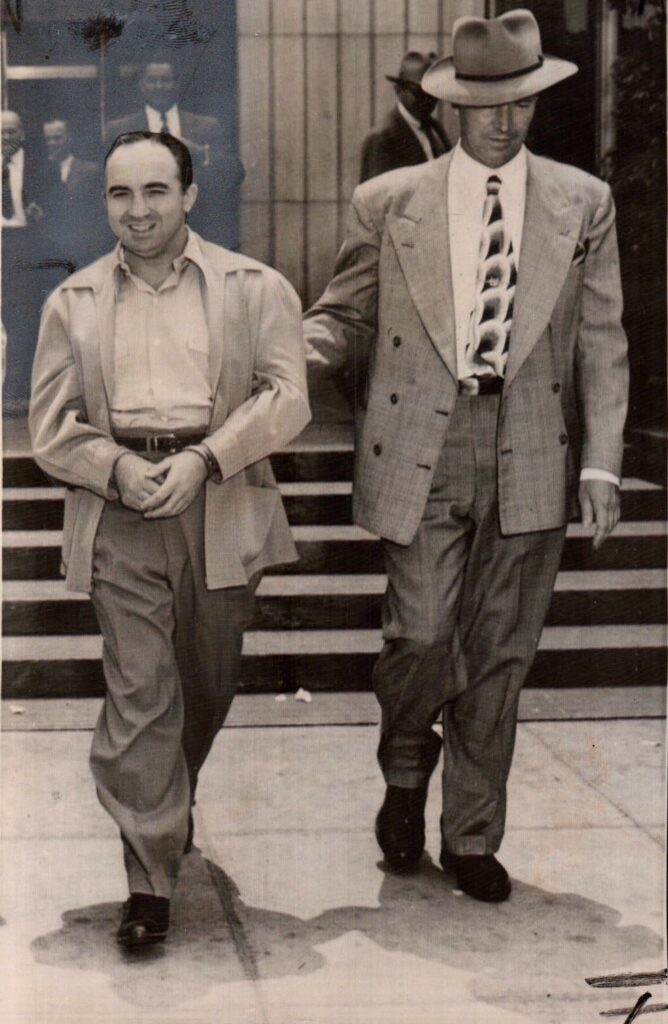
Although he did come into his own after Siegel’s murder in June 1947, Cohen was ill-equipped for the job, Turkus and Feder wrote. “Mickey Cohen thought he was just the man to fill Buggsy’s [sic] shoes. His efforts appear to have been about as weighty as Mickey Mouse.”
Snubbed often throughout the course of the 1940s and ’50s, Cohen seized the opportunity to rewrite his own history with a highly sensationalized autobiography in 1975, his last year of life. Elevating his status to “King of L.A.” and declaring a rivalry, he influenced a whole new crop of authors. “Benny Siegel’s knocking over Continental was kind of a slap in the face to Dragna and Rosselli who thought they were running the West Coast,” he wrote. But the U.S. Senate’s Special Committee to Investigate Organized Crime in Interstate Commerce disagreed, stating that Cohen and fellow mobster Joe Sica were “undoubtedly acting on behalf of Jack I. Dragna.” Continental employee George Redston outlined Dragna’s meeting with L.A. wire head Russell Brophy. Dragna told him, “He wanted Mickey Cohen and Joe Sica to distribute Continental’s racing sheets.” Later, Dragna, Siegel and Brophy sat together to work out the kinks. The backstory appears in Redston’s 1965 book Conspiracy of Death.
Dragna’s final decade
With Siegel gone, the situation in L.A. remained amicable. Dragna appeared at the opening of Cohen’s hat shop in December 1947, then Cohen attended the wedding of Dragna’s daughter in June 1948. The big affair drew New York Mafia bosses Tommaso Gagliano and Tommy Lucchese. Lucchese’s daughter even served as maid of honor. Back in 1914, Dragna had worked alongside their former boss Gaetano Reina. But Dragna’s ties ran even deeper. Reaching East Harlem as a boy, he landed early enough to witness Giuseppe Morello’s rise to “boss of all bosses.” By no coincidence, they lived in the same building—their families were close in Corleone when Morello was still a child.
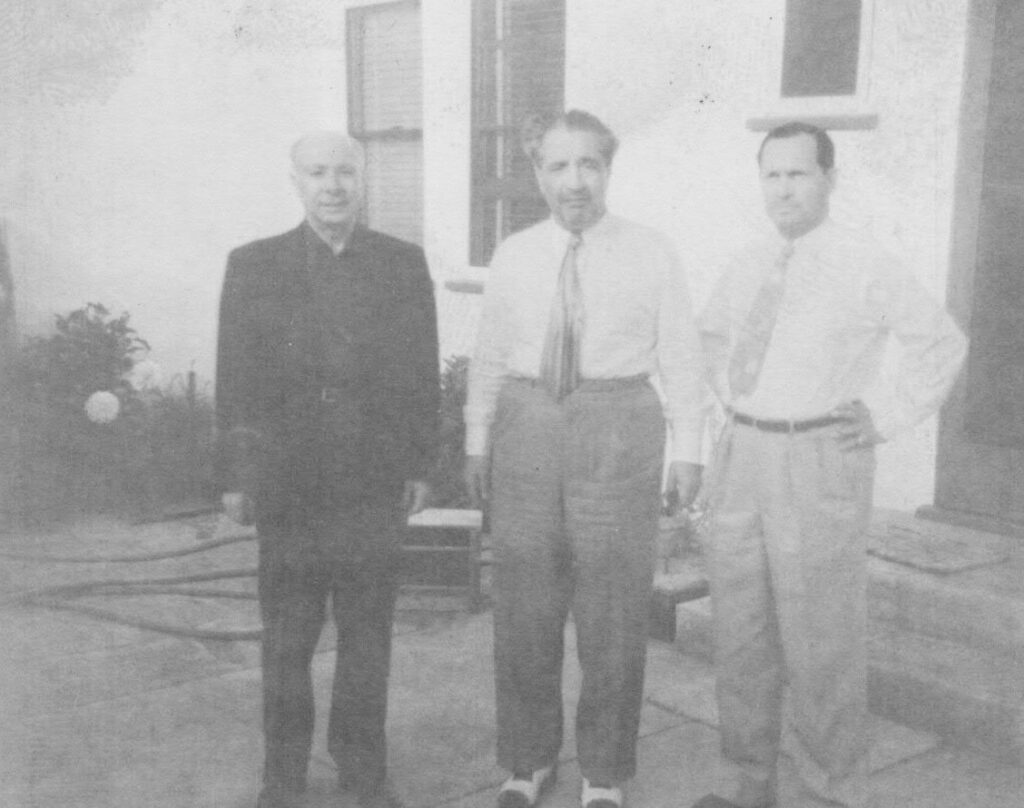
The fireworks in L.A. kicked off late in the summer of 1948. The press pitched it as a war for control of the city’s rackets, calling it the “Battle of the Sunset Strip,” but events fell short of the dramatic moniker. The bullets flew in only one direction. Cohen survived bomb blasts and shootout scrapes but not the fallout. More than half a dozen men abandoned his camp for the Italians. And those who refused were violently taken out, including Neddie Herbert, Frank Niccoli, Davey Ogul and even attorney Sam Rummel. No retaliation followed. In fact, Cohen never harmed a single made man. When authorities carted him off for tax evasion in 1951, his remaining rackets went to Dragna.
Dragna’s infiltration of Las Vegas began while Siegel was still alive. Though he saw some success, these efforts were continually hampered by health issues, court dates, frequent harassment by the LAPD and incessant deportation attempts.
His plans ended with a heart attack on February 23, 1956. The day after the funeral, his brother and nephew registered at the Desert Inn in Las Vegas. They made the trip “to discuss the liquidation of certain unidentified business interests held in common by JACK DRAGNA and others.”
J. Michael Niotta has authored four nonfiction titles, lectured at The Mob Museum as a program speaker and appeared on Showtime, Paramount Plus, and the History and Travel Channels. His current projects include several biopics covering the life of his great-grandfather, L.A. godfather Jack Dragna.
Feedback or questions? Email blog@themobmuseum.org